
NvidiaWatch changes the question a driver release note can answer. Instead of asking only what changed in the latest update, a user can follow one acknowledged problem across successive Game Ready and Studio releases: when it appeared, how long it persisted, and whether Nvidia documented a resolution. Its open repository makes that linked record inspectable, while exposing how much interpretation sits between a vendor's notes and a claim about reliability.
The distinction is illustrated by a Surface Book clock-speed problem. The creator traced it from driver 531.41 through five further releases to a documented fix in 536.23—83 days later. Reading the two endpoints would miss much of that persistence. The sequence does not establish that every Surface Book experienced the fault; it establishes what the public record said over time.
An index across releases, not another driver utility
Nvidia's release-by-release notes serve an immediate purpose: identify changes, fixes and recognized issues in one version. A person investigating flicker, a crash or poor performance needs a different view. Symptoms can recur under changing wording, survive multiple updates, or disappear without an explicit fix. Forum feedback adds clarifications and configuration-specific reports, but also duplicates and unresolved suspicions.
NvidiaWatch organizes records around both bugs and drivers. An issue page follows its first documented appearance, releases carrying it and a later fix. A driver page brings together fixes, known issues and problems carried forward. Search by application, game, version or Nvidia issue identifier, then filtering pending and fixed records, narrows the documents a user needs to inspect. Links back to notes and feedback preserve context rather than replacing the sources.
The implementation is deliberately modest: plain HTML, CSS and JavaScript on GitHub Pages, with no framework or build step. Structured files hold driver and bug data. One maintainer enters records manually; validation scripts catch some malformed or inconsistent data, not every mistaken interpretation. That combination makes inspection and reuse possible without making the database comprehensive.
Its status vocabulary also preserves uncertainty. A record can be fixed, pending or “forgotten” when the official trail stops explaining it. The last label is documentary, not proof Nvidia ignored a defect. A game patch, application-profile update, reclassification or an omitted note might explain why an issue disappears. The tracker does not reproduce every fault or establish which explanation is correct.
Changing totals reveal why categories matter
October 12 coverage cited 462 tracked bugs. Subsequent accounts described 507 across 88 releases with 52 pending, then 517 across 90 with 51 open. Those are changing database snapshots, not simultaneous measurements or an immutable Nvidia defect total.
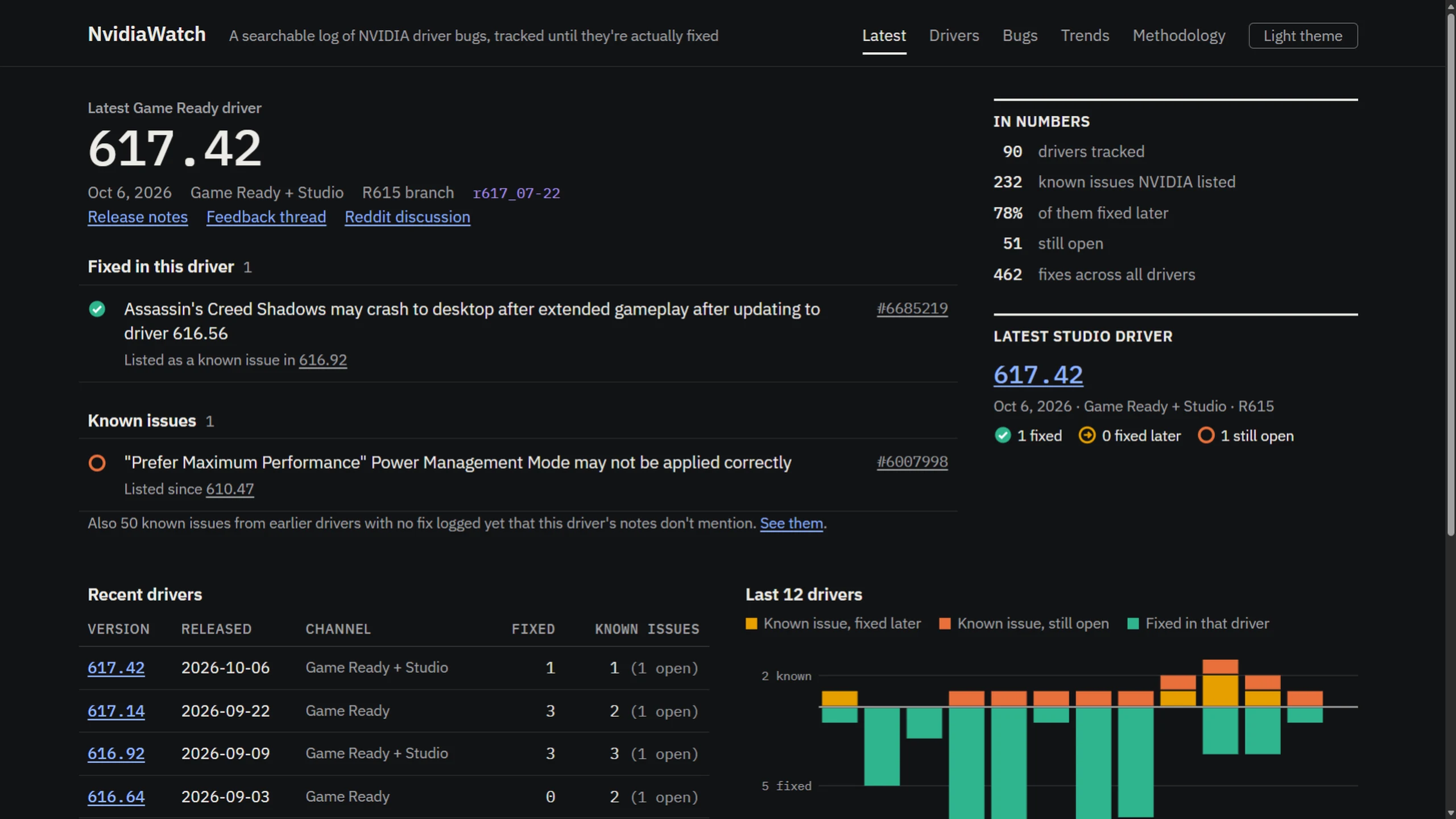
Even within a snapshot, labels matter. The accompanying NvidiaWatch screenshot distinguishes 232 known issues, 51 still open and 462 fixes across all drivers, with 90 drivers tracked. Its 462-fix category must not be equated with a count of distinct bugs merely because the number matches an earlier headline. A useful analysis needs the date, dataset version and definition of the quantity being compared.
A chart's early “worst” label produced a related dispute in the creator's launch discussion. A tall bar could show many fixes rather than many new failures. The maintainer checked the notes and agreed to remove the misleading label and clarify the chart. A release fixing numerous relevant problems may be an attractive update, not a particularly faulty one.
The dataset itself was corrected during the redesign: versions 531.79 and 581.29 were added, while withdrawn 595.59 was removed. The visible timeline extends from 526.47 in October 2022 through 617.42, released October 6, 2026. Corrections improve the record while showing why an archived snapshot or traceable change log is more useful than an undated total.
The official record has a selection boundary
The maintainer's response to an unacknowledged cursor problem was explicit: the tracker generally follows issues Nvidia recognizes. Missing records therefore cannot establish that a release is trouble-free. A short known-issues list might coexist with problems not yet reproduced, acknowledged or documented. Independent coverage of the tracker emphasized the same boundary.
Raw counts also do not weight severity, prevalence or reproducibility. A cosmetic glitch and a serious crash can each occupy one record. Memory instability, overclocking, operating-system changes or another application may contribute to a driver-like symptom. Matching GPU, displays, software and workload remains essential before applying another user's finding.
Driver pages now show release and build branches: the former groups development, the latter identifies a more specific build lineage. That context can help compare related releases, but does not assign every defect to a branch. Likewise, clusters around RTX 40- or 50-series launches do not demonstrate causation. New hardware coincides with games, features, operating-system changes and reporting activity.
Better update decisions still depend on the machine
The live database can produce a shortlist for a creator, gamer or local-AI workstation user. Start with the required application, symptom or bug ID; follow the history; inspect what a candidate version fixes and carries forward. The official Nvidia driver service remains the installer source. NvidiaWatch is neither an installation manager nor a stability certification.
Game Ready prioritizes recent games; Studio targets tested creative workflows. Neither label guarantees every configuration, and the channels can share components and known issues. A hotfix between regular packages can be valuable for the exact fault it addresses; installing every hotfix without a relevant need simply adds change. Waiting for community feedback and updating immediately with a rollback plan reflect different workloads and tolerances, not one universally correct policy.
Critical systems can retain the working installer and settings, test a representative machine or limited group, and compare actual workloads before wider rollout. Connecting local incidents and verified resolutions to public bug identifiers makes the next investigation more useful. A searchable engineering knowledge base can preserve those relationships without turning another team's experience into a guarantee for yours.
Durability will depend on maintenance and disclosure
The code uses MIT and the dataset CC BY 4.0, allowing inspection, correction proposals and alternative analyses. Openness does not eliminate editorial choices about differently worded records or external fixes. Timely new-release coverage, preserved histories and traceable corrections will determine whether a one-person project remains useful as its workload grows.
Nvidia could narrow the gap with persistent issue pages, structured identifiers and explicit statuses distinguishing driver fixes, external resolutions and reclassification. Similar histories could help other software categories, although operating systems bring more versions, channels and enterprise configurations. NvidiaWatch's narrower scope is part of its practicality.
Its contribution is continuity, not a universal “best driver.” A useful record shows what was acknowledged, what later changed and where the trail becomes ambiguous. Whether that evidence justifies an update still depends on the exact problem, machine and ability to recover—not the tallest chart bar.