
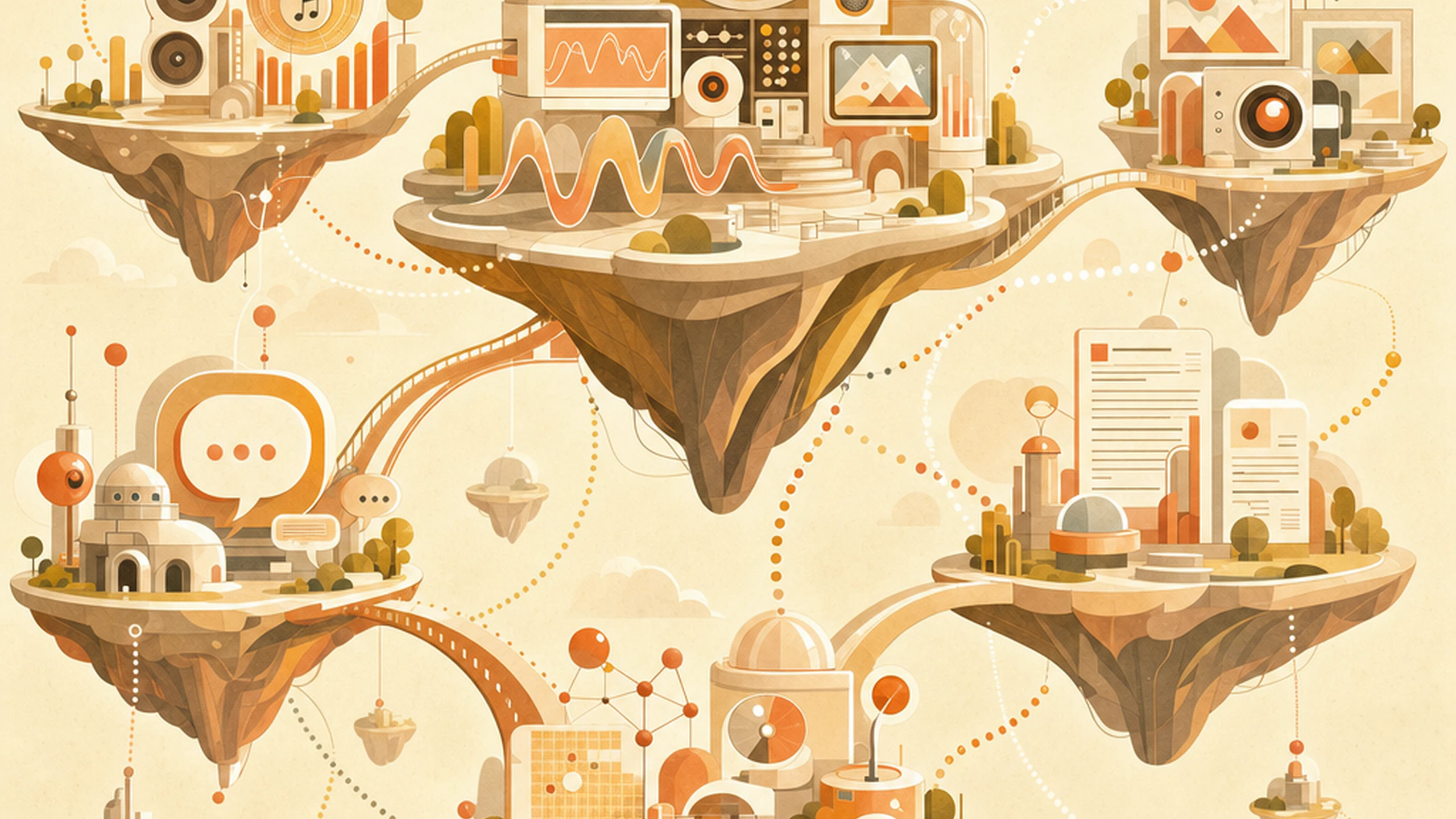
Multimodal AI is an AI system that processes and reasons across multiple types of input, including text, images, audio, and video, within a single model. Rather than handling one format at a time, such a system can look at a chart, read the accompanying report, and answer questions that require understanding both at once.
These models accept inputs that go beyond text: photographs and diagrams, audio recordings and speech, video sequences, and scanned or handwritten documents. The model does not just detect that an image exists; it interprets what the image contains and relates that meaning to any accompanying text or question.
When you show a multimodal model a sales chart and ask "what drove the dip in March," it does not describe the chart and separately answer the question. It reads the visual data and your question together, producing an answer that integrates both sources. That joint reasoning is the defining characteristic of this approach.
The key insight from CLIP, OpenAI's model trained on 400 million image-text pairs, is that encoders for different modalities can be trained to produce compatible representations. When trained on data that pairs images with their descriptions, the image encoder and text encoder learn to place matching content at similar positions in vector space.
Cross-modal alignment is genuinely difficult. Small mismatches in how modalities are encoded produce compounding errors in reasoning. Hallucinations, a problem in text-only models, become harder to detect in multimodal systems because the model may confidently describe something in an image that is not there, and the error is harder to verify than a factual claim about text. Data scarcity is also a challenge: paired examples of high-quality image-text-audio combinations are far rarer than text-only training data.
Use single-modal AI when your task involves one clean input type and precision matters. Use the multimodal approach when the information you need to reason over exists across multiple formats and cannot be reduced to text alone.
Technical debugging. Developers paste a screenshot of an error alongside a description of the code they were running. A multimodal model reads both, identifies the specific visual error state, and proposes a fix that accounts for context from both sources.
Document and annotation processing. Scanned documents with handwritten annotations, mixed-language forms, or embedded diagrams can be processed as a whole. The model reads the printed text, interprets the handwriting, and reasons about any charts or tables without requiring separate preprocessing steps.
Q: Do I need this for note-taking or knowledge management?
A: Not necessarily for basic text notes. But if your knowledge base includes meeting recordings, screenshots, scanned documents, or any non-text captures, then this technology is what allows those assets to become searchable and usable rather than just stored. The more your knowledge lives outside typed text, the more relevant multimodal capabilities become.