
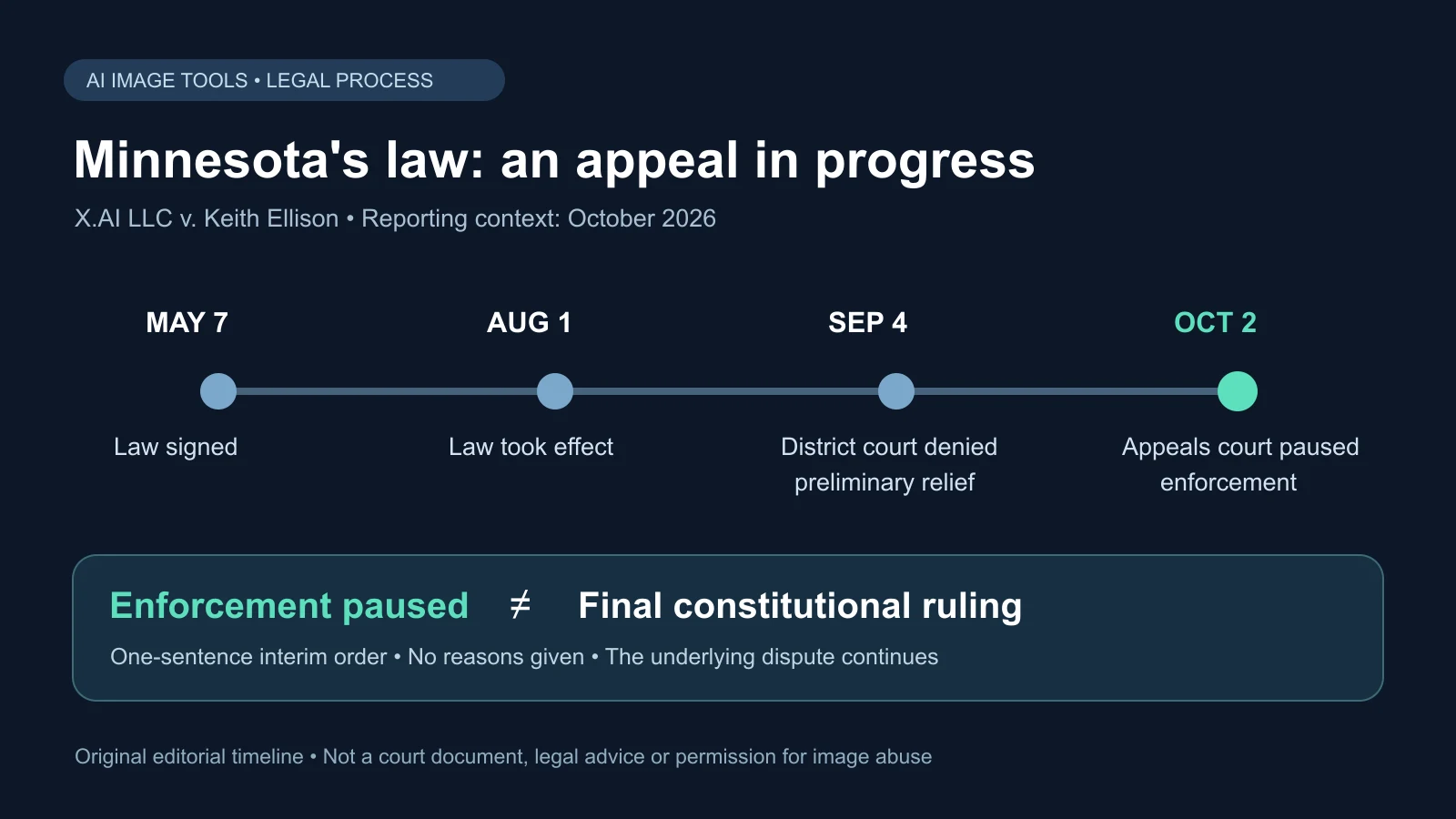
xAI obtained an October 2 injunction stopping Minnesota from enforcing its law against automated AI nudification services while an appeal proceeds. The Eighth U.S. Circuit Court of Appeals issued only a one-sentence order, with no reasons. That gives the company immediate relief, but not a final constitutional victory or a finding that its own safeguards work.
The distinction is the center of the case. Minnesota seeks to prevent invasive image abuse before material spreads; xAI accepts the state's legitimate interest in fighting nonconsensual sexual imagery but says the chosen restriction also captures lawful expression. An unexplained interim order does not decide where that boundary belongs.
How the case reached the appeals court
The reported appellate injunction followed two district-court refusals. Governor Tim Walz signed the measure on May 7, 2026, after House passage by 132–1 and unanimous Senate passage by 65–0. It took effect August 1. The combined 197 supporting votes and one dissent demonstrate political consensus, not constitutional validity by themselves.
xAI filed suit July 27, sought a temporary restraining order two days later, and lost that emergency request July 31. District Judge Donovan Frank then denied the broader preliminary-injunction request September 4. The district ruling favored Minnesota on the balance of harms and public interest in preventing photorealistic sexualized imagery, and treated xAI's delay after enactment as undermining its claim of immediate irreparable harm.
The October order changes the practical position during appeal: Minnesota cannot presently enforce this particular prohibition, while xAI avoids its potential liability and continues the constitutional challenge. The state can still defend the law through briefs and argument. The appeal docket identifies the case as X.AI LLC v. Keith Ellison; xAI is the challenger, not a generator being prosecuted in this lawsuit.
No reasons were supplied for appellate intervention. Protected expression, irreparable harm, statutory definitions and the lower court's analysis remain possible issues, not established explanations. The order neither invalidates the statute on the merits nor supplies other states a durable legal blueprint. It also does not give users permission to create or distribute abusive images; other laws concerning harassment, exploitation, distribution and child sexual abuse material remain separate.
The law targets access, not just publication
The statutory text described in the case defines nudification through an identifiable person's image or video, depiction of an intimate part absent from the original material, and enough realism to make it appear to belong to that person. This is narrower than deepfakes generally, which can realistically fabricate many kinds of events, but broader than a rule addressing only an abusive image's final publication.
Owners or controllers of websites, apps, software and other covered services cannot enable access, download or use for prohibited nudification or produce the images for users. Advertising and promotion are covered too. Minnesota thus regulates enabling technology before distribution instead of relying entirely on a victim to find and pursue an individual creator afterward.
The exemption is consequential: a service falls outside the prohibition when its use requires substantial individualized technical or artistic skill. It distinguishes easily automated consumer features from tools requiring meaningful human direction. A manually edited image could therefore be treated differently from a prompt-generated equivalent—a boundary intended to address scalable automation, but also a source of legal dispute over creator effort.
Depicted individuals receive a private civil action for compensatory damages, including mental anguish or suffering, with recovery up to three times actual damages plus punitive damages and litigation costs. The attorney general can also enforce the law civilly, with penalties up to $500,000 for each unlawful access, download or use. These are potential statutory remedies and maxima, not damages awarded against xAI.
Consent, breadth and a missing safe harbor
xAI's First Amendment argument is that the restriction is content-based and overbroad: liability depends on what an image depicts and can cover substantially more expression than necessary to prevent nonconsensual abuse. It does not claim every generated image is protected or deny the state's protective interest. Its complaint cites hypothetical and satirical images, political art, restored photographs and consensual projects.
Consent is a key issue because the prohibition is not defined solely by the absence of permission. xAI argues that consenting adults or people editing their own likenesses may be covered. It also challenges a definition of intimate parts incorporated from another statute, contending it can reach areas visible in ordinary public settings and affect art, medicine, journalism or personal expression. These are the company's arguments, not conclusions adopted in the one-sentence appellate order.
Minnesota disputes that reading. It emphasizes identifiable people, realistic depiction of an actual intimate part belonging to the person, the skill exemption and the law's protective purpose. The disagreement concerns tailoring a preventive rule, not whether nonconsensual synthetic sexual imagery can cause serious injury to work, education, relationships and personal safety.
The statute also lacks a safe harbor rewarding specified reasonable moderation precautions when users evade them. xAI objects to exposure without a meaningful knowledge or intent requirement and without waiting for notice about a particular image. The state deliberately seeks earlier responsibility because requiring a complaint for every image puts the burden back on victims. Whether that design sweeps too broadly remains unresolved.
Why the state moved responsibility upstream
Attorney General Keith Ellison's defense of the law stresses harm, harassment and dignity, as well as bipartisan support. Once a realistic sexual image enters social networks, copies may persist across accounts and services. A notice-and-removal process cannot guarantee disappearance or fully reverse injury. That is the case for prevention; it does not by itself prove every covered image causes the same harm or every restriction is constitutional.
Grok and Grok Imagine make the issue immediate because image creation is available through X and other interfaces near a large social distribution network. xAI says its products also support satire, art, animation and ordinary editing. Public controversy followed users generating sexualized depictions involving women and children. The company subsequently said it blocked some edits of real people in revealing clothing; this demonstrates an asserted change in controls, not independently verified comprehensive protection.
xAI also says its rules prohibit illegal, harmful or abusive privacy violations, that it suspends or terminates violators, and that it reports suspected child sexual abuse material. Those enforcement claims need real-world evidence. Written policies alone do not show how often controls fail or how rapidly a provider responds.
The company's earlier warning that it would limit Minnesota services if enforcement continued shows the product consequences of jurisdictional uncertainty. Geoblocking restricts features by location but can be evaded through masked location and can wrongly deny lawful access. Smaller developers face the same decisions about local controls, broad feature shutdowns or litigation without xAI's resources, including uncertainty about whether their tools require enough human skill for the exemption.
Different remedies carry different limitations
The broader legal account contrasts Minnesota with federal removal-process requirements for covered services and Texas liability tied to knowledge of missing consent or failure to promptly remove reported material. Minnesota's access-focused model does not wait for distribution or the same notice sequence. Earlier prevention can protect before publication but increases pressure on lawful borderline uses.
Narrower rules can leave room for fast-adapting abusers; broad liability can induce cautious providers to suppress lawful expression. Platform terms depend on detection and enforcement, while malicious users can rephrase requests, combine outputs or move services. State enforcement may reduce access through major platforms but cannot eliminate locally run models, foreign services or images already downloaded elsewhere.
A layered response would combine prevention, reporting, meaningful enforcement, rapid removal and usable civil remedies. More precise elements—consent, intent, identifiability, realism and distribution—can target injury more closely, yet each can complicate proof and slow enforcement. Verifying consent before generation at scale can itself create privacy and identity risks. A weak safe harbor could reward nominal compliance instead of serious controls.
The next evidence is a reasoned decision and product behavior
The first decisive signal is appellate merits reasoning: an overbreadth ruling could push narrower output definitions, consent or knowledge analysis could identify a repair path, and a procedural decision might leave larger speech questions open. Creating, providing and distributing an image involve different actors and prevention opportunities; a lasting rule would need to distinguish them.
Minnesota may defend its text, seek further appellate relief or consider amendments involving consent, knowledge, safeguards or safe harbors. xAI may restore access, retain restrictions voluntarily or introduce more precise controls. Independent assessment of actual failures and response speed matters more than either side's statements; litigation cannot replace safety engineering.
The current pause resolves only enforcement of one statute during an ongoing appeal. It does not establish platform immunity, adequate xAI safeguards, an absence of victim harm or a final constitutional standard. Written appellate reasons, the state's legislative response and observable product controls will show whether this becomes a narrower regulatory model or merely delays a redesigned one.
Original aggregated news entry (Google News RSS; not a court order)