Original document
GPT Image 2 · en
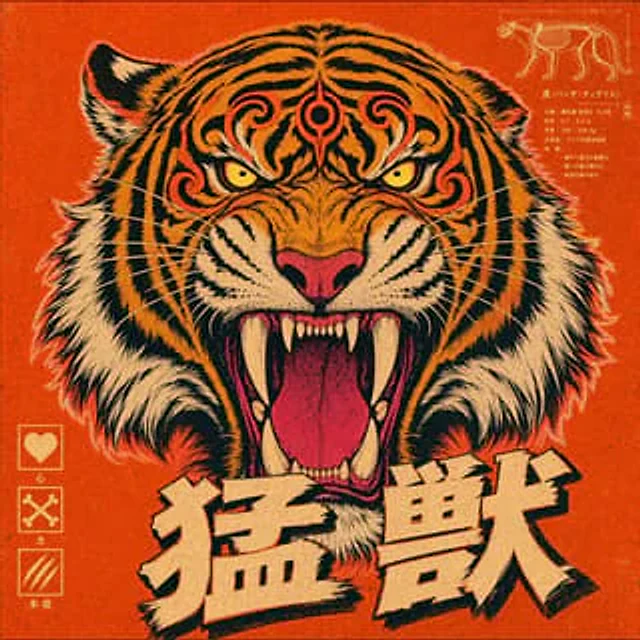
Create a bold, retro-Japanese-style poster on a square canvas, with a fierce, frontal tiger head as the sole central subject. The composition is perfectly symmetrical and occupies most of the frame. The tiger roars with its mouth wide open, revealing long, curved tusks, smaller lower teeth, a bright pink tongue, a dark throat, a pink nose, sharp yellow eyes, and dramatic black stripes covering its saturated orange fur, with white down on its cheeks and neck. Add decorative swirling stripes on its forehead to give the tiger's face a stylized, mythical feel. Use a rough, retro screen or stencil texture with noticeable grain, worn ink, and slightly broken edges, employing a limited palette of burnt orange, black, cream, white, soft pink, and touches of yellow. The background should be a flat, textured orange-red. In the upper right corner, include a small technical panel showing a side view of the tiger's skeleton, drawn with delicate cream lines, with compact, vertical Japanese annotation text below and to the sides, like pseudoscientific label blocks. In the bottom left corner, there are three vertically stacked icon boxes with thin cream borders: the first contains a heart icon and the label "Heart," the second contains a crossbones icon and the label "Strength," and the third contains three claw marks icons and the label "Instinct." At the bottom center, there are two very large cream-colored Japanese kanji characters with heavy black shadows and a rough, hand-carved woodblock print texture: "Beast." The overall composition maintains an aggressive, iconic, poster-like feel, is centered, and highly graphic, blending traditional Japanese poster aesthetics, the energy of tattoo GIFs, and a retro animal anatomy style.How to use
- Copy the complete original prompt, including any parameters.
- Replace the subject, text and composition with your own requirements.
- Use a compatible external tool; check its current access conditions and review the result.
Before you start
- Check whether a reference image is required. A compatible model label does not mean this example was generated with that model.
- Keep names, figures and visible text accurate; results can vary between model versions.