Original document
GPT Image 2 · en
{
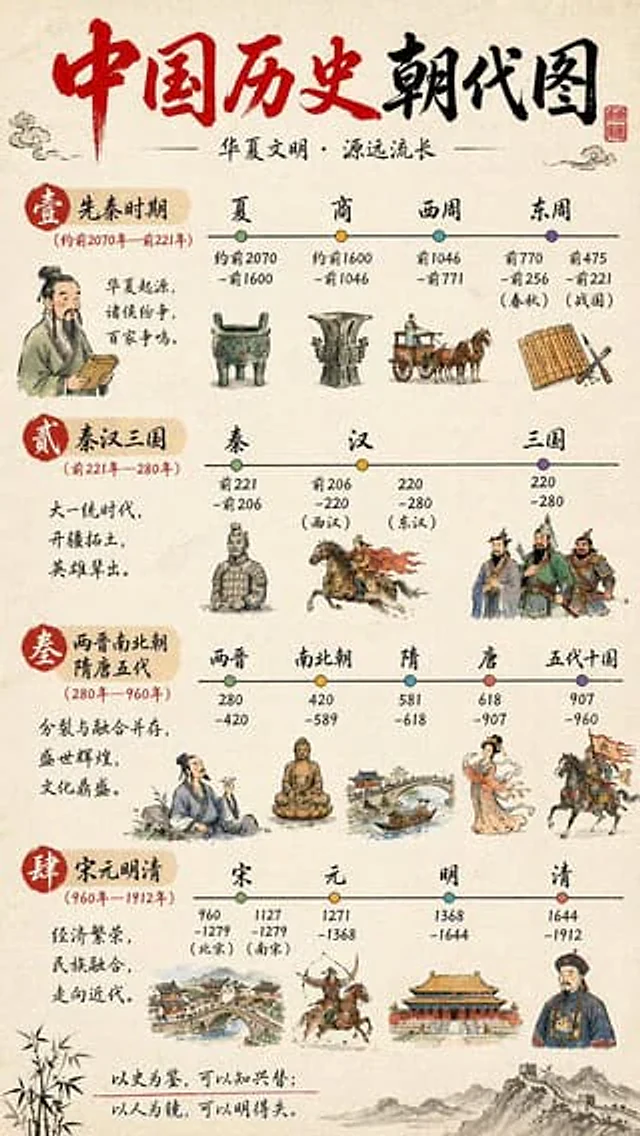
  "type": "Infographic Timeline",
  "style": {
    "background": "{argument name=\"background style\" default=\"Textured beige Xuan paper\"}",
    "art_style": "{argument name=\"art style\" default=\"Traditional Chinese ink painting style\"}"
  },
  "header": {
    "title": "{argument name=\"main title\" default=\"Chart of Chinese Historical Dynasties\"}",
    "subtitle": "{argument name=\"subtitle\" default=\"Chinese civilization has a long history.\"}",
    "elements": [
      "Red calligraphy title",
      "Red square stamp in the upper right corner",
      "Auspicious cloud pattern"
    ]
  },
  "layout": {
    "sections_count": 4,
    "sections": [
      {
        "id": "1",
        "label": "Pre-Qin Period",
        "date_range": "(c. 2070 BC – 221 BC)",
        "description": "The origins of Chinese civilization: the struggles among feudal lords and the contention of a hundred schools of thought.",
        "timeline_nodes": 4,
        "dynasties": [
          "summer",
          "business",
          "Western Zhou Dynasty",
          "Eastern Zhou"
        ],
        "illustrations": [
          "Scholars holding bamboo slips",
          "Bronze tripod",
          "Bronze Ritual Vessels",
          "carriage",
          "Bamboo slips and writing brush"
        ]
      },
      {
        "id": "2",
        "label": "Part Two: Qin, Han and Three Kingdoms",
        "date_range": "(221 BC – 280 AD)",
        "description": "In the era of unification, territorial expansion led to the emergence of numerous heroes.",
        "timeline_nodes": 3,
        "dynasties": [
          "Qin",
          "Chinese",
          "Three Kingdoms"
        ],
        "illustrations": [
          "Terracotta Army",
          "Horse cavalry",
          "Three generals in traditional armor"
        ]
      },
      {
        "id": "3",
        "label": "The Three Dynasties: Jin, Southern and Northern Dynasties, Sui, Tang and Five Dynasties",
        "date_range": "(280–960 AD)",
        "description": "Divide and integration coexist, a glorious era unfolds, and culture flourishes.",
        "timeline_nodes": 5,
        "dynasties": [
          "Jin Dynasty",
          "Northern and Southern Courts",
          "Sui",
          "Tang",
          "Five Dynasties and Ten Kingdoms"
        ],
        "illustrations": [
          "Scholars who drink",
          "Seated Buddha statue",
          "Arched stone bridge with boat",
          "Elegant Tang Dynasty ladies",
          "Flag-bearing cavalry"
        ]
      },
      {
        "id": "4",
        "label": "Four Song, Yuan, Ming and Qing",
        "date_range": "(960–1912)",
        "description": "Economic prosperity, ethnic integration, and the transition to modernity.",
        "timeline_nodes": 4,
        "dynasties": [
          "Song",
          "Yuan",
          "bright",
          "clear"
        ],
        "illustrations": [
          "A bustling riverside town landscape",
          "Horse archer turning around to shoot",
          "Palace complex",
          "Qing Dynasty officials"
        ]
      }
    ]
  },
  "footer": {
    "quote": "{argument name=\"bottom quote\" default=\"By learning from history, we can understand the rise and fall of dynasties; by learning from others, we can understand our own gains and losses.\"}",
    "decorations": [
      "Bamboo leaf in the lower left corner",
      "Great Wall illustration in the bottom right corner"
    ]
  }
}
How to use
- Copy the complete original prompt, including any parameters.
- Replace the subject, text and composition with your own requirements.
- Use a compatible external tool; check its current access conditions and review the result.
Before you start
- Check whether a reference image is required. A compatible model label does not mean this example was generated with that model.
- Keep names, figures and visible text accurate; results can vary between model versions.