
Original document
GPT Image 2 · en
Scene:
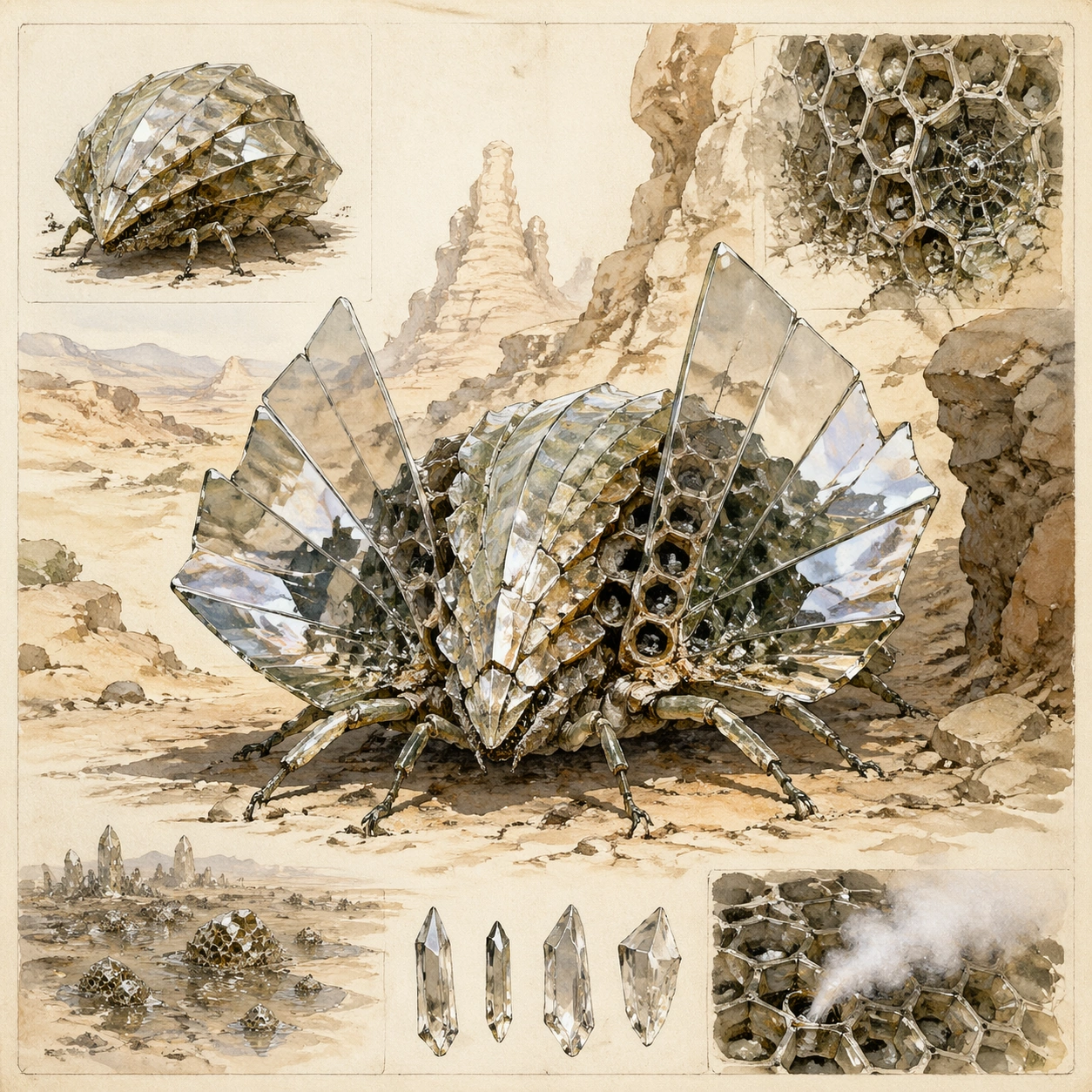
Construct a page around one dramatic but disciplined defense display, with the main figure opening reflective frills against a rocky desert backdrop sketched in wash. The composition should feel observed, not theatrical, as if the naturalist caught a brief warning posture in the field. Build the frame as a square natural history study with disciplined composition, believable lighting, and enough environmental evidence to explain how this organism or system functions without any caption. Keep the image polished, observational, and suitable for a research gallery rather than pulp fantasy spectacle.

Subject:
Show the animal spreading shard-like lateral plates, angling mirrored surfaces toward a threat, and exposing vibrating resonance cavities that could confuse predators or crack fragile attackers. Include a smaller resting-state inset for comparison. Show the anatomy, habitat interaction, and scale cues clearly so the viewer can infer locomotion, feeding, reproduction, or ecological role from the visual alone. Every visible structure should feel evolved for a purpose, with layered foreground, midground, and background information that rewards close inspection.

Important details:
Assume these organisms use mineral accretion, fracture repair, thermal gradients, and electrochemical surfaces instead of flesh-heavy metabolisms. Forms should look feasible for an arid silicon ecology: faceted growth, abrasive wear, and slow but purposeful movement across sand and rock. The defense mechanism should derive from the same material logic as the rest of the organism: reflective planes, stress-managed seams, and multipurpose structures that also assist thermoregulation or communication. Avoid turning it into a fantasy weapon showcase. Favor coherent biology over decorative excess: tissues, shells, membranes, spores, tendrils, fins, silica lattices, or atmospheric sacs should all follow one material logic. Preserve a convincing relationship between the environment and the body plan, use restrained color hierarchy, and make the image feel like a serious speculative field record rather than a random monster concept.

Use case:
Crystal Silicon Lifeform Field Sketch single study 8/9.

Constraints:
No readable text, no watermark, no logos, preserve exact 1:1 aspect ratio, no battle armor, no humanoid pose, no glowing laser attack, no readable marginal notes, no accidental brand resemblance, no direct copy of known terrestrial species, no cartoon simplification.
How to use
- Copy the complete original prompt, including any parameters.
- Replace the subject, text and composition with your own requirements.
- Use a compatible external tool; check its current access conditions and review the result.
Before you start
- Check whether a reference image is required. A compatible model label does not mean this example was generated with that model.
- Keep names, figures and visible text accurate; results can vary between model versions.