Original document
GPT Image 2 · zh
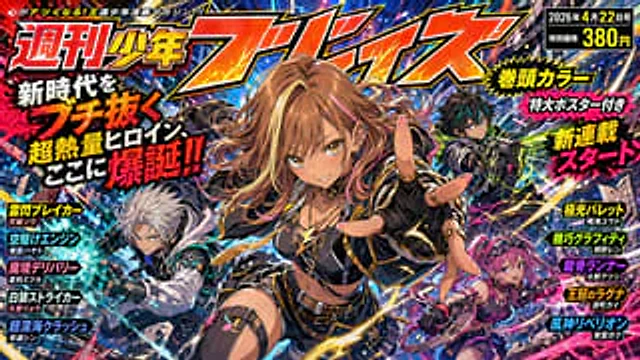
Create an incredibly detailed cover for a Japanese weekly shonen manga magazine, featuring a full bleed design, an explosive and crowded visual, leaving no blank space. Employing a single-panel vertical composition, the cover illustration stacks typographic text, character art, dynamic effects, and a chaotic urban sci-fi feel. At the top is a large, stylized Japanese title in fiery orange-red with a heavy black outline and gold edges, spanning the entire page width; the text reads "Weekly Shonen Break," with a small 40th-anniversary celebration badge integrated into the title. A short Japanese slogan is added to the very top edge. A black magazine information box in the upper right corner, with bright yellow and white text, displays the date "April 22, 2026" and the price "Special Price 380 yen." The main image presents three anime characters in a dynamic triangular composition. In the center foreground, the main heroine charges towards the viewer with a strong perspective shortening effect, one hand reaching towards the camera, almost touching the screen. She is a teenage, gyaru-style action heroine with…{argument name="hair color" default="Light brown with pink highlights"} Her long, wavy hair flew wildly, her sharp, golden-brown eyes gleamed with a confident yet mischievous smile. She possessed a sun-kissed complexion, multiple earrings, and exuded a cool, rebellious street warrior aura. Her black and gold outfit comprised six key visible pieces: a cropped top, a short jacket with metallic trim, shorts, a belt with a dangling chain, a single leg strap, and fingerless gloves. Gold lightning bolt patterns and glossy highlights were added to the clothing. Yellow energy arcs and speed lines were drawn around her hands and body to emphasize impact. To her left in the mid-ground, a white-haired boy, dressed in a black and white futuristic combat suit, crouched in an attack stance, aiming a massive mechanical gauntlet or weapon at the viewer, surrounded by icy blue fragments and sharp, dynamic lines. To her right in the mid-ground, a pink-haired girl, with her hair in pigtails or tied up, wielded a circular bladed weapon, her movements accompanied by vibrant magenta energy trails. In the upper right background, a fourth visual focal point (not a main character) is added: a black-haired boy in a green-black combat suit, aiming diagonally at a glowing sci-fi rifle, partially obscured by text and effects, blending into the background action. The background is a neon-lit, futuristic Japanese nighttime city street, presented from a tilted perspective, featuring towering signs, fragments, sparks, broken debris, electrical stripes, and saturated blues, purples, pinks, and oranges. Extreme contrast, glossy print textures, ink splatter embellishments, a halftone manga magazine style, and high-end anime-style main visual rendering are employed. A striking large Japanese cover text is added to the left stacked blocks, using thick white, yellow, red, and black fonts, including the prominent title "A New Era is Born: A Super-Heat Heroine!!" Add 5 feature annotation boxes on the left, using colored rectangular boxes, with names in bold and subtitles below: Thunder Flash ブレイカー/天城ノア, 空駆けエンジン/南云ハヤト, 魔界デリバリー/ Kurashina Mirage, White Wolf Skylark/Kuse Rika, Super Deep Sea Skylark/Hayase Sky. Add five matching bold feature boxes to the right: Aurora Parette / Narumi Yuto, Kiki Gurafiti / Kono Rei, Ryukotsu Ranner / Hino Atsushi, Oukan no Ragna / Fukamachi Kai, Fuujin Riberion / Shinonome Gaku. Additionally, add three promotional tags to the right, using star-shaped or explosion-shaped tags with large yellow and white text: Header Color, Extra Large Poster Included, New Series Start. This gives the cover the feel of a major first issue of a new era of popular battle manga, full of energy, rebelliousness, dazzling, exquisite, and highly impactful characteristics of a Japanese manga magazine cover.How to use
- Copy the complete original prompt, including any parameters.
- Replace the subject, text and composition with your own requirements.
- Use a compatible external tool; check its current access conditions and review the result.
Before you start
- Check whether a reference image is required. A compatible model label does not mean this example was generated with that model.
- Keep names, figures and visible text accurate; results can vary between model versions.