Original document
GPT Image 2 · en
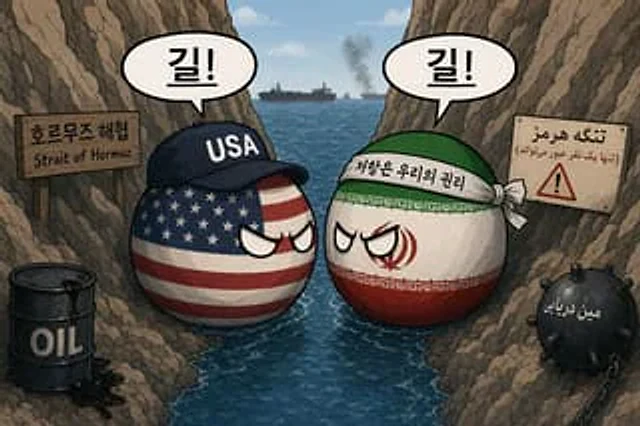
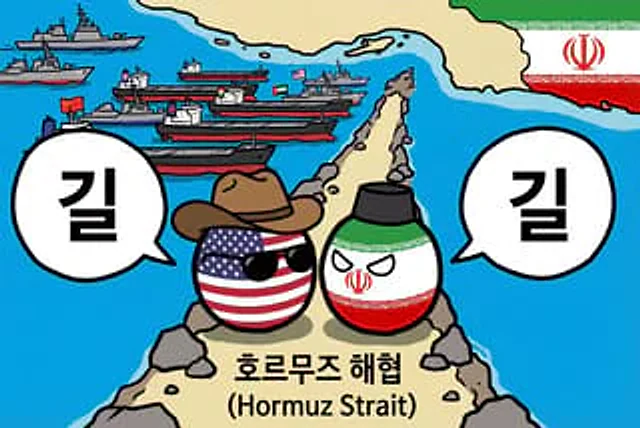
A simple, cartoonish political humor illustration of a national ball, showcasing{argument name="location label" default="Strait of Hormuz"} The current state of the narrow passageway. A wide horizontal composition is used, employing bright, flat colors, bold black outlines, and a clean, hand-drawn infographic style. In the foreground, two spheres stand side-by-side on an extremely narrow sandy land bridge, flanked by rocks, highlighting the predicament of only allowing one person to pass at a time. On the left is a sphere painted with the American flag.{argument name="left country" default="USA"} The national ball, wearing black sunglasses and a brown cowboy hat, faces another ball with unwavering determination. On the right is a ball painted with the Iranian flag.{argument name="right country" default="Iran"} The national ball, wearing a dark headscarf-like hat, glares angrily and refuses to move. Add a large white speech bubble next to each national ball, filling both bubbles with the same bold Korean text:{argument name="speech bubble text" default="길"} In the mid-ground and background, a busy blue sea is shown, crowded with a total of nine vessels: two gray American warships on the far left, a Chinese submarine flying the Chinese flag, four oil tankers carrying different flags lined up in a row on the left-center and in the center, and two gray warships flying small American flags near a narrow passage. In the upper right corner, a large Iranian flag is superimposed along the coastline. Beige land is drawn around the waterway to present a simplified map view of the Strait of Hormuz. At the bottom center, a bold caption in Korean and English is added on the sand:{argument name="bottom caption" default="호르무즈 해협 (Hormuz Strait)"} The overall atmosphere should be ironic, tense, and memetic, while remaining visually appealing and easy to read.How to use
- Copy the complete original prompt, including any parameters.
- Replace the subject, text and composition with your own requirements.
- Use a compatible external tool; check its current access conditions and review the result.
Before you start
- Check whether a reference image is required. A compatible model label does not mean this example was generated with that model.
- Keep names, figures and visible text accurate; results can vary between model versions.