
Original document
GPT Image 2 · en
Scene:
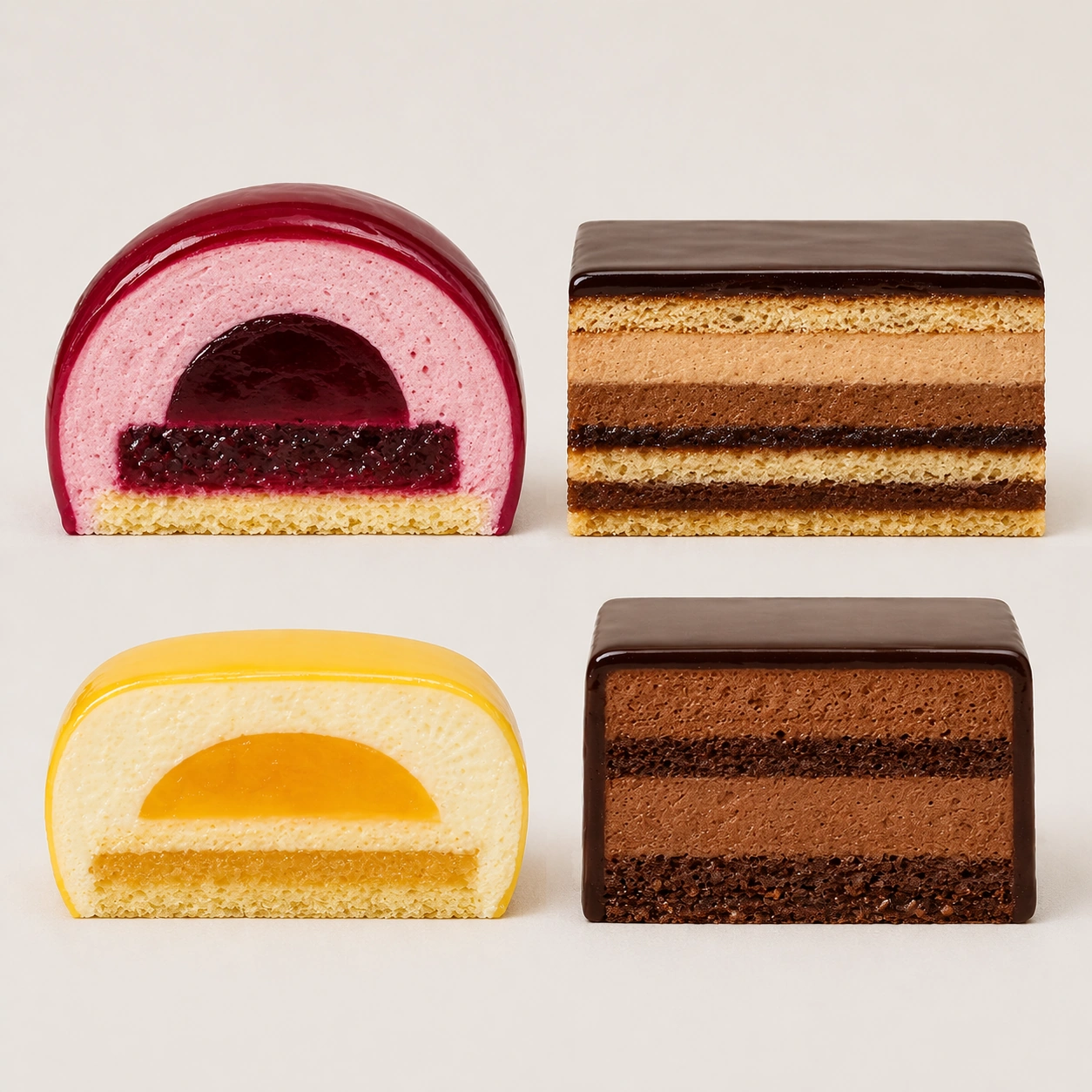
Create a square pastry documentation image on a seamless pale gray or warm ivory studio background with soft catalog lighting and almost no cast-shadow drama. The camera should feel orthographic or gently frontal so cross-sections remain easy to compare. Everything must read like a pastry atlas: clean, measured, and highly legible, with crumbs controlled and edges crisp. Use the same specimen-board spacing, pale background, and frontal cut-face presentation as the reference image, but let the surfaces gain slightly more gloss so mirror glazes and mousse layers stay readable. The lighting must remain calm and documentary.

Subject:
Show four entremet or mousse-cake sections: one berry dome half, one rectangular opera-inspired mousse bar, one citrus insert cake wedge, and one chocolate glaze cube section. Their exteriors should be polished, but the real focus is the precise internal layering of mousse, sponge, gel insert, and glaze skin.

Important details:
Treat every cut face as the hero: laminated layers, cream density, air pockets, fruit cavities, glaze thickness, and crumb structure all need to be countable and believable. The studio language should stay consistent and understated so structural detail does the work. No element should feel collapsed, smeared, or over-stylized. Preserve exact spacing, angle, and catalog-light behavior from the reference model while only shifting into colder mousse and glaze structures. Layers need clean boundaries, even thickness, and believable interaction between sponge, cream, and insert.

Use case:
Pastry cross-section atlas series study 4/9, completing the board system with entremet geometry.

Constraints:
No readable text, no watermark, no logos, preserve exact 1:1 aspect ratio, no bakery counter background, no casual napkins, no readable labels, no powdered sugar mess, no rustic knife marks, no smeared mirror glaze, no melting edges, no plated restaurant garnishes.
How to use
- Copy the complete original prompt, including any parameters.
- Replace the subject, text and composition with your own requirements.
- Use a compatible external tool; check its current access conditions and review the result.
Before you start
- Check whether a reference image is required. A compatible model label does not mean this example was generated with that model.
- Keep names, figures and visible text accurate; results can vary between model versions.