Original document
GPT Image 2.5 · en
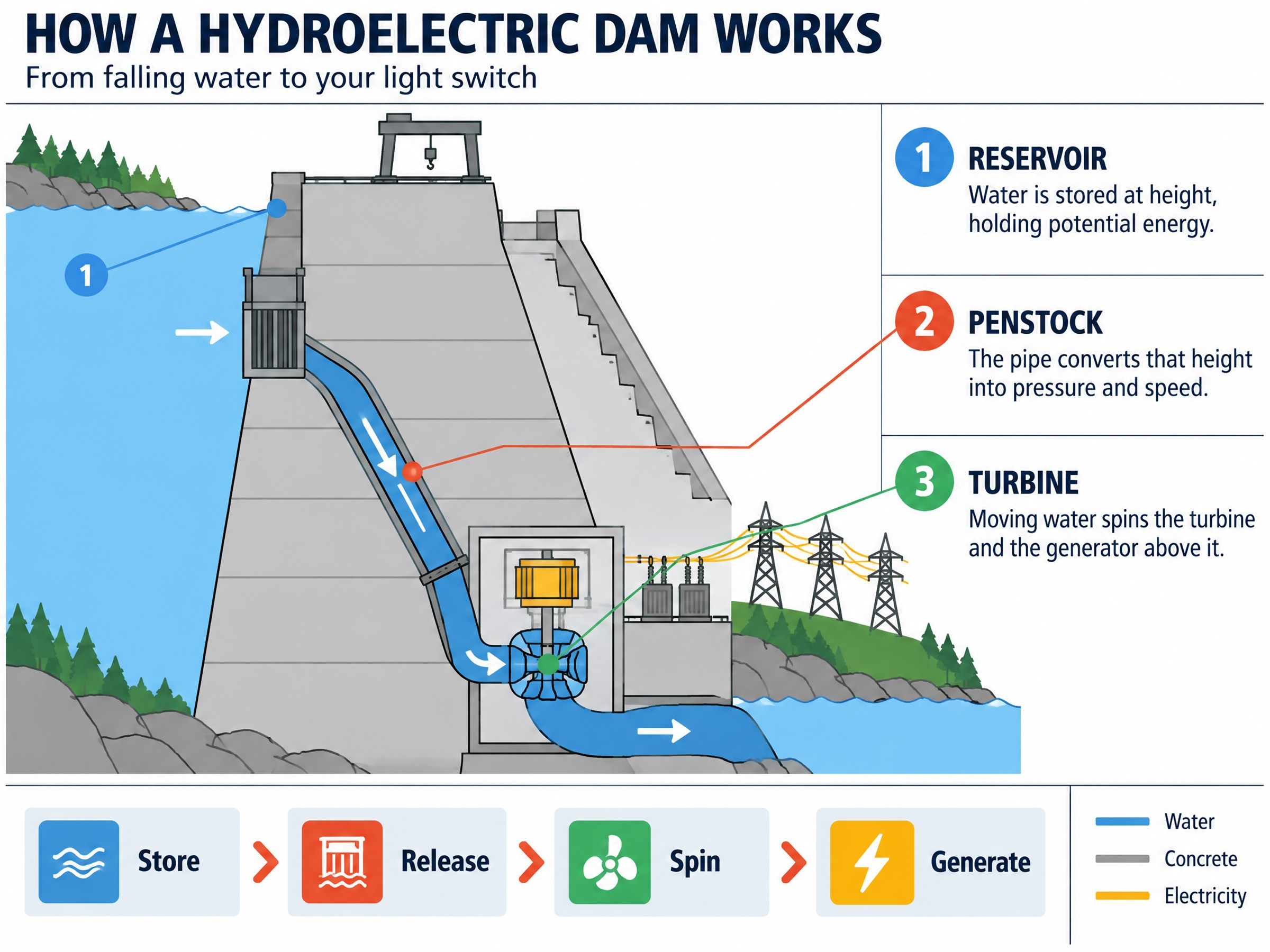
A fixed-zone explainer infographic, 4:3 landscape, titled "How a Hydroelectric Dam Works", drawn as flat vector
art with no photograph, no 3D render and no perspective beyond the cutaway.

ZONE 1 — TITLE BAND, top 12% of the frame height
The title "HOW A HYDROELECTRIC DAM WORKS" set left aligned in a bold condensed sans, all capitals, with the
subtitle "From falling water to your light switch" beneath it in a lighter weight at roughly a third of the
title's size. A single hairline rule closes the band across the full width.

ZONE 2 — MAIN DIAGRAM, left 62% of the width, from below the title band down to the process strip
A cutaway cross-section of a concrete gravity dam seen from the side, with the reservoir behind it on the left
and the river valley below on the right. Within this zone:
- The reservoir: a large body of water filling the left third, its surface a flat pale blue, with a shoreline
  of rock and pine trees along its upper edge.
- The dam wall: a massive grey concrete wedge, widest at the base, with visible horizontal construction
  joints. Its crest carries a low parapet and a gantry crane on rails.
- The intake: a rectangular opening in the dam's upstream face just below the waterline, with a trash rack of
  vertical bars across it and a steel gate above it.
- The penstock: a thick steel pipe running down through the body of the dam at a steep angle, drawn in
  section so its wall thickness reads, ending at the turbine below.
- The powerhouse: a rectangular hall cut into the base of the dam on the downstream side, containing a
  vertical turbine and, directly above it on the same shaft, a cylindrical generator.
- The draft tube: a curved widening passage carrying water away from the turbine out into the river.
- The switchyard: two transformers and a row of insulators on a flat platform beside the powerhouse, with
  three transmission pylons stepping away to the right.
- The spillway: a separate overflow channel at the dam crest on the right, dry, with a stepped chute.
Water direction is shown by five small white arrows: into the intake, down the penstock, through the turbine,
out of the draft tube and away downstream.

ZONE 3 — CALLOUT COLUMN, right 34% of the width, beside the diagram
Three stacked panels of equal height, each with a coloured circular number badge at its top left, one line of
bold label text, and two lines of smaller explanatory text beneath. A thin leader line runs from each badge to
its element in the diagram, and no leader crosses another.

ZONE 4 — PROCESS STRIP, bottom 16% of the frame height, full width beneath both columns
Four equal boxes in a row, each with a coloured square icon at its left and one short label to the right of it,
joined by three right-pointing chevrons between the boxes.

ZONE 5 — LEGEND, bottom right corner, inside the process strip's row
Three legend entries stacked vertically, each with a short coloured line sample at the left and one short label
beside it.

EXACT VISIBLE TEXT — render exactly these strings, once each
- Title: "HOW A HYDROELECTRIC DAM WORKS"
- Subtitle: "From falling water to your light switch"
- Callout 1 label: "RESERVOIR" and its text: "Water is stored at height, holding potential energy."
- Callout 2 label: "PENSTOCK" and its text: "The pipe converts that height into pressure and speed."
- Callout 3 label: "TURBINE" and its text: "Moving water spins the turbine and the generator above it."
- Process boxes, left to right: "Store" / "Release" / "Spin" / "Generate"
- Legend entries, top to bottom: "Water" / "Concrete" / "Electricity"
No other text anywhere: no units, no measurements, no capacity figures, no equations, no logos, no watermark.

STYLE
Flat vector illustration: solid fills, uniform hairline outlines, no gradients, no drop shadows, no texture.
Background flat white. Palette: concrete grey, water blue, a warm amber for electricity, and one accent colour
used only on the three number badges and the three chevrons. One neutral sans throughout, in exactly four
sizes: title, subtitle, labels, and explanatory text.

CONSTRAINTS
Exactly three callouts, exactly four process boxes, exactly three legend entries, exactly five direction
arrows, exactly three pylons. Every leader line must end on the element it names and must not cross another
leader, a callout panel or any part of the diagram. Do not add a second dam, a fish ladder, a boat, a person,
a bird, a road or a town. Do not put text on any part of the diagram itself. Do not use 3D shading, isometric
projection or perspective.
How to use
- Copy the complete original prompt, including any parameters.
- Replace the subject, text and composition with your own requirements.
- Use a compatible external tool; check its current access conditions and review the result.
Before you start
- Check whether a reference image is required. A compatible model label does not mean this example was generated with that model.
- Keep names, figures and visible text accurate; results can vary between model versions.