Original document
GPT Image 2 · zh
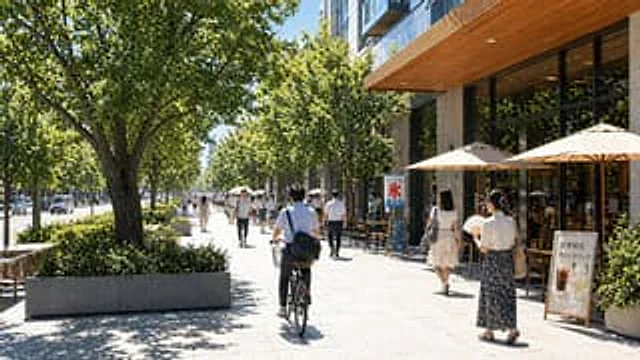
A bright, hyper-realistic depiction of a Japanese summer street scene, shot from pedestrian level, showcases a wide, clean city sidewalk flanked by dappled sunlight filtering through the trees. The scene presents a modern mixed-use neighborhood on a sunny summer day. On the right is a contemporary café or restaurant with tall floor-to-ceiling windows, dark-framed windows, a stone facade, and a warm-toned wooden ceiling extending to the terrace. Three large beige parasols stand outside the café, beneath which wooden tables and chairs are arranged. Pedestrians move about in an orderly fashion on the sidewalk, with about 14 people scattered in the distance, most dressed in light-colored summer business casual attire, primarily in white, beige, navy blue, and gray. In the foreground center, a cyclist is added with their back to the camera, wearing a short-sleeved white shirt and dark trousers, carrying a shoulder bag. In the foreground on the right, two women are added with their backs to the camera: one wears a white shirt and a long dark floral skirt, holding a round fan; the other wears a white top and a light-colored patterned skirt, carrying a bag. Add two eye-catching freestanding signs outside the café: one a vertical banner with the striking Japanese character "氷" (ice) and an ice-blue graphic; the other a freestanding folding sign with the Japanese phrase "Summer Limited Cold Drink," accompanied by images of two cold drinks: a dark iced beverage and a light lemonade-like drink. On the left, showcase a quiet street with a few vehicles, benches, low concrete flowerbeds, and neatly trimmed shrubs in the distance. The composition should emphasize depth, creating a long vanishing point through the tree-lined avenue, showcasing the bright midday sun, realistic reflections in the windows, and an upscale, tranquil urban atmosphere. Photorealistic architectural photography, natural colors, high detail, wide-angle lens, deep focus.How to use
- Copy the complete original prompt, including any parameters.
- Replace the subject, text and composition with your own requirements.
- Use a compatible external tool; check its current access conditions and review the result.
Before you start
- Check whether a reference image is required. A compatible model label does not mean this example was generated with that model.
- Keep names, figures and visible text accurate; results can vary between model versions.