
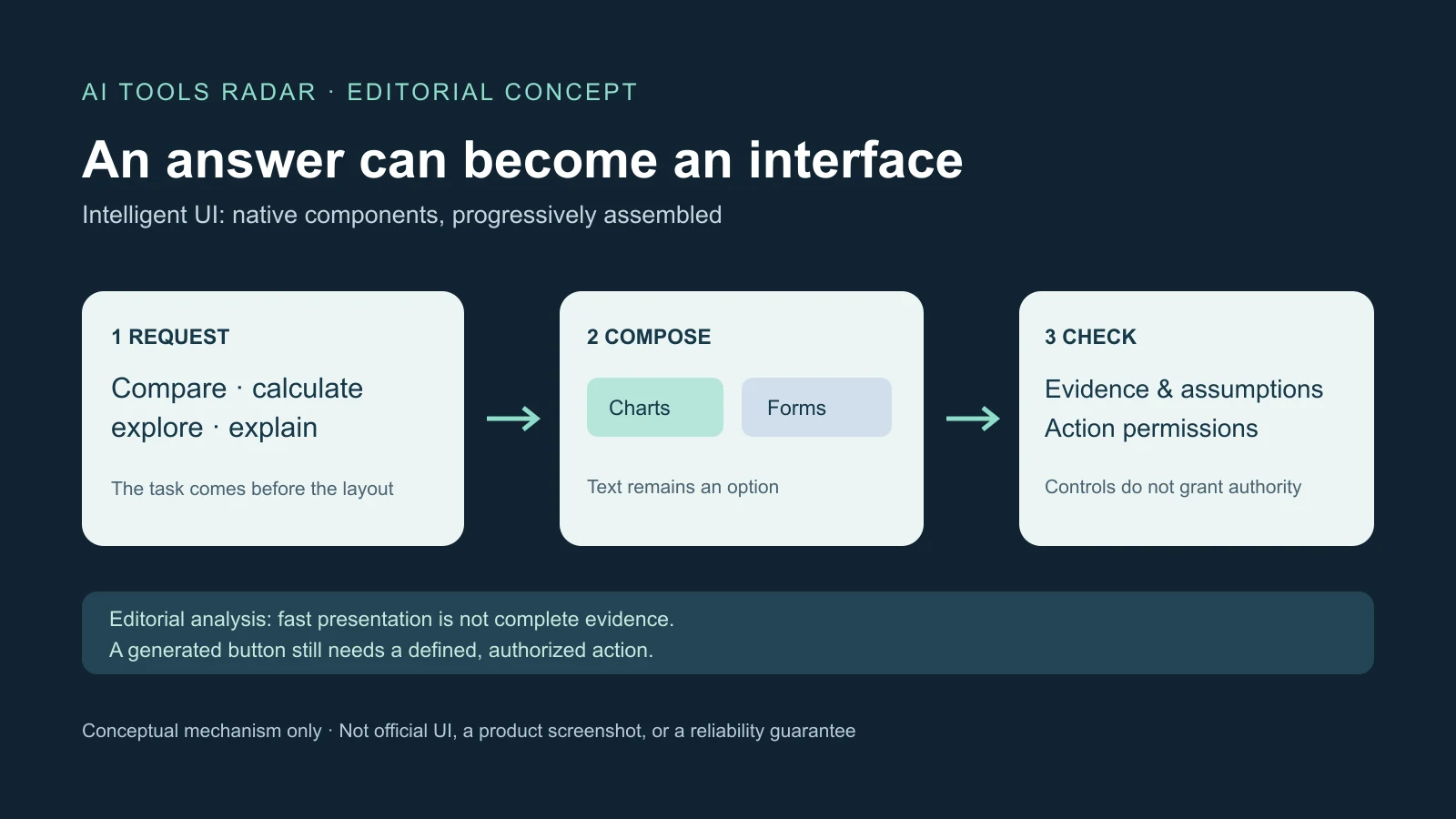
OpenAI’s October 7 Intelligent UI announcement changes what counts as an answer in ChatGPT. GPT-6 can choose charts, forms, diagrams, maps, buttons or narrow tools instead of relying on a vertical text stream. The consequential change is not decoration: model judgment now determines which choices a user sees and how a task can be explored.
A recipe can gain a preparation timeline; a route can connect stops to a map; a comparison can place alternatives side by side. Savings calculators, dinner-bill splitters and simple games illustrate software assembled for a request rather than an application selected in advance. Plain text remains appropriate when controls add nothing.
Native components and streaming define the mechanism
OpenAI describes a library of native components and a compiler that processes the interface as GPT-6 generates it. The model arranges standardized elements such as buttons and fields instead of producing an unrestricted web page with entirely new underlying behavior. That controlled vocabulary offers consistency but also limits composition to platform choices.
Components stream progressively, so reading or interaction can start before the response finishes. Release notes also say GPT-6 can keep thinking or using tools after an initial response and add findings without another prompt. A research summary might appear before all research ends; a calculator can expose inputs while the explanation is still arriving.
Those behaviors address the blank-screen delay of richer answers, but create a completeness problem. A chart needs to signal when data is provisional or revised. A calculator should not invite reliance on a result before essential inputs are settled. Fast presentation and finished evidence are different states.
Account access is not universal GPT-6 feature parity
Plus, Pro, Business and Enterprise rollout began October 7; Free and Go rollout began October 8. The announced expansion is global in the Chat tab, with account, client, workspace settings and administrator model permissions affecting availability. A rollout start is not confirmation that every account or device already has it.
OpenAI identifies GPT-6 Sol for everyday Chat on paid and managed accounts, and GPT-6 Luna for Free and Go. Astra remains available for supported higher-reasoning uses, but its Pro reasoning option does not support Intelligent UI. This announcement does not replace the models powering ChatGPT Work or Codex or guarantee identical interaction across every GPT-6 surface.
The company reports training and evaluation around layout, interaction, clarity, completeness and when text is preferable. It also acknowledges that design judgment needs improvement. More than 1.2 billion weekly ChatGPT users represents the assistant’s reported reach, not evidence that every one has used or benefited from Intelligent UI.
A useful control keeps assumptions attached to the conversation
The opportunity is clearest when explanation normally leads to another task. Retirement scenarios need adjustable growth assumptions; probability lessons can benefit from manipulating variables. A bill splitter can take total, diners, tax and tip rather than merely describe a formula. The conversation preserves context so users can challenge an assumption or ask why a result changed.
Knowledge work similarly needs inspectable decisions and revisable alternatives, not prose alone. A comparison panel might expose disagreement between documents, but can also hide missing evidence. Source review and knowledge blending remain necessary; arranging a claim attractively does not establish its provenance.
This is also a distribution strategy. The steps after a recommendation—comparing routes, practicing a lesson, narrowing products—can remain inside ChatGPT. OpenAI must show that keeping people there reduces work, not merely increases clicks or time spent deciphering unfamiliar controls.
Rivals expose different boundaries for generated software
Claude Artifacts presents distinct objects such as documents, dashboards, websites, code and interactive tools beside conversation. Persistence supports iteration and sharing. Gemini’s interactive simulations emphasize adjustable models for education and exploration. Microsoft 365 Copilot widgets connect defined components to services and enterprise workflows.
Intelligent UI differs by selecting a format automatically inside ordinary conversation, without requiring a separate builder or an explicit artifact request. That lowers the burden of knowing which interface to ask for. It also means a user may encounter controls without consciously choosing to enter a generated application.
The competitive divide is partly generated UI versus fixed software. Fixed products offer learned landmarks and tested screens; intent-first composition can remove irrelevant menus but makes each answer a new layout to understand. A narrow component library limits flexibility; unrestricted generation increases risks of broken controls, inaccessible arrangements and unsafe actions. Native components occupy a controlled middle ground, not a guarantee of correct judgment.
Visual confidence must not outrun factual confidence
A calculator can be an illustrative model rather than a validated professional tool. A form might refine a response, collect data for a tool call or commit an external action. “Book,” “send” and “apply” need explicit meaning before a click; visual familiarity cannot supply missing authority.
Charts require correct data, categories, units, scales and uncertainty. Even correct numbers can mislead through grouping or axes. Comparison cards may appear equally supported when their sources differ in date and reliability. Forms can silently exclude relevant choices, especially dangerous when health, legal or financial context is incomplete.
Accessibility remains a composition-level obligation: keyboard navigation, contrast, labels, text alternatives, predictable focus and reading order while content streams. Standard components can help, but an accessible button does not make an incoherent sequence understandable. Excess variation also undermines habits that make fixed software efficient.
The launch materials do not supply a broad public benchmark establishing wrong-format frequency or misleading-composition rates. That is an evidence gap, not proof of failure. Novelty-driven clicks and longer sessions cannot distinguish useful exploration from confusion; task completion and correct interpretation provide stronger comparisons with text-only answers.
Businesses need authority outside the generated layout
Teams could expose trusted data and narrow capabilities, then let a model assemble a status panel or review form for unusual requests. But the model’s decision to add a button must not grant permission to send mail, approve payments or change accounts. Validated inputs, access control, confirmation and audit records remain software responsibilities.
Reproducibility also changes. Prompt, conversation history, model version and available context may alter which information a dashboard emphasizes. Reviewers may need records of the request, selected components, source data and the basis for a presentation choice to explain different recommendations. Existing administrator model-access settings are not proof of granular controls for every generated action.
The Chat launch is not a promise that API developers can reproduce every interface or component behavior. MCP connects assistants to external tools and data; service-backed widgets and OpenAI’s native answer composition address related but distinct layers. Combining trusted capabilities with adaptive presentation introduces shared responsibility among model, data provider and host executor.
Practical tests should check source traceability, data versus inference, display-only versus external actions, confirmation, incomplete-data behavior, recovery after revisions and keyboard-only use. Reversible exploration—filtering, adjusting assumptions, organizing evidence and drafting—is a narrower starting point than irreversible transactions. Deterministic safeguards must validate high-stakes inputs, permissions and outcomes.
Three developments will show whether this becomes durable infrastructure rather than a striking feature: consistent rollout across accounts and clients, quality evidence on fidelity/accessibility/task success, and rival choices between automatic composition and more explicit user control. The useful outcome is not an app for every answer. It is the right amount of interface, with visible evidence, understandable changes and plain text when that serves the task best.
Sources and related reading
GPT-6 launch · ChatGPT release notes · Related reading: knowledge blending · WIRED hands-on · Claude Artifacts · Gemini simulations · Copilot UI widgets · Intelligent UI reporting