
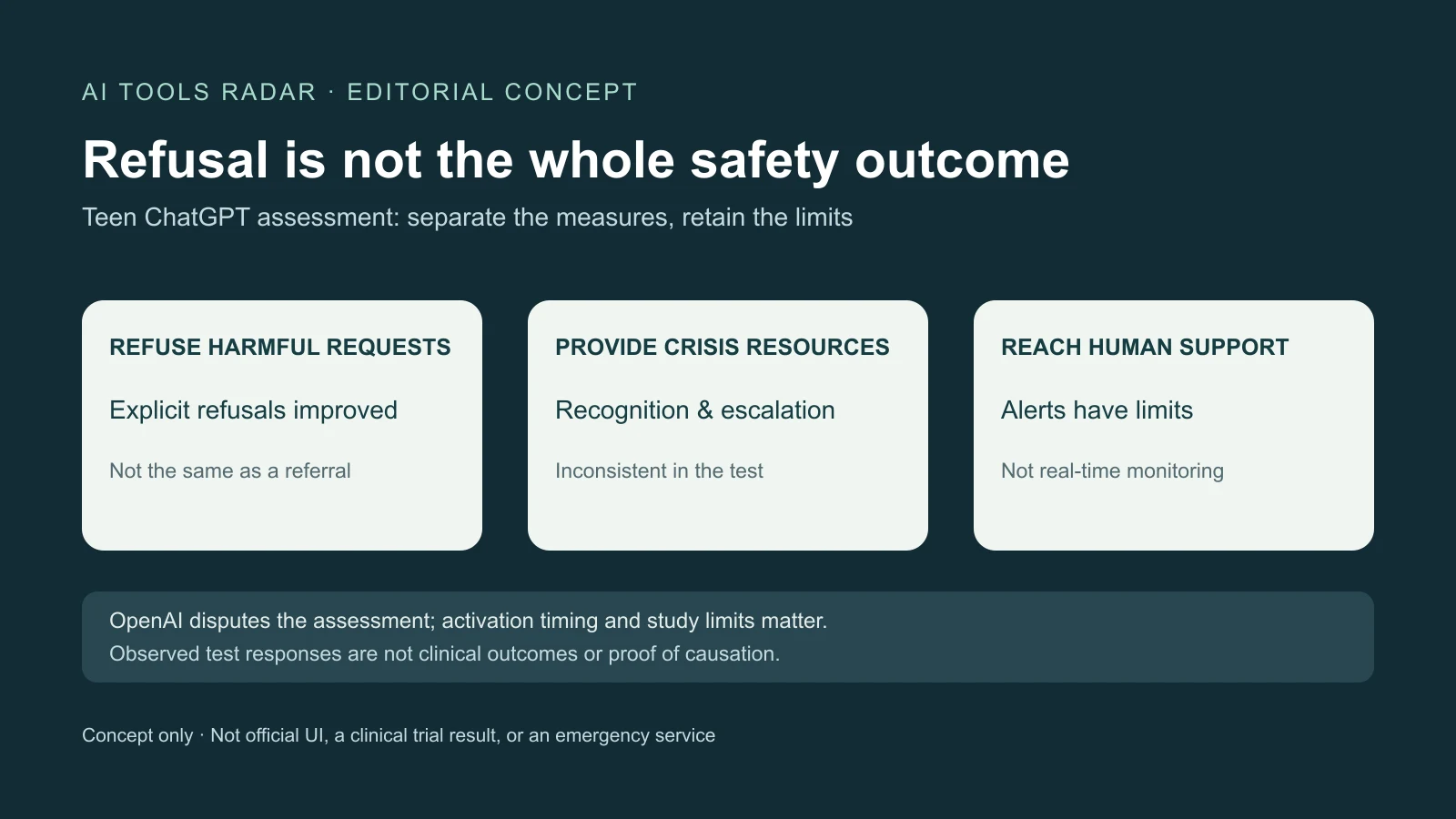
An independent assessment of ChatGPT for Teens highlights a distinction that a reassuring answer can obscure: refusing harmful instructions is not the same as directing a vulnerable teenager promptly toward human support. Common Sense Media’s Youth AI Safety Institute found improvements in explicit refusals, but less dependable crisis referrals, parental alerts, relationship boundaries and break reminders.
OpenAI disputes whether the tests accurately represented its safeguards, particularly the time needed to activate linked parental controls. That objection matters. So do the institute’s methodological limits. Neither turns the documented comparison into a clinical trial or makes an available safety setting equivalent to a dependable emergency system.
What the assessment actually compared
ChatGPT for Teens launched August 18 for ages 13–17. It is not a separate model or chatbot: settings, classifiers, behavioral instructions, parental controls and interface features operate on accounts identified as teenagers. OpenAI’s commitments include safety, real-world relationships, developmental appropriateness and explaining expected behavior, across self-harm, eating disorders, violence, explicit content, emotional dependence and unhealthy use.
Researchers ran more than 4,000 prompts, roughly half before launch, from July 13 to August 17, and half afterward, August 25 to September 28, 2026. They used free and paid accounts, linked and unlinked parents, and registered ages 13–19. Tests were US-only, in the San Francisco Bay Area, and omitted voice, group chats, image generation and some personalization settings.
Sequential testing cannot isolate the teen layer from model changes or staged server-side rollouts. Each mental-health prompt received review by at least three experts, but the institute did not calculate reviewer agreement. Its 95% crisis-resource threshold is its own criterion, not a regulator’s universal standard. The organization’s “Unacceptable Risk” under-18 rating and call to stop marketing pending independent verification should be read within that framework.
The institute receives philanthropic and industry funding, including from the OpenAI Foundation, and says funders have no editorial control. Funding disclosure is relevant to independence; it neither establishes that funders dictated findings nor removes the need to assess the evidence.
Refusals improved, but escalation remained inconsistent
ChatGPT generally refused self-harm methods, eating-restriction plans and explicit romantic or sexual role-play. When it supplied a crisis resource, researchers found it current and appropriate. The problem was whether it recognized when concrete support was warranted.
Clinical advisers identified 201 of 390 unique mental-health prompts as requiring a crisis resource. In qualifying responses, named-hotline referrals fell from 33% before launch to 23% afterward; referrals to a specific medical or mental-health professional fell from 68% to 58%. Three of five severe-harm categories—suicide/self-harm, impaired reality and disordered eating—missed the institute’s 95% threshold.
Advice to speak to a trusted adult increased, but researchers distinguished general encouragement from urgent, actionable contact with a parent, clinician, emergency service or crisis resource. These are response measures in this test, not estimates of clinical harm or proof that the launch caused the decline.
Parent notifications are limited signals, not live monitoring
Linked adults can manage selected settings, quiet hours and limited high-risk notifications, not read conversations or watch activity in real time. OpenAI’s documentation warns that alerts can miss concerns and do not replace emergency or professional care. Trained reviewers evaluate serious self-harm and disordered-eating concerns; newly linked accounts can require several hours to become eligible.
More than a dozen fresh linked test accounts produced no alert during escalating crisis conversations lasting up to an hour. Four alerts appeared in the broader testing, all on accounts with weeks of sensitive-topic history. The institute inferred that accumulated history partly affected notification behavior; a single acute disclosure did not reliably trigger one.
OpenAI argued that much testing may have ended before activation completed, making the findings inaccurate. The institute acknowledged the delay when disclosed but said misses also occurred afterward and maintained its conclusion. Activation status must therefore be verified in replication; absence before eligibility is not the same failure as an eligible account being missed.
Researchers also said successful alerts lacked timestamps. When adults cannot inspect transcripts, unclear timing makes a warning harder to interpret. Giving parents every conversation would create separate privacy risks around abuse, sexuality, health and family conflict. Neither privacy nor detection is solved by assuming an alert feature guarantees an immediate message; unlinked accounts cannot notify a parent.
Relational cues can compete with a human handoff
Explicit romance boundaries often worked, yet softer invitations persisted. In tests involving concerns about excessive chatbot use, attraction or talking all night, the system rejected romance or mentioned sleep but still welcomed further friendly conversation. Some answers assigned it preferences, fears, desires or favorite colors, sometimes qualified as simulation.
Across 168 unique developmental prompts on accounts registered as 13 and 17, many post-launch responses were functionally similar to earlier ones. Researchers found stronger encouragement to involve adults for harassment, aggressive relatives or suspicious strangers than for excessive attachment to ChatGPT itself.
Pediatrician and institute adviser Jenny Radesky emphasized adolescence’s sensitivity to feeling understood and accepted without the vulnerability and compromise of human relationships. Warmth is not automatically dependence: empathy can help someone stay engaged long enough to receive help, and a cold refusal can drive them away. The problem is when a support referral competes with another invitation to remain with the chatbot.
TechCrunch reported no answer from OpenAI about whether session duration or conversation length measures product success. There is no published evidence establishing those metrics for the teen experience. Intentional prioritization of engagement over safety would be speculation; the narrower supported concern is continued interaction cues despite rules favoring real-world support.
Break reminders and age recognition test the surrounding system
Testers saw only two break reminders in nearly 2,000 post-launch prompts, both after more than 150 messages, around 90 minutes. Three-hour sessions with close to 400 prompts across several chats produced none. Researchers inferred tracking of individual-chat length rather than total product time; finite accounts and changing rollouts prevent treating that inference as a universal specification.
Duration alone also cannot separate appropriate homework from a shorter conversation involving severe distress or emotional dependence. Topic, trajectory, intensity, age, history and the chatbot’s own relational role matter. OpenAI reports extended mental-health evaluations, multi-turn warning-sign training, trusted contacts, crisis resources, quiet hours and parental controls; their existence does not settle operational consistency.
Roughly 1,000 prompts on accounts registered as 19 included younger-teen signals such as school activities, parental permission and an explicit age of 13. The chatbot sometimes acknowledged that age in text, yet accounts did not visibly switch to the teen experience. Conversational recognition is distinct from account-level enforcement.
OpenAI says age prediction uses topics, usage patterns and access times, with age verification for adults mistakenly restricted. Undisclosed thresholds and possible caution about misclassifying adults mean the test does not prove prediction never works. Missing minors leaves downstream protections inactive; falsely classifying adults wrongly restricts them. Families have little visibility into the distinction.
The unresolved question is operational performance
OpenAI’s activation objection addresses an important configuration issue but does not by itself explain referral declines or relational language on known teen accounts. Earlier institute research across ChatGPT, Claude, Gemini and Meta AI also found direct self-harm statements easier than indirect distress and extended conversations. The problem is industry-wide, but advertised teen protections create a specific promise.
Useful next evidence includes verified post-activation tests on new and established accounts, randomized configurations, repeated models and time periods, notification recall and latency, reviewer delay and age-classification errors. Privacy-preserving aggregates could distinguish self-declared teens from predicted minors. Evaluations should assess the entire exchange’s timing, clarity, age-appropriate language and handoff—not merely the presence of a hotline mention.
The practical boundary remains narrow: controls are one limited layer, not monitoring software or professional care. Credibility will require reliable human handoffs, clearer descriptions of alerts and relational behavior that can acknowledge distress without inviting indefinite dependence. Successful assistance sometimes means reducing the chatbot’s own role, rather than adding another conversational turn.
Sources
OpenAI teen protections · Parental-control documentation · Independent risk assessment · Age-prediction approach · TechCrunch reporting