
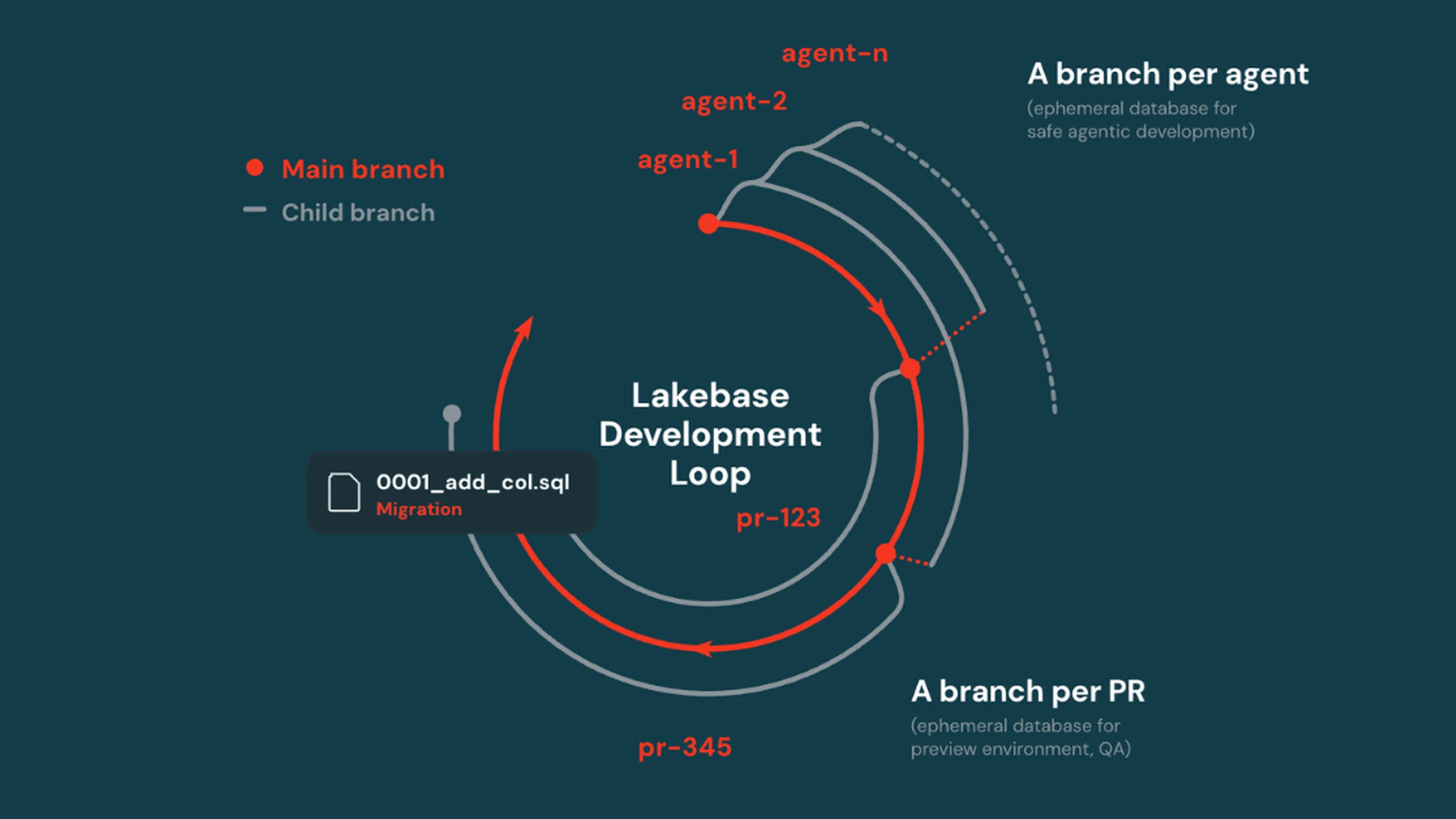
A coding agent can work in its own Git branch and still collide with every other task through one shared development database. A migration changes the schema, a test fixture is overwritten, and suddenly a failed test no longer has a clear cause. The practical boundary is not a repository checkout alone; it is code plus the state the code can change.
The illustration is an attributed Databricks workflow image. It provides event context, not a claim that every database product has identical branching behavior.
Databricks presents Lakebase branching as one answer: attach a disposable database branch to a coding task. Similar patterns exist in Postgres workflows such as Neon, while PlanetScale illustrates the separate discipline of reviewed schema promotion. The useful lesson is vendor-neutral: use isolated state to make experiments reproducible, then use reviewed migrations to decide what reaches production.
Start with a task identity
Create an environment only when it can be traced. Record the agent run, repository commit, pull request or ticket, parent database state, creation time, owner, allowed tools and an expiry. This turns a temporary branch into evidence rather than an anonymous copy. Two agents can be compared only when their starting state is known.
A branch should begin from the smallest suitable dataset. Schema-only, synthetic or masked data is usually safer than a production-derived copy. If realistic records are necessary for a defect investigation, limit access separately from branch creation. Permission to request an environment should not automatically grant permission to read every row in it.
Give each task least privilege
A database branch contains writes, not every side effect. An agent-connected application can still send mail, call a payment provider, invoke a webhook, write an object store or use a broad credential. Give the task a unique, short-lived connection identity; deny production targets; and redirect side-effecting integrations to test sinks. Network controls and secret scopes are part of the workspace, not optional extras.
Set an expiry when the branch is created. Cheap copy-on-write creation does not mean storage, compute, logs and indexes are free after a task diverges. Automatic cleanup should have documented exceptions for incidents, audits and legal retention. A branch that outlives its task is both a cost and a data-governance problem.
Treat the branch as an evaluation environment
Use the branch to run migrations, tests and investigations against a defined state. Capture test results, commands and the generated migration artifact with the task record. If multiple agents explore alternatives, give them the same parent snapshot so results are comparable. Resetting or deleting a failed environment should be safe because no accepted production action depends on it.
This is where database branching helps agentic development: it prevents one experiment from silently changing another experiment's conditions. It does not prove that the chosen implementation is correct. Published branch APIs and documentation describe lifecycle controls, but teams should benchmark their own branch depth, changed-data volume and concurrent compute rather than assume a product demonstration predicts their workload.
Promote instructions, not experimental state
Data does not merge like source code. Two plausible agent migrations can conflict in ordering, compatibility or rollout requirements. The production candidate should therefore be a reviewed migration file with tests, rollback considerations and a deployment plan—not a request to merge a branch's records into production. PlanetScale's deploy-review approach is a helpful reminder that isolation and promotion solve different problems.
Before approval, check backward compatibility with the currently deployed application, destructive operations, required indexes, data backfills and deployment order. Keep a human review point for permission changes and irreversible schema operations. A passing branch test is strong evidence, but it is not a replacement for operational judgment.
Measure the boundary, not branch count
A useful rollout begins with one bounded flow: one branch per pull request, masked data, short expiry and no outbound production access. Measure shared-environment contention, test reproducibility, cleanup success, review time and escaped migration defects. Do not use the number of agent-created databases as a success metric.
Databricks' Lakebase announcement makes the right problem visible: agents need a state boundary as much as a code boundary. The durable operating pattern is simple: identify the task, minimize data and privileges, expire the environment, record the evidence, and promote only reviewed instructions. That makes rapid experimentation easier without turning temporary database state into an ungoverned route to production.