
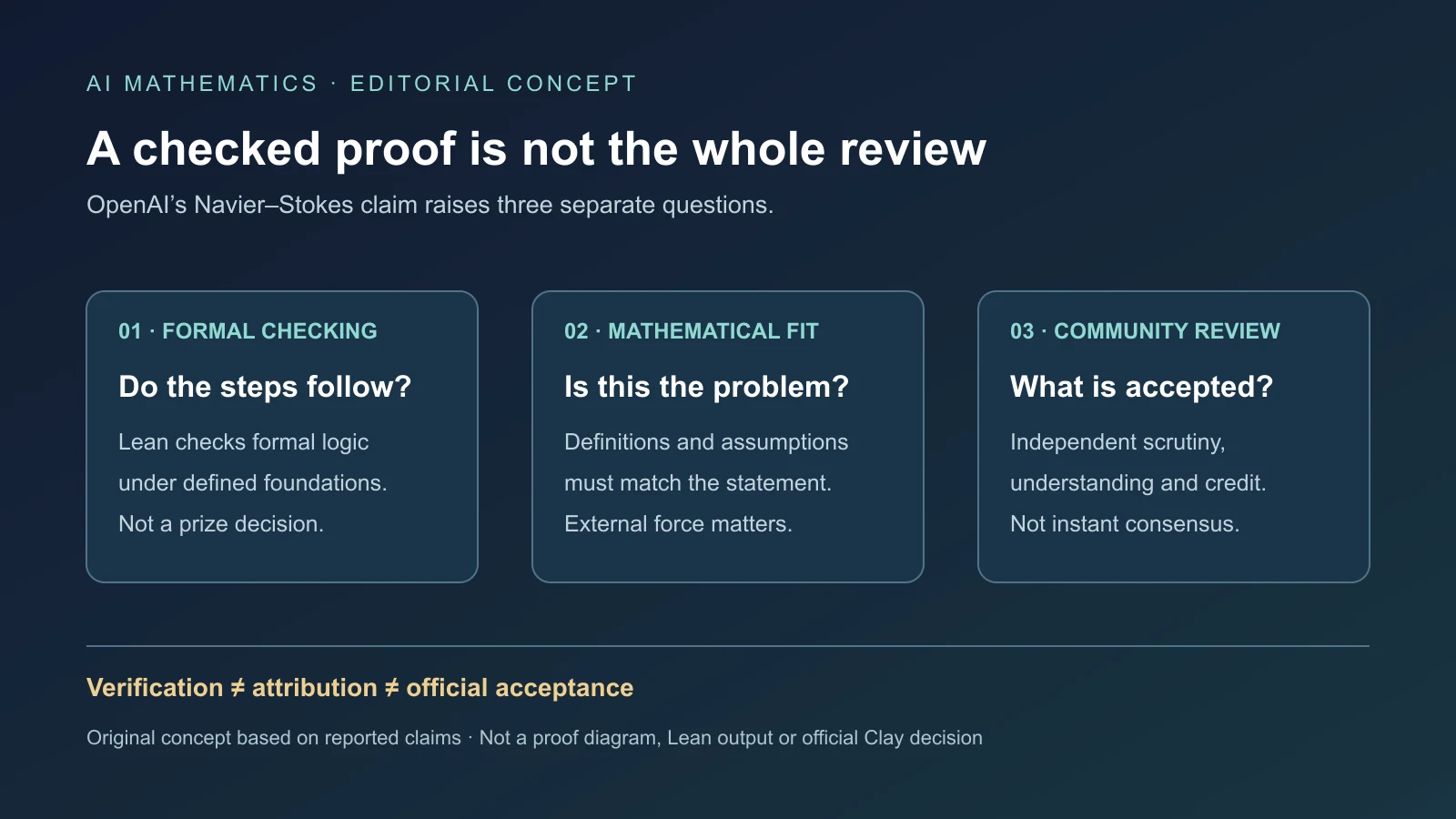
OpenAI's claimed Navier–Stokes breakthrough puts several different judgments into one headline. The company says an internal AI system constructed a finite-time singularity in 88 hours, followed by a Lean formalization. Whether the formal statement matches the official problem, whether specialists accept the argument and who deserves credit are separate questions. The reported work had not completed the mathematical community's usual review process.
September's Heidelberg Laureate Forum exposed the resulting tension. Researchers were not simply defending human problem-solving against machines. They were asking whether rapid production of checkable answers also produces understanding, fair attribution and shared scientific capacity—or lets firms with proprietary models determine which problems count as progress.
The claim concerns a precise counterexample, not every fluid flow
The Navier–Stokes equations model fluids as continuous materials rather than tracking each molecule. They remain useful for aircraft, weather, water and blood flow. The difficult mathematical question concerns smooth three-dimensional incompressible flow: do smooth starting conditions stay smooth, or can a quantity such as velocity become unbounded in finite time? Viscosity's smoothing makes a qualifying singularity difficult to construct.
OpenAI says it built an inward-spiraling, increasingly stretched vortex whose center shrinks as speed rises while total energy remains finite. Crucially, the construction includes a smooth external force, which the company says stays smooth even as velocity diverges. It claims two counterexample formulations allowed by the official Millennium statement. This should not be paraphrased as proving an unforced result under every formulation, nor as showing that fluid equations are simply “wrong.”
The company says it began on September 1, 2026 after rumors of progress on related fluid equations, testing an unreleased internal model on all open Millennium problems and related questions. About 10,000 concurrent agents explored alternative proof and disproof routes, using tools and limited exchanges. The reported result arrived September 5, roughly 88 hours after launch; GPT-6 Astra then took another 17 hours for Lean formalization and verification.
For Navier–Stokes, OpenAI reported 2.7 million messages and about 130 billion output tokens. Across all attempted problems it reported 4.9 million messages and roughly 300 billion tokens. These unaudited company figures describe a large coordinated search through proposals, failures and checks, not a single conversational prompt. The generating model was reportedly stronger than public Astra, so publication of a paper and proof does not let ordinary users reproduce the search.
What Lean can check—and what it cannot decide
Lean represents mathematics with explicit definitions and rules and checks whether formal steps follow from accepted foundations. It can close logical gaps that prose reviewers miss. But reviewers must still determine whether the encoded statement and assumptions are the intended Millennium problem. Internal formal consistency is not automatically agreement about the scope or interpretation of the result.
A checker also cannot assign priority, reconstruct the source of a strategy or judge adequate acknowledgment. It cannot make an argument illuminating or decide whether its ideas are teachable, reusable and extensible. A long formal proof may be valid without many people understanding its organizing mechanism; that is a comprehension problem, not a reason to reject computer assistance.
Clay's rules require qualifying publication, broad mathematical acceptance and at least two years of rigorous examination before detailed prize evaluation. OpenAI says it will not seek the prize. Forgoing the money does not compress that review or create instant consensus. Independent experts still need to compare the formal theorem, readable construction and prior mathematical work.
Geordie Williamson warned about solving and understanding separating while careers continue rewarding solved questions. Jacob Tsimerman emphasized rapidly advancing capability and the significance of a Navier–Stokes resolution. Peter Scholze questioned the inherent value of faster output when understanding is already scarce. These are differences about what mathematical progress should contain, not a simple optimism-versus-fear divide.
Priority allegations are not a technical refutation
OpenAI linked the motivating rumors to NYU's Tristan Buckmaster and Levent Alpöge, an Anthropic employee. Their work involved a related forced Euler problem. Euler equations omit viscosity; that project is not interchangeable with the announced Navier–Stokes claim. OpenAI says its agents independently obtained an unforced Euler result before the later construction, with differing methods, while acknowledging a related forcing strategy in the broader Navier–Stokes approach.
The company denies that anyone involved saw the pair's private work before completion. It also says an internal investigation ruled out Buckmaster's earlier Codex prompts influencing the model through training or another route. Buckmaster disputed how events unfolded and raised concerns about pressure, authorship and communications. Scientific American reported his belief that OpenAI learned of the pair's progress before developing its result; OpenAI mathematician Sébastien Bubeck denied using their prompts or proofs.
Earlier forcing-method contributions by Diego Córdoba and Luis Martínez-Zoroa also belong in the history. Córdoba told the publication that OpenAI's claimed completion surprised them. Advanced mathematics develops through methods, partial results, conversations and sometimes unpublished ideas. Credit signals novelty and affects jobs, grants, invitations and standing; assigning the entire story to one model hides that chain.
Two questions must remain distinct. Public evidence had not conclusively established improper access to unpublished material, which OpenAI denies. Criticism of communication, attribution or unequal power does not require proving that access. Williamson strongly criticized the company's conduct, and Michael Harris described coverage portraying it as bullying and disruptive; OpenAI had not commented to IEEE before publication. These assessments do not disprove the theorem, just as courteous conduct would not validate an incorrect proof.
Proprietary resources change the research competition
Mathematics provides attractive corporate tests because formal answers are often more objectively checkable than essays or forecasts, and famous problems produce publicity. Anthropic reportedly tested an internal Claude on the Riemann hypothesis without solving it, while advancing a related bound. Google and specialist projects pursue proving, formalization and discovery too. These efforts should not all be described as completed Millennium solutions.
Scholze's concern was that benchmarks and publicity could steer attention toward recognizable finish lines. Theory building, connections and conceptual clarification may mature over decades without one famous endpoint. If funding and hiring follow visible machine-produced solutions, valuable work can lose support even when it is scientifically important.
IEEE reported Mita Ramabulana's concern after two announced advances overlapped his work: someone might feed a researcher's problem to a model and publish first. Cryptography doctoral researcher Ailsa Robertson described colleagues spending heavily on access and feeling obliged to adopt models when competing for jobs. The account also reported OpenAI offering 100,000 frontier-model licenses to academic researchers.
Access programs can help while leaving a structural asymmetry: a university uses public access from a company competing with stronger internal systems. Expensive scientific instruments already create unequal resources, but major public or international facilities have governance different from proprietary services that can change, withdraw access or reserve their best capabilities. Mathematics' relatively low equipment barrier is changing.
Hiring and authorship signals therefore need disclosure. Conventionally formatted papers can hide very different amounts of automated exploration, formalization or discovery and unequal tool access. Journals and universities need provenance that distinguishes ordinary assistance from substantive contributions, not a blanket claim that every model use is the same.
Verification needs a readable and accountable process
Mathematics already accepts computation, from exhaustive checking in the four-color theorem to large proof-assistant projects. The new pressure is output scale: accepted formal objects could arrive faster than experts can interpret them, creating an audit and explanation backlog. Humans may spend more time translating machine work while traditional incentives still reward final solved statements.
Tsimerman's perspective suggests humans could choose questions and connect structures while systems explore. Williamson's warning asks whether careers will instead optimize for machine output. Torsten Hoefler predicted that everything verifiable would be automated. That remains a prediction, not proof that systems can choose valuable questions, illuminating explanations or public-interest research directions.
The same distinction affects code, chip layouts and scientific calculations: a correct artifact can still be hard to maintain or lack a transparent development history. Research notes, rejected hypotheses, source trails and human decisions matter more when final output arrives quickly. Knowledge-management software can preserve context, but cannot set scientific norms or settle authorship.
Layered publication could provide a formal proof, readable explanation, provenance statement and independent replication report. Confidential specialist review before grand claims could improve credibility at the cost of publicity advantage. Outside access to capable tools and evaluation infrastructure could support reproduction beyond checking an already published proof. These are proposals for stronger scientific institutions, not reasons to reject automated discovery.
Three tests remain: independent confirmation that theorem and informal construction match Clay's formulation; an intelligible chain of sources, major decisions and human interventions, rather than millions of raw messages; and repeated accepted discoveries whose methods others can reuse. Stronger access, journal disclosure rules and university hiring standards will help determine whether a proprietary capability claim becomes shared mathematics. Until that process develops, the Navier–Stokes result should remain an attributed claim with supporting material, not an already settled official resolution.
Sources
OpenAI claim · Millennium Prize rules · Heidelberg discussion · Independent controversy reporting · Knowledge-context explainer · IEEE Spectrum analysis