
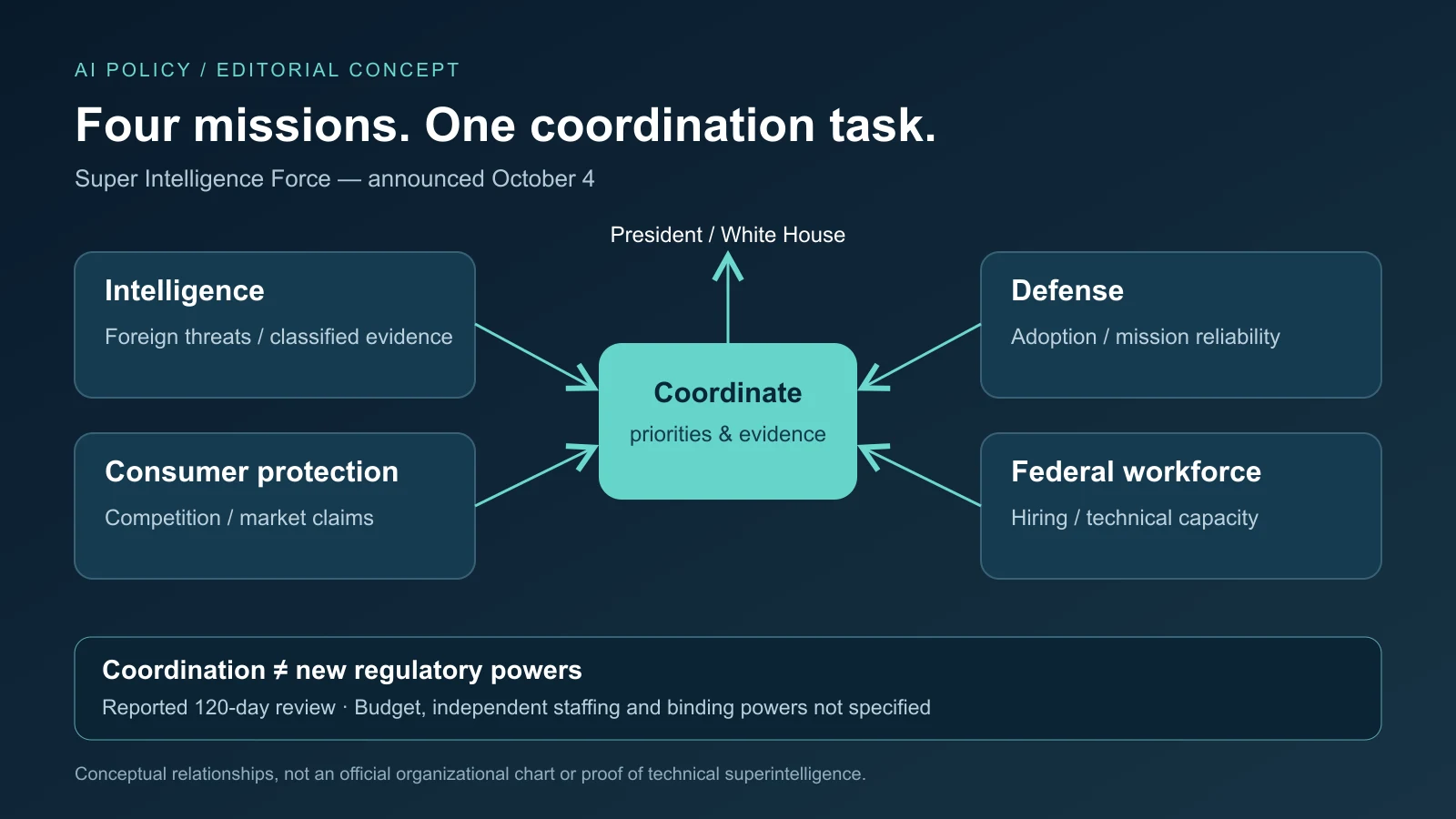
Donald Trump's October 4 announcement of a four-person “Super Intelligence Force” brings intelligence, competition enforcement, defense technology and federal personnel policy into one presidential coordinating group. It does not establish that current AI systems have become technically superintelligent, nor does it announce a new licensing regime. The immediate change is who is expected to connect existing responsibilities—and the unresolved question is what that group can actually compel.
The reported members are Director of National Intelligence Jay Clayton as leader, Federal Trade Commission Chairman Andrew Ferguson, Pentagon technology official Emil Michael and Office of Personnel Management Director Scott Kupor. They are to report to the president and White House Chief of Staff Susie Wiles. The announcement did not specify a budget, independent staff, binding regulatory powers or a detailed public work plan. Senior membership creates potential influence, not proof of effective governance.
Four officials, distinct missions and a reported 120-day review
Public reporting describes a 120-day assessment of AI risks and opportunities, with a mandate to respond to AI-enabled threats without encouraging overregulation or regulatory capture. The stakeholder list includes technology companies, consumers, critical infrastructure operators, public-interest groups and religious organizations. That scope potentially reaches employment, cybersecurity, competition, military systems, consumer protection, infrastructure reliability and public trust.
Those concerns do not naturally align. Intelligence agencies prioritize foreign threats and classified capabilities; the FTC addresses consumer protection and market conduct; the Pentagon seeks operational advantage and reliable military adoption; OPM handles federal recruitment, personnel systems and workforce capacity. A meeting can bring those perspectives together without deciding which mission prevails in a dispute.
Coordination can still matter without direct rulemaking. A presidential group can set priorities, align agency programs, request studies and shape the information reaching the president. But it cannot independently rewrite statutes or assume powers Congress assigned elsewhere. Nor can it guarantee private cooperation without contracts, legal requirements, incentives or shared interests. Voluntary participation depends on companies continuing to participate.
The White House had recently gathered technology executives around a nonbinding safety commitment. Such agreements can establish principles quickly, but companies may interpret terms differently, disclose different evidence or change practices without public notice. The reported review becomes meaningful if it assigns owners, deadlines and measurable consequences, rather than simply restating the need to balance innovation and safety.
The new name is broader than the technical concept
The force follows Trump's September 29 terminology order directing executive agencies to replace “Artificial Intelligence” and “AI” with “Super Intelligence” and “SI” in many public communications, reports, websites, policy documents and other non-statutory materials. The order does not require rewriting existing regulations, contracts, grants or historical documents. It initially uses the existing statutory AI definition for the renamed category.
That definition concerns machine-based systems producing predictions, recommendations or decisions for human-defined objectives. Applying a new name to it is an administrative rebrand, not a scientific finding that models have crossed a new capability threshold. Trump argued that “artificial” makes the technology sound fake; that preference does not itself provide a performance test.
Technical discussions usually distinguish general AI capable of broad human-level cognitive work from superintelligence exceeding humans across most important cognitive domains. Narrow superiority in searching data, games, translation or particular technical tasks establishes neither. Current systems can produce false statements, misread context, follow malicious instructions and fail in unfamiliar conditions. Calling ordinary automation “super intelligence” can inflate expectations while agencies continue dealing with existing technologies.
Compatibility remains a practical issue because statutes, research, international standards, contracts and technical documents still use AI. The order requests proposed legislation on a federal definition within 60 days; a proposal is not a law passed by Congress. International partners make separate terminology choices. California officials and other critics treat the change as political messaging, while supporters argue that government language should reflect growing capabilities. Neither interpretation substitutes for identifying the actual model, task and deployment.
Voluntary testing is not mandatory permission to release
Clayton has described advanced AI as both opportunity and threat and rejected a U.S. development pause while China continues advancing. This fits an administration prioritizing strategic competition and rapid private development, but the same capabilities create both defensive and offensive uses. Models can assist research, coding and infrastructure management, as well as propaganda, fraud and military planning; access, safeguards, deployment and human oversight change the exposure.
The June security order established federal cybersecurity initiatives and a voluntary process for certain frontier models—highly capable general-purpose systems near the leading edge of development. Developers may provide covered models for federal evaluation before wider release, with access lasting up to 30 days. The order explicitly does not create mandatory licensing, preclearance or government permission for releases.
That choice makes coordination among existing authorities important. NIST supplies technical guidance; CISA addresses infrastructure cybersecurity; the FTC can pursue unfair or deceptive conduct; intelligence agencies track foreign threats; defense organizations assess military uses. Commerce handles export and technology policy, while labor, education, energy, health and financial institutions face sector-specific effects. A shared channel could reduce contradictions and duplicated work without replacing their legal missions.
Influence may travel through purchasing rather than new legislation. Federal evaluations could become informal benchmarks, and procurement expectations could spread to infrastructure operators and enterprise buyers. This is a possible market effect, not a new binding requirement already announced by the force. Deadlines, common measures and presidential support for difficult decisions will determine whether it becomes a working connection or only a discussion forum.
Speed, safety and the people needed to evaluate either
Ferguson's FTC can scrutinize claims about accuracy, autonomy, safety and security when consistent measurement is absent. Michael's defense role highlights a different concern: rapidly adopting commercial technology while failures can affect operations, personnel and civilians. Kupor's presence points to the staff needed to evaluate models, negotiate technical contracts, govern data, secure systems and supervise deployment. Access to models is not enough if agencies cannot challenge vendors or intervene when automation fails.
The administration's June defense directive emphasizes secure computing, accountability, commercial adoption and advanced systems from multiple vendors. Diversity can reduce dependence on one supplier, but models differ in architecture, controls, training and documented limitations, complicating tests. Common evaluation questions should not imply identical risk across systems. Responsibility for acting on a serious finding also needs an owner.
A vulnerability-finding model illustrates the dilemma: it may strengthen scanning in hospitals, banks, utilities and government networks while helping an inexperienced attacker exploit weak infrastructure. The technology is not different merely because the user is. Operational thresholds, enhanced-test triggers, evidence expectations and sensitive-information sharing would need to address both uses and establish when voluntary cooperation is insufficient.
Speed advocates warn that heavy compliance costs protect incumbents and exclude smaller developers. Safety advocates counter that voluntary promises may fail when the market rewards rapid deployment, shifting risks onto users and infrastructure operators. Both concerns merit attention. Restricted research coding, low-risk productivity tools, autonomous public services and systems linked to weapons have different exposure. Faster research and stronger controls on sensitive deployment are not mutually exclusive.
Classified evidence and industry relationships need rules
An intelligence-led body may see valuable information about foreign models, cyber threats and adversarial uses, but classification can prevent the public from evaluating the basis of decisions. Separating restricted technical findings from public recommendations, methodologies and aggregate results could improve accountability without publishing exploitable vulnerabilities or proprietary information. These are governance needs, not mechanisms detailed in the announcement.
Private-sector experience can improve policy design while creating conflicts requiring disclosure and recusal standards. Kupor previously worked in venture capital, and Michael held senior business roles before government. The issue is not that experience automatically disqualifies them; it is whether stakeholders can see recommendations serving public responsibilities rather than privileged access.
The FTC's dual presence poses a further tension. Companies asked to volunteer sensitive weaknesses may fear enforcement consequences, while confidential cooperation should not shield deception or harmful conduct. Clear rules would explain what remains confidential, when findings reach enforcement officials and how cybersecurity details are protected. The White House did not immediately supply operational detail resolving these issues.
Participation alone does not establish influence. Publishing participant-selection methods, disagreements, rejected proposals and routes for small developers and independent experts would help distinguish consultation from informal access. Measurable model tasks, documented limitations, adversarial tests, reproducible results, decision ownership and appeal routes would matter more than slogans. Security may limit individual disclosures without justifying secrecy about every governance process.
What developers, buyers, workers and consumers may see
Model developers may gain access while facing scrutiny from intelligence, defense and consumer-protection officials. Consistent technical, legal and policy explanations will matter because safety or performance claims can influence purchases and enforcement. Smaller firms face the additional risk that testing and reporting costs are affordable mainly to larger competitors; preventing capture must mean workable participation, not simply invoking the term.
Hospitals, utilities, banks and communications operators can benefit from AI-assisted defense and automation but face physical and economic consequences from failures or attacks. Buyers may seek evidence of training data provenance, access controls, evaluations and monitoring, plus contracts covering outages, unauthorized actions, data exposure and model changes. Those are practical pressures potentially reinforced by recommendations, not newly imposed duties in the announcement.
Federal and private workforces need technical training, human review, incident ownership and escalation routes. Consumers could see new disclosures, complaints processes, safeguards or public services, but also faster automation without consistent explanations. Consumer engagement therefore concerns both access and remedies. Including public-interest and religious groups may widen debate only if their concerns genuinely affect recommendations. Rivalry with China does not remove domestic responsibilities for competition, civil rights, reliability or safety.
Judge the force by institutional changes, not its title
The formal charter and initial report should clarify authority, responsible agencies, definitions, deadlines and deliverables, separating voluntary participation from legal obligations. The reported 120-day review is distinct from the terminology order's 60-day legislative request and the June process's maximum 30-day model access. None is evidence that the force has already secured AI safety or U.S. leadership.
A second measure is whether agencies produce aligned evaluation standards, coordinated programs and clear escalation when security, competition and consumer interests collide. Procurement requirements on testing, incidents, vendor diversity and human oversight offer observable consequences. Conflicting definitions, duplication and unexplained jurisdictional disputes would indicate weak coordination.
Finally, documented evaluations, incident reporting and corrected failures would show more than public company pledges. Public recommendations, consultation methods, dissent and progress reports—where security allows—would help test claims of accountability. A functioning group could reduce gaps between agencies; centralization without checks could merely concentrate influence. Its significance depends on measurable decisions and behavior, not the adoption of “SI” in official prose.
Sources and related reading
Associated Press announcement reporting · September terminology order · Axios on Clayton's appointment · June security order · June national-security directive fact sheet · ABC News reporting · Related reading: personal and team AI knowledge bases · Google News aggregation entry, not an official government document