
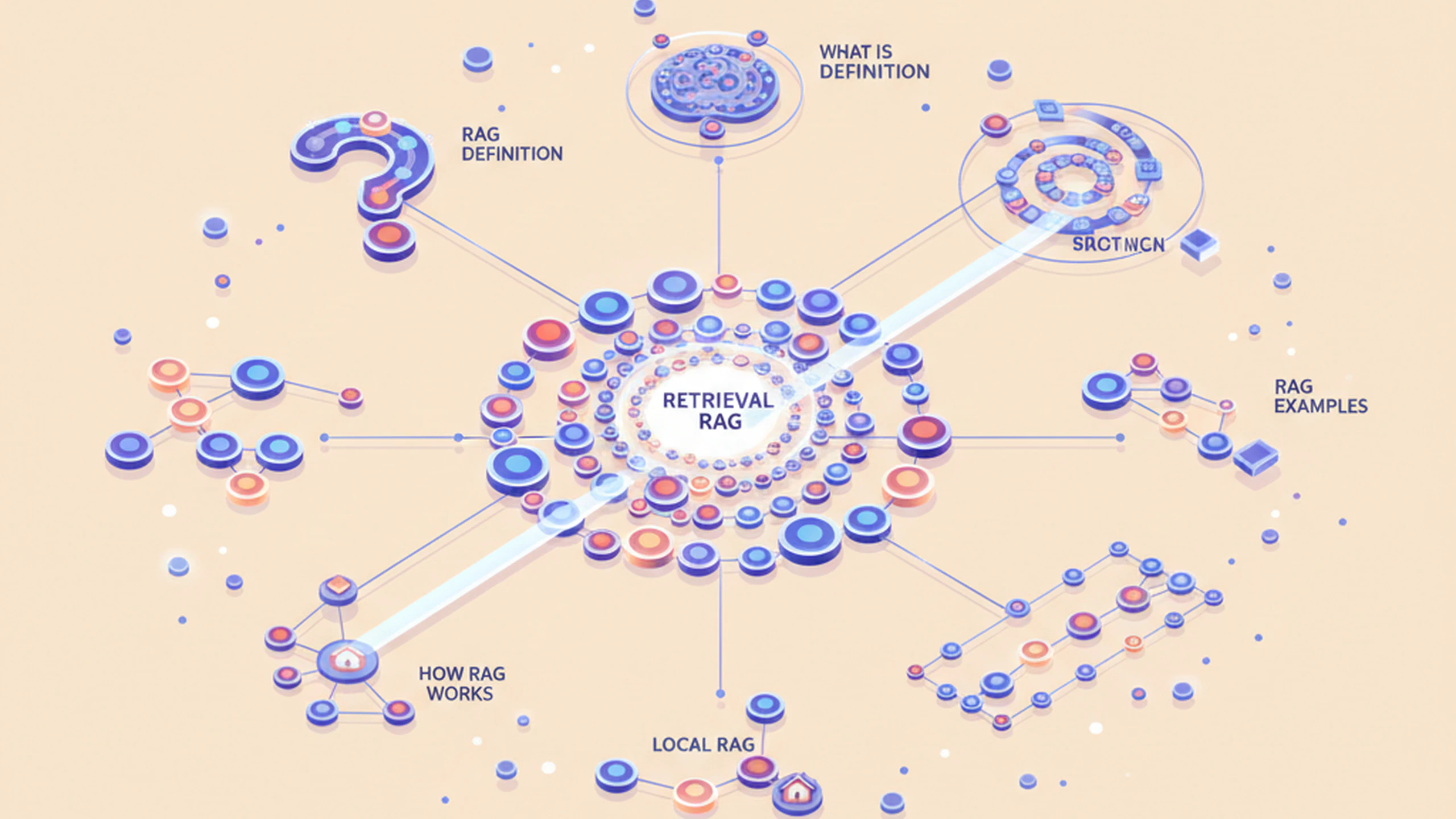
What Is RAG? Retrieval-Augmented Generation Explained is easier to use when the concept is connected to a real decision rather than treated as another AI buzzword. This AI Tools Radar guide focuses on the working idea, the tradeoffs that matter, and the questions worth asking before you adopt a tool or workflow.

Retrieval-Augmented Generation (RAG) is an AI technique that retrieves relevant documents from a knowledge base before generating a response, grounding answers in real sources rather than model memory. Instead of relying on patterns baked into model weights, RAG pulls actual text and uses it as evidence when composing a reply. The result is an AI that can answer questions about documents it has never seen during training, with citations it can point to.

Large language models have a fundamental blind spot: they cannot distinguish between what they genuinely know and what they are confidently fabricating. A 2024 MIT Technology Review investigation found that hallucinations stem from AI hallucination causes rooted in how models learn statistical patterns rather than facts, and the problem intensifies when a model is queried about recent events, proprietary data, or niche domains outside its training distribution. Retrieval-augmented generation emerged as a direct response to this structural flaw. By anchoring generation to retrieved source text, RAG shifts the failure mode from confident confabulation to honest "document not found."

• How RAG works in one sentence: RAG retrieves relevant document chunks at query time, then feeds them to a language model to generate a grounded, source-backed answer. • RAG vs. fine-tuning: Fine-tuning bakes knowledge into model weights permanently; RAG retrieves knowledge dynamically at query time. They solve different problems, and knowledge-heavy tasks almost always call for retrieval augmented generation. • When RAG is the right choice: Use RAG when your knowledge base changes frequently, when answers must be auditable, or when you work with private documents that cannot enter training data. • What local RAG means: Local RAG runs the retrieval pipeline entirely on-device, so documents never leave your machine. This matters for personal notes, medical records, legal files, and any context you would not upload to a cloud service.

What Retrieval-Augmented Generation Actually Does.

Retrieval-augmented generation is a two-phase architecture: a retrieval phase that finds the most relevant passages in a knowledge base, and a generation phase that uses those passages as grounded context. The language model never operates from memory alone; it operates from evidence. This separation is what makes RAG fundamentally different from a standard chatbot, which draws only on patterns learned during training. It also means the knowledge accessible to the model is not fixed at training time; it can be updated continuously by changing the document store.

This architecture delivers three distinct capabilities that neither retrieval nor generation can produce independently.

• Grounding: Every answer traces back to a specific passage in the knowledge base. The model cannot invent a fact that no source supports, because the prompt itself contains only retrieved text. Grounding is the mechanism that makes RAG reliable for factual questions. • Dynamic Knowledge: The knowledge base is a separate storage layer, not model weights. Updating it means adding or editing documents, not retraining a model. A legal team can add a new regulation this morning and have it instantly accessible this afternoon, with no engineering work required. • Source Traceability: Because the retrieved chunks enter the prompt explicitly, the system knows which document produced each answer. This makes retrieval-augmented generation suitable for audited environments: compliance teams, medical records, customer support, and anywhere an answer must be accompanied by a citation.

The Three-Step Pipeline: How RAG Produces an Answer.

The original retrieval-augmented generation architecture, introduced by Lewis et al. in their 2020 paper at NeurIPS, established the three-stage pipeline that most implementations still follow today. Each stage has a distinct role, and a failure at any stage degrades the final answer quality. Understanding how each step works helps clarify where retrieval-augmented generation succeeds and where it can still fall short. It also reveals which part of the pipeline to improve when a system produces poor answers.

Step 1: Chunking and Indexing, Preparing the Knowledge Base.

Before any query arrives, documents must be prepared for retrieval. A document ingestion process splits raw text into chunks, typically 200 to 500 tokens each, chosen to preserve semantic coherence while staying small enough to fit multiple chunks into a single prompt. Each chunk is then converted into a vector embedding, a high-dimensional numerical representation of its meaning, and stored in a vector database alongside the original text.

This pre-processing step happens offline, before any user ever asks a question. The result is a searchable index where every chunk can be retrieved by semantic similarity rather than exact keyword match. The quality of chunking directly affects retrieval precision; poorly split documents produce chunks that mix unrelated topics and return noisy, irrelevant matches at query time.

When a user submits a query, the system converts that query into a vector embedding using the same embedding model applied during indexing. It then computes similarity scores between the query vector and every chunk vector in the index, returning the top-k most semantically similar chunks to pass forward.

Think of it like a librarian who listens to your question, walks into the stacks, and returns with the five most relevant books rather than reciting the entire collection from memory. The retrieval step does not require keyword overlap; it matches meaning. A query about "why my contract renewal was rejected" can surface a passage about "agreement termination clauses" even without a single shared word between them.

Step 3: Augmented Generation, Answering With Evidence.

The retrieved chunks and the original query are concatenated into an augmented prompt: the model sees the evidence and the question together. The language model then generates a response using that combined input, constrained by the source text rather than free to invent from training memory alone.

One limitation deserves direct acknowledgment: the quality of the generated answer depends entirely on retrieval quality. If the relevant document was never indexed, or if chunking fragmented a key passage, the model may still produce an inaccurate answer, because the retrieved chunks simply do not contain what is needed. Retrieval-augmented generation reduces hallucinations sharply for questions within the knowledge base, but it does not eliminate errors for questions the knowledge base cannot answer.

RAG retrieves knowledge at query time; fine-tuning bakes knowledge into model weights. These are not competing approaches to the same task; they solve fundamentally different problems, and choosing between them requires understanding what type of problem you actually have.

Knowledge Freshness • RAG: Update the knowledge base by adding or editing documents. Changes are available immediately, with no model modification required. • Fine-tuning: New knowledge requires a new training run, which can take hours to days depending on dataset size and hardware.

Cost • RAG: Costs are dominated by storage and retrieval infrastructure. Vector databases are inexpensive at most scales, and no GPU compute is required after indexing. • Fine-tuning: Requires substantial GPU training compute. A 2024 arXiv analysis found that LLM fine-tuning costs for a 7B-parameter model can reach $1,000 to $12,000 per run, scaling steeply with model size.

Transparency • RAG: The source of every answer is explicit in the prompt. You can log which documents produced which responses and trace any error back to a specific chunk. • Fine-tuning: Knowledge is distributed across billions of model weights. There is no mechanism to audit which training example influenced a specific output.

Best For • RAG: Dynamic, private, or verifiable knowledge; frequently changing information; compliance-sensitive environments; personal document libraries. • Fine-tuning: Adapting a model's output style, tone, or format to a fixed domain; tasks where behavioral consistency matters more than factual freshness.

For personal knowledge bases, enterprise document repositories, and real-time information retrieval, retrieval augmented generation is almost always the correct architecture. Fine-tuning a model to memorize your meeting notes would be slower, far more expensive, and impossible to update without retraining from scratch. When the knowledge changes frequently, retrieval-augmented generation is the only approach that keeps pace without recurring engineering costs.

A vector database stores embeddings and supports similarity search. RAG is a full architecture that uses a vector database as one component among several. Conflating the two is one of the most common misunderstandings among developers new to this space, and the confusion has practical consequences for anyone trying to build a working system.

The distinction is concrete. A vector database answers the question "which chunks are most similar to this query?" Retrieval-augmented generation uses that answer as an intermediate step, then routes the retrieved chunks to a language model that synthesizes a natural-language response. Having a vector database gives you retrieval capacity; having RAG gives you a complete question-answering pipeline built on top of that retrieval layer.

A useful analogy: a vector database is the library's stacks and catalog system. RAG is the full library service, including the librarian who finds the books, reads the relevant sections, and explains the answer in plain language. You can build and query a vector database without ever generating text. You cannot run a RAG system without a retrieval layer, but retrieval alone is not RAG.

The practical implication: if a product claims to "use vector search" or "embed your documents," ask whether it also generates answers from retrieved context. Vector search returns a list of relevant passages; a retrieval-augmented generation system takes those passages and composes a direct response. The two are related, but they operate at different levels of abstraction, and one does not imply the other.

Common Questions About Retrieval-Augmented Generation.

A: Semantic search finds the documents most similar to your query and surfaces them for you to read. RAG goes one step further: it takes those documents and synthesizes a direct, natural-language answer from them. Semantic search returns evidence; retrieval-augmented generation interprets it and composes a response.

A: No. Retrieval-augmented generation retrieves knowledge at query time and passes it to the language model as prompt context. The model weights are never modified. A standard pretrained base model works as the generation layer, which is one reason RAG is faster and cheaper to deploy than fine-tuning for most use cases.

Q: Is my data secure when using a RAG-based tool?

A: It depends entirely on deployment architecture. Local RAG keeps all documents and embeddings on-device; nothing reaches external servers. Cloud RAG sends your documents to a hosted service to generate embeddings and run retrieval. The privacy implications differ substantially, and the difference matters for sensitive personal or professional data. When evaluating any RAG-based product, ask explicitly where the embeddings are stored and which party controls them.

Q: How is RAG different from pasting documents into a chat?

A: Pasting documents into a chat window runs into two hard limits: context window size and data exposure. Even large context windows hold perhaps 75,000 words, and the entire document goes to the model provider's servers. RAG retrieves only the relevant chunks at query time, scales to knowledge bases of any size, and, in local deployments, keeps source material completely private. For anything beyond a handful of pages, retrieval-augmented generation is the only architecture that remains practical.

SEO Metadata. Title: What Is RAG? Retrieval-Augmented Generation Explained Meta Description: RAG combines document retrieval with AI generation for grounded answers. Learn how retrieval-augmented generation works and when to use it. Primary Keyword: retrieval augmented generation Featured Snippet Target: what is rag LSI Keywords: what is rag, rag definition, local rag, rag examples, how rag works Difficulty Level: intermediate Reading Time: 9 min read Word Count: 2117

External References Used. 1. "hallucinations stem from how models learn statistical patterns, not facts" -- MIT Technology Review, https://www.technologyreview.com/2024/06/18/1093440/what-causes-ai-hallucinate-chatbots/ 2. "Retrieval-Augmented Generation for Knowledge-Intensive NLP Tasks" -- Lewis et al. 2020, NeurIPS, https://arxiv.org/abs/2005.11401 3. "full fine-tuning a 7B-parameter model can cost between $1,000 and $12,000 per run" -- Understanding the Performance and Estimating the Cost of LLM Fine-Tuning, arXiv 2024, https://arxiv.org/abs/2408.04693

Suggested URL Slug. /blog/what-is-retrieval-augmented-generation

The practical test is whether this approach improves a repeatable piece of work without hiding its sources, costs, or failure modes. Start with a representative task, keep a human checkpoint where mistakes matter, and reassess the result as models and products change.

Editorial method

AI Tools Radar separates product facts, editorial judgment, and commercial placement. Updated facts retain their verification date.

Sources

Browse the directory