
Original document
GPT Image 2 · en
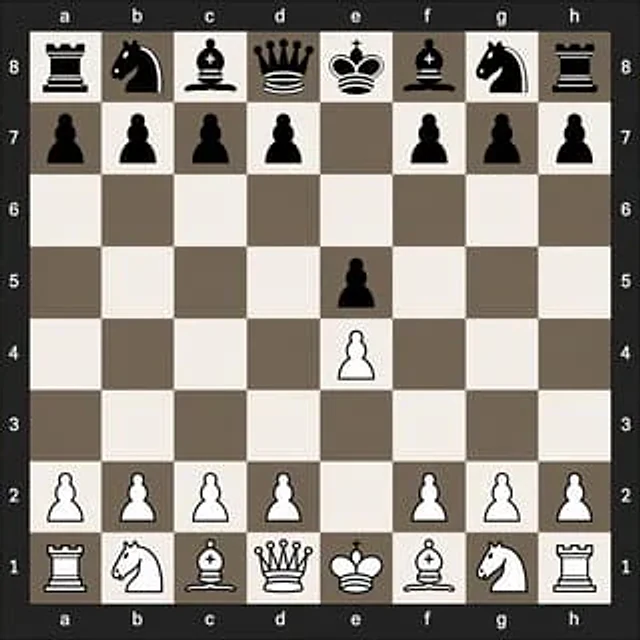
A clear, flat, numerically-oriented chessboard is centered in the image. The chessboard is an 8x8 grid, with algebraic coordinates displayed around its edges: letters a through h at the top and bottom, and numbers 8 through 1 on the left and right. A dark charcoal gray is used for the outer background and border, while the chessboard squares alternate between light beige and soft gray-brown. The rendered graphics are simple, high-contrast 2D chess icons, with black pieces at the top and white pieces at the bottom, exhibiting a clean vector style, devoid of wood grain textures, realistic lighting, and superfluous interface elements. Demonstration 1. The precise positions after the opening moves e4 e5: Black's major pieces are located at a8 (rook), b8 (knight), c8 (bishop), d8 (queen), e8 (king), f8 (bishop), g8 (knight), and h8 (rook); Black's pawns are located at a7, b7, c7, d7, f7, g7, h7, and e5; White's pawns are located at a2, b2, c2, d2, f2, g2, h2, and e4; White's major pieces are located at a1 (rook), b1 (knight), c1 (bishop), d1 (queen), e1 (king), f1 (bishop), g1 (knight), and h1 (rook). The remaining squares are left empty. Maintaining absolute symmetry, this diagram is educational and easily recognizable, similar to a numerical chess diagram used to illustrate opening moves.How to use
- Copy the complete original prompt, including any parameters.
- Replace the subject, text and composition with your own requirements.
- Use a compatible external tool; check its current access conditions and review the result.
Before you start
- Check whether a reference image is required. A compatible model label does not mean this example was generated with that model.
- Keep names, figures and visible text accurate; results can vary between model versions.