Original document
GPT Image 2 · en
Scene:
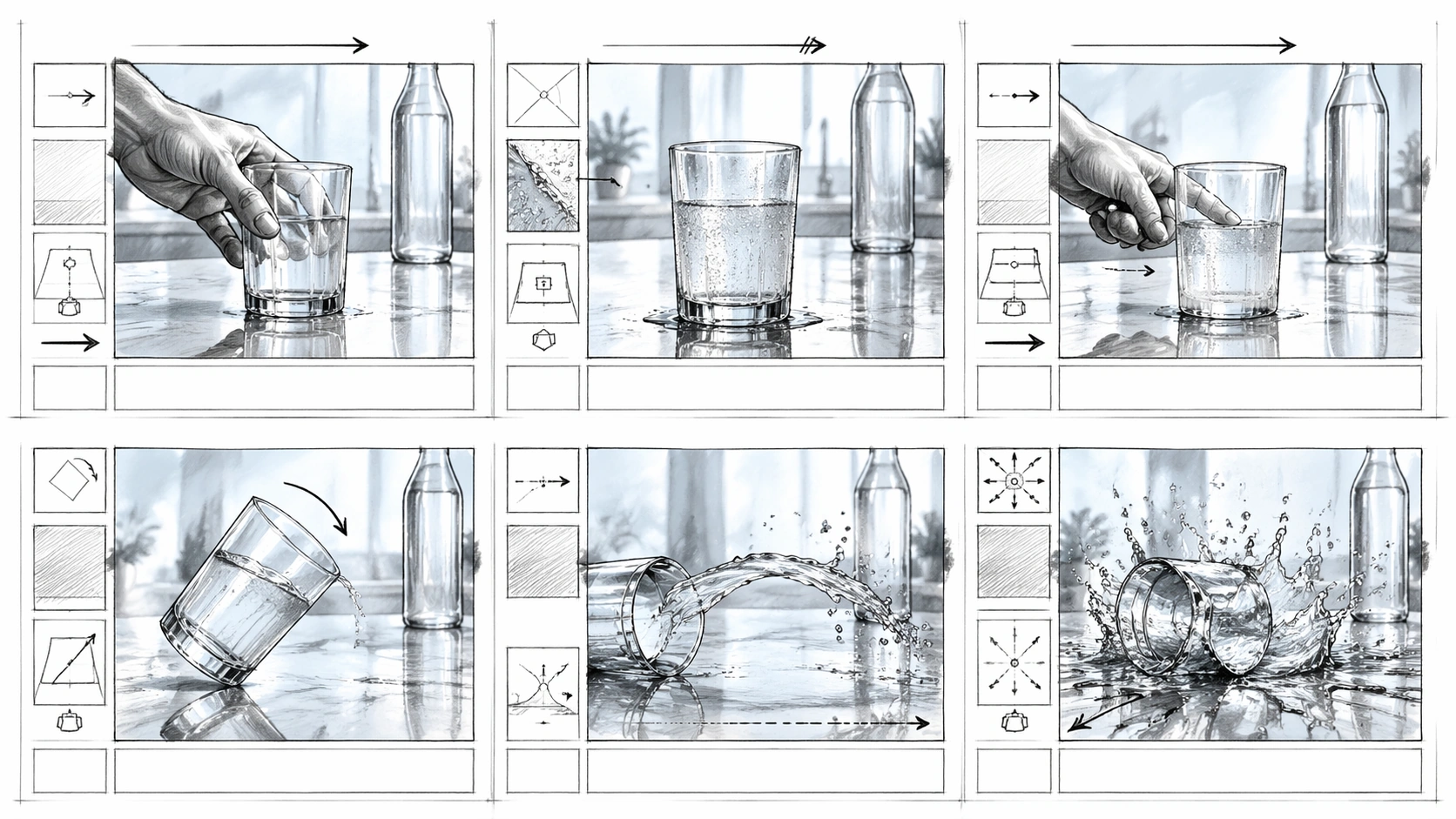
A horizontal 16:9 advertising storyboard sheet drawn in pencil, gray marker, and pale blue wash, arranged as six equal panels in a clean 2 by 3 grid. Each panel includes abstract production-note blocks, camera arrows, and blank caption strips with no readable words. The board plans a tabletop beverage commercial in a bright kitchen studio with reflective glass, polished stone, and controlled splash lighting.

Subject:
The six panels follow one physical action: a hand sets down a clear tumbler, condensation beads form on the glass, a second hand nudges it, the tumbler tips in slow motion, liquid arcs across the stone counter, and the final panel shows a dramatic splash frozen around the fallen glass. A plain unbranded bottle silhouette sits in the background as a product placeholder, never showing a label. The hand, glass, bottle, and counter remain consistent across the sequence.

Important details:
The board must feel useful for production: precise camera framing, arrows for dolly and tilt movement, cutaway insert boxes, notes bands, and clear physical continuity from upright glass to spill. Emphasize physics-materials: transparent glass refraction, water surface tension, droplets, splash direction, condensation, countertop reflections, and gravity. Keep the style as storyboard pencil work, not a finished advertisement render. All notation should be graphic and unreadable.

Use case:
Film Storyboard Sequence single study 5/8, an independent tabletop commercial board testing material physics and production layout.

Constraints:
No readable text, no watermark, no logos, preserve exact 16:9 horizontal aspect ratio, no brand label, no broken six-panel grid, no impossible liquid direction, no extra products, no full-color polished ad comp.
How to use
- Copy the complete original prompt, including any parameters.
- Replace the subject, text and composition with your own requirements.
- Use a compatible external tool; check its current access conditions and review the result.
Before you start
- Check whether a reference image is required. A compatible model label does not mean this example was generated with that model.
- Keep names, figures and visible text accurate; results can vary between model versions.