
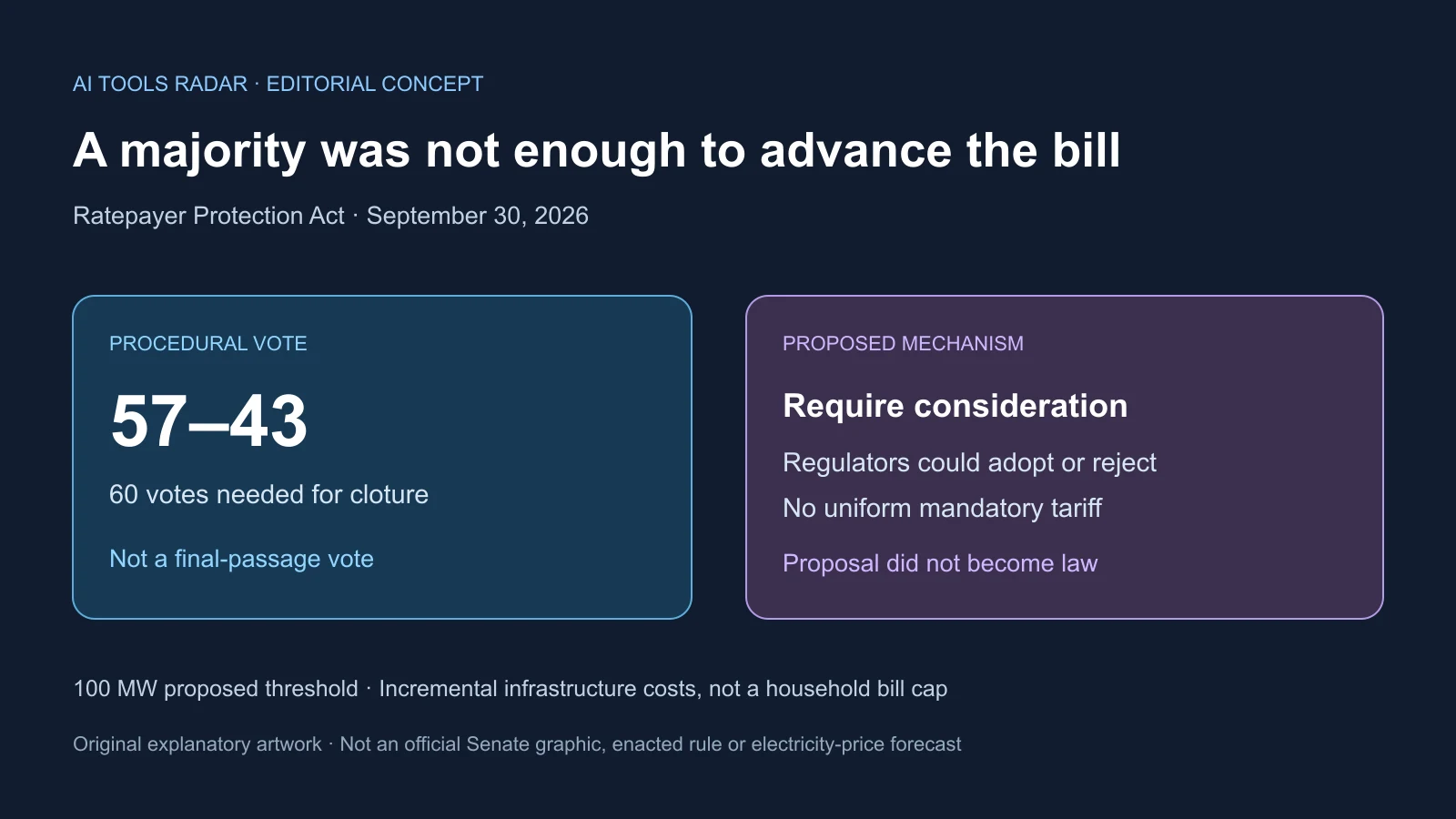
The Ratepayer Protection Act had a Senate majority on September 30, 2026, but not enough votes to advance. Senators voted 57–43 on cloture for the motion to proceed, three short of the required 60. After cloture failed, the motion was withdrawn. There was no final up-or-down Senate passage vote and no enacted nationwide protection from this measure.
That precision matters because the bill’s name implied more than its mechanism guaranteed. H.R. 9340 would have required consideration of protections against shifting large data-center infrastructure costs onto other electricity customers. Regulators could still adopt or reject the standard. Supporters saw a practical first step; critics saw a process that could let Congress announce protection without compelling it.
How a 417–3 House vote became a Senate impasse
The House passed the measure on September 16 by 417–3. In the Senate, all Republicans and four Democrats supported advancing it. Agreement that very large electricity users should pay their own way did not translate into agreement on an enforceable mechanism.
Ohio Republican Jon Husted led the Senate advocacy. He argued that companies creating enormous demand should pay for the generation, transmission, substations and distribution needed to serve them, rather than leaving families with those expenses. Clear obligations could also help developers price a location and reduce opposition after a utility announces an upgrade.
The proposal targeted exceptionally large customers through a 100-megawatt threshold. State commissions and nonregulated utilities would review recovery of the incremental infrastructure costs caused by those loads. They could also consider guarantees against stranded costs if a project was delayed, downsized or abandoned.
Stranded investment means facilities built for demand that does not arrive or persist long enough to repay them. Without suitable contracts or guarantees, a utility may seek payment from its wider customer base. The risk concerns both canceled construction and lower demand after opening.
The CBO assessment confirmed the legal limit: regulators would have to consider the federal standard but could accept or reject it under existing law. A proceeding, evaluation and stated decision were required; one mandatory national rate or direct federal bill to a data center was not.
Flexibility was both the selling point and the objection
American electricity authority is divided among states, municipal utilities, cooperatives, regional grid organizations and federal agencies. A strict nationwide rate design would enter contested jurisdiction. Supporters argued that Virginia, Ohio, Texas and California have different generation, constraints, structures and development goals, making local decisions appropriate.
A public process could examine matters otherwise embedded in confidential utility contracts: connection charges, minimum payments, contract length and exit protection. It could ask whether a tariff covers not only a dedicated substation but wider generation and transmission caused by a new customer.
Democratic Representative Sean Casten supported the bill in the House while warning it addressed only part of the problem. It did not change federal allocation of major generation and transmission costs, and state regulators needed better information. Most House members accepted an imperfect review requirement rather than no federal action.
Some Senate Democrats made a different judgment. New Mexico’s Martin Heinrich accepted the cost-responsibility principle but called the measure insufficient, arguing that voluntary pledges and suggestions had not prevented rate increases. His GRID Savings Act proposed a larger Federal Energy Regulatory Commission role, binding cost allocation, transparency and planning. It was an alternative proposal, not a stronger law already in force or demonstrated to have enough votes.
The difference is not simply industry against consumers. Requiring consideration is legally different from requiring action. A tariff might cover dedicated equipment while spreading regional upgrades across customers, or protect against cancellation while leaving post-opening demand reductions uncovered.
Campaign stakes did not erase the substantive disagreement
The vote came near the midterm elections. Husted faced a competitive Ohio race and, as a former lieutenant governor who helped attract technology investment, criticism linking him to frustration with large computing projects. A bill victory would support his consumer-protection argument; blocking it let Democrats challenge the response’s strength without handing a vulnerable incumbent a win.
That context helps explain the difference between House and Senate calculations, but does not make enforcement concerns fictional. Supporters feared that binding federal rules could delay projects, provoke litigation or override local conditions, slowing generation and grid investment. Critics thought ordinary consideration standards too weak for unusually fast, concentrated load growth.
The failed vote settled neither argument. It removed this compromise from the immediate legislative path. Broader community concerns—water, noise, land and transmission corridors as well as electricity—also remain outside a simple claim that a campus will pay its own connection costs.
Demand growth creates risk, not an automatic household surcharge
EIA figures put annual US electricity-load growth at about 0.1% from 2005 through 2019, compared with 1.7% from 2020 through 2025. Its forecast was 1.9% growth in 2026 and 2.5% in 2027, identifying data centers and other large computing facilities as major contributors. Those forecasts are not guaranteed outcomes.
A large customer can spread fixed costs across more sales and support generation investment. An emerging academic analysis described in the reporting estimated modest average retail-rate reductions associated with data centers from 2015 to 2024, while warning that future supply constraints could reverse the benefit. It is not sound to assume every data center raises every neighboring household’s bill.
Location, generation availability, transmission constraints, contracts, regulatory choices and construction timing change the result. Computing campuses can arrive faster than major power plants or interstate lines. Demand ahead of supply can tighten wholesale and capacity markets while local investments remain in rates for decades.
Forecast uncertainty adds another layer. Developers can request connections at several candidate sites before choosing one, and reserve capacity while computing plans remain unfinished. That does not establish intentional deception. It does require assigning the financial consequences of mistaken forecasts before infrastructure is built.
Utilities can wait and risk losing real development, or build and risk underused assets. Upfront contributions, minimum-demand charges, long contracts, exit fees, credit guarantees and flexible consumption during grid stress can distribute that risk. Their design varies by jurisdiction; the failed bill did not establish one national model.
A cost-allocation standard would not cap the whole bill
Even a binding successor would not control every reason electricity bills rise. H.R. 9340 focused on incremental infrastructure, not household rate caps or refunds. Fuel prices, wholesale energy, storm recovery, utility returns and replacement of aging equipment also affect bills.
Paying a direct connection does not necessarily cover regional impacts. A new load can accelerate generation or interstate transmission needs. State retail regulators have limited reach over some regional costs, while federal regulators oversee important interstate markets but leave many retail choices to states.
The 100-megawatt threshold also left smaller projects outside the standard even if several together created substantial demand. The broad data-center category did not separate AI training, cloud services, content delivery, enterprise computing and cryptocurrency, despite different flexibility. Latency-sensitive services cannot always curtail quickly; some training can be scheduled, but only with appropriate systems and contracts.
Cost causation becomes contested when one line serves data centers, factories, population growth and reliability. Charging one customer everything can be unfair; spreading everything broadly can also be unfair when private development drives most of it. The failed measure neither supplied a common causal method nor settled whether flexibility should reduce infrastructure obligations.
The next decisions will be in legislation, tariffs and contracts
An AP-NORC and University of Chicago poll in 2026 found roughly six in ten Americans favored limiting new data-center construction, with a majority highly concerned about electricity prices and local water. That sentiment can affect permits, hearings and incentives even without new federal law. Power procurement has become part of the political permission to expand AI.
Three developments deserve attention. A binding legislative replacement must define covered facilities, costs, enforcement and guarantees for delayed or abandoned projects—and assemble bipartisan support. States can independently use deposits, minimum bills, long contracts and exit safeguards, with credible project milestones separating firm demand from speculation.
Finally, technology companies’ energy commitments should specify who bears risk when plans change. Dedicated generation, long-term power contracts, grid-support services and enforceable upgrade payments are more informative than investment totals or confidential assurances. The decisive evidence is in regulatory orders and contracts. The three-vote shortfall did not answer who pays; it left that allocation to the next legislation and the existing regulatory system.
Sources
Senate vote reporting · CBO assessment · House debate record · Husted Senate remarks · Heinrich post-vote statement · EIA electricity forecast · AP-NORC national survey · Original coverage