
October 20, 2026 —
Amazon makes agent evaluation a production control
Today’s briefing follows a practical question: as AI systems move from answering to acting, how can teams continuously evaluate quality, limit authority, and preserve human control that is observable and reversible? The completed-source reports span agent evaluation, security, open deployment, software delivery, science, and infrastructure. Each item keeps its original verified source available on its AI Tools Radar issue page.
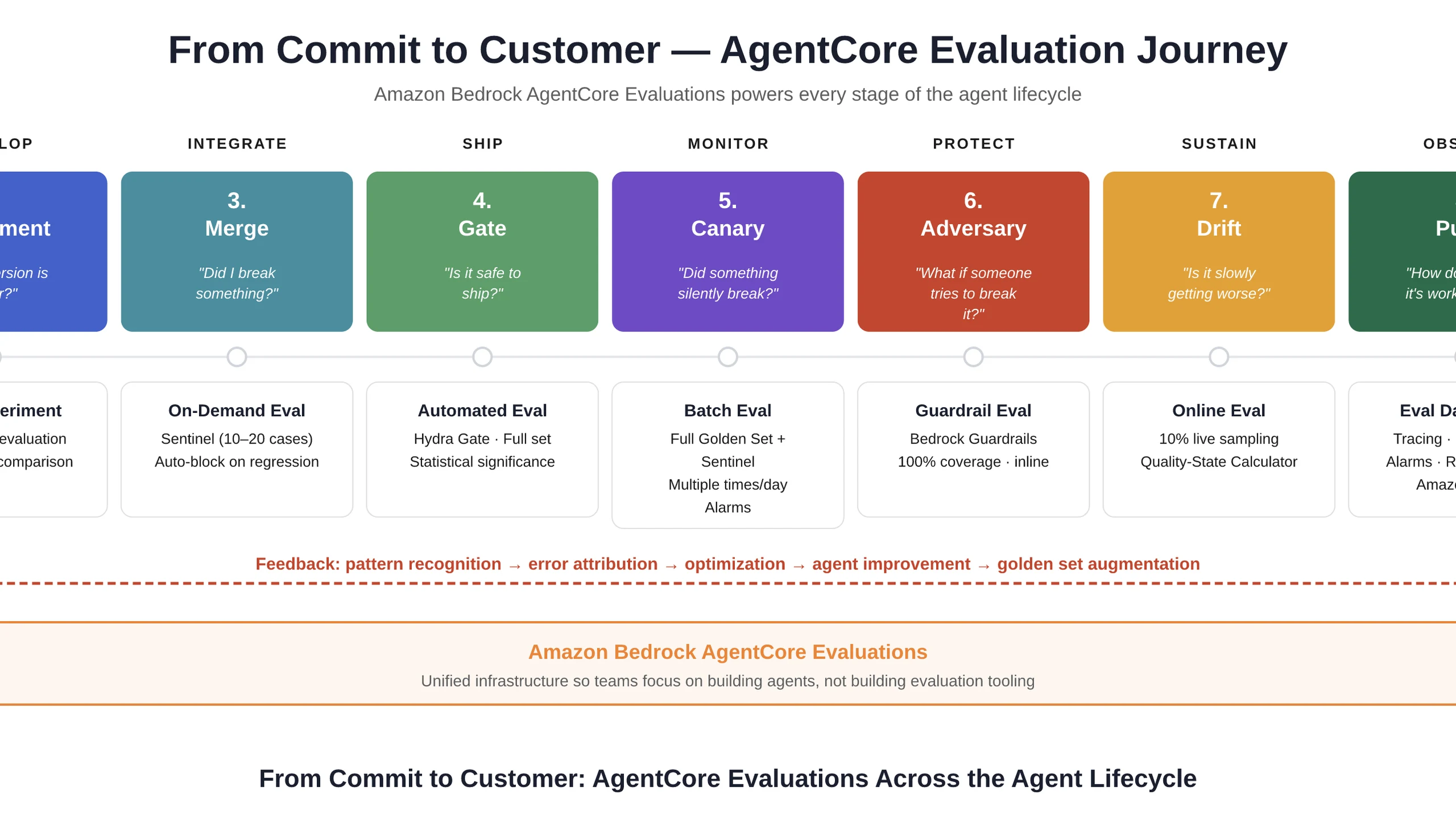
Amazon makes agent evaluation a production control
AWS describes a nine-stage AgentCore evaluation loop that joins CI gates, canaries, live scoring, drift checks, and feedback so an agent can be judged while it is serving users. The reported aim is to catch semantic failures—wrong answers or tool choices—even when latency and error rates look normal.
AWS frames agent autonomy as layered evidence
AWS proposes five linked layers—scope, identity, boundaries, observation, and proof—to make an agent’s authority conditional rather than treating autonomy as an all-or-nothing setting. The account keeps people for ambiguous or high-consequence decisions.
NVIDIA puts open multimodal agents on more hardware tiers
NVIDIA’s Nemotron 3.5 range spans a 120B multimodal model and smaller Bolt variants intended for desktop and edge deployment. NVIDIA positions the lineup around customization, data control, and local operation, while the source also notes limits in independent testing.
Codex adds more live controls to long-running CLI work
Codex 0.163.0 adds searchable configuration, immediate steering, parallel lookups, and managed recovery controls. The release distinguishes settings that affect a live session from those needing a restart, making active agent state easier to inspect and redirect.
Meta’s Forum account makes verification the unit of progress
Meta says Forum reached feature parity with Facebook Groups in eight weeks using agents throughout planning, implementation, testing, and investigation. Its reported success measure was production-ready changes that built, passed checks, survived visual review, and received engineer approval—not code volume.
Google’s antimicrobial workflow shortens the search, not the lab
Google DeepMind describes using Antigravity to connect protein search, annotation, structural comparison, genomic analysis, literature work, and experimental planning around a possible antimicrobial peptide. Wet-lab validation remains in progress, so the candidate is not a clinical result.
Microsoft’s Magnetar pursues fast verifiable general-purpose computing
Microsoft Research presents Magnetar as a proof system for ordinary RISC-V programs that can keep private inputs hidden while using standard hash-function assumptions. The research claim is high proving throughput, but deployment choices still depend on tool maturity and workload needs.
Visko reports real-time world-model generation on Cloud TPUs
Visko says its Orbis pipeline reached 1.07 times playback speed after moving video, upscaling, and synchronized audio onto a Cloud TPU slice. The relevant constraint is deadline reliability: one slow segment can interrupt a live generated world even when average throughput looks good.
Federal guidance treats agent control failures as an incident class
NIST, NSA, and CISA outline ten voluntary practices for detecting, containing, investigating, recovering from, and reporting consequential agent-control failures. The guidance separates an agent acting outside its boundary from a conventional intrusion, while leaving implementation choices to operators.
Databricks describes agents multiplying research training jobs
Databricks says agents helped its research team raise training-job volume eightfold by proposing, launching, and evaluating experiments through AI Runtime. The published account does not disclose utilization, failure rates, costs, or model-quality gains, so those remain the measurements to watch.