PROMPTS · CREATIVE EXPLORATION

Prompt Gallery

Explore real prompts and their generated examples. Find inspiration for your next creative mission and copy the complete prompt for free.

Examples
6,699
Models
9
Sources
67
6,699 prompt examples · page 12 of 140
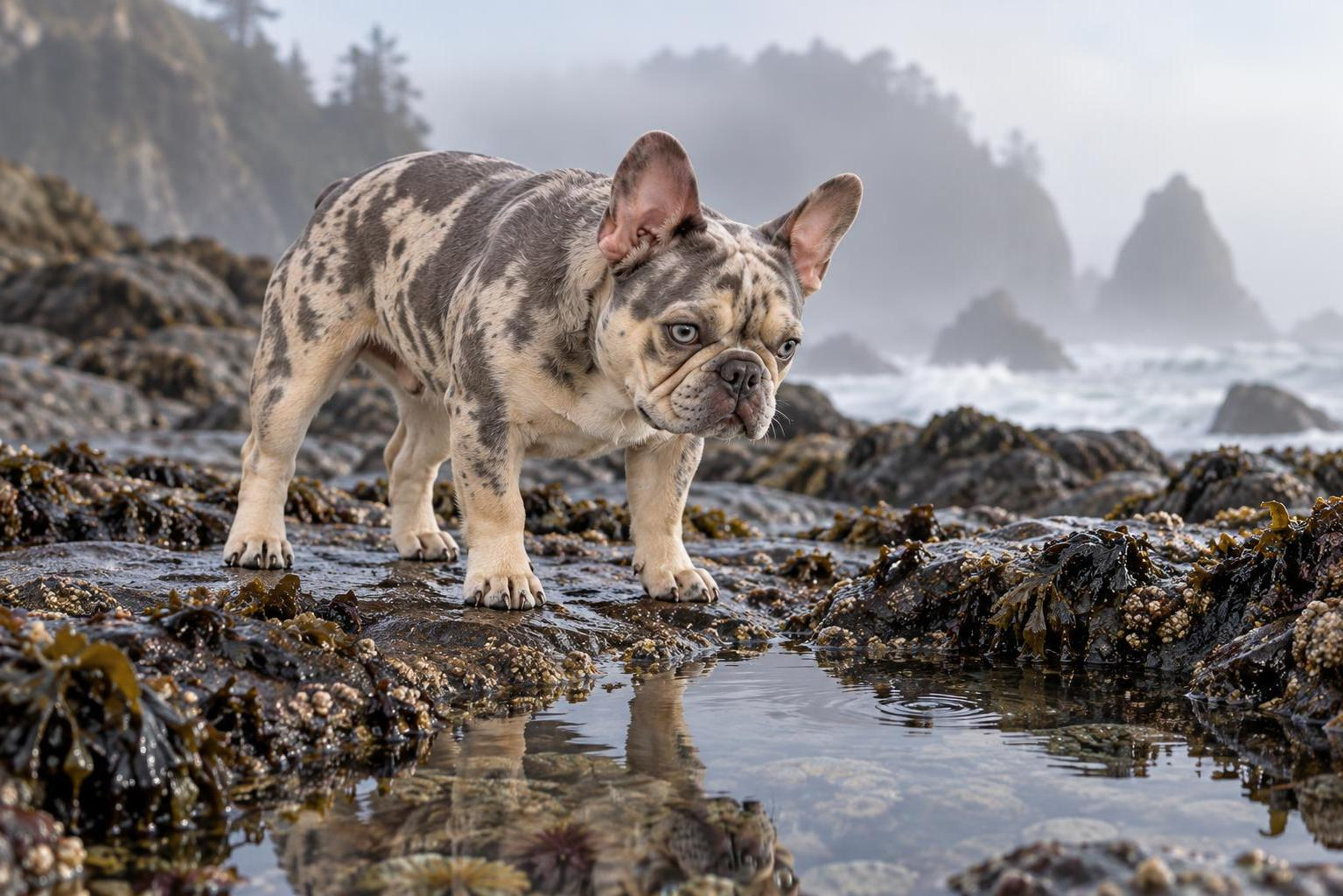
Example generated from “Merle Bulldog Explores a Misty Tidepool — Alosem · reference required · CC BY 4.0”
GPT Image 2.5en

Use case: identity-preserve Asset type: character-consistency campaign scene Primary request: Generate a new natural photorealistic scene of the exact merle French bulldog identity from Image 1 standing alert on wet coastal rocks and investigating a small tidepool in soft morning mist. Input images: Image 1 is the sole identity anchor. Preserve its head, ears, muzzle, eyes, merle pattern language, body proportions, paws, and age; do not copy the reference-sheet layout or gray studio background. Scene/backdrop: Quiet rocky coast at low tide, one small reflective tidepool, wet charcoal stones, faint sea foam and misty horizon; no people or other animals. Subject and load-bearing identity proportions: One dog only. Preserve the broad nearly square head; tall upright bat ears set wide apart with rounded tips; extremely short broad muzzle approximately one quarter of head length; broad dark nose; pale blue-gray eyes set wide; cream blaze on lower face and chest. Preserve the compact cobby muscular torso, wide chest, short sturdy legs, slightly longer body than tall, broad paws, and very short tail. Preserve blue-gray and warm-cream merle patches as irregular mottling rather than stripes or spots. Pose/activity: Natural four-square standing pose with head lowered slightly toward the pool, ears upright, curious calm expression, all four legs and paws visible and bearing plausible weight. Composition/framing: Low eye-level landscape photograph, full dog contained with clear separation between all four legs; reflection may appear only inside the tidepool and must not resemble a second dog. Lighting/mood: Diffused cool morning light, soft mist, quiet curiosity. Materials/textures: Short realistic fur, wet nose, detailed paw pads/claws where visible, water ripples, slick stone. Constraints: Identity fidelity and load-bearing proportions take priority. Exactly one dog, one head, two ears, four legs, four paws; anatomically coherent joints and toes. No collar, clothing, readable text, gibberish, logos, watermark, extra animal, duplicated face, extra leg, fused paw, long muzzle, floppy ears, long tail, cropped paws, or reference-sheet panels. Avoid: tall lean terrier proportions, narrow head, long snout, low ear set, blue coat without cream, dalmatian spots, cartoon style, 3D render.
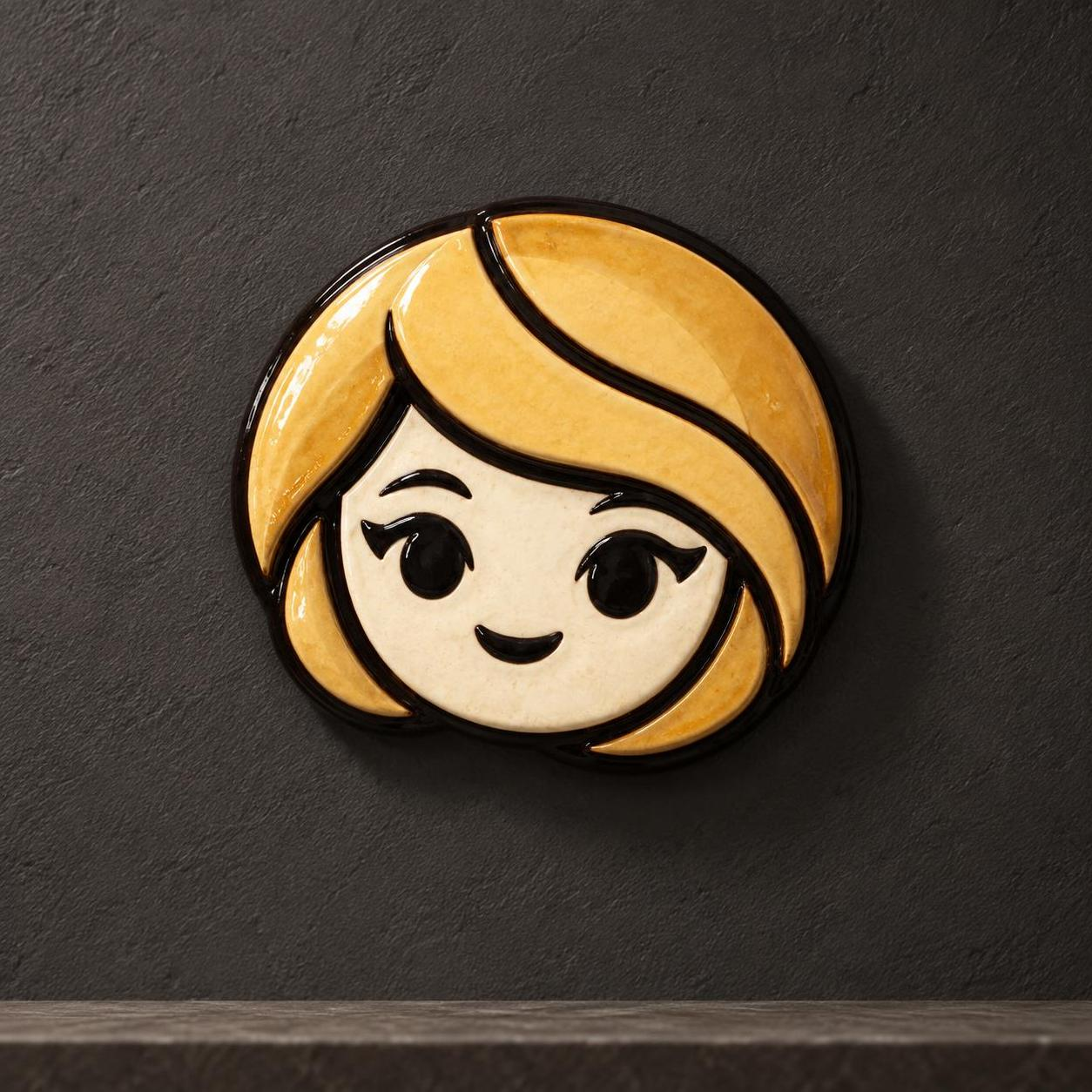
Example generated from “Sema Becomes a Glazed Ceramic Portrait — Alosem · reference required · CC BY 4.0”
GPT Image 2.5en

Use case: style-transfer Asset type: identity-across-media campaign hero Primary request: Re-render the exact flat-vector-style Sema head from Images 1 and 2 as a handcrafted glazed ceramic wall portrait photographed as a physical object. Change the medium only; preserve the mascot identity and proportions. Input images: Image 1 is the primary silhouette, viewing-angle, hair-sweep, face-inset, line-placement, and palette anchor. Image 2 is the primary eye, lash, mouth, and expression-language anchor. Scene/backdrop: Warm charcoal mineral-plaster wall, subtle museum plinth edge, no other objects. Subject and load-bearing identity proportions: Exactly one Sema head, no body. Preserve the near-circular horizontal oval silhouette, slightly wider than tall; compact bob ending in two rounded lower side lobes; heavy golden fringe beginning near top-center and sweeping diagonally across the forehead to the lower-right cheek; shorter pointed lock on the left. Preserve the warm-ivory face inset centered low inside the hair mass at roughly two-thirds of total head width, with wide soft cheeks and a small rounded chin. Preserve evenly spaced black oval eyes at mid-face, outer winged lashes, no nose, and a tiny curved approving mouth well below the eyes. Medium/material: Real handmade glazed ceramic in shallow relief, cream face glaze, honey-gold and ochre hair glazes, glossy near-black outlines/features. Slight glaze pooling and kiln variation, but contours remain crisp and readable. Composition/framing: Square studio hero, object fully contained with generous wall margin, slight three-quarter physical depth, no crop. Lighting/mood: Soft directional museum light, gentle physical shadow, refined and tactile. Constraints: Medium translation must not alter identity geometry. No body, neck, ears, nose, extra face, duplicated object, flattened printed illustration, text, labels, logos, watermark, chipped missing features, or cropped silhouette. Avoid: taller egg-shaped head, narrow face inset, centered curtain bangs, reversed hair sweep, oversized eyes, realistic human face, emoji redesign, plastic toy, vector-flat rendering.

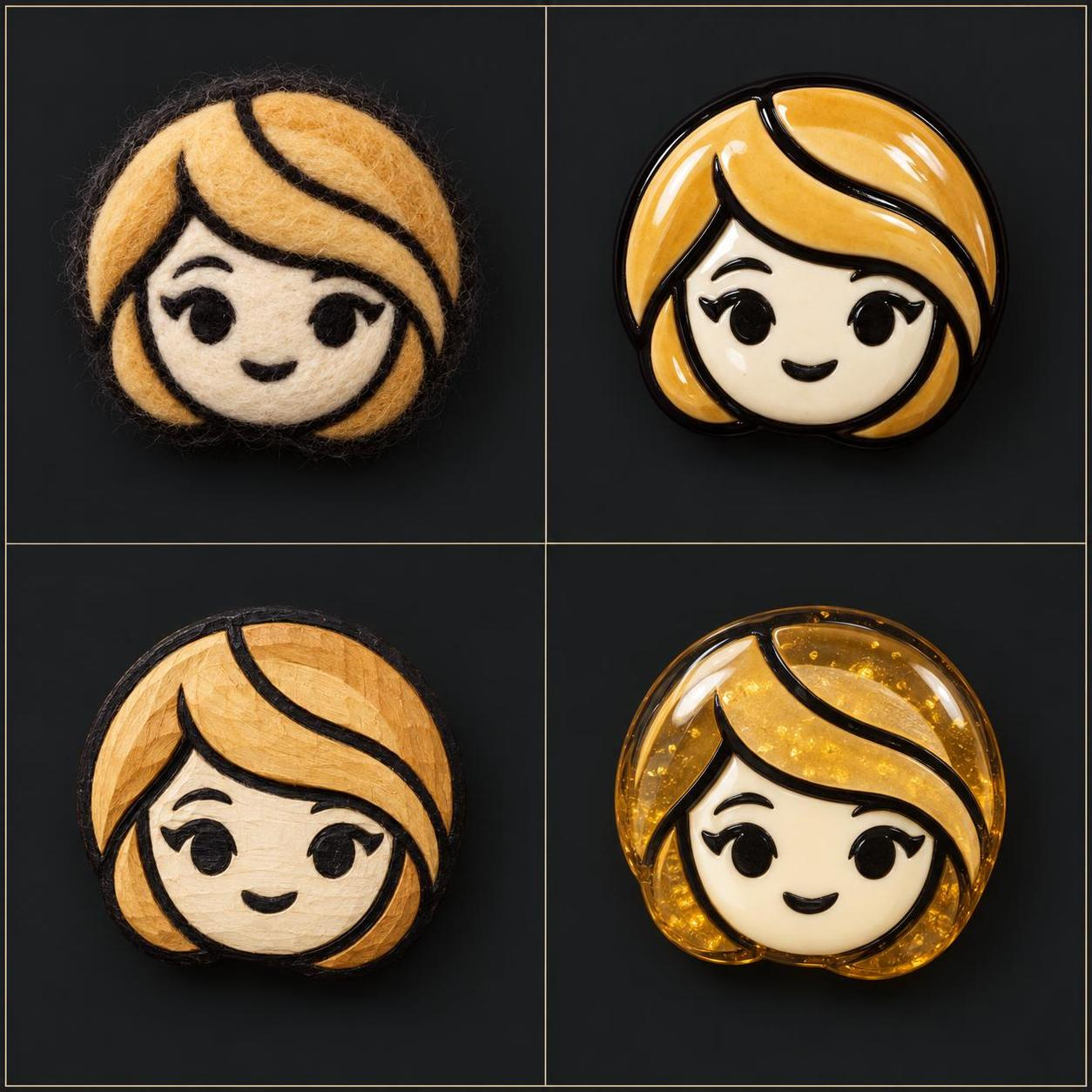
Example generated from “Sema Travels Across Four Crafted Materials — Alosem · reference required · CC BY 4.0”
GPT Image 2.5en

Use case: style-transfer Asset type: identity-across-media material study Primary request: Create one polished 2-by-2 study sheet showing the exact same Sema head from Images 1 and 2 physically re-rendered in four unmistakably different media: needle-felted wool, glazed ceramic relief, carved and painted wood, and translucent cast resin. Preserve identity geometry in every cell; change material only. Input images: Image 1 is the primary silhouette, viewing-angle, hair-sweep, face-inset, line-placement, and palette anchor. Image 2 is the primary eye, lash, mouth, and expression-language anchor. Scene/backdrop: Four equal charcoal specimen cells separated by thin warm-gray rules; no labels or captions. Subject and load-bearing identity proportions: The same one Sema head in every cell, no body. Preserve the near-circular horizontal oval silhouette, slightly wider than tall; compact bob ending in two rounded lower side lobes; heavy golden fringe beginning near top-center and sweeping diagonally across the forehead to the lower-right cheek; shorter pointed lock on the left. Preserve the warm-ivory face inset centered low inside the hair mass at roughly two-thirds of total head width, wide soft cheeks, small rounded chin, evenly spaced black oval eyes at mid-face, outer winged lashes, no nose, and tiny curved mouth. Cell media: top-left needle-felted wool with visible fibers and stitched black features; top-right glossy glazed ceramic relief with glaze pooling; bottom-left carved and painted wood with shallow tool marks and visible grain; bottom-right translucent cast resin with suspended golden pigment and embedded opaque face/features. All retain the same cream, gold, ochre, and black palette. Composition/framing: Exact 2-by-2 grid, one fully contained head per cell, matching scale, viewing angle, face placement, and expression, generous padding, no overlap. Lighting/mood: Even museum specimen lighting tailored subtly to reveal each material. Constraints: Identity proportions must match across all four cells and the references. Exactly four heads total. No body, neck, ears, nose, extra face, duplicated cell, text, labels, logos, watermark, cropped silhouette, or medium ambiguity. Avoid: taller oval heads, narrow face insets, reversed or centered fringe, realistic human faces, four color variants of the same material, flat printed vector copies, inconsistent eye spacing or mouth placement.

Example generated from “Citrus Soda Campaign — Callirra Atlas · CC BY 4.0”
GPT Image 2.5en

A bright beverage advertisement photograph of a chilled can of orange sparkling soda, standing at a slight tilt on a smooth pale surface, shot on a 3:4 vertical canvas at close product distance. COMPOSITION The can is the largest and most central element, occupying about 55% of the frame height, its base resting just below the lower third. A single thin orange slice curls behind the can's upper third, its circle echoing the can's rim. One narrow arc of liquid rises from the surface behind the can and sweeps around its right side at the can's mid-height, then falls out of frame. The arc passes BEHIND the can and never crosses the label. The composition is built on three circles — the slice, the rim, the liquid arc — held on one vertical axis. Empty space falls to the lower left. Nothing touches the frame edges. SETTING AND LIGHT Background: a seamless warm cream backdrop with a soft apricot falloff toward the lower right, no props, no horizon. Lighting: one large soft source behind the can at the upper left, acting as a rim light that passes through the orange slice and glows through the liquid arc; one broad white bounce card in front at low intensity to keep the label legible. Contact shadow: one tight soft shadow directly beneath the can base. No coloured gels, no second light, no reflections of studio equipment. MATERIALS Cold aluminium can with a satin brushed finish and a fine bead-blasted sheen along the rim; heavy condensation across the cold metal, with droplets varying from fine mist to a few larger runs, all catching the back light. Orange slice: translucent flesh with visible radial segments and a pith ring, the back light glowing through it so the pulp reads as wet rather than as coloured glass. Liquid: thin, glossy, opaque orange with a defined meniscus, heavy enough to hold a smooth curve, catching a bright highlight line along its top edge. LABEL AND TEXT The label is white with a matte paper texture, wrapped cleanly and registered straight to the can's vertical axis. It carries exactly this text, once each: the brand word "ZEST" in a bold condensed sans on the upper third, "ORANGE" beneath it in a smaller light sans, and "330 ML" at the bottom of the label. No other words, numbers, marks or symbols appear anywhere in the frame. Brand text must be crisp, correctly kerned, unobstructed and readable at thumbnail size. CONSTRAINTS One liquid arc only. No scattered fruit pieces, no splashes, no droplets scattered through the air. The can's silhouette, the label's proportions and the label's registration must stay unchanged. Do not add a second can, a glass, ice cubes, leaves or a straw. No invented logos, no badges, no awards, no "new" or "best" flashes, no watermark. Avoid plastic-looking CGI, avoid flat airless lighting, avoid over-sharpened edges.

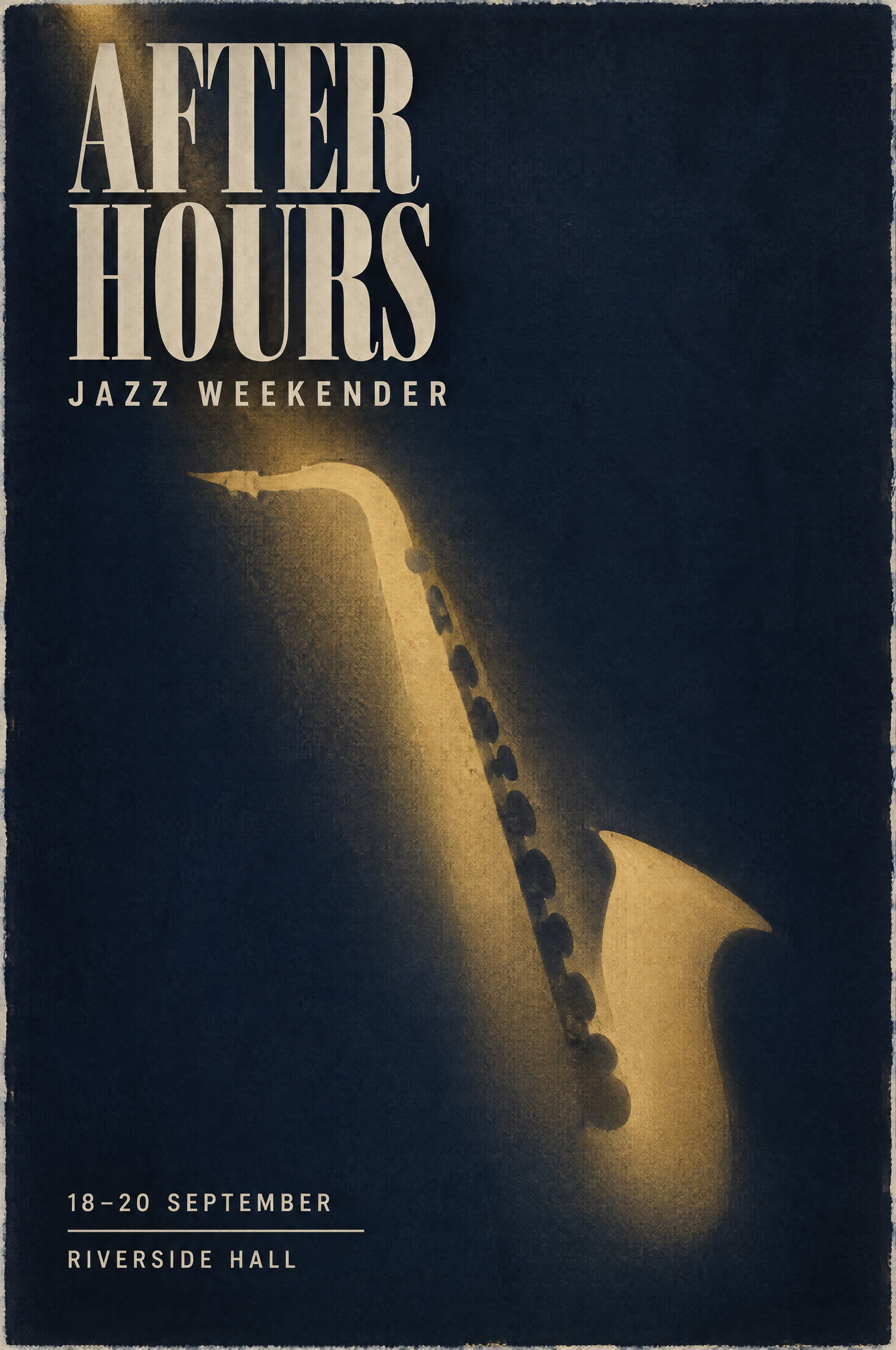
Example generated from “After Hours Jazz Poster — Callirra Atlas · CC BY 4.0”
GPT Image 2.5en

A vertical editorial concert poster, 2:3, printed artwork seen flat and straight on — not a photograph of a poster on a wall. COMPOSITION Deep indigo ground with a subtle ink-darkening toward the outer edges. A single narrow shaft of warm gold stage light enters from the upper left and falls through the centre of the sheet, and the illuminated volume of that beam resolves into the abstract silhouette of a saxophone: bell low right, neck rising left, keys suggested by a row of small dark interruptions along the beam's right edge. The silhouette is built only from light and its absence — no outline, no drawn instrument. The headline sits above the beam, set large; the supporting lines sit below it in a compact block with clear air around them; the date and venue occupy their own zone at the bottom margin. The beam never crosses any letterform. TEXT — render exactly these four strings, each appearing once "AFTER HOURS" "JAZZ WEEKENDER" "18–20 SEPTEMBER" "RIVERSIDE HALL" Hierarchy: "AFTER HOURS" is the largest, set in a high-contrast condensed serif, tracked tight, on two lines if needed. "JAZZ WEEKENDER" is roughly one third that height in a neutral uppercase sans with wide letter spacing. "18–20 SEPTEMBER" and "RIVERSIDE HALL" are the smallest, set on one shared left-aligned column in the bottom margin, separated by a thin rule. All type sits on one left axis. No other text anywhere. PAPER AND FINISH Heavy uncoated poster stock with visible fibre grain and a faint deckled suggestion along the edges; ink sits slightly into the paper rather than on top of it. The gold light is printed ink luminance, not a glow effect: flat in the deep areas, softly graduated only where the beam passes. CONSTRAINTS No QR code, no barcode, no sponsor logos, no decorative microtext, no fictional support acts, no ticket prices, no "sold out" flashes. Do not paraphrase, abbreviate, re-case or hyphenate the four strings. Do not rotate, outline, shadow or gradient-fill the type. Do not add a saxophone photograph, a player, a crowd or a venue illustration. Keep the poster plane flat: no frame, no perspective, no wall shadow, no mockup, no tape, no torn edges beyond a faint deckle. No watermark, no signature.

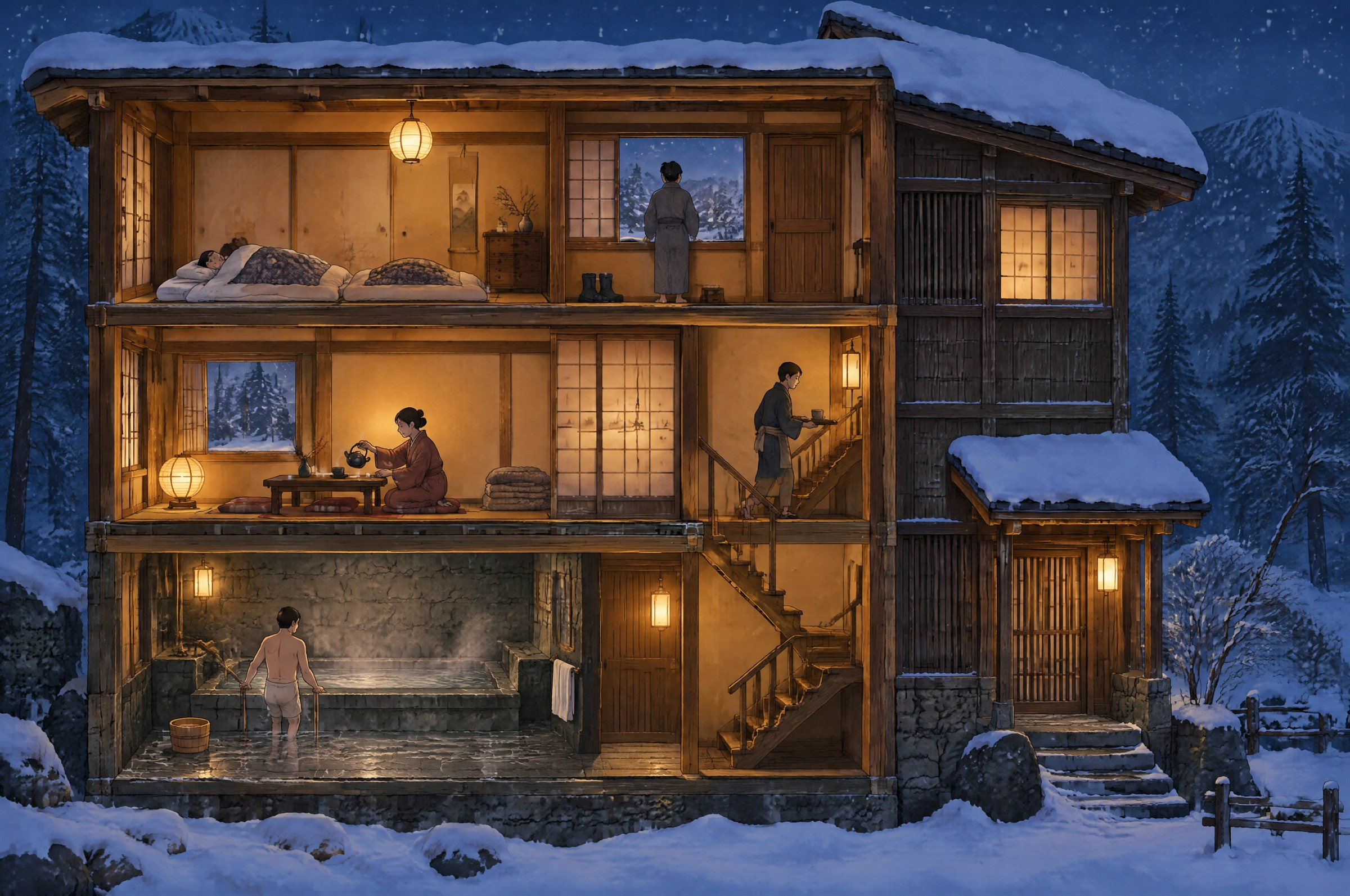
Example generated from “Mountain Bathhouse Cutaway — Callirra Atlas · CC BY 4.0”
GPT Image 2.5en

A three-storey cutaway illustration of a small mountain bathhouse at night, drawn straight on as a section through the building, on a 3:2 landscape canvas. THE BUILDING A compact timber inn, roughly three times as wide as it is tall, its left half cut away so all three floors are visible at once. Outside: deep blue snow night, a low driftscape against the base, bare larch trunks behind, falling snow. Inside: warm amber lamplight on timber, paper screens, and steam, clearly separated from the cold exterior. Floor slabs read as solid timber sections; the roof is snow-loaded with a visible eave. One staircase connects all three floors in a legible run, and its landings align with the floor slabs. LOWER FLOOR — the bath A sunken stone pool with faint steam rising off the water surface only, not through the walls. Wet stone apron, a low wooden bucket, a folded towel on a rail. The water line is visible against the pool wall. MIDDLE FLOOR — the tea room Low table with a teapot mid-pour, two cups, a paper lantern, a folded blanket, a window onto the snow. A paper screen partially drawn so the room behind it stays readable. UPPER FLOOR — the guest room Two futons, a small chest, a hanging lamp, a pair of boots set beside the door, snow built up on the window sill. FIGURES Five small figures, each doing something different and quiet: one stepping into the bath, one seated pouring tea, one asleep under a futon, one standing at an upper window looking out, one on the stairs carrying a tray. Figures are small relative to the building, anatomically plain, and never repeated as identical stamps. MATERIAL AND LIGHT Timber: warm grain, visible joinery, worn edges at thresholds. Paper screens: translucent, glowing from the lamps behind them. Stone: cold grey-green with damp sheen near the pool. Snow: matte, with soft blue shadow. Outside light is cool and low-contrast; inside light is warm and pooled around each lamp. The two light sources never mix — snow stays blue, interiors stay amber. CONSTRAINTS Water and steam never pass through a wall, floor or the roof. Exterior falling snow never appears indoors. Each floor's boundary, door and stair connection must be readable. Do not fill rooms with clutter; the space must stay explorable along the stairs. Do not add text, signage, numbers or logos. No watermark.

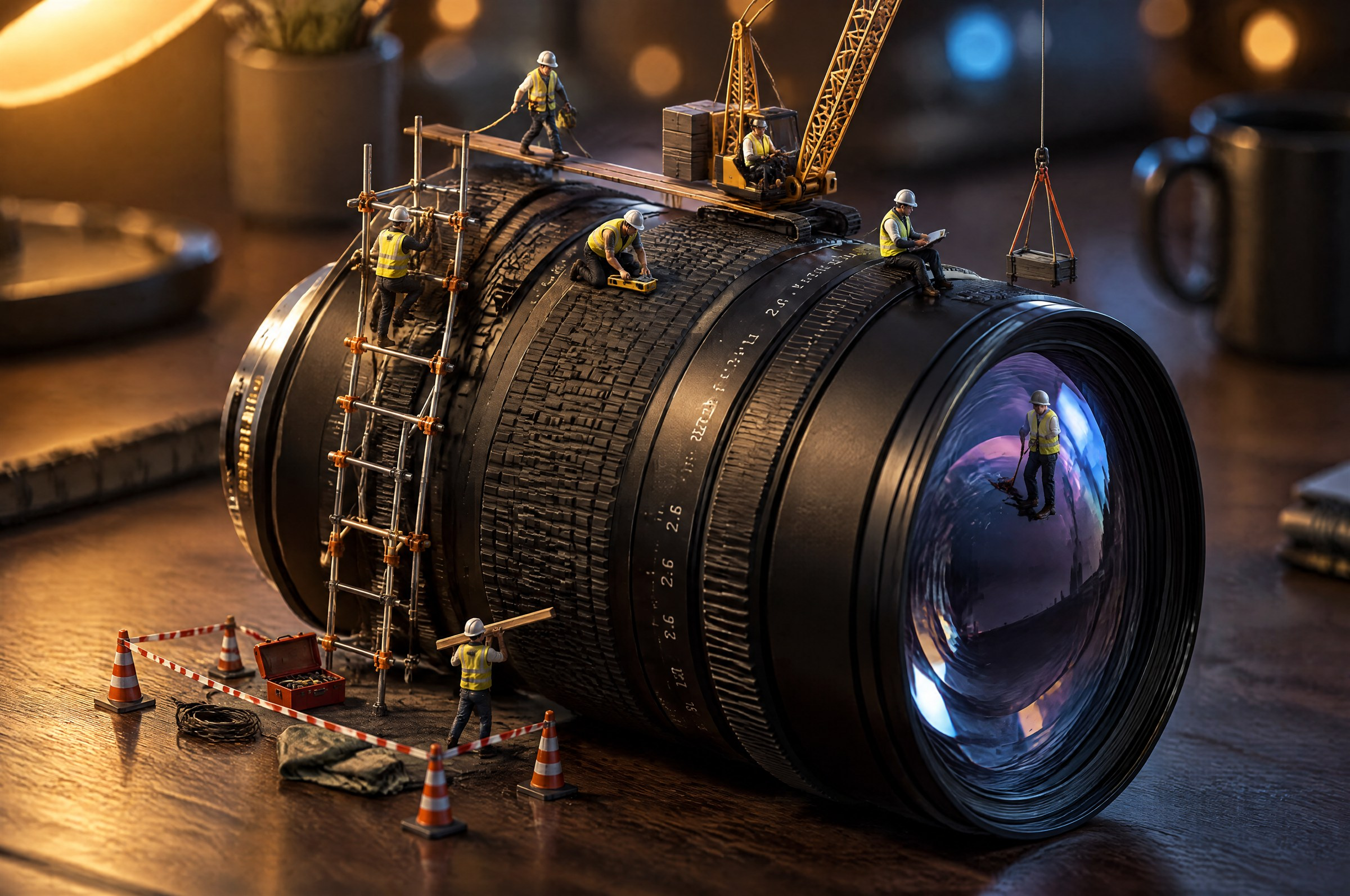
Example generated from “Miniature Construction Crew on a Lens — Callirra Atlas · CC BY 4.0”
GPT Image 2.5en

A macro photograph of a miniature construction site built on top of a real camera lens lying on a dark wooden desk, shot at 3:2 with a tilt-shift effect so the plane of focus runs diagonally across the lens barrel. THE LENS AS LANDSCAPE A large prime lens lies on its side, filling most of the frame: black anodised aluminium barrel with fine knurled focus and aperture rings, a metal mount ring at the near end, engraved white numerals along the barrel, and the front glass element facing the camera at the far end. The glass is deep blue-violet with concentric coating rings and a curved reflection of the room's ceiling. The lens is the terrain — everything else is built on it. THE SITE A miniature crew is working along the top of the barrel. On the rubber ring: a climbing scaffold of thin aluminium poles lashed with small orange ties. Mid-barrel: a lattice crane with a counterweight, its hook lowered toward the glass. Near the mount: a striped barrier line of cones and tape around a "work area", with a tiny open toolbox, a coiled cable, a folded tarp and two traffic cones. On the front glass element: a single worker standing well out on the glass, casting a reflection beneath himself. FIGURES Seven figures in high-visibility yellow vests and white helmets. Each is doing something different: one climbing the scaffold, one walking a beam with a tether, one at the crane controls, one kneeling to check a level, one carrying a plank over the shoulder, one standing on the glass, one sitting on the barrel edge with a clipboard. All are anatomically plain, correctly scaled to each other, and never repeated as identical stamps. LIGHT AND DEPTH One warm desk lamp off-frame to the upper left, its shade just visible as a soft amber glow at the frame's edge, throwing warm directional light along the barrel and long soft shadows to the right. A cold blue rim from a window behind separates the figures from the background. Strong tilt-shift depth of field: the strip across the barrel top is sharp, the near knurling and the far background fall into soft focus. Background bokeh of warm amber point lights and one blue highlight. CONSTRAINTS The lens must remain a real, correctly proportioned camera lens: barrel diameter, ring widths, mount ring, engraved numerals and the glass element all plausible and consistent. No text anywhere except the lens's own engraved markings, which are embossed metal and unreadable at this scale. No logos, no brand marks, no watermark. Do not make the scene look like plastic toys: real metal, real rubber, real glass, real tiny clothing with fabric weave. No flame, no welding sparks, no dust cloud.

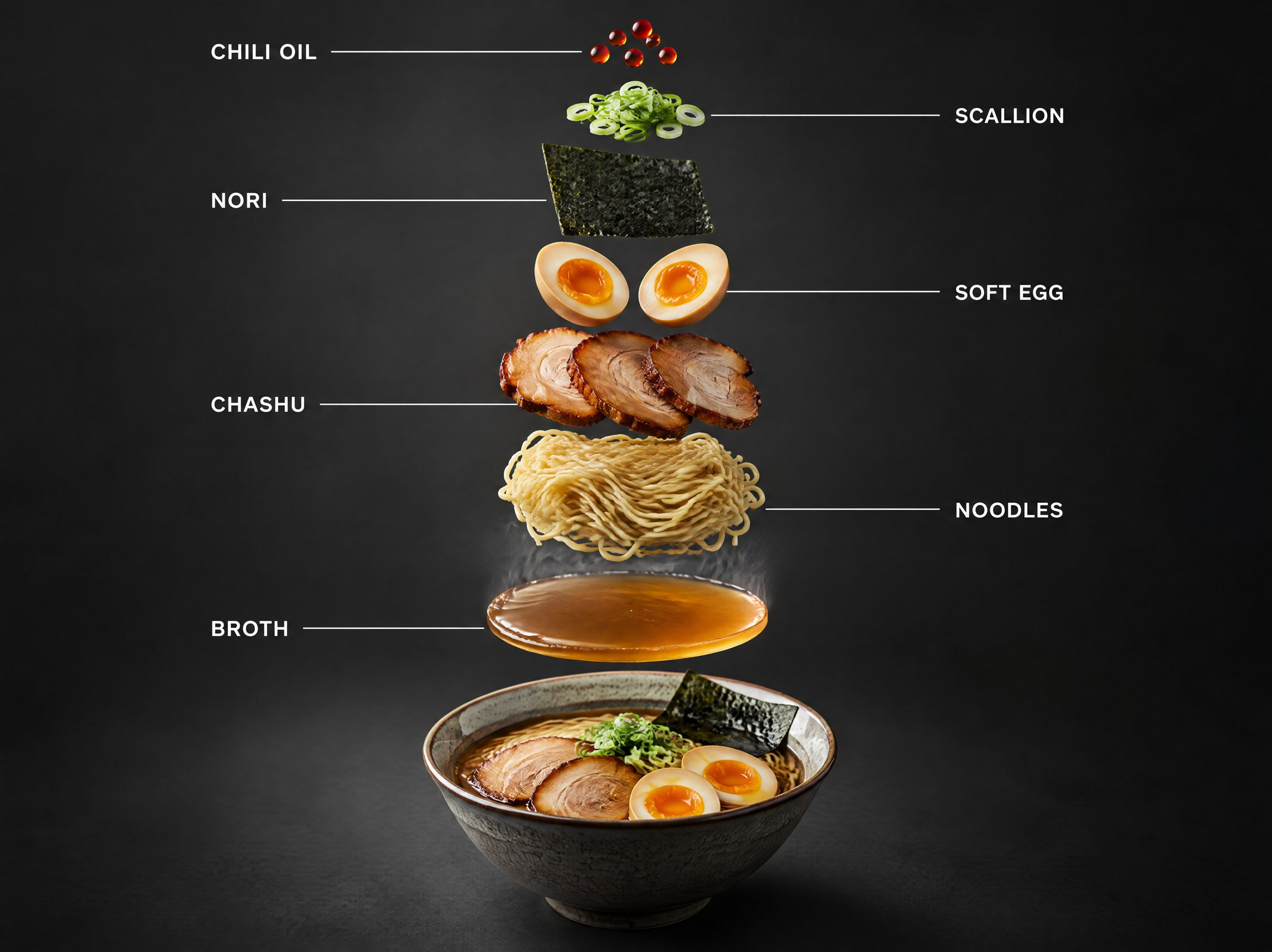
Example generated from “Exploded Ramen Ingredient Diagram — Callirra Atlas · CC BY 4.0”
GPT Image 2.5en

A commercial food photograph of an exploded ramen bowl, drawn on a 4:3 canvas as a vertical assembly diagram in three dimensions: the finished bowl at the bottom, and its components suspended above it in the order they are assembled, each labelled. COMPOSITION Dark slate ground filling the frame, one value, with a soft pool of light in the centre. The ceramic bowl sits in the lower third, centred, seen from a slightly raised three-quarter angle so its interior is visible. Directly above the bowl, seven components float in a vertical stack with generous even gaps, largest at the bottom, smallest at the top. Each component has one thin straight leader line running horizontally out to a label at the left or right margin; no leader crosses another, no leader crosses a component, and every leader ends exactly on the component it names. THE COMPONENTS, bottom to top 1. Amber broth held as a perfect disc of liquid suspended in mid-air, with a defined meniscus and a bright highlight along its edge; faint steam rising from this disc only. 2. A coil of fresh noodles, lifted and separated so individual strands are visible, glossy and pale gold. 3. Three slices of braised pork belly, edge-seared, with visible fat-to-meat layering and a caramelised rim. 4. Two halves of a marinated soft-boiled egg, yolks jammy and slightly translucent, cut faces toward camera. 5. A sheet of toasted nori standing almost upright, matte black-green with visible fibre structure. 6. A small fan of sliced scallions, fresh green and white rings, crisp edges. 7. A tight cluster of chili oil droplets suspended together, each catching a small bright specular point. TEXT — render exactly these seven strings, one per label, each appearing once "BROTH" / "NOODLES" / "CHASHU" / "SOFT EGG" / "NORI" / "SCALLION" / "CHILI OIL" Typography: one neutral uppercase sans, one size only, set horizontally, left-aligned on the left margin for components 1, 3, 5, 7 and right-aligned on the right margin for components 2, 4, 6, so the leaders stay short. No other text anywhere in the frame. LIGHT AND MATERIAL One large soft key from the upper left, one weak fill from the right, and one narrow back light that makes the broth glow from within and catches the rim of the egg yolks. Ceramic: matte glaze with fine crazing and a soft rim highlight. Liquid: glossy, opaque amber with a viscous meniscus. Noodles: wet and reflective without looking oiled plastic. Pork: crisp caramelised edge, fibrous interior. Egg: dense jammy yolk with a matte albumen. Steam rises only from the broth disc, thin and directional, never covering a component or a label. CONSTRAINTS Exactly seven components and exactly seven labels, one each, in the order given. Components must not overlap, touch, or drift off the vertical axis. Do not add chopsticks, a spoon, a napkin, a second bowl, scattered ingredients, flying droplets, herbs or decorative garnishes. Do not add brackets, arrows, dashed boxes, measurement lines or dimension marks — the only graphics in the frame are the seven thin leaders. Do not restyle the labels, do not add units or prices. No watermark, no logo, no border.
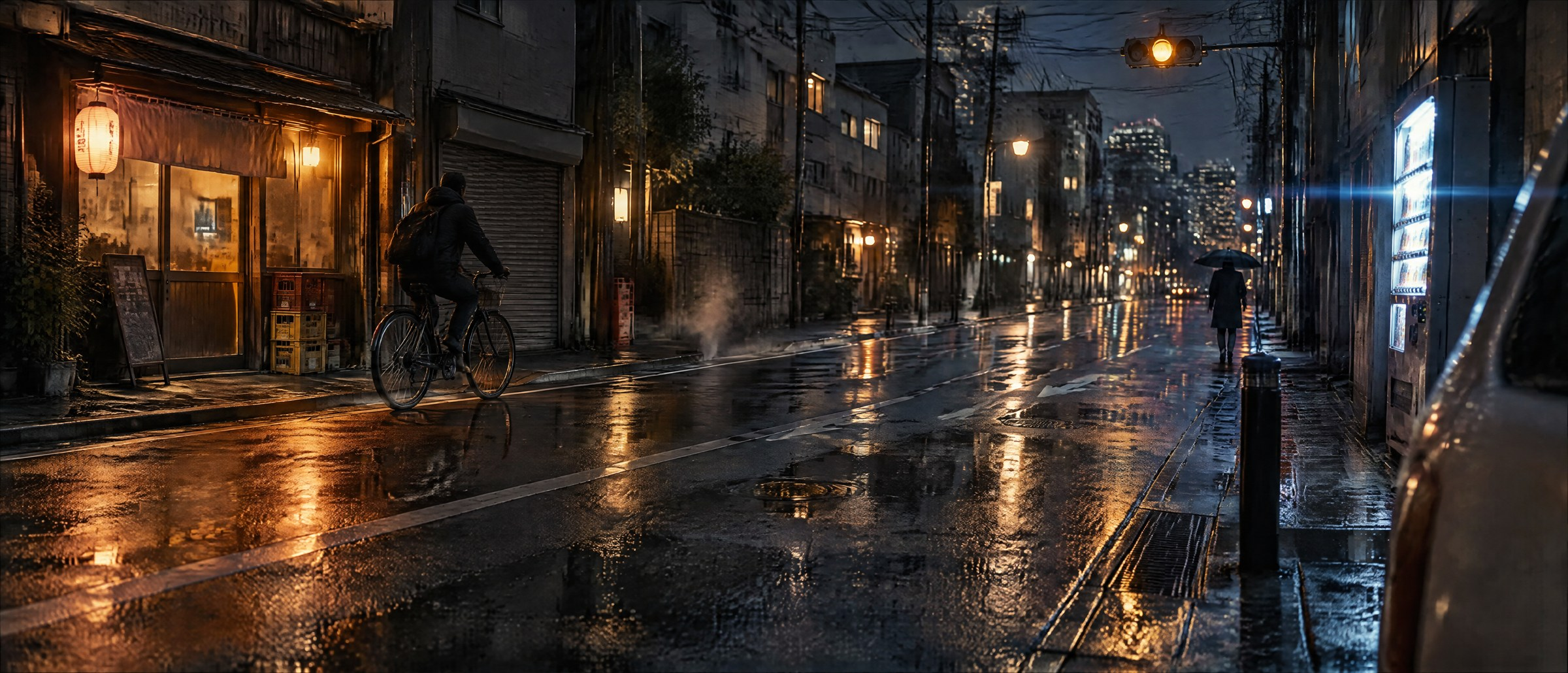
Example generated from “Rainy Street Cinematic Banner — Callirra Atlas · CC BY 4.0”
GPT Image 2.5en

An anamorphic night exterior, 21:9, shot on a rain-slicked city street minutes after the rain stopped — a cinematic still, not a tourist photograph. COMPOSITION Wide frame, camera at chest height on the near pavement, the road running diagonally away to the right so the reflections carry the eye into depth. A single cyclist crosses left to right through the middle third, small in frame, moving out of the left of the shot, caught mid-pedal; a pedestrian with a dark umbrella walks away from camera on the far pavement, well down the street. Foreground: the wet kerb and the out-of-focus edge of a parked van intruding into the lower right corner, cropped by the frame. Empty wet road occupies the lower half. Nothing is centred. THE STREET Named elements, all present: wet asphalt, painted lane markings, standing puddles holding reflections, a bento shop window with a paper lantern, a vending machine glowing on the near wall, a bento shop sign with unreadable lettering, a traffic signal showing amber, overhead power lines crossing the sky, a metal drain grate, a steam vent from a basement grate, wet bicycle tyres, a low bollard, a shuttered roller door, a stack of plastic crates beside a doorway. LIGHT Night, blue hour, no sun. Sources: the amber lantern of the bento shop at the left, at eye level; the cold white of the vending machine on the near right; the amber traffic signal high in the frame; and a weak blue-grey ambient sky. One dominant direction: the warm shop light comes from the left and slightly behind, so the cyclist is rimmed and the road reflections stretch toward camera. Every shadow and every reflection must agree with the warm source being on the left. LENS CHARACTER True anamorphic rendering: one long horizontal blue lens flare streak across the frame at eye level, sourced from the vending machine; oval bokeh in the background lights, elongated horizontally; a slight horizontal smear at the frame edges; fine film grain; a very shallow depth of field that keeps the puddles and road reflections sharp in the middle distance and softens the far street. CONSTRAINTS No readable text anywhere: all signage, the vending machine front and the shop lantern must stay illegible — off-angle, cropped, or out of focus — and must never resolve into invented words. No legible vehicle plates. No people facing the camera, nobody posing, no crowd. No lens flare except the one horizontal streak. No watermark. Do not light the scene with a fill: keep the contrast deep and the shadows held. Do not add neon signage in colours that contradict the amber-left / cold-right lighting logic. No rain falling, no spray from tyres — the street is wet, the weather has stopped.

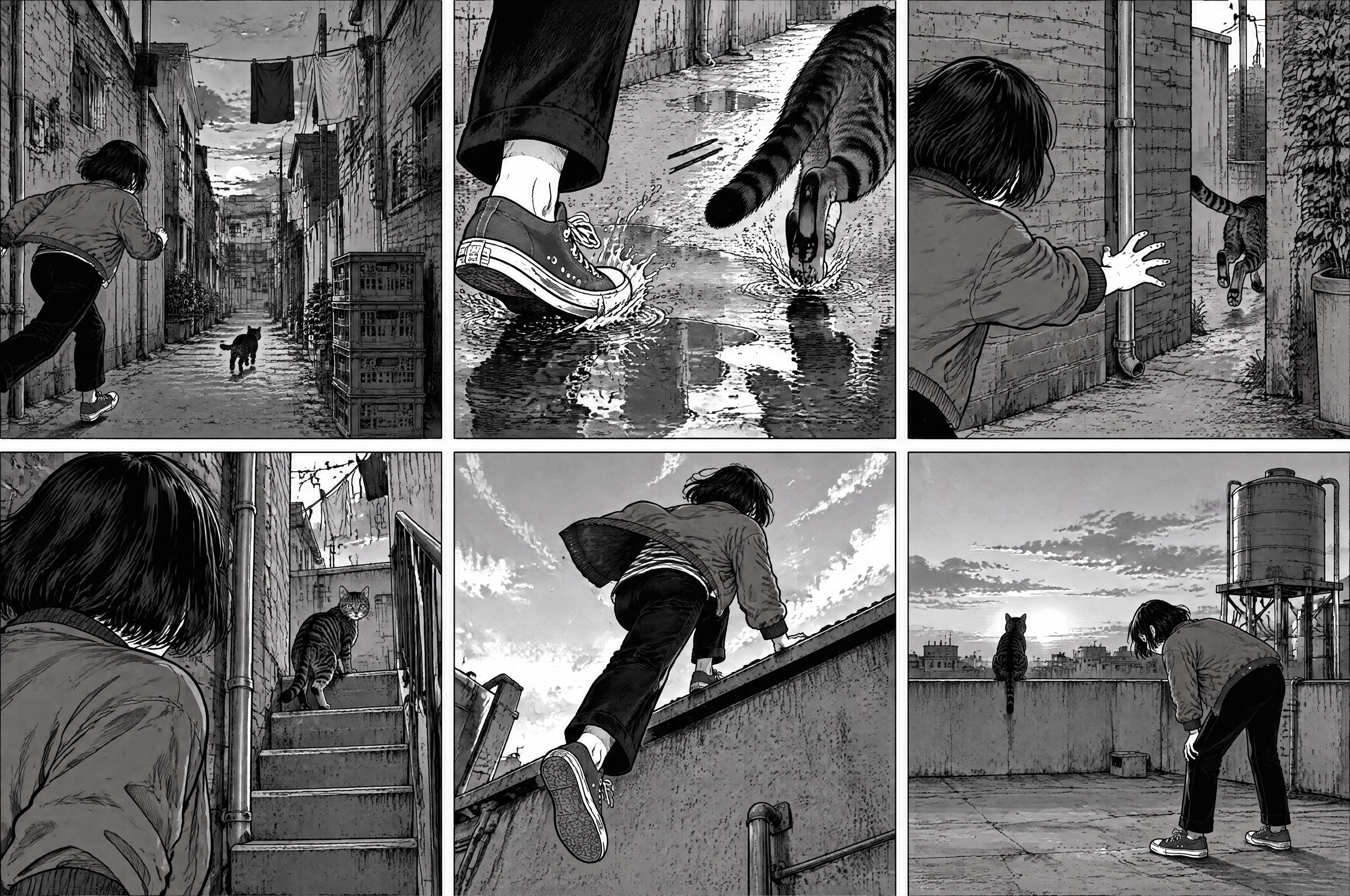
Example generated from “Six-Panel Wordless Manga — Callirra Atlas · CC BY 4.0”
GPT Image 2.5en

A six-panel manga spread, 3:2 landscape, black and white, telling one continuous action with no dialogue and no text of any kind. Two columns of six equal panels: three columns across, two rows down, with even gutters. Reading order is left to right, then top to bottom. STYLE Traditional ink manga: confident black linework with variable weight, screentone for mid-tones and shadow, cross-hatching for the darkest areas, and large untouched white areas for light. High contrast, clean panels, no grey wash. Screentone dots stay legible at print size. Nothing is coloured. THE ACTION — one girl pursuing a cat through a narrow alley and up to a roof, six beats Panel 1 — wide establishing shot: a narrow residential alley at dusk, deep in frame, laundry lines overhead, a stack of crates against a wall; the girl enters from the left edge, small, mid-stride. Panel 2 — extreme close-up on the ground: her feet and the cat's paws over a puddle, water displaced, motion indicated by two short speed lines only. Panel 3 — medium shot from behind: the cat slips around a corner ahead, only tail and hindquarters visible; the girl's arm reaches into frame from the left, fingers open, missing it. Panel 4 — over-the-shoulder: the alley opens onto a narrow exterior stairwell rising to the right; the cat is two steps up, paused, looking back; the girl's shoulder and hair fill the left edge. Panel 5 — low angle from below: the girl at the top of the stairs, mid-leap, cape of her jacket lifting, the roofline and sky behind her, strong diagonal composition. Panel 6 — wide, calm: a rooftop with a water tank and a low parapet; the cat sits on the parapet with its back to us; the girl stands four steps away, doubled over and out of breath, one hand on her knee. CONSISTENCY ACROSS ALL SIX PANELS Same character throughout: a girl of about sixteen, short dark bobbed hair with a blunt fringe, a bomber jacket with ribbed cuffs over a striped shirt, dark trousers, scuffed canvas shoes. Her hairstyle, fringe, jacket, shirt stripes and shoe design are identical in every panel where she appears. The cat is a single dark tabby of the same size and markings in every panel. The alley is the same alley: brick walls, the same laundry lines, the same crates. CAMERA Every panel uses a different shot — wide, extreme close-up, medium, over-the-shoulder, low angle, wide — and no panel repeats another panel's framing. Panels 1 and 6 are both wide but differ in subject and altitude. CONSTRAINTS No text anywhere: no dialogue, no captions, no signage, no sound-effect lettering, no speech balloons, no page numbers, no watermark, no signature. Do not add a title strip or a border beyond the panel gutters. Do not colour any element. Do not let the character's design change between panels, and do not mirror her asymmetrically between panels. Nothing may be cropped by a panel edge that should not be: hands, feet and the cat's tail stay inside their panels.

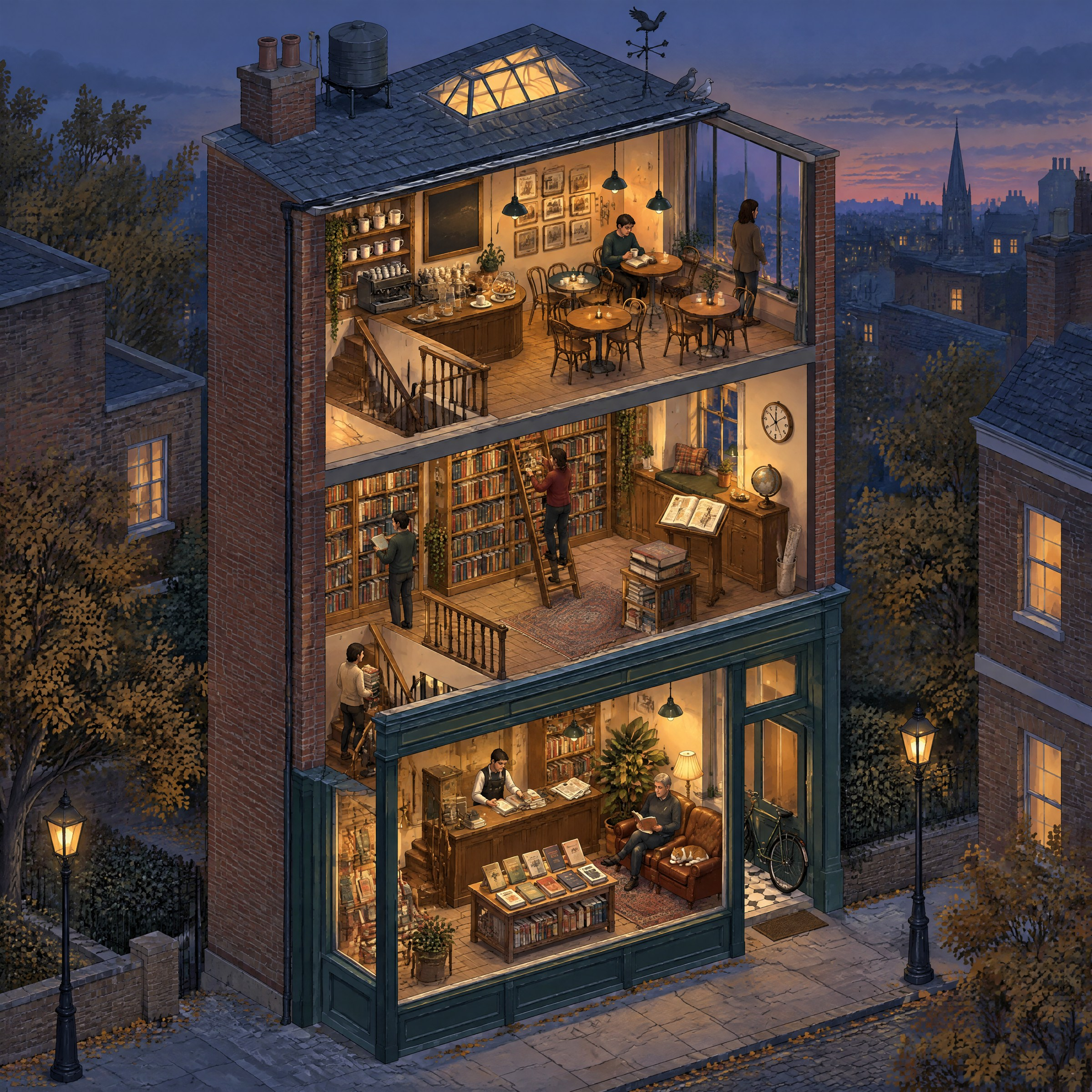
Example generated from “Isometric Bookshop Cutaway — Callirra Atlas · CC BY 4.0”
GPT Image 2.5en

A true isometric cutaway illustration of a three-storey independent bookshop in the evening, on a 1:1 canvas, drawn in a single axonometric projection at 30 degrees on both horizontal axes, orthographic, with no perspective and no vanishing point. The front-right quarter of the building is removed so all three floors and the roof are visible at once. The building is lit from inside; it is dusk outside. THE BUILDING Narrow and tall, roughly twice as tall as it is wide. Brick side walls with visible coursing, a slate roof with a glazed skylight and a small chimney, a painted timber shopfront on the ground floor with a deep doorway recess, and a gutter running the full width of the roof edge. Floor slabs read as solid sections with visible thickness. GROUND FLOOR — the shop A long service counter with a till, a stack of books waiting to be shelved, a low display table with books fanned open face-up, two deep reading armchairs, a floor lamp, a potted rubber plant, a brass bell on the counter, a stack of newspaper, a bicycle leaning inside the doorway, and a cat asleep on the armchair. MIDDLE FLOOR — the shelves Six full-height shelves in two rows along the side walls, a rolling wooden ladder hooked to a rail, a reading nook with a window seat and a cushion, an open atlas on a stand, a globe on a cabinet, a desk lamp, a stack of oversize art books lying flat, a rolled map in a corner, and a wall clock. TOP FLOOR — the café A small espresso machine on a counter with two cups and a knock box, three round tables with chairs, a tray of pastries under a glass dome, a floor-to-ceiling window with the evening sky beyond, hanging pendant lamps, a wall of small framed prints, a chalkboard, a water jug, and a tall shelf of mugs. ROOF The glazed skylight glowing from below, the chimney, a small water tank, two pigeons, and a weather vane. FIGURES Six small figures, each doing something different: one browsing a shelf with a book half out, one reading in a ground-floor armchair, one climbing the rolling ladder, one carrying a stack of books up the stairs, one seated at a café table with a cup, one standing at the top-floor window looking out. Figures are small relative to the building and are never repeated as identical stamps. LIGHT AND MATERIAL Evening: cool blue dusk light from outside, warm amber lamplight pooled inside each floor, and the skylight glowing up onto the roof. The two light temperatures never mix — exterior blue, interior amber. Materials: painted timber, brick, glass, brass, worn leather on the armchairs, matte paper. Wood grain and brick texture are visible but never noisy. CONSTRAINTS True isometric only: parallel verticals stay parallel, both floor plans keep the same 30-degree axes, and no element is drawn in perspective. Each floor's ceiling must not be drawn — the viewer looks down into each level. Staircases must connect visibly between floors and land on the slabs. Do not add text, signage, prices, numbers, lettering on spines, or a shop name; all book spines are abstract blocks of colour with no lettering. No watermark. Do not fill the building with so much furniture that the floor plates stop reading as separate levels.
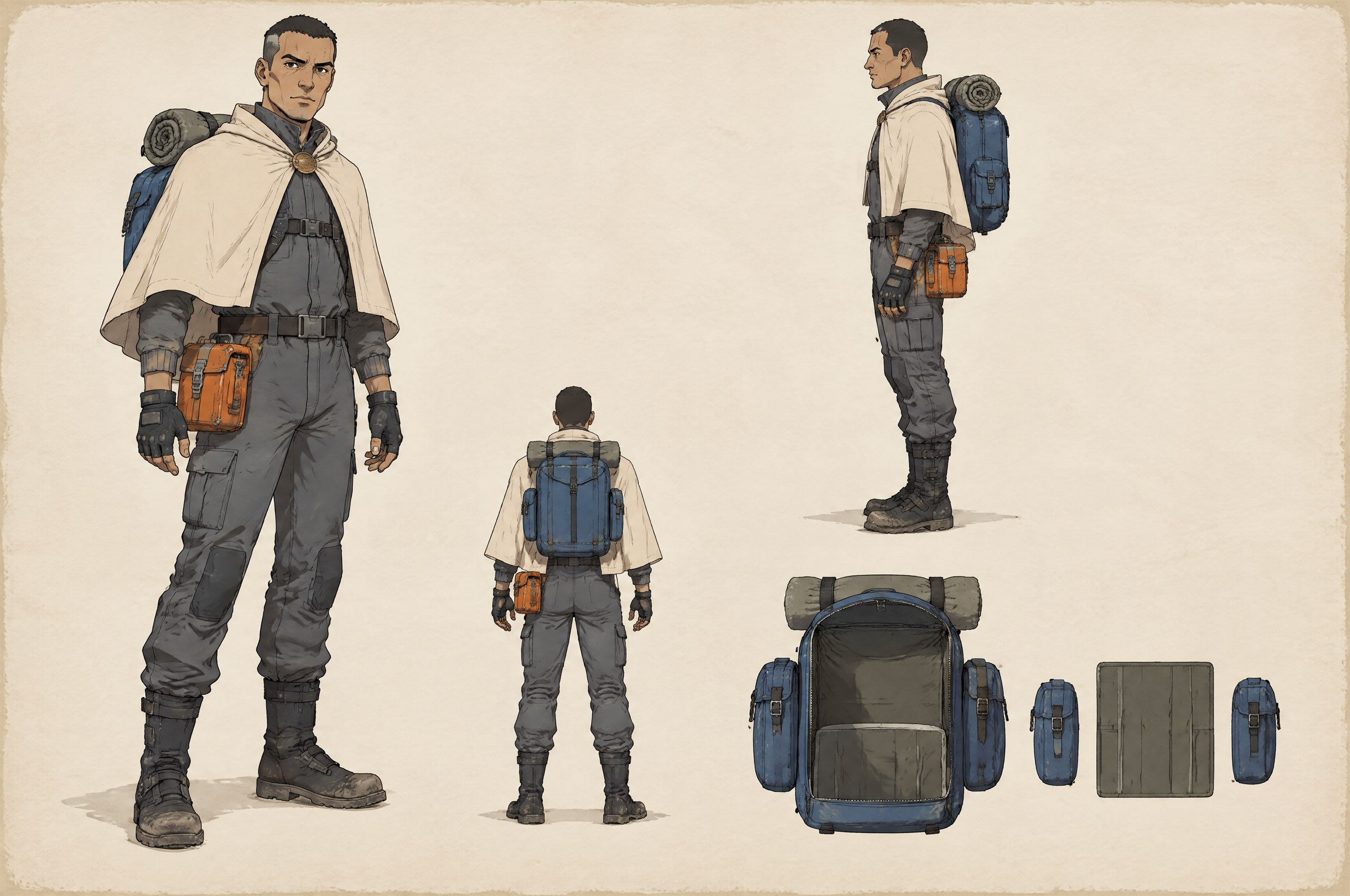
Example generated from “Lunar Courier Turnaround Study — Callirra Atlas · CC BY 4.0”
GPT Image 2.5en

A character design sheet for a lunar courier, drawn on a 3:2 landscape sheet of warm off-white design paper at a slightly larger scale than a technical reference: four zones, each with a clear border of empty space, hand-drawn production-art quality, flat cel shading with a single light source from the upper left. THE CHARACTER — reproduce identically in every view A courier of about thirty, wiry build, medium height, close-cropped dark hair, a narrow face with a strong jawline and a thin scar through the left eyebrow. Wearing a cream short cape that stops at the hip with a scuffed brass clasp at the throat, a slate-grey flight suit with a high collar and ribbed cuffs, worn carbon boots scuffed at the toe, and fingerless gloves. Equipment: a hard-shell backpack in cobalt blue with a visible seam, two side pockets and a rolled blanket strapped on top, and — the asymmetric detail — a single orange tool box clipped to the character's RIGHT hip. Nothing is worn on the left hip. THE HIP SIDE — read this before drawing any view The orange tool box is on the character's OWN RIGHT hip. A figure facing the viewer is mirrored, so the two views must show it on opposite sides of the sheet: - FRONT or three-quarter-front view: the box appears on the **LEFT** side of the sheet. - BACK view: the box appears on the **RIGHT** side of the sheet. - SIDE view: the character faces the **viewer's right**, so that the right hip is the near side and the box is visible in profile at the front of the hip. Never draw the box on the same side of the sheet in the front view and the back view. Getting this wrong is the single failure that ruins the sheet. ZONE 1 — main three-quarter front view, upper LEFT of the sheet, the largest figure Full body, standing, weight on the left leg, turned about thirty degrees, head facing the viewer, arms relaxed. The orange tool box reads on the left side of the sheet. Both hands are empty and open. ZONE 2 — side view, upper RIGHT of the sheet Full body, facing the viewer's right, standing straight, arms at the sides. The backpack's profile is visible: its depth, the two side pockets, the rolled blanket on top. The orange tool box is visible on the near hip. ZONE 3 — back view, lower centre-left of the sheet, roughly a third smaller than Zone 1 Full body, seen from directly behind. The cape falls open at the back, the backpack covers the upper back with its straps crossing at the chest, and the rolled blanket sits on top of it. The orange tool box appears on the RIGHT side of the sheet. ZONE 4 — equipment detail, lower right of the sheet, no figure The backpack shown on its own, opened: the main compartment, the two side pockets, and the internal divider laid out flat. Drawn at about half the size of the backpack in Zone 2 and consistent with it in every proportion, seam position and colour. Nothing else is drawn in this zone. SHEET PRESENTATION Drawn figures and equipment only, on flat design paper. No grid lines, no measurement rulers, no dimension arrows, no callouts, no leader lines. Line work is confident and slightly varied in weight; shadows are a single flat tone per material, not rendered gradients. The paper has a faint tooth and a soft uneven edge where the sheet meets the background. CONSTRAINTS No text anywhere: no labels, no names, no view captions, no colour swatches with codes, no watermark, no signature. The character's face, hair, cape, suit, boots and both pieces of equipment must be identical across Zones 1 to 3 — same proportions, same colours, same seam positions. The backpack in Zone 4 must match the backpack as worn in Zones 1 to 3. Do not mirror the orange tool box between the front and back views. Do not add a second character, a pose sheet, a turnaround strip, a colour palette strip, or a background environment.

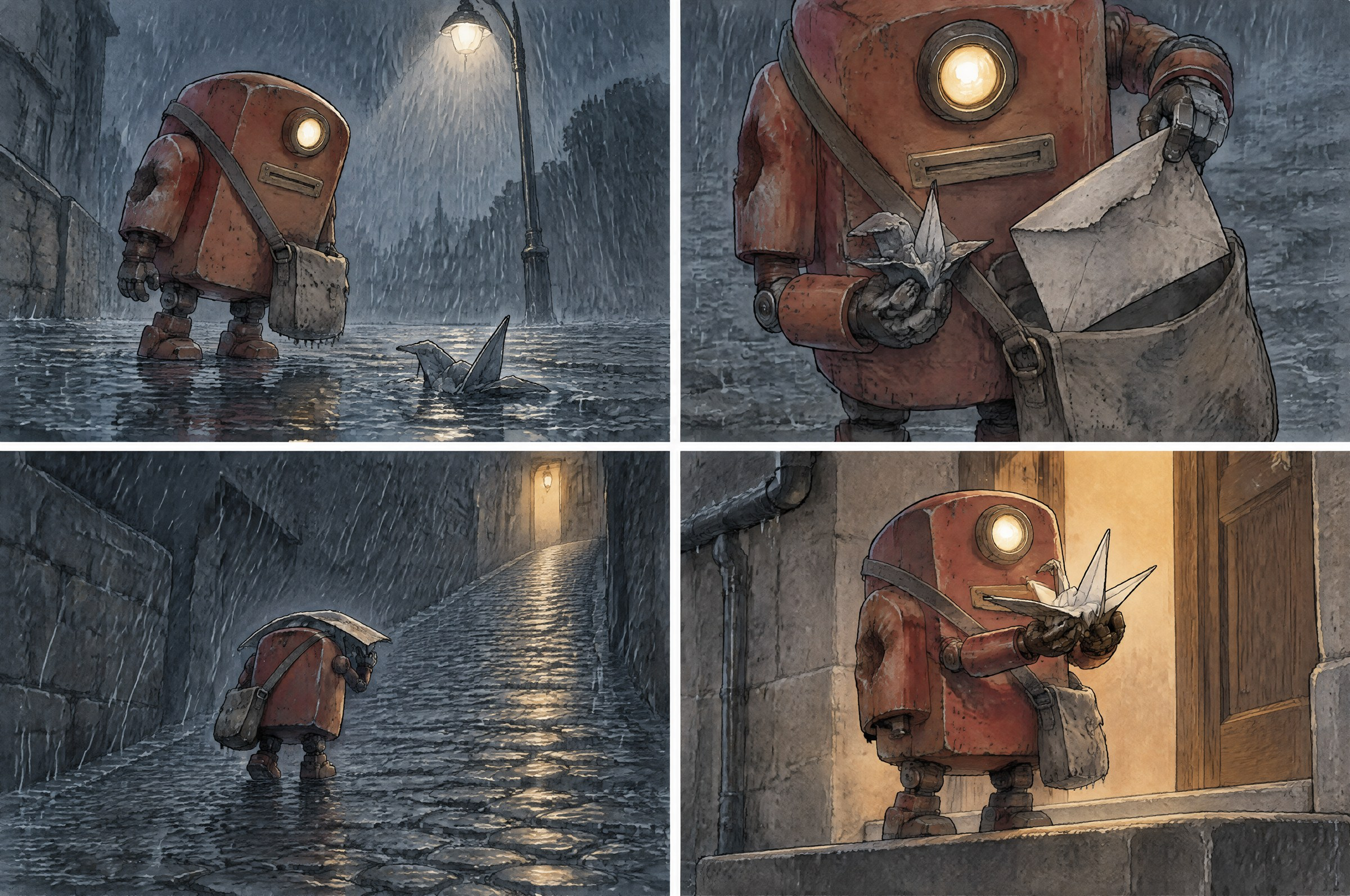
Example generated from “Postal Robot and Paper Crane Comic — Callirra Atlas · CC BY 4.0”
GPT Image 2.5en

A four-panel wordless comic, 3:2 landscape, arranged as two columns of two equal panels with even gutters, reading left to right then top to bottom. Ink line with watercolour wash, consistent throughout. No text of any kind. STYLE Loose confident ink linework with a fine nib, watercolour washes layered underneath, edges softening slightly outside the lines. Cool grey-blue palette for the rain, warm amber for the lit interior. Paper texture visible in the washes. Whites are left as raw paper. Nothing is digitally sharp or vector-clean. THE CHARACTER — identical in all four panels A small boxy postal robot, about knee height, with a rounded rectangular body in faded red paint with visible scratches and a dent in the left flank, a single round lamp eye set high on the front, a small brass slot on the chest, short articulated legs with flat feet, and a worn canvas mail satchel on a strap across its body. Its proportions, paint wear and the dent must be in the same place in every panel. THE STORY, four beats Panel 1 — the discovery. Medium shot, low angle at the robot's eye level. Rain falls across the frame. The robot stands on a wet pavement looking down at a small paper crane lying crumpled in a puddle, one wing soaked through and dark. A single street lamp above and behind it throws a cold cone of light; the crane sits just inside the light's edge. Panel 2 — the protection. Close-up, from just above. The robot has lifted the crane clear of the water and is holding it against its chest with one small articulated hand while it pulls a large used envelope out of the satchel with the other. The envelope is already creased and its flap is torn. The robot's lamp eye is angled down at the crane. Panel 3 — the journey. Wide shot, from behind and slightly to the side. The robot walks away from us up a steep wet cobbled lane toward a single warm light at the far end. It is holding the envelope arched over the crane like a small roof; the crane is hidden underneath, only its folded tip visible. Rain streaks the frame diagonally. The lane is empty and dark. Panel 4 — the arrival. Medium close-up, from a low angle. The robot stands on a dry stone doorstep in front of a warm amber doorway with a paper of light spilling out onto the wet step. It is holding the crane up with both hands, offering it. The crane is dry and its folds have opened back into shape. The rain has stopped and only drips from the gutter remain. CONSISTENCY The same robot, the same satchel, the same envelope once it appears, the same crane. Lighting is consistent throughout: cold blue-grey for the rain in panels 1 to 3, warm amber for the doorway in panel 4. The paper crane's condition progresses in one direction only — soaked in panel 1, dark and limp in panel 2 and 3, dry and opened back into shape in panel 4. CONSTRAINTS No text anywhere: no dialogue, no captions, no sound-effect lettering, no signage, no page numbers, no watermark, no signature. Do not add a title, a border beyond the gutters, or a gutter gutter label. Do not add people, cats, cars, bins or other props. Do not let the robot's design change between panels, and do not mirror its dent or its satchel strap between panels. Do not make the crane into a bird — it stays a folded paper object in every panel.

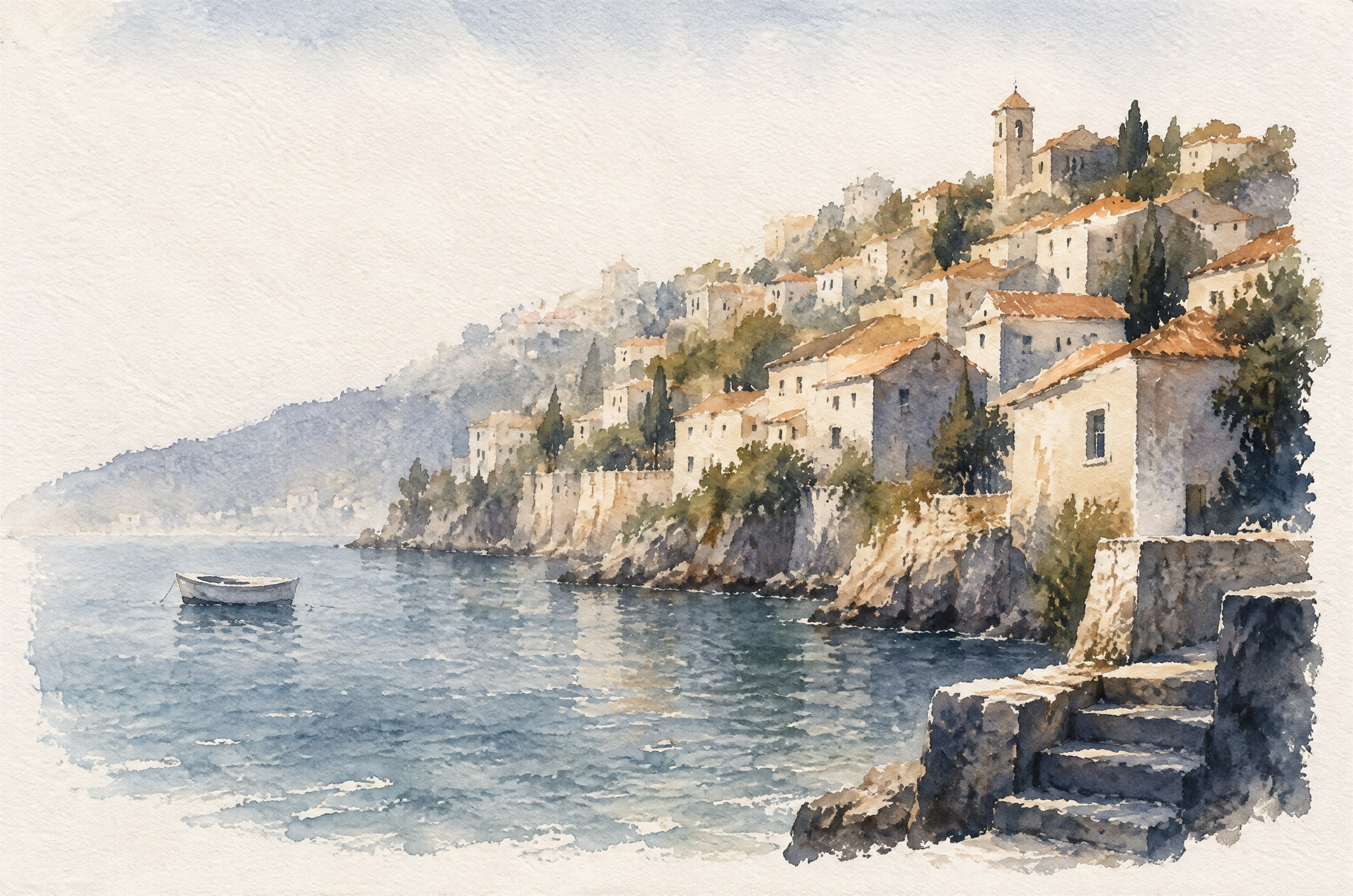
Example generated from “Watercolor Coastal Town — Callirra Atlas · CC BY 4.0”
GPT Image 2.5en

A loose watercolour painting of a small coastal town on a steep hillside, on a 3:2 landscape sheet of rough cold-pressed paper, painted from across the water at a low vantage point. COMPOSITION The town rises diagonally from the lower right to the upper left, filling the right two thirds of the sheet with stacked whitewashed houses and terracotta roofs. To the left, a strip of harbour water occupies the lower third and opens toward the upper left, where the paper is left almost entirely unpainted. In the immediate foreground at the lower right, a short flight of worn stone steps and a low wall anchor the composition and are painted darkest. A single small boat sits on the water at the middle left, very simply described, no rigging detail. The sky is bare paper with one pale wash at the very top edge. No element touches the sheet's edges; generous margins are left on all four sides. WATERCOLOUR TECHNIQUE — this is the subject of the painting as much as the town is Wet-in-wet for the sky and the water, so the two bleed into each other along a soft horizontal band. Wet-on-dry for the roofs and the walls, so their edges stay crisp on the lit sides and soften on the shadowed ones. Where two washes meet, one is allowed to bloom into the other and the granulation of the pigment settles visibly in that boundary. Roof terracotta granulates into the wall below it in places. Several edges are deliberately lost: the far end of the town dissolves into the sky with no line at all. The paper's tooth shows through every wash, and a few small dry-brush skips appear where pigment was dragged across the grain. Whites are unpainted paper — there is no white paint anywhere in the image. PALETTE — four pigments only A warm ochre, a burnt sienna for the roofs, a cool grey-blue for the water and distant hill, and one deep indigo for the darkest notes in the foreground steps and the shadowed sides of two or three houses. Colours are allowed to mix on the paper rather than on the palette, so the greys lean green in places and violet in others. CONSTRAINTS No people, no animals, no vehicles, no boats beyond the single one, no cranes, no washing lines with legible laundry, no signage. No text, no signature, no stamp, no watermark. Do not tighten the painting: no hard outlines around buildings, no evenly-filled shapes, no white body paint, no digital-looking gradients. Do not paint every window — most house fronts are left as a single wash with one or two dark window marks only.

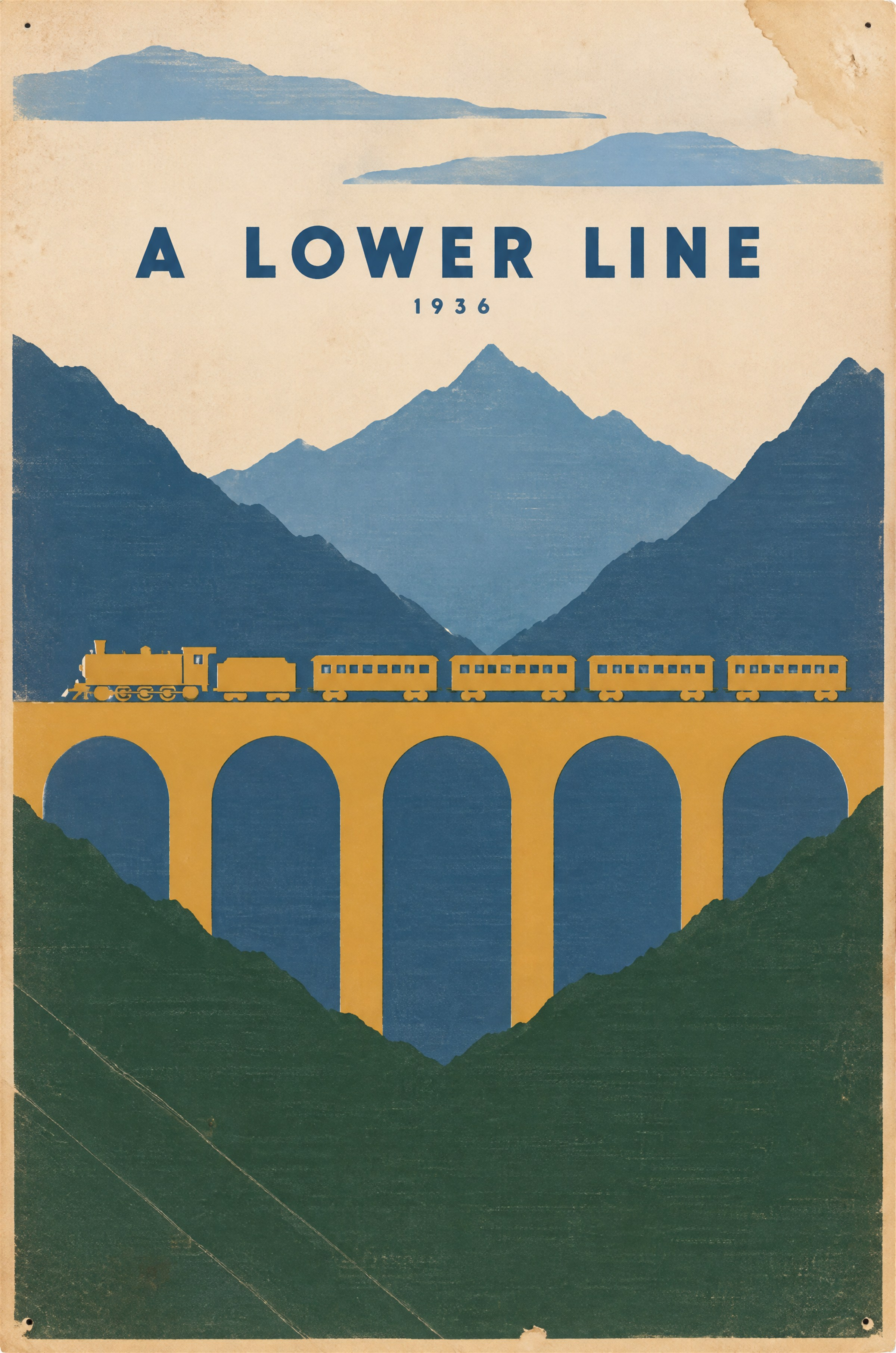
Example generated from “Fictional 1936 Railway Poster — Callirra Atlas · CC BY 4.0”
GPT Image 2.5en

A 1936 travel poster, 2:3 portrait, designed as a four-colour silkscreen print on aged poster stock and seen perfectly flat and straight on — this is the printed sheet, not a photograph of one on a wall. COMPOSITION A steep mountain valley seen head-on, arranged in three flat bands. The lower band is the valley floor, a single flat dark green. Above it, a tall viaduct crosses the full width on five arches, drawn as one flat ochre shape with the arches cut out as negative space. On the viaduct, a passenger train in profile running left to right: locomotive, tender and four carriages, reduced to their simplest readable silhouettes with no interior detail and no visible windows, only a row of small rectangles along the carriages. Behind and above the viaduct, three peaks rise in two flat blues, the nearer one darker. The sky is the paper colour left bare, with two long horizontal clouds as single flat shapes. Vertical composition: the train sits on the upper third, the valley floor occupies the lower quarter, and the peaks fill the space between. TEXT — render exactly these two strings, each appearing once "A LOWER LINE" "1936" Set "A LOWER LINE" in a bold geometric sans, all capitals, generously letter-spaced, centred in the band of sky below the peaks; its width is about two thirds of the sheet's width. Set "1936" much smaller in the same typeface, centred directly beneath it, at about one sixth of the title's height. No other text anywhere: no route names, no station names, no prices, no small print, no printer's marks. PRINT CHARACTER — deliberately imperfect Four flat inks only: ochre, deep green, two blues, plus the paper. Each colour sits in its own solid shape with hard edges and no gradients, no shading and no halftones. Registration is very slightly out on one or two plates, so a thin sliver of paper shows along the left edge of the train's ochre and along the top edge of one blue peak — under one millimetre and never enough to look broken. Ink is slightly uneven within a shape where the screen was thin, with fine horizontal streaks visible in the largest flat areas. The paper is aged: a warm off-white with light foxing at the corners, two soft handling creases running diagonally across the lower left, a small water stain at the upper right that has very slightly lifted the blue, and a tiny nibbled loss at the bottom edge. Four pinholes, one in each corner, sit just inside the margin. CONSTRAINTS No illustration style other than flat silkscreen: no painterly edges, no airbrush, no glow, no photo texture, no 3D shading, no drop shadows. Do not add people, birds, trees with individual leaves, rocks, rivers, road signs or a border. Do not paraphrase, re-case, hyphenate or translate the two strings, and do not add a year, a place name or a slogan. No mockup: no wall, no frame, no shadow behind the sheet, no perspective tilt, no tape or pins other than the four pinholes.

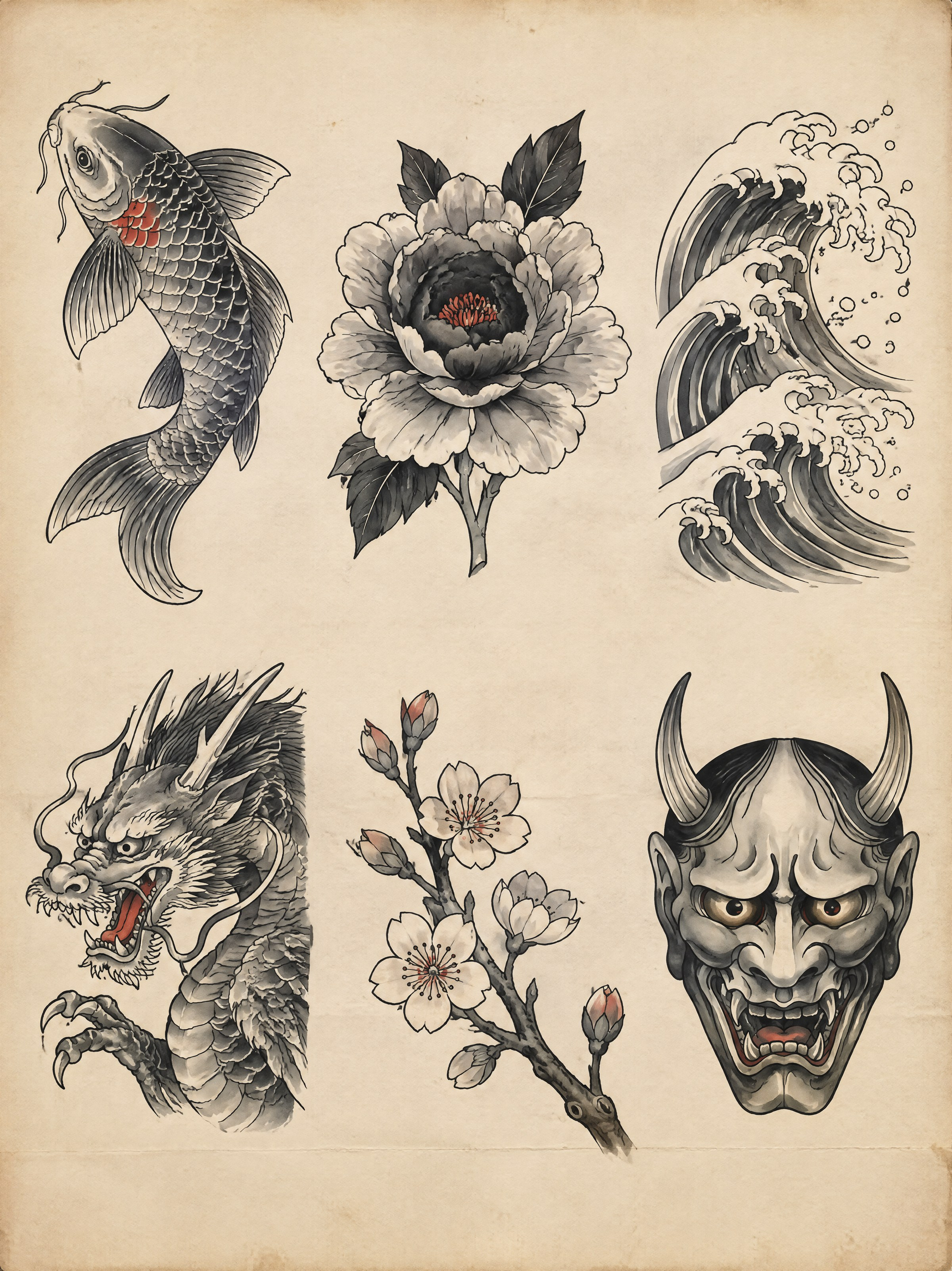
Example generated from “Six-Motif Irezumi Flash Study — Callirra Atlas · CC BY 4.0”
GPT Image 2.5en

A traditional Japanese tattoo flash sheet, 3:4 portrait, drawn in black sumi ink with grey wash and one accent colour on a single aged sheet of off-white paper, flat and straight on. SHEET Six motifs arranged in a 3 by 2 grid with wide, even clear space between them and a generous margin on all four sides. Each motif is a finished, self-contained design that could be lifted off the sheet and tattooed as it stands. No boxes, no frames, no dividing rules, no shading behind the motifs. The paper is warm off-white with a faint fibrous tooth, a soft crease across the lower third, and a very slight tea-coloured tone at the edges. THE SIX MOTIFS, top row left to right then bottom row left to right 1. A koi carp swimming upward and to the left, body curved into a strong S, fins spread and filled with fine black lines, a few scales picked out individually near the shoulder and the rest left as graded grey wash. 2. A single open peony, petals layered from a pale outer ring to a dense dark centre, with two leaves behind it and one stem cut off square at the bottom. 3. A breaking wave drawn with clawed white crests in the traditional manner, the interior filled with a fine pattern of parallel curved lines and graded wash, the spray flicked outward at the top right. 4. A coiled dragon head and shoulder only, seen from the front-left, jaws open, whiskers sweeping back, one claw raised; the body is implied and cropped by the drawing's own edge, not by the sheet. 5. A cherry blossom branch entering from the lower right with five open blossoms at different stages and three closed buds, the branch drawn in a single confident stroke with two small knots. 6. A hannya mask, front on, horns curving back, eyes narrowed, mouth open to show pointed teeth, the cheeks graded from pale grey at the temples to near-black at the jaw. INK AND WASH Fine confident black linework with clear variation in weight: heavy on the outer contours, hair-fine on scales, whiskers, petal veins and water lines. Mid-tones are built from even black wash in distinct flat gradations, not smooth gradients — you can see the edges where one wash value meets the next. The only colour on the sheet is a single vermilion accent, used sparingly and identically in each motif: one small area per design, never more than about a tenth of it. Whites are untouched paper and are used as a designed element, not left over. CONSTRAINTS No text anywhere: no labels, no Japanese characters, no signature, no seal, no stamp, no numbers, no brand mark, no watermark. Do not add background: no clouds, no water, no flowers behind the motifs. Do not merge two motifs into one design and do not let one motif run into its neighbour's space. Do not use more than one accent colour, do not fill large areas with it, and do not outline the motifs with a coloured line. Do not render as a 3D illustration, a tattoo on skin, or a photograph of a sheet.

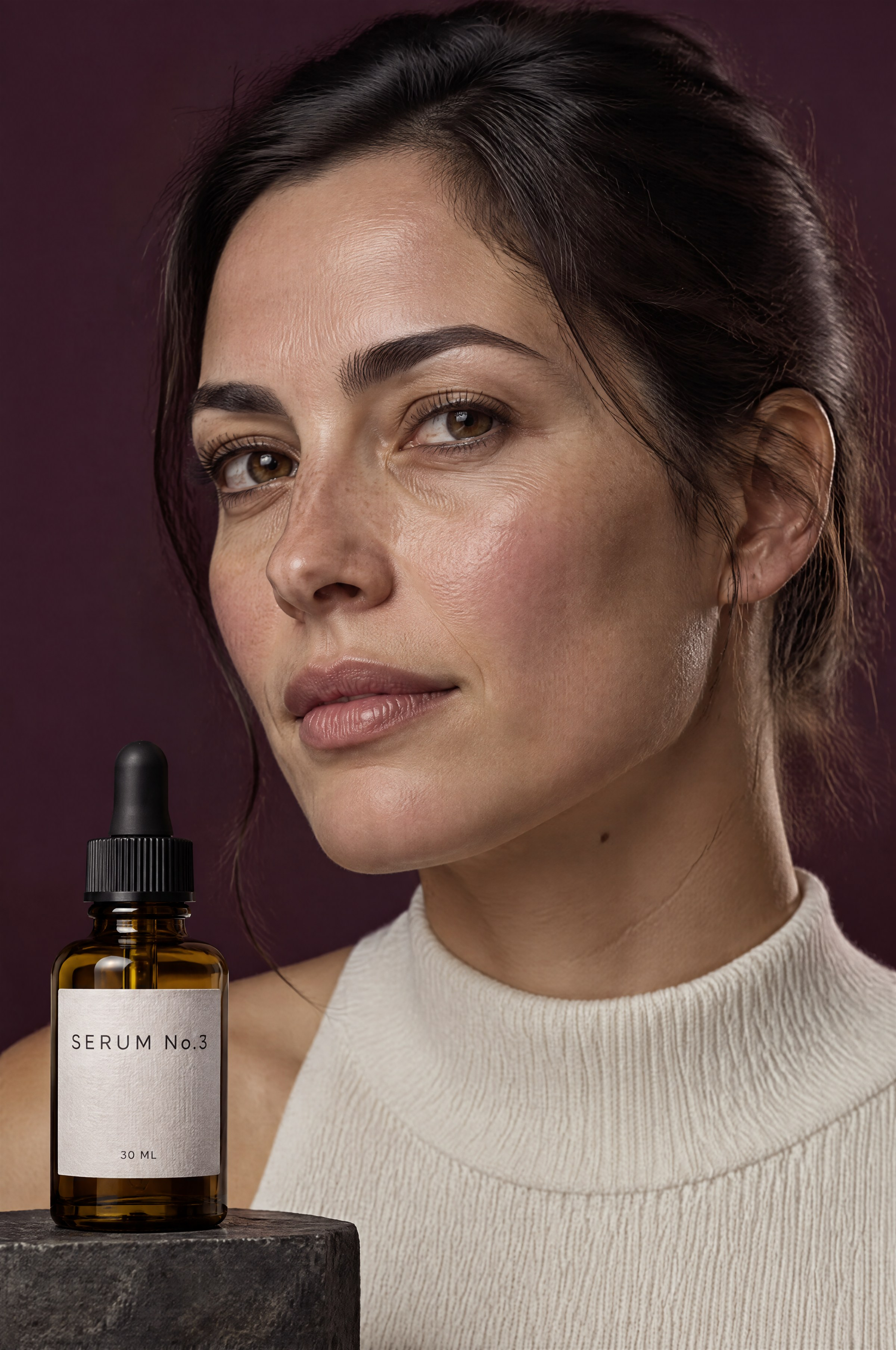
Example generated from “Skincare Serum Editorial Concept — Callirra Atlas · CC BY 4.0”
GPT Image 2.5en

A beauty editorial photograph, 2:3 portrait, a head-and-shoulders portrait with a skincare product standing in the foreground on the same focal plane, shot in a studio against a deep plum seamless. THE FACE A woman of about thirty-five, head and shoulders in frame, turned about forty degrees to her left so three quarters of her face is toward the camera, chin very slightly lowered, eyes looking just off the lens to the left. Expression settled and unperformed — mouth closed and relaxed, no smile for the camera. Dark hair pulled back off the face with a few loose strands at the temple and one at the jaw. Bare shoulders and a high-necked fine-rib knit in off-white, the collar visible at the lower edge of the frame. SKIN — the point of the picture Real skin at close range: visible pores across the nose and inner cheeks, fine lines at the outer eye and between the brows, a faint natural redness across the cheeks and chin, a few small freckles on the temple and the bridge of the nose, one small mole below the left jaw, fine down on the jawline catching the light, and a slight shine on the forehead, nose tip and upper lip — healthy, not greasy, and nowhere matte-flat. Skin tone is even in tone but not in texture. No retouching, no smoothing, no pore-filling, no whitened sclera, no reshaped features. The under-eye area keeps its real depth and colour. PRODUCT An amber glass dropper bottle, 30 ml, standing upright on a low dark stone plinth in the lower left foreground, at the same focus plane as the face so both are sharp. Matte black dropper cap with a fine ribbed skirt, a pipette bulb visible through the glass shoulder, the liquid inside a clear pale gold. A rectangular off-white paper label wraps the front of the bottle, slightly proud at its edge, with a fine fibre texture. The bottle is about a third the height of the face in frame and sits closer to the camera, lower in the picture. EXACT VISIBLE TEXT — render exactly these two strings on the label, once each "SERUM No.3" "30 ML" "SERUM No.3" is the larger, in a fine uppercase sans with wide letter spacing, sitting on the upper third of the label. "30 ML" is much smaller, centred at the bottom of the label. Both must be crisp and correctly kerned. No other text, numbers, symbols or marks appear anywhere in the frame. LIGHT AND CAMERA One large soft source from the front left at about forty-five degrees, close to the subject so the falloff is gentle; one narrow strip light from behind on the right to rim the cheek, the jaw and the shoulder; one black flag on the right to deepen the shadow side. The shadow side of the face keeps detail — it is deep, not blocked. No fill from the front. Camera at eye level, 85 mm equivalent, head and shoulders, the top of the head inside the frame with headroom, the collar cut by the lower edge. Shallow depth of field, but the eyes, the lips and the label are all inside it. COLOUR AND FINISH Deep plum seamless background, one value, no gradient and no visible sweep edge. Palette is warm neutral skin against cool plum, with the amber glass the only saturated element. Natural colour, slight film grain, no coloured gels, no glow, no bloom. CONSTRAINTS No other products, no cotton pads, no flowers, no water droplets on the face, no jewellery, no visible hands or fingers anywhere in the frame, no second figure. No invented claims, ingredient names, badges, awards, price tags, barcodes or certification marks. Do not add text anywhere except the two strings above. Do not smooth, lift, slim, widen or symmetrise the face. Do not make the skin plastic, waxy or uniformly matte. No watermark.

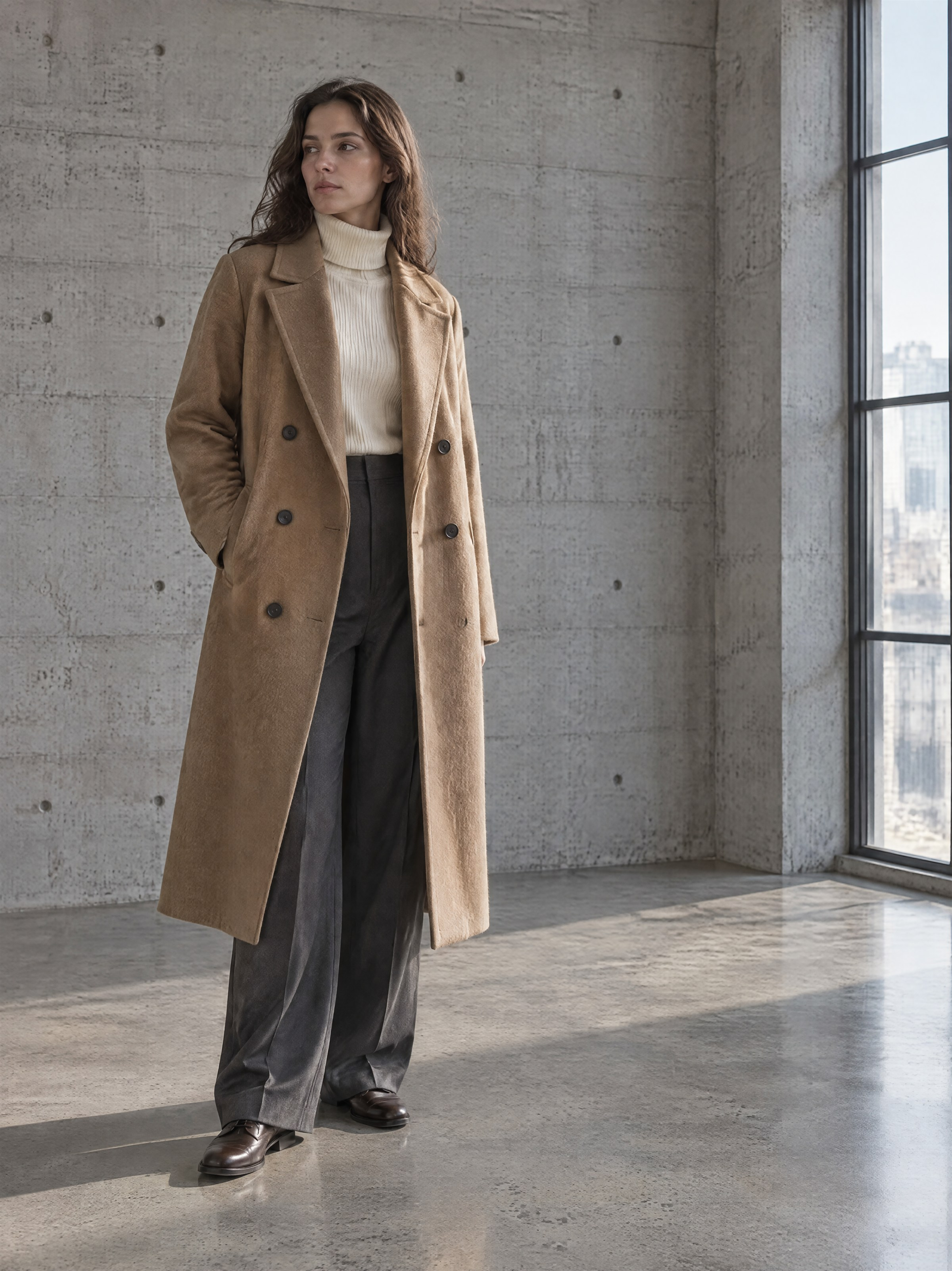
Example generated from “Camel Coat Fashion Lookbook — Callirra Atlas · CC BY 4.0”
GPT Image 2.5en

A full-body fashion editorial frame, 3:4 portrait, shot in a stripped-back concrete studio in front of a single large window, daylight only. THE FRAME Full body, head to feet, both feet inside the frame with clear floor beneath them and headroom above the head. Camera at chest height, 50 mm equivalent, straight on, no tilt and no wide-angle distortion. The figure stands just left of centre, turned about thirty degrees, leaving a wide column of empty concrete wall and window light to the right. The floor is visible across the lower quarter. Nothing is cropped. THE SUBJECT AND THE OUTFIT A woman in her late twenties, about 175 cm, standing with her weight on the left leg, the right leg relaxed and slightly forward, one hand pushed into the coat pocket so no fingers are visible anywhere in the frame, the other arm hanging relaxed at her side with the hand mostly hidden behind the coat's edge. Chin level, gaze directed off to the left of the lens, expression neutral and unperformed, mouth closed. Outfit, in this order from the outside in: an oversized double-breasted wool coat in camel, cut long to mid-calf, with wide notch lapels, horn buttons and a visible brushed nap; beneath it a fine-gauge ribbed knit in chalk white with a high rolled neck; wide-leg wool trousers in charcoal with a single centre crease; low leather derby shoes in dark brown, laced. The coat is worn open, hanging straight from the shoulders, so the knit and the trouser waist are both visible. One shoulder of the coat sits slightly forward, as it would if a real garment were worn open. STUDIO AND LIGHT A bare concrete studio: board-formed walls with visible horizontal formwork lines and a scatter of small tie holes, a polished concrete floor with a faint sheen, one large steel-framed window occupying the right third of the back wall. Daylight only, entering through that window from the right at a low morning angle, so the subject is lit from her right side: the lit side of the coat shows the wool's nap and the shadowed side holds detail without going black. Long soft-edged shadow of the figure falls to the left across the floor. No artificial light, no fill, no reflector, no coloured light. MATERIAL Wool coat: brushed nap readable at this distance, edges of the lapel slightly lighter where the fibre catches the light, one or two fine creases across the sleeve at the elbow. Rib knit: fine vertical ribs, a matte surface, a soft fold at the neck. Trousers: smooth worsted wool with a crisp centre crease and a slight break over the shoe. Leather shoes: scuffed toe, one clean highlight. Concrete: cold grey, matte, small aggregate visible in the floor's polished sheen. CONSTRAINTS No visible hands, no fingers, no jewellery, no bag, no hat, no scarf, no second figure, no props, no furniture, no plants. No text, no signage, no logo on the clothing, no watermark. Do not change the outfit's proportions, do not shorten the coat, and do not turn it into a different garment. Do not add a background wall other than the concrete described, and do not add a cyclorama or a studio backdrop paper. Do not pose the subject: no hand on hip, no arm raised, no walk, no jump. Do not retouch the face or slim the body.

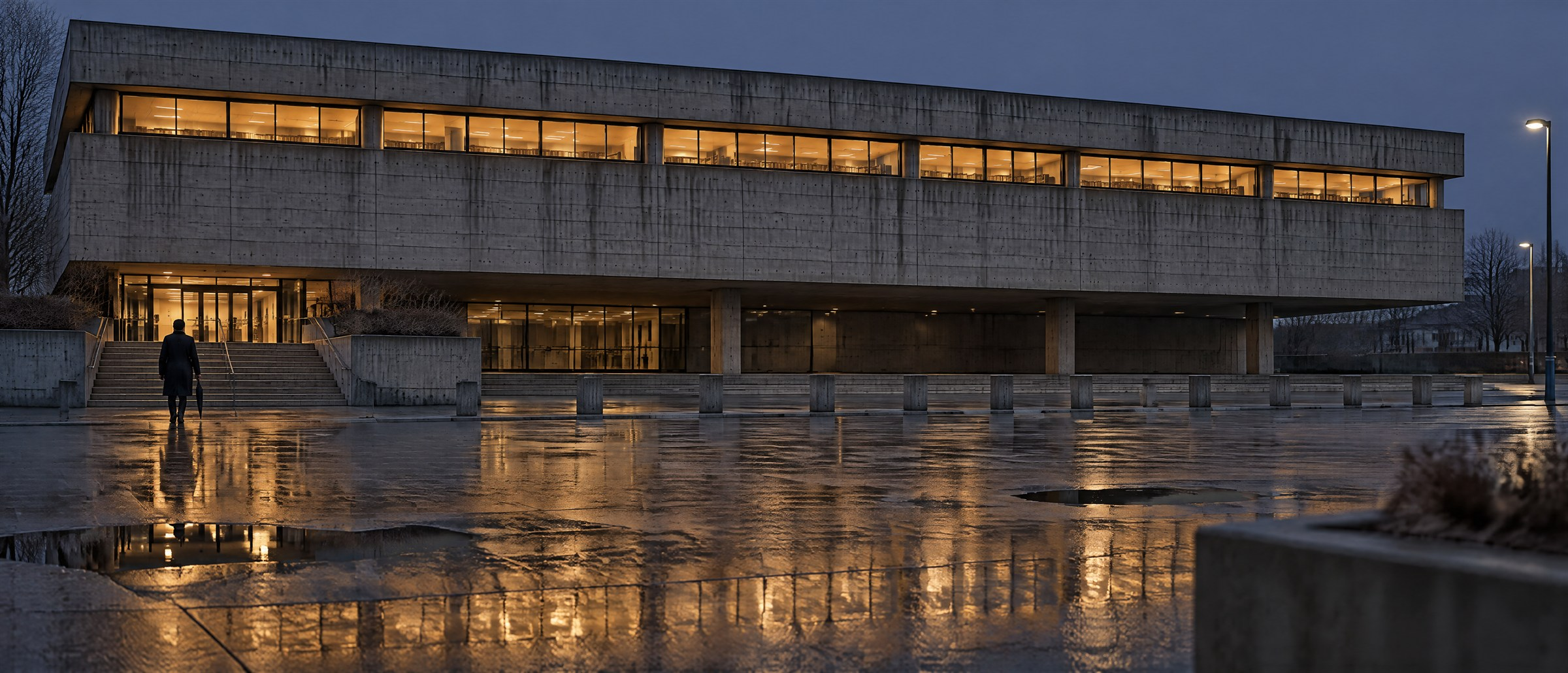
Example generated from “Brutalist Library Architecture Concept — Callirra Atlas · CC BY 4.0”
GPT Image 2.5en

A wide architectural photograph of a brutalist public library at dusk, 21:9, shot from across a wet plaza. THE BUILDING A long, low concrete volume, roughly five times as wide as it is tall, sitting heavily on a raised podium. Its upper mass cantilevers out over a recessed ground floor, so a deep shadowed undercroft runs the full width beneath it. The concrete is board-formed, with horizontal formwork lines running the entire length at even spacing, a regular grid of small circular tie holes, and long vertical rain streaks staining the surface below the parapet. A continuous band of clerestory glazing sits directly under the roof slab along the whole facade, glowing warm from the interior lights inside. At the left end, a broad flight of concrete steps rises to the entrance, flanked by two low concrete planters holding bare winter shrubs. The roof slab reads as a single heavy horizontal line against the sky. THE PLAZA Wet dark paving across the lower half of the frame, holding long reflections of the glowing window band and of the street lamps. Two shallow puddles with visible edges. A row of low concrete bollards runs across the middle distance. A single steel handrail beside the steps. One street lamp at the far right, out of focus. In the foreground, the corner of a concrete planter crops into the lower right of the frame, out of focus. THE FIGURE One person, small in the frame, walking away from the camera toward the entrance at the left, wearing a long dark coat and carrying a closed umbrella. Their reflection stretches down into the wet paving beneath them. They are the only person in the frame and they occupy roughly one fifteenth of the frame height. LIGHT Blue hour, after sunset, no sun. The dominant light comes from the building itself: the warm amber clerestory band is the brightest thing in the picture and it is the source of every warm reflection on the wet plaza. Cool blue-grey ambient sky light fills the concrete's upper surfaces and the far end of the plaza. Two street lamps add small cold pools of light at the right. The two temperatures never blend — the concrete outside the window band stays cold, the interior glow stays warm. Long soft shadows fall away from the building toward the camera. CONSTRAINTS No readable signage, no lettering on the building, no logos, no vehicle number plates, no advertising. Any text-like mark must stay illegible: off-angle, out of focus or too distant to resolve, and it must never resolve into invented words. No cars, no buses, no bicycles, no litter, no crowds and no second figure. No lens flare. Do not straighten, tilt or perspective-correct the frame: keep the camera level and the verticals true. Do not make the building glossy or reflective; concrete is matte everywhere except where it is wet. No watermark. Do not add neon, coloured gels, mist or light beams.

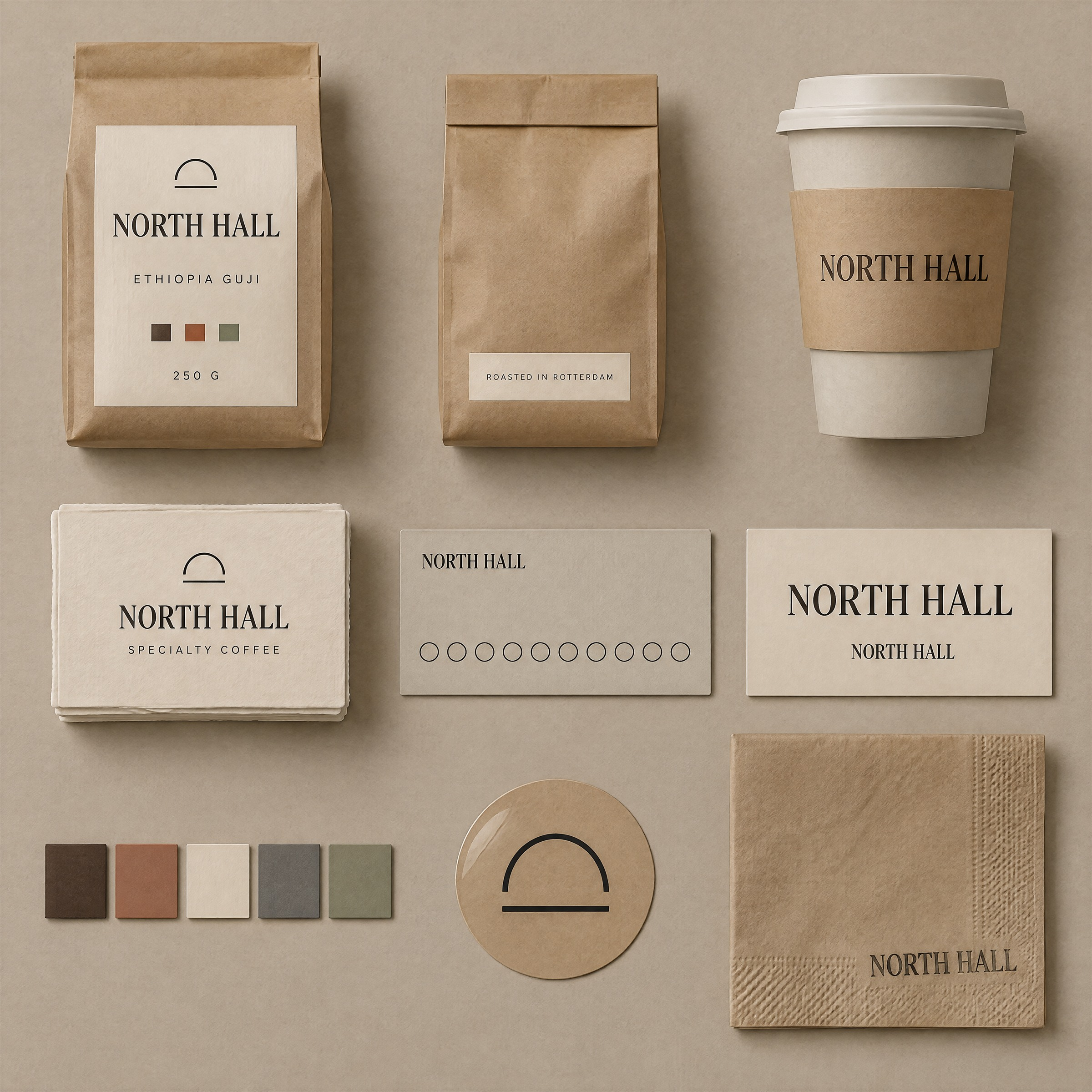
Example generated from “North Hall Coffee Identity Board — Callirra Atlas · CC BY 4.0”
GPT Image 2.5en

A brand identity touchpoint board for a specialty coffee roaster, 1:1 square, presented as a studio flat lay photographed from directly above: nine physical items arranged in a 3 by 3 grid on a warm greige paper backdrop, evenly spaced, each item fully inside its own cell with clear air around it. THE BRAND — identical on every item The wordmark is the words "NORTH HALL" set in a single high-contrast serif, all capitals, with the two words on one line separated by a single space, tracked tight. It appears on seven of the nine items and must be letter-for-letter identical on all of them: same typeface, same weight, same letterforms, same proportions, same spacing between the two words, and the same clear space around it equal to the height of the letter H on every side. A small circular emblem — a thin-stroke arch over a horizontal line — sits above the wordmark on packaging only, and is the same size relative to the wordmark wherever it appears. THE NINE ITEMS, reading left to right then top to bottom 1. A 250 g kraft coffee bag, front on, with a cream label panel carrying the wordmark in the upper third and "ETHIOPIA GUJI" in a small wide-spaced sans beneath it, plus a row of three small filled squares at the bottom of the label indicating roast level. 2. The same bag seen from behind, filling less of its cell, showing a plain kraft back with a small cream patch carrying two lines of tiny type and a debossed fold line. 3. A stone-coloured takeaway cup standing with a printed kraft sleeve around its middle; the wordmark runs across the sleeve once, horizontally, at the sleeve's vertical centre. 4. A neat stack of thick cotton-rag business cards, the top card square to the camera, carrying the emblem and the wordmark centred, with "SPECIALTY COFFEE" in small wide-tracked capitals beneath it. 5. A slim loyalty card in the same stone colour, laying flat, with the wordmark small at the top left and a row of ten empty circular stamp positions across its lower half, none of them filled. 6. A type specimen strip: the wordmark set large in the centre of a narrow cream card, and directly beneath it the same wordmark at one third of the size, showing that the letterforms do not change with size. 7. Five colour chips in a row — deep espresso brown, clay terracotta, bone cream, slate grey, and one muted sage — each a small square with a narrow margin between them, no text on any chip. 8. A single die-cut vinyl sticker, cream on kraft, carrying only the emblem at a larger size, with no wordmark. 9. A folded kraft napkin with the wordmark stamped once in the lower right corner in slightly uneven ink, so the stamp's edges are a little soft and one corner of the impression is fainter than the rest. MATERIAL AND LIGHT One large soft source from the upper left, close to the set, so shadows fall down and to the right and are soft and short. Materials must be distinguishable: matte uncoated kraft with visible fibre, thick cotton-rag card stock with a deckled textured edge, matt laminated paper on the sleeve, and a slightly glossy vinyl sticker catching one soft highlight. Slight top-down perspective flattening with no keystone distortion. COLOUR The palette is limited to the five chips: deep espresso, clay terracotta, bone cream, slate grey and muted sage. Kraft brown is the substrate, not a palette colour. CONSTRAINTS The wordmark must be spelled exactly "NORTH HALL" everywhere it appears, with no variation, no alternate spelling, no translated version and no second logo. Render only these five strings and no others: "NORTH HALL", "ETHIOPIA GUJI", "SPECIALTY COFFEE", "ROASTED IN ROTTERDAM", "250 G". Do not add taglines, tasting notes, weights, prices, awards, certifications, recycling symbols, barcodes, QR codes or any other text. Do not add a tenth item, a plant, a cup of coffee, beans, a hand or a prop. Do not repeat an item in two cells. Do not rotate the items: everything is square to the camera. No watermark.

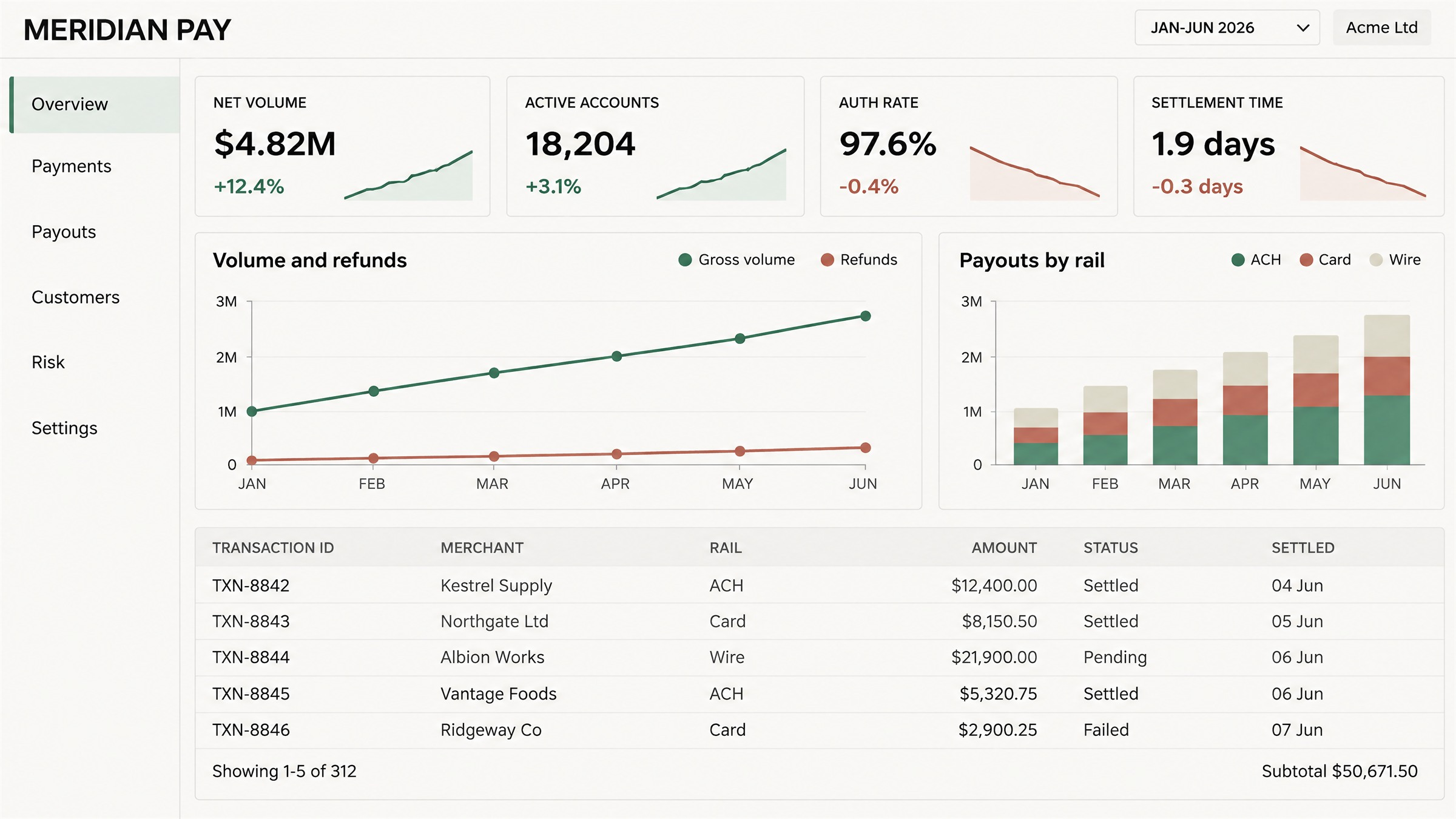
Example generated from “Fictional Fintech Dashboard Mockup — Callirra Atlas · CC BY 4.0”
GPT Image 2.5en

A fintech operations dashboard, 16:9, screen only — a flat rectangular interface shown straight on with no device, no desk, no hand and no perspective. This is a UI mock with real committed data, not a photograph. LAYOUT — fixed regions, no overlap - Top bar, 9% of the frame height: product name at the left, the date-range control and one account chip at the right, and a single hairline rule closing the bar across the full width. - Left rail, 15% of the frame width: six navigation items stacked with even spacing. The first is active, marked by a 3 px accent bar on its left edge and a tinted row background. - Main area, to the right of the rail, split into three stacked panels with even gaps: KPI row 24% of the main height, charts row 36%, table panel 40%. - KPI row: four equal tiles side by side, each with its label above its value, its value above its delta, and one small sparkline at the tile's right edge. - Charts row: a line chart at 62% of the row width and a stacked bar chart at 38%, with one gutter between them. - Table panel: a six-column table with a header row, five data rows and a footer line. - Every panel sits on a flat ground with a 1 px border. No drop shadows anywhere. DATA — this must be internally consistent, and the arithmetic must close - Net volume: $4.82M, up 12.4%, sparkline rising left to right. - Active accounts: 18,204, up 3.1%, sparkline rising left to right. - Auth rate: 97.6%, down 0.4%, sparkline falling left to right. - Settlement time: 1.9 days, down 0.3 days, sparkline falling left to right. Each delta's sign must agree with the direction its own sparkline moves. All four sparklines appear. - The line chart has exactly two series, each with a legend entry, and no legend entry without a series. - The five table amounts below sum to exactly $50,671.50, which is the figure stated in the table footer. EXACT VISIBLE TEXT — render exactly these strings - Product name: "MERIDIAN PAY" - Date range: "JAN-JUN 2026" - Account chip: "Acme Ltd" - Navigation, top to bottom: "Overview" / "Payments" / "Payouts" / "Customers" / "Risk" / "Settings" - KPI tile 1: "NET VOLUME" then "$4.82M" then "+12.4%" - KPI tile 2: "ACTIVE ACCOUNTS" then "18,204" then "+3.1%" - KPI tile 3: "AUTH RATE" then "97.6%" then "-0.4%" - KPI tile 4: "SETTLEMENT TIME" then "1.9 days" then "-0.3 days" - Line chart title: "Volume and refunds"; its legend entries: "Gross volume" and "Refunds" - Line chart x-axis ticks, left to right: "JAN" "FEB" "MAR" "APR" "MAY" "JUN" - Line chart y-axis: four labelled ticks ascending bottom to top: "0", "1M", "2M", "3M" - Bar chart title: "Payouts by rail"; its legend entries: "ACH", "Card", "Wire" - Table headers, in order: "TRANSACTION ID" "MERCHANT" "RAIL" "AMOUNT" "STATUS" "SETTLED" - Table rows, in order: "TXN-8842" "Kestrel Supply" "ACH" "$12,400.00" "Settled" "04 Jun" "TXN-8843" "Northgate Ltd" "Card" "$8,150.50" "Settled" "05 Jun" "TXN-8844" "Albion Works" "Wire" "$21,900.00" "Pending" "06 Jun" "TXN-8845" "Vantage Foods" "ACH" "$5,320.75" "Settled" "06 Jun" "TXN-8846" "Ridgeway Co" "Card" "$2,900.25" "Failed" "07 Jun" - Table footer: "Showing 1-5 of 312" at the left and "Subtotal $50,671.50" at the right TYPOGRAPHY One UI sans throughout, five sizes only: page-level product name, KPI value, panel title, table and axis text, and small labels. Numerals are tabular. The AMOUNT column is right-aligned; all other columns are left-aligned. KPI values are right-aligned within their tiles. All text is horizontal. RENDERING Flat interface rendering: no photographic lighting, no reflections, no glass, no bevels, no gradients. Ground "#FBFAF8", body text "#1C1B19", one accent "#3D6B4F" used only for the active nav bar, the positive deltas and the primary chart series; negative deltas in a muted "#B4442E". Hairline borders in "#E3DFD8". A 1 px grid of faint horizontal rules in the table only. CONSTRAINTS Render only the strings listed above. Do not invent a metric, a merchant, a transaction, a menu item, a column, a tooltip, a notification badge or a footnote. Do not use lorem ipsum, "TBD", "xx,xxx" or placeholder dashes. Every chart must have both labelled axes and legend entries that match the series actually drawn. No two table rows may share a transaction ID and no value may repeat verbatim in two rows of the same column. No browser chrome, no OS status bar, no notch, no cursor, no selection highlight, no watermark. Do not round or reformat any figure, and do not change a single digit.

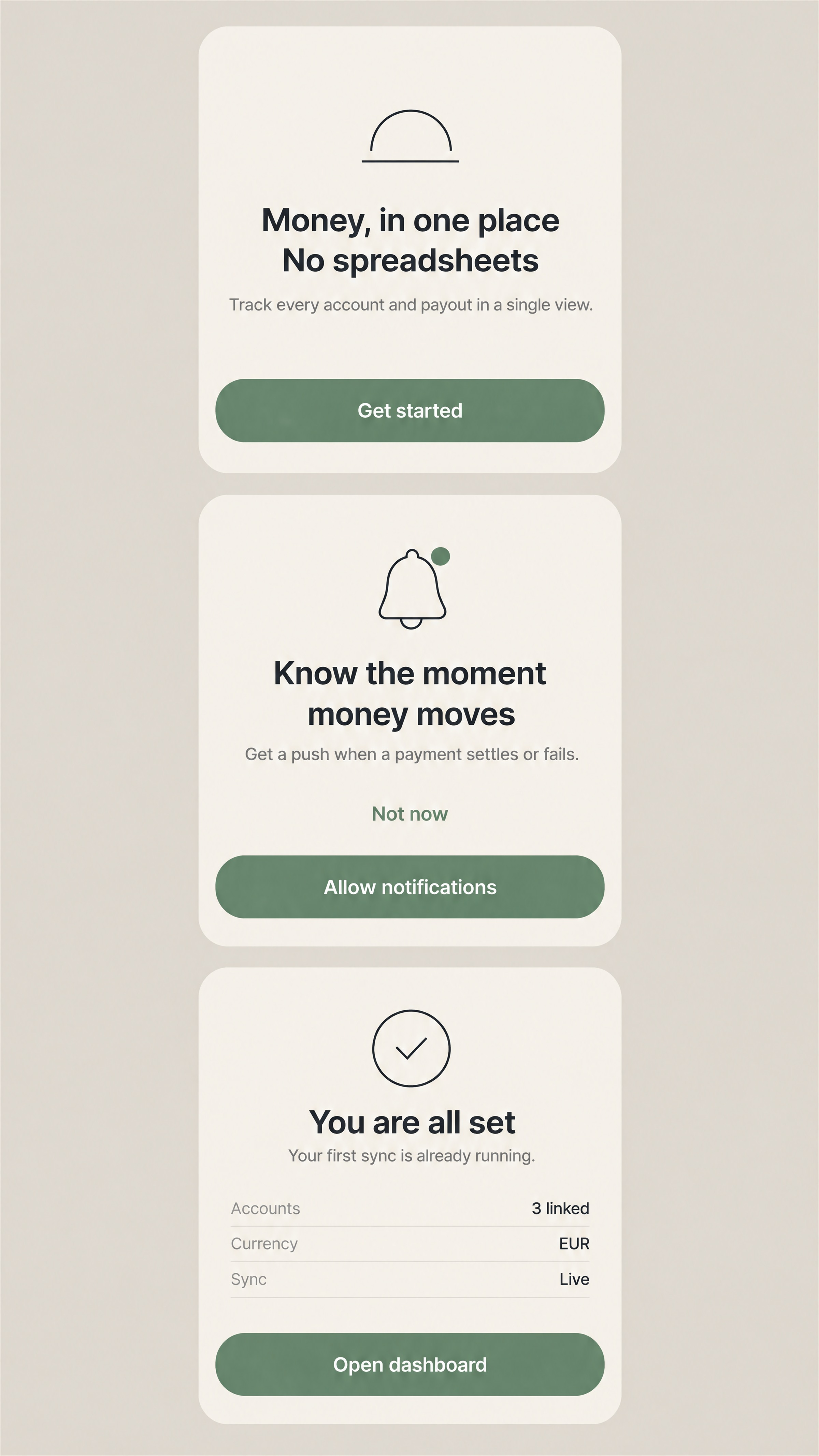
Example generated from “Three-Screen Mobile Onboarding Concept — Callirra Atlas · CC BY 4.0”
GPT Image 2.5en

A mobile app onboarding set, 9:16 portrait, presented as three phone screens stacked vertically on a soft warm greige background with even gaps between them, shown straight on with no perspective and no hand. THE THREE SCREENS, top to bottom - Each screen is a rounded rectangle at the same size and the same width, occupying about 30% of the frame height each, their left and right edges aligned to one vertical axis so the stack reads as a single column. - Each screen shows its content only: no device bezel, no notch, no camera cutout, no status bar, no home indicator, no browser chrome. The rounded corners are the only indication that these are screens. SCREEN 1 — welcome A small thin-stroke emblem centred in the upper third: an arch over a horizontal line. Below it, a two-line headline centred. Below that, one short supporting line centred in a lighter weight. At the bottom, a single full-width primary button with rounded ends, filled in the accent colour, with its label centred. SCREEN 2 — notifications A simple line illustration centred in the upper third: a rounded bell with a single small dot badge at its upper right, drawn with the same thin stroke as the emblem on screen 1. Below it, a two-line headline centred and one supporting line. At the bottom, the same full-width primary button, and directly above it one text-only secondary link centred in the accent colour. SCREEN 3 — complete A centred mark in the upper third: a thin-stroke circle with a simple check inside it. Below it, a short headline of four words centred, one supporting line, and a small three-row summary list — each row a label at the left and a value at the right, separated by faint rules. At the bottom, the same full-width primary button. EXACT VISIBLE TEXT — render exactly these strings, once each, in the screen stated - Screen 1 headline line 1: "Money, in one place" - Screen 1 headline line 2: "No spreadsheets" - Screen 1 supporting line: "Track every account and payout in a single view." - Screen 1 button: "Get started" - Screen 2 headline line 1: "Know the moment" - Screen 2 headline line 2: "money moves" - Screen 2 supporting line: "Get a push when a payment settles or fails." - Screen 2 button: "Allow notifications" - Screen 2 secondary link: "Not now" - Screen 3 headline: "You are all set" - Screen 3 supporting line: "Your first sync is already running." - Screen 3 summary row labels, top to bottom: "Accounts", "Currency", "Sync" - Screen 3 summary row values, top to bottom: "3 linked", "EUR", "Live" - Screen 3 button: "Open dashboard" No other text anywhere — no page dots, no step counters, no "1 of 3", no version numbers, no legal line, no watermark. STYLE AND MATERIAL A light, warm, quiet interface. Ground is a warm off-white; body text is near-black; one accent colour, a muted green, used only for the three primary buttons, the secondary link and the small bell badge. Type is one geometric sans throughout, in exactly four sizes: headline, supporting line, button label, and the small summary rows. Rounded rectangles with generous internal padding. Buttons are flat fills with no gradient, no shadow and no border. Thin line illustrations use a single stroke weight throughout and no fills except the bell badge. CONSTRAINTS No dark mode, no glassmorphism, no neon, no gradient meshes, no photographic imagery, no product screenshots inside the screens, no charts or graphs on any screen. Do not add a fourth screen, a floating card, a tooltip, a notification banner, an avatar or a logo other than the emblem described. Do not rotate, tilt or perspective the screens. Do not paraphrase, re-case or re-punctuate any string, and do not add a full stop that is not written above. No watermark, no signature, no frame around the whole set.

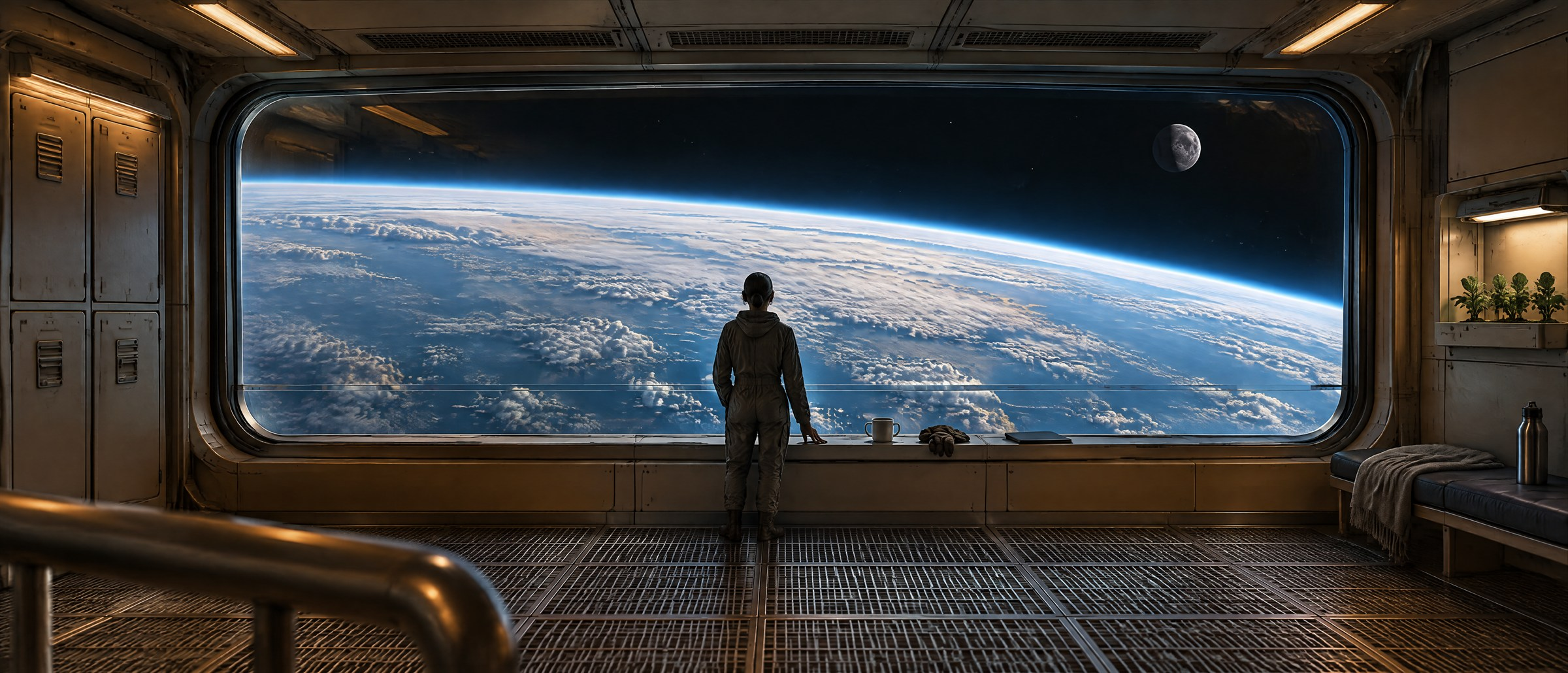
Example generated from “Orbital Observation Deck Concept — Callirra Atlas · CC BY 4.0”
GPT Image 2.5en

An interior photograph from inside an orbital station's observation deck, 21:9, looking out through a huge curved window at the limb of a planet. Shot on a wide lens from the back of the deck so the window frame, the interior and the view all read at once. THE WINDOW The window is the far wall: a single curved pane about four metres tall and twelve wide, held in a deep structural frame. The frame is heavy and layered — an outer structural rib, then a primary seal, then an inner trim panel — and every layer is visible in section where it meets the glass. Running horizontally across the glass at waist height is one thin defroster wire, and at its lower edge a narrow metal sill. The glass itself is not perfectly clear: a faint double reflection of the interior lights sits across its upper left, and where the deck's warm light is brightest the glass picks up a soft haze. THE VIEW A planet limb fills the lower two thirds of the window, seen from low orbit: a curved horizon running from the lower left to the middle right, cloud bands layered in soft horizontal streaks, and a deep blue ocean under broken cloud toward the terminator. Above the horizon, a thin bright arc of atmosphere — a single luminous line of pale blue-white — separates the planet from the black of space. Above that, space is almost black with a very sparse scatter of stars, no more than thirty visible in the whole pane. In the upper right of the window, one small airless moon, a plain grey disc with visible craters along its lower edge, no larger than a thumbnail at this distance. THE DECK The interior is compact and functional. In the foreground, low and slightly out of focus, the top rail of a steel handrail crosses the lower left. Along the left wall, four equipment lockers with louvred vents and plain recessed latches. On the ceiling, two continuous strips of warm light running the length of the deck, their housings visible. The floor is open steel grating. Against the right wall, a narrow upholstered bench with a folded grey blanket and one steel water bottle. In a recessed tray beside the window, a shallow hydroponic unit with four small green plants under a single small grow lamp. On the sill by the window, one ceramic mug, a pair of work gloves and a hand-held tablet lying face down. THE FIGURE One person, standing at the centre of the window with their back to camera, small in the frame — about one ninth of the frame height — silhouetted against the planet, wearing a soft grey flight suit with the hood down, one hand resting on the sill. No other person anywhere. LIGHT Two sources only. Inside: the warm amber ceiling strips, which light the deck, the lockers, the bench and the figure's shoulders from above and behind, and put a warm reflection across the upper left of the glass. Outside: the cold blue-white light of the planet, which rims the window frame from beyond and lights nothing inside the deck. The two temperatures never mix: interiors stay amber, the planet stays cold, and the figure is read as a silhouette because the outside is brighter than the inside. CONSTRAINTS No text anywhere: no signage, no labels on the lockers, no warning placards, no numbers, no stencilled lettering, no readable screens, no watermark. Do not add a second figure, a spaceship, a satellite, a docking bay, a spacecraft passing by, or a laser. No lens flare, no light beams, no god rays. Do not make space purple, do not add nebulae or coloured stars, and do not fill the window with debris. Keep the verticals of the window frame true and the horizon a genuine curve, not a straight line. No HUD overlays, no targeting reticles, no graphics layered over the view.

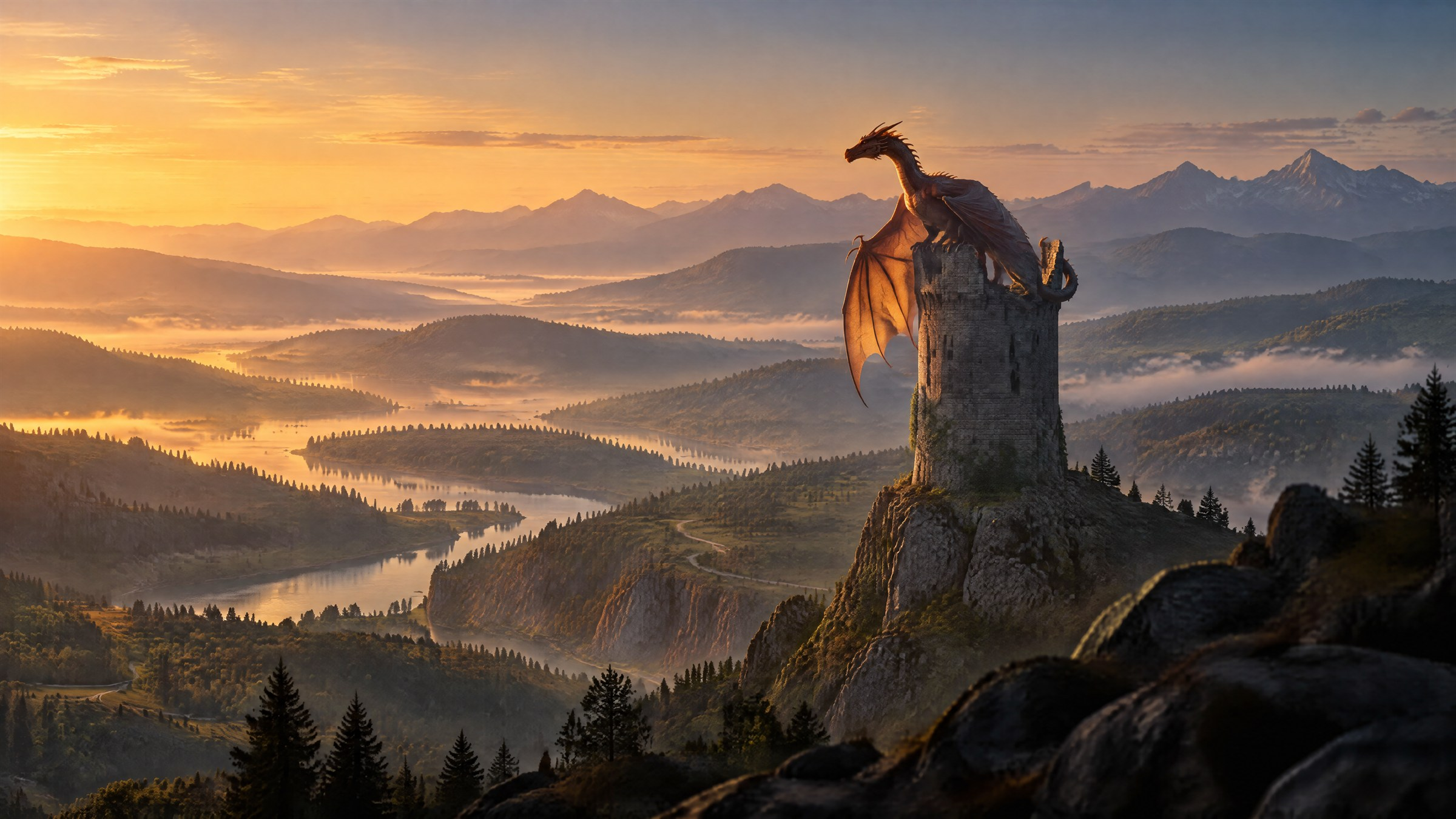
Example generated from “Dragon on a Ruined Tower — Callirra Atlas · CC BY 4.0”
GPT Image 2.5en

A wide fantasy landscape painting, 16:9, of a dragon perched on the broken crown of a ruined stone tower at golden hour, seen from a distance across a valley so that scale reads before detail does. THE TOWER A single round tower of dark weathered stone, standing on a rocky spur in the middle distance, its upper third collapsed: the crown is broken open on the near side, the wall's cross-section showing rubble core and double skins of squared masonry. Two merlons survive on the far side; the rest is a stepped ruin. A spiral of narrow windows runs up the shaft, dark and empty. Ivy climbs the lower third. The tower is roughly one sixth of the frame height, and it is the only building in the picture. THE DRAGON Perched on the broken crown, gripping the shattered stone with four clawed feet, tail curled around the remaining merlon. It is long and lean rather than bulky, with a serpentine neck and a narrow head, and its near wing is half-spread and half-folded, drooping down the outside of the tower so its tip hangs in open air. The far wing is folded along the back. Its head is turned in profile to the left, looking out down the valley. Its total body length is about twice the tower's width, so it reads as large without dominating the frame. THE VALLEY Below and beyond the tower, a broad valley recedes in five or six distinct layers of depth: a foreground ridge in near-black silhouette at the lower right; the spur and the tower; a middle distance of wooded slopes in muted green; a wide river catching the light as a pale ribbon; a far range of hills in cool blue-grey; and a final band of distant peaks reduced almost to haze. Three separate layers of low mist lie in the folds between ridges, each flat-bottomed and each paler than the layer behind it. A single narrow road winds through the middle distance with two tiny switchbacks; no vehicles and no travellers are visible on it. LIGHT — this is the whole picture The sun is out of frame to the left and very low, just above the horizon line behind the far hills. It throws warm amber light almost horizontally: every left-facing surface catches it, every right-facing surface falls into cool shadow, and the shadows run long toward the right. The dragon is rim-lit along the top of its neck, the leading edge of its wing and the whole length of its tail. The sun's disc itself is not visible; only its glow behind the haze of the far range. The mist layers catch the light so each one is warm at its top edge and cool underneath. The sky above the hills moves from warm amber at the horizon through pale gold to a cool blue-grey at the top of the frame. WING MEMBRANE Where the near wing is spread against the light, the membrane between the fingers is translucent: the low sun passes through it, showing the vein structure as darker lines, and the sky behind glows through the thinner areas. Where the membrane overlaps the body, it is opaque and in shadow. This contrast is the brightest and most delicate thing in the picture and must be clearly readable. CONSTRAINTS One dragon only, one tower only. No rider, no saddle, no harness, no army, no village, no castle, no second ruin. No text, no banners with lettering, no heraldry, no signature, no watermark. Do not put the sun's disc in frame, do not add lens flare, do not add fire or smoke from the dragon. Do not make the dragon metallic or armoured; it is a scaled animal with leathery wings. Do not flatten the valley into two layers, and do not place the horizon at the centre of the frame.

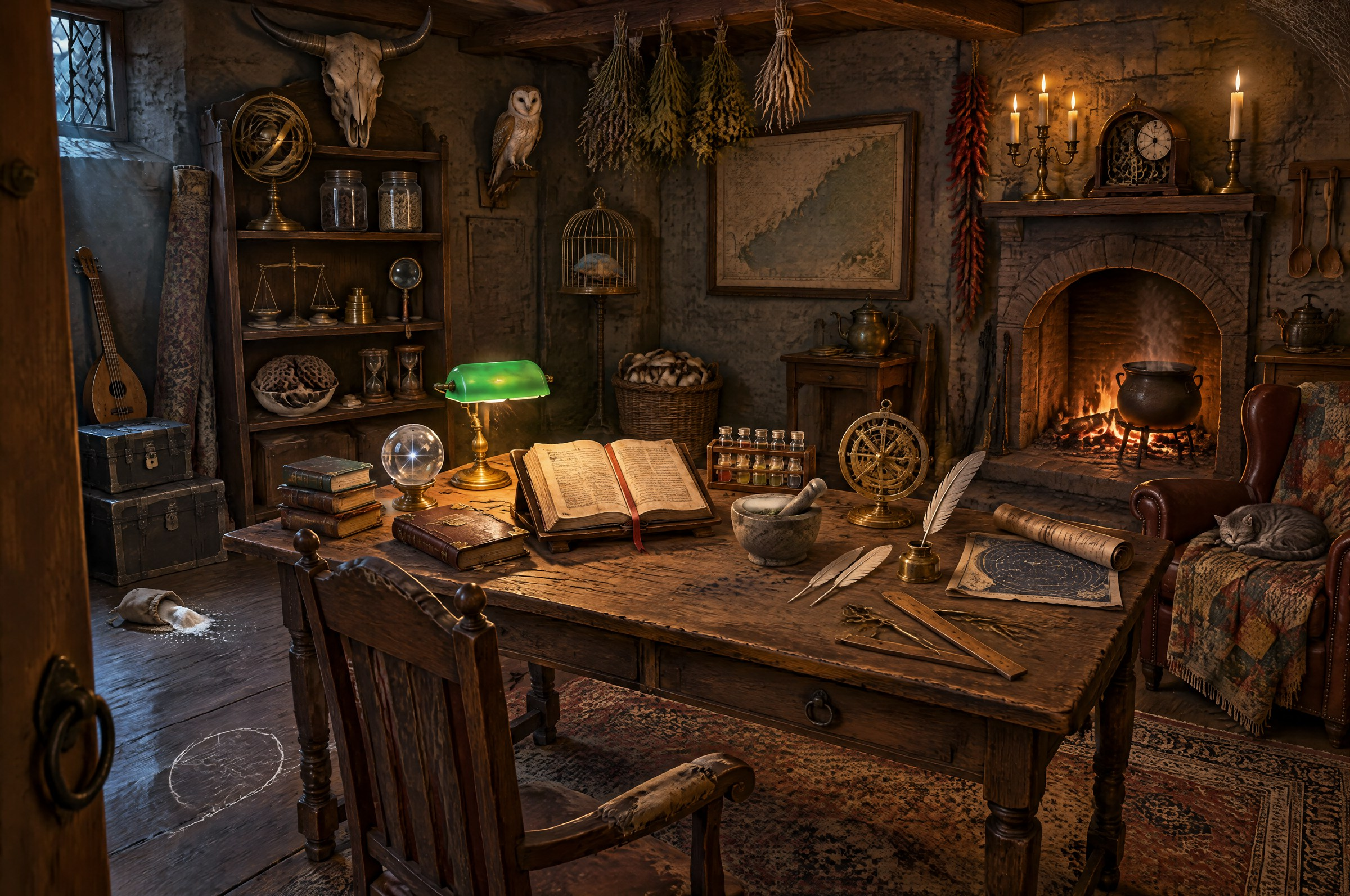
Example generated from “Wizard Study Environment Concept — Callirra Atlas · CC BY 4.0”
GPT Image 2.5en

A dense interior painting of a wizard's study, 3:2, seen from standing height at the doorway looking in, lit by lamplight and a fire. This is a maximalist picture: every surface is occupied and the eye should find something new on the fourth look. Forty-four separate objects are listed below and all forty-four must appear. THE ROOM A stone-walled study about four metres square, one small deep-set leaded window high on the left wall with the night beyond it, a low arched fireplace on the right wall, a timber ceiling with exposed joists, and a floor of worn dark boards partly covered by a threadbare patterned rug. THE DESK — twelve objects 1. A long oak desk across the middle of the room, its surface scarred and ink-stained. 2. A brass desk lamp with a green glass shade, lit, throwing a warm pool onto the desk. 3. An open leather grimoire on a wooden cradle, its pages yellowed, one red silk ribbon. 4. A second closed book with brass corner pieces and a clasp, lying flat. 5. A stack of three smaller books at different angles. 6. A crystal ball on a brass ring stand, one bright point of light inside it. 7. A stone mortar with green residue in it and its pestle laid across the rim. 8. A rack of nine small glass vials, each holding a different coloured liquid. 9. A brass astrolabe with visible graduated rings. 10. A scroll in an open leather tube, with a corner of a star chart unrolled beside it. 11. A quill standing in a brass inkwell, and two loose quills lying beside it. 12. A pair of brass dividers resting on a wooden ruler. THE LEFT SHELF WALL — nine objects 13. A tall open-fronted shelf unit leaning against the left wall. 14. A mounted armillary sphere on a wooden base. 15. The horned skull of a large animal, hung on the wall above the shelf. 16. A glass jar of dried beetles. 17. A glass jar of pale root slices. 18. A brass balance scale with its pan and four stacked weights. 19. A magnifying lens on a turned handle. 20. A small hourglass, half run through. 21. A chipped ceramic bowl holding three large seed pods. THE FIREPLACE AND HEARTH — eight objects 22. The low arched fireplace with a live fire banked low, glowing embers visible. 23. A black iron cauldron on a three-legged trivet, steam rising from it. 24. A long iron poker and a pair of tongs leaning against the stone. 25. A stack of split firewood in a wicker basket beside the hearth. 26. A string of dried red peppers hanging on the wall beside the chimney. 27. A brass candelabra with three candles, all lit. 28. A single tall wax candle standing in a holder on the mantel. 29. A broken mantel clock, its face open, its hands stopped. THE CEILING AND CORNERS — seven objects 30. A rack of dried herbs hanging head-down from a ceiling joist. 31. A bundle of dried roots suspended beside them. 32. A wicker basket of mushrooms on the floor beneath the herbs. 33. A birdcage on a stand with a small sleeping songbird inside. 34. An owl perched on a wall bracket, awake and watching. 35. Cobwebs filling the upper right corner. 36. Dust suspended in the shaft of light falling from the high window. THE FLOOR AND FURNITURE — eight objects 37. A tall-backed wooden chair with one elbow worn through, pulled back from the desk. 38. A wingback armchair beside the fire with a patchwork blanket on it. 39. A grey cat asleep in the armchair. 40. A small iron-bound chest against the wall, its lid closed. 41. A padlocked strongbox sitting on top of the chest. 42. A lute leaning in the far corner beside the window. 43. A spilt pile of white salt on the boards, swept halfway into a drift. 44. A chalk diagram, half erased, drawn on the boards beside the desk. WALLS AND FURNISHINGS A framed chart of an unfamiliar coastline hangs on the wall behind the desk. A heavy tapestry, rolled and leaning in the corner, its colours faded. A rack of long wooden spoons and a small teapot on a side table. LIGHT AND PALETTE Three sources only: the lamp with its warm green-tinted pool on the desk; the fire, low and orange, from the right; and one cold shaft of moonlight through the high window, striking the floor and the board wall on the left. Each source keeps its own colour and its own shadow direction: lamp from above the desk, fire from the right at knee height, moon from upper left. The palette is warm — amber, oak, brass, deep greens and blacks — with the cold moon shaft and the crystal ball's point as the only cool notes. CONSTRAINTS All forty-four listed objects must be present, each visible and identifiable, and no object may appear twice. No text anywhere: no legible lettering on any book page, spine, chart, clock face or label, and no runes, sigils or symbols anywhere. Do not add a second person; the room is empty of people. Do not add a second cat, a second owl or a second bird. Do not add hanging chains, floating objects, spell effects, glowing runes or any magical light. No watermark. Keep the room believable: every object rests on a surface or hangs from a fixing, and nothing floats.

Example generated from “Hydroelectric Dam Explainer Layout — Callirra Atlas · CC BY 4.0”
GPT Image 2.5en

A fixed-zone explainer infographic, 4:3 landscape, titled "How a Hydroelectric Dam Works", drawn as flat vector art with no photograph, no 3D render and no perspective beyond the cutaway. ZONE 1 — TITLE BAND, top 12% of the frame height The title "HOW A HYDROELECTRIC DAM WORKS" set left aligned in a bold condensed sans, all capitals, with the subtitle "From falling water to your light switch" beneath it in a lighter weight at roughly a third of the title's size. A single hairline rule closes the band across the full width. ZONE 2 — MAIN DIAGRAM, left 62% of the width, from below the title band down to the process strip A cutaway cross-section of a concrete gravity dam seen from the side, with the reservoir behind it on the left and the river valley below on the right. Within this zone: - The reservoir: a large body of water filling the left third, its surface a flat pale blue, with a shoreline of rock and pine trees along its upper edge. - The dam wall: a massive grey concrete wedge, widest at the base, with visible horizontal construction joints. Its crest carries a low parapet and a gantry crane on rails. - The intake: a rectangular opening in the dam's upstream face just below the waterline, with a trash rack of vertical bars across it and a steel gate above it. - The penstock: a thick steel pipe running down through the body of the dam at a steep angle, drawn in section so its wall thickness reads, ending at the turbine below. - The powerhouse: a rectangular hall cut into the base of the dam on the downstream side, containing a vertical turbine and, directly above it on the same shaft, a cylindrical generator. - The draft tube: a curved widening passage carrying water away from the turbine out into the river. - The switchyard: two transformers and a row of insulators on a flat platform beside the powerhouse, with three transmission pylons stepping away to the right. - The spillway: a separate overflow channel at the dam crest on the right, dry, with a stepped chute. Water direction is shown by five small white arrows: into the intake, down the penstock, through the turbine, out of the draft tube and away downstream. ZONE 3 — CALLOUT COLUMN, right 34% of the width, beside the diagram Three stacked panels of equal height, each with a coloured circular number badge at its top left, one line of bold label text, and two lines of smaller explanatory text beneath. A thin leader line runs from each badge to its element in the diagram, and no leader crosses another. ZONE 4 — PROCESS STRIP, bottom 16% of the frame height, full width beneath both columns Four equal boxes in a row, each with a coloured square icon at its left and one short label to the right of it, joined by three right-pointing chevrons between the boxes. ZONE 5 — LEGEND, bottom right corner, inside the process strip's row Three legend entries stacked vertically, each with a short coloured line sample at the left and one short label beside it. EXACT VISIBLE TEXT — render exactly these strings, once each - Title: "HOW A HYDROELECTRIC DAM WORKS" - Subtitle: "From falling water to your light switch" - Callout 1 label: "RESERVOIR" and its text: "Water is stored at height, holding potential energy." - Callout 2 label: "PENSTOCK" and its text: "The pipe converts that height into pressure and speed." - Callout 3 label: "TURBINE" and its text: "Moving water spins the turbine and the generator above it." - Process boxes, left to right: "Store" / "Release" / "Spin" / "Generate" - Legend entries, top to bottom: "Water" / "Concrete" / "Electricity" No other text anywhere: no units, no measurements, no capacity figures, no equations, no logos, no watermark. STYLE Flat vector illustration: solid fills, uniform hairline outlines, no gradients, no drop shadows, no texture. Background flat white. Palette: concrete grey, water blue, a warm amber for electricity, and one accent colour used only on the three number badges and the three chevrons. One neutral sans throughout, in exactly four sizes: title, subtitle, labels, and explanatory text. CONSTRAINTS Exactly three callouts, exactly four process boxes, exactly three legend entries, exactly five direction arrows, exactly three pylons. Every leader line must end on the element it names and must not cross another leader, a callout panel or any part of the diagram. Do not add a second dam, a fish ladder, a boat, a person, a bird, a road or a town. Do not put text on any part of the diagram itself. Do not use 3D shading, isometric projection or perspective.

Example generated from “Sixteen-Pose Character Contact Study — Callirra Atlas · CC BY 4.0”
GPT Image 2.5en

A character pose contact sheet, 1:1 square, sixteen panels in a 4 by 4 grid with even gutters and a thin dark outer border. Each panel shows the same person in a different standing pose, photographed on a plain mid-grey seamless with flat even lighting. This is a reference sheet, not a beauty photograph. THE CAMERA — identical in all sixteen panels One camera, one position, never varied: eye level at 60% of the figure's height, straight on, 85 mm equivalent, no wide-angle distortion, no tilt, no zoom change, no perspective change between panels. Because the camera and the distance never move, the ground line falls at exactly the same height in all sixteen panels and the top of the head falls at exactly the same height in all sixteen panels. The figure is centred horizontally in every panel with even margins left and right, and the feet are inside the panel in all sixteen. THE CHARACTER — identical in all sixteen panels A woman of about thirty, athletic build, medium height. Short dark hair cut to the jaw with a blunt fringe, a thin scar on her LEFT forearm about four centimetres long, and a small mole on her RIGHT cheekbone. She wears a plain charcoal cotton t-shirt with a crew neck, olive cargo trousers with a single pocket flap on the LEFT thigh only, and tan canvas boots laced to the ankle. Her clothing, hair, scar and mole must be identical in every panel, and the pocket flap must stay on the left thigh in all sixteen — it must never appear on the right. THE SIXTEEN POSES, reading left to right then top to bottom 1. Neutral stance, feet shoulder-width apart, arms hanging at her sides. 2. Weight on the left leg, right knee slightly bent and relaxed, arms at her sides. 3. Feet together, hands clasped in front of her at waist height. 4. Feet apart, arms folded across her chest. 5. Left hand on her hip, right arm hanging down. 6. Right hand on her hip, left arm hanging down. 7. Both hands on her hips, elbows out, feet apart. 8. Left arm raised forward, pointing at chest height, right arm down. 9. Right arm raised straight up above her head, left arm down. 10. Both arms raised out to the sides at shoulder height, palms down. 11. Leaning forward from the hips, both hands resting on her thighs. 12. Standing turned a quarter away, looking back over her right shoulder. 13. Half crouch, knees bent, weight low, both arms held forward. 14. Standing up on the balls of both feet, heels off the ground, arms swung back. 15. Right foot forward a full stride, torso twisted to the left, arms loose. 16. Standing straight, both hands clasped behind her back. PANEL NUMBERS A small numeral in the bottom left corner of each panel, reading 1 to 16 in order, all the same size and in the same position within their panels. These numerals are the only text on the sheet. LIGHTING One large soft source directly in front of the figure and slightly above, plus a soft fill from both sides, so the lighting is even and flat and identical in all sixteen panels. One short soft shadow directly beneath each figure, the same shape and length everywhere. No dramatic lighting, no coloured light, no rim light, no change of exposure between panels. CONSTRAINTS All sixteen panels are present and all sixteen poses are different. No sitting, kneeling, lying, jumping or airborne pose: both feet are on the ground in every panel. Do not hide the feet, do not crop the head, and do not let the figure leave the panel. Do not mirror the character's asymmetric details between panels — the scar stays on the left forearm and the mole stays on the right cheekbone in all sixteen. Do not add props, weapons, bags, hats, furniture or a background other than the plain seamless. No text anywhere except the sixteen panel numerals, and no number larger than 16.

Example generated from “Retro Pixel-Style Town at Dusk — Callirra Atlas · CC BY 4.0”
GPT Image 2.5en

Pixel art in the style of a 16-bit console role-playing game, 16:9 landscape, showing a small walled town at dusk seen from a slight raised angle, as a single game screen. THE PIXEL GRID — this is the whole style The image is built from large, visible square pixels at one consistent size across the entire frame, roughly the scale of a 320 by 180 pixel image enlarged for display. Every edge in the picture is a hard staircase of whole pixels: there is no anti-aliasing, no sub-pixel smoothness, no soft blending and no blurred edge anywhere. Diagonal edges step in visible blocks. Curves are chunky. Nothing in the image is smaller than one pixel, and nothing has a detail finer than the pixel grid. Colour transitions happen by dithering — ordered checkerboard and scattered-dot patterns of two palette colours — never by a smooth gradient. PALETTE — exactly twenty-four colours and no more A dusk palette of twenty-four fixed colours: four blues for the sky, two deep purples for the far hills, three greens for foliage, two browns for wood and earth, three greys for stone and the road, four warm ambers and oranges for lit windows and lanterns, one off-white for highlights, one near-black for outlines and one muted red for roof tiles. Every colour in the image is one of these twenty-four; no colour is blended, faded or tinted outside the palette. THE TOWN A low stone wall with a square gatehouse runs across the middle of the frame, the gate standing open. Behind it, fifteen or so small buildings with steeply pitched red-tiled roofs crowd together along two narrow streets; windows are small and most of them are lit warm amber. A square tower with a single clock face stands above the roofs at the left, and a windmill turns slowly on a low hill at the right. A cobbled road enters through the gate and runs toward the viewer, widening in the foreground. A stone well with a wooden frame stands in the small square just inside the gate. THE LANDSCAPE Behind the town, three stepped bands of hills recede in increasingly dark purples, undulating rather than smooth. On the far left, a river runs down from the hills and passes under a two-arch stone bridge, its surface drawn as horizontal bands of two blues with dithered highlights, and it catches a few dither-speckled glints of the dying light. Three conical pine trees stand on the near bank and four on the far bank, all the same size and drawn from the same four or five pixels of shape. THE SKY Late dusk: the sky is a vertical gradient built entirely from dithered bands of the four blues, from a deeper blue at the top to a warm orange band at the horizon, with no smooth blend anywhere. Eight small stars are placed in the upper third, each a single off-white pixel with no glow. One low cloud sits in the middle of the sky, a flat two-colour shape with a dithered lower edge. THE FIGURE A single small sprite of a traveller stands on the cobbled road just inside the gate, facing away from the viewer. The sprite is about twelve pixels tall, drawn from the same palette, with a visible dark outline around its whole silhouette. It is the only figure in the scene and casts no shadow. CONSTRAINTS The whole image must read as pixel art, not as a photograph or painting with a pixel filter applied over it: no photographic texture, no painted brushwork, no smooth gradients, no 3D rendering, no depth of field. No text anywhere: no signposts, no shop signs, no town name, no window lettering, no watermark. Do not add a second figure, animals, carts, vehicles, laundry, banners or smoke. Do not add modern elements. Keep the horizon straight and place it in the upper third of the frame.

Example generated from “Retro Airbrush Science-Fiction Paperback Concept — Shuryne · MIT”
GPT Image 2en

A 1970s science fiction paperback cover painted with an airbrush. A lone figure in a white suit stands on an orange dune field, dwarfed by three impossible ringed moons in a graduated violet sky. Perfectly smooth airbrushed gradients meet crisp frisket-cut edges, with tiny hand-flicked white star spatter and a soft atmospheric haze at the horizon. Chrome highlights are rendered as hard-edged white slivers. Slightly faded ink and visible paper yellowing. A wide empty foreground is reserved for absent cover type.

Example generated from “Imaginary Coast Antique Map Illustration — Shuryne · MIT”
GPT Image 2en

A hand-drawn antique map of an imaginary coastline, engraved and hand-tinted. Fine copperplate etched linework for the shore, with dense parallel hachures indicating inland hills and stippled shoals offshore. Pale watercolor washes in faded ochre, sage and rose sit slightly outside the plate lines. A decorative compass rose, a sea monster in the empty ocean, and invented place names in copperplate italic script. Aged laid paper with visible chain lines, one horizontal fold crease, and browned edges.

Example generated from “Art Nouveau Absinthe Poster Concept — Shuryne · MIT”
GPT Image 2en

An Art Nouveau lithograph poster advertising an absinthe brand. A woman with flowing hair rendered in flat color fields, her tresses dissolving into stylized whiplash curves that frame the composition and become the border. Heavy confident black contour lines of varying weight, four-color stone lithography with slight visible misregistration and a subtle stipple in the flat areas. Muted sage green, dusty rose, cream and gold. Ornamental hand-drawn display lettering arches above her head. Aged paper tone with faint foxing at the corners.

Example generated from “Birthday Table for One Narrative Pastel — Shuryne · MIT”
GPT Image 2en

A soft pastel still life of a long dining table laid for eight, photographed from one end of the room. Eight places are set with folded napkins and untouched glasses; a cake with candles burned down to stubs sits at the centre. Only one place has been used, its chair pulled out and a chair-back cardigan slumped over it. Streamers hang slack. Chalk laid on toothed paper so the pits stay dark, warm ochre and faded rose against a cool grey room, edges deliberately lost into the corners. Late afternoon light, unsentimental and quiet.

Example generated from “Impossible Blue Bookshop Door Illustration — Shuryne · MIT”
GPT Image 2en

A children's book illustration in colored pencil and watercolor, showing the back corner of a cramped secondhand bookshop. Between two overloaded shelves stands a small door that clearly does not belong to the building, painted a faded cornflower blue, with warm golden light and a few drifting dandelion seeds escaping from the gap beneath it. The shop cat sits squarely in front of it, tail curled, entirely calm. Fine layered pencil hatching over soft wet-in-wet washes, warm dusty palette with one cool blue accent. Cosy, curious, gently impossible.

Example generated from “Eucalyptus Botanical Watercolor Study — Shuryne · MIT”
GPT Image 2en

A botanical watercolor study of a single eucalyptus sprig on cold-press paper, centered with wide white margins. Soft sage and dusty blue pigments pool at the leaf edges, a faint pencil under-drawing shows through, and the stem fades to dry brush at the bottom. Delicate granulating washes, visible paper tooth, translucent layering, subtle backruns, no ink outlines, botanical illustration accuracy.

Example generated from “Resting Dancer Chalk-Pastel Study — Shuryne · MIT”
GPT Image 2en

A soft pastel drawing of a dancer resting between rehearsals, drawn on black textured paper. The chalk sits on the raised tooth of the sheet and leaves the pits dark, so every stroke breathes. Warm ochre and rose skin tones are built in broken layers with the black ground doing the shadow work, and a few decisive white highlights land on the collarbone and the arch of the foot. Edges are deliberately lost into darkness on the left. Visible smudging from the heel of the hand, loose and unfinished.

Example generated from “Older Fisherman Charcoal Portrait Study — Shuryne · MIT”
GPT Image 2en

A charcoal portrait study of an older fisherman on toned grey paper, three-quarter view looking slightly down. Deep compressed-charcoal darks in the coat and hair, white chalk highlights on the cheekbone and brow, mid-tone paper left bare across the background. Vigorous directional hatching, smudged blended transitions, visible eraser lifts, loose unfinished edges at the shoulders, expressive academic life-drawing quality.

Example generated from “Information Overload Editorial Collage — Shuryne · MIT”
GPT Image 2en

A mixed-media collage editorial illustration about information overload. A cut-out vintage photograph of a human head in profile is overlaid with torn newspaper strips, a halftone-printed spiral, hand-cut geometric shapes in mustard and red, and a fragment of graph paper. Rough torn paper edges with visible fibre, slight drop shadows suggesting physical layering, muted archival palette, deliberate misregistration, magazine editorial art direction.

Example generated from “Fern Herbarium Cyanotype-Style Illustration — Shuryne · MIT”
GPT Image 2en

A cyanotype photogram of three fern fronds arranged as a herbarium specimen on heavy watercolor paper. Deep Prussian blue ground where UV struck the emulsion, ghost-white silhouettes where the fronds blocked it, with soft bleeding halos along every pinnule edge. The brush-coated emulsion leaves visible streaks and a ragged dark border; faint bronzing and pale wash-out patches record the water rinse. A handwritten pencil label sits in the lower right corner. Flat even lighting, no cast shadows, sharp botanical detail.

Example generated from “Open Desert Motel Film-Poster Concept — Shuryne · MIT”
GPT Image 2en

A three-color screenprinted film poster of a desert motel at three in the morning. One room stands open, spilling hot yellow light across the concrete walkway; a suitcase lies burst open on the ground with clothes spread in a fan. A car idles in front with its headlights on and both doors ajar. Flat separated color layers in dust rose, deep teal and black, with deliberate misregistration and visible halftone grain where the layers overlap. Long hard shadows, a vacancy sign burning at the top of the frame, and wide empty space reserved for absent title type at the bottom. No people anywhere.

Example generated from “Pomegranate Egg-Tempera-Style Still Life — Shuryne · MIT”
GPT Image 2en

An egg tempera painting of a split pomegranate resting on linen cloth. Color is built from hundreds of fine translucent cross-hatched strokes because the medium dries too fast to blend, giving a luminous enamel-like surface. The seeds read as tiny glazed jewels of alizarin over a cool green underpainting that shows through the shadows. Matte chalky ground with the faintest crackle. Even north-facing window light, a shallow tabletop composition, muted earth palette, quiet devotional stillness.

Example generated from “Footprints Ending at a Letter Narrative Print — Shuryne · MIT”
GPT Image 2en

A mezzotint print of a snowfield at first light. A single line of footprints crosses the plate from the lower left and stops at an unfolded letter lying face-up in the snow. There are no prints leading away. Velvety unbroken blacks in the treeline behind, burnished down through infinite silver greys to the near-white of the drifts, with the rocker's fine mesh texture visible throughout. A dropped glove lies a few paces back. Deep atmospheric perspective, absolute stillness, no color, no figure.

Example generated from “Rainy Tram Stop Gouache Study — Shuryne · MIT”
GPT Image 2en

A gouache painting of a tram stop at dusk in steady rain. Opaque matte pigment laid in flat overlapping planes, the brushstrokes chalky and slightly streaky where a second layer lifted the one beneath. Wet asphalt reflects the tram's warm interior light as vertical smears of cadmium orange against slate grey and Payne's blue. Three silhouetted figures under umbrellas, painted as simple dark shapes with no facial detail. Dry-brush texture on the overhead wires. Muted desaturated palette, soft edges, quiet melancholy.

Example generated from “Retro Jazz LP Brush-Lettering Cover Concept — Shuryne · MIT”
GPT Image 2en

A 1950s jazz LP cover with hand-lettered brush script. Bold custom lettering in warm ivory over a flat burnt-orange field, the strokes showing genuine brush pressure variation and slightly imperfect terminals. A loose abstract ink drawing of a double bass occupies the lower third, rendered in three confident gestural strokes. Two-color offset printing with visible halftone rosettes in the shadow areas and a hairline registration shift. Slight ring-wear and edge softening from decades in a record sleeve.

Example generated from “Misty Chinese Ink Landscape Study — Shuryne · MIT”
GPT Image 2en

A traditional Chinese ink wash landscape on aged rice paper. Layered mountain ridges recede into pale mist, a lone pine clings to a foreground cliff, and a tiny fishing boat sits on still water at lower left. Vast empty space in the upper third. Monochrome black ink with grey washes and a single faint ochre tint, visible brush texture, dry-brush rock strokes, soft bleeding edges, no outlines, no color saturation.

Example generated from “Lighthouse Kitchen Two-Plate Novel-Cover Concept — Shuryne · MIT”
GPT Image 2en

An oil painting of a lighthouse keeper's kitchen at dusk, painted like a literary novel cover. The small table is set for two, but one plate is clean and dulled with a fine layer of dust while the other is half-eaten and still steaming. A single chair is pushed back at an angle. Through the salt-crusted window a storm is building over black water, and the lamp above throws a warm pool of light that fails before it reaches the corners. Thick impasto on the highlights, thin scumbled greys in the shadows, visible brush drag on the wall. Muted ochre, sea green and bitumen palette. Nobody is in the room.

Example generated from “Breaking Wave Two-Ink Linocut-Style Study — Shuryne · MIT”
GPT Image 2en

A two-color linocut print of a breaking wave, carved with confident gouge strokes. A bold black keyline block over a muted indigo second pass, with visible misregistration of about two millimeters along the left edge. The carving shows chatter marks and stray slivers where the gouge skipped; ink sits unevenly, heavily saturated at the block's center and dry and starved near the margins. Printed on cream mulberry paper with visible fibers and a plate impression. Flat graphic shapes, no gradients.

Example generated from “Dew on Spiderweb Synthetic Macro Study — Shuryne · MIT”
GPT Image 2en

An extreme macro photograph of an orb spider's web strung with dawn dew. Each droplet acts as a lens, holding an inverted miniature of the meadow behind it. A razor-thin plane of focus crosses three droplets while everything else dissolves into creamy green and gold bokeh. Backlit by low sun so the silk threads glow as fine bright lines against a dark hedgerow, with a visible sag in the loaded threads. Cool blue shadow tones against warm highlights; no subject but water and silk.

Example generated from “Closing Mask Shop Film-Poster Concept — Shuryne · MIT”
GPT Image 2en

A nocturne oil painting of a small mask shop at closing time, framed as a mysterious film poster. The shopkeeper is seen only from behind as a dark silhouette reaching for the light switch. Every mask on the crowded walls — animal, theatrical, ceremonial — has been turned to face him, though he is not looking at them. Warm shop light dying into deep viridian shadow, wet cobbles visible through the door glass. Loose confident brushwork, glazed dark passages with a few thick bright accents on the mask highlights. Unsettling but beautiful, no violence.