
Ver en acción
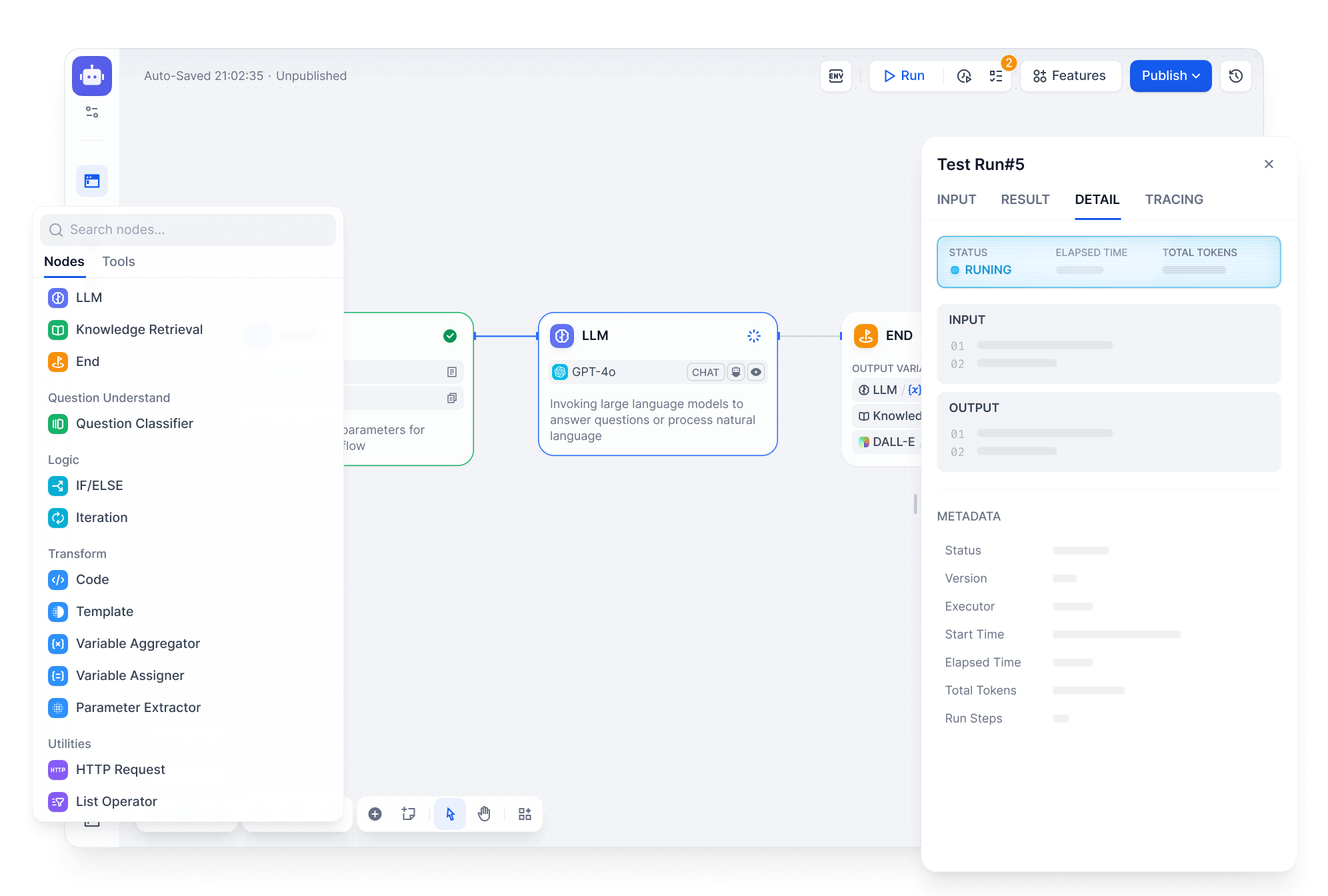
Workflow canvas and test panel
The author-provided UI illustration shows a node picker, connected workflow blocks and the test-run panel.
Licencia
Lossless PNG-to-WebP conversion; original dimensions and decoded pixels preserved. No crop, generated input, execution claim or site test. Existing interface marks remain visible. Source UI illustrations contain placeholder content. Full modified license and branding are retained; no Dify frontend code is deployed or operated.
# Open Source License

Dify is licensed under a modified version of the Apache License 2.0, with the following additional conditions:

1. Dify may be utilized commercially, including as a backend service for other applications or as an application development platform for enterprises. Should the conditions below be met, a commercial license must be obtained from the producer:

a. Multi-tenant service: Unless explicitly authorized by Dify in writing, you may not use the Dify source code to operate a multi-tenant environment.
    - Tenant Definition: Within the context of Dify, one tenant corresponds to one workspace. The workspace provides a separated area for each tenant's data and configurations.

b. LOGO and copyright information: In the process of using Dify's frontend, you may not remove or modify the LOGO or copyright information in the Dify console or applications. This restriction is inapplicable to uses of Dify that do not involve its frontend.
    - Frontend Definition: For the purposes of this license, the "frontend" of Dify includes all components located in the `web/` directory when running Dify from the raw source code, or the "web" image when running Dify with Docker.

2. As a contributor, you should agree that:

a. The producer can adjust the open-source agreement to be more strict or relaxed as deemed necessary.
b. Your contributed code may be used for commercial purposes, including but not limited to its cloud business operations.

Apart from the specific conditions mentioned above, all other rights and restrictions follow the Apache License 2.0. Detailed information about the Apache License 2.0 can be found at http://www.apache.org/licenses/LICENSE-2.0.

The interactive design of this product is protected by appearance patent.

© 2025 LangGenius, Inc.
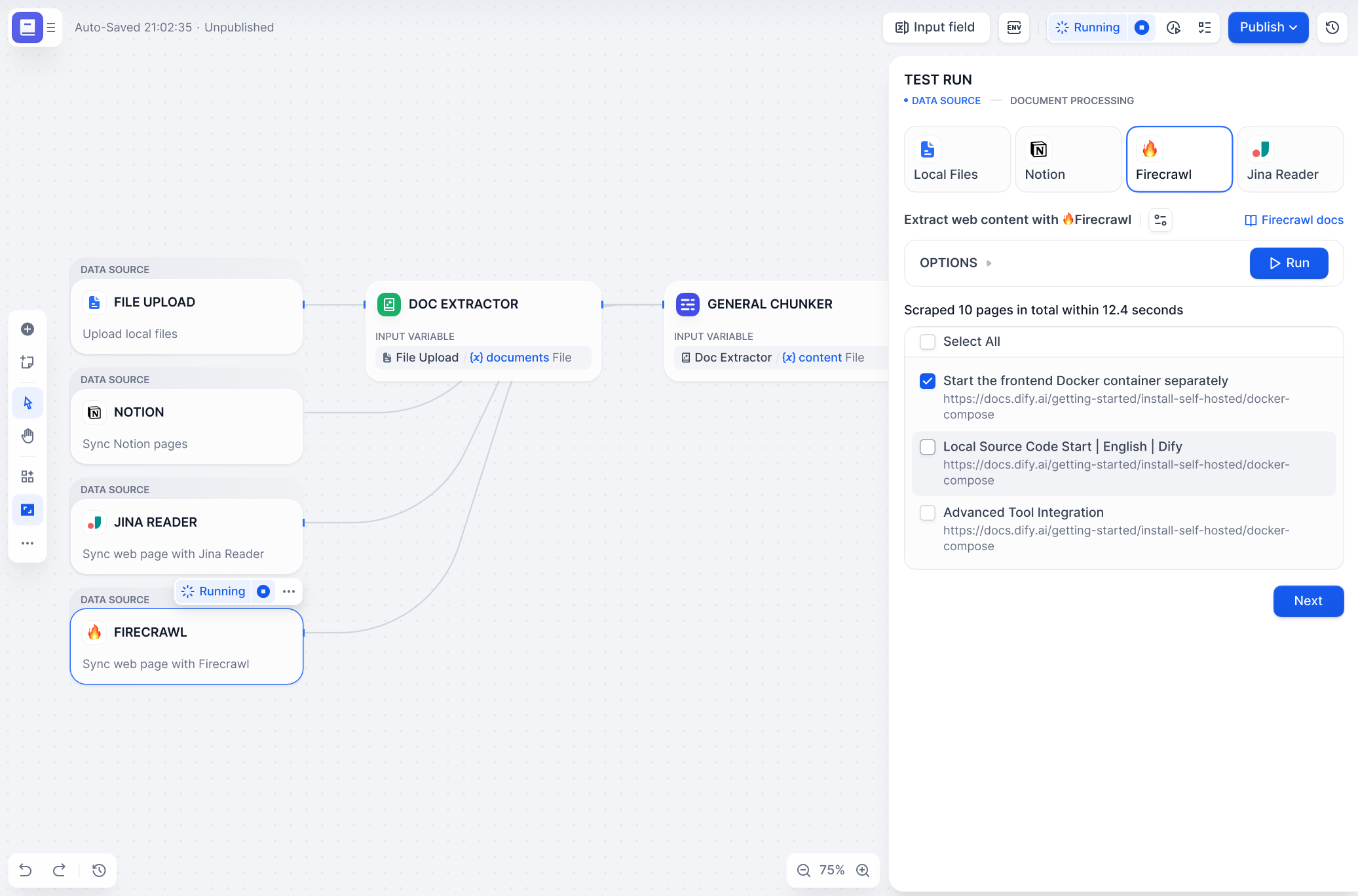
Knowledge-ingestion pipeline
The author-provided pipeline preview connects document sources to extraction and chunking, with a source-selection panel beside the canvas.
Licencia
Lossless PNG-to-WebP conversion; original dimensions and decoded pixels preserved. No crop, generated input, execution claim or site test. Existing interface marks remain visible. Source UI illustrations contain placeholder content. Full modified license and branding are retained; no Dify frontend code is deployed or operated.
# Open Source License

Dify is licensed under a modified version of the Apache License 2.0, with the following additional conditions:

1. Dify may be utilized commercially, including as a backend service for other applications or as an application development platform for enterprises. Should the conditions below be met, a commercial license must be obtained from the producer:

a. Multi-tenant service: Unless explicitly authorized by Dify in writing, you may not use the Dify source code to operate a multi-tenant environment.
    - Tenant Definition: Within the context of Dify, one tenant corresponds to one workspace. The workspace provides a separated area for each tenant's data and configurations.

b. LOGO and copyright information: In the process of using Dify's frontend, you may not remove or modify the LOGO or copyright information in the Dify console or applications. This restriction is inapplicable to uses of Dify that do not involve its frontend.
    - Frontend Definition: For the purposes of this license, the "frontend" of Dify includes all components located in the `web/` directory when running Dify from the raw source code, or the "web" image when running Dify with Docker.

2. As a contributor, you should agree that:

a. The producer can adjust the open-source agreement to be more strict or relaxed as deemed necessary.
b. Your contributed code may be used for commercial purposes, including but not limited to its cloud business operations.

Apart from the specific conditions mentioned above, all other rights and restrictions follow the Apache License 2.0. Detailed information about the Apache License 2.0 can be found at http://www.apache.org/licenses/LICENSE-2.0.

The interactive design of this product is protected by appearance patent.

© 2025 LangGenius, Inc.
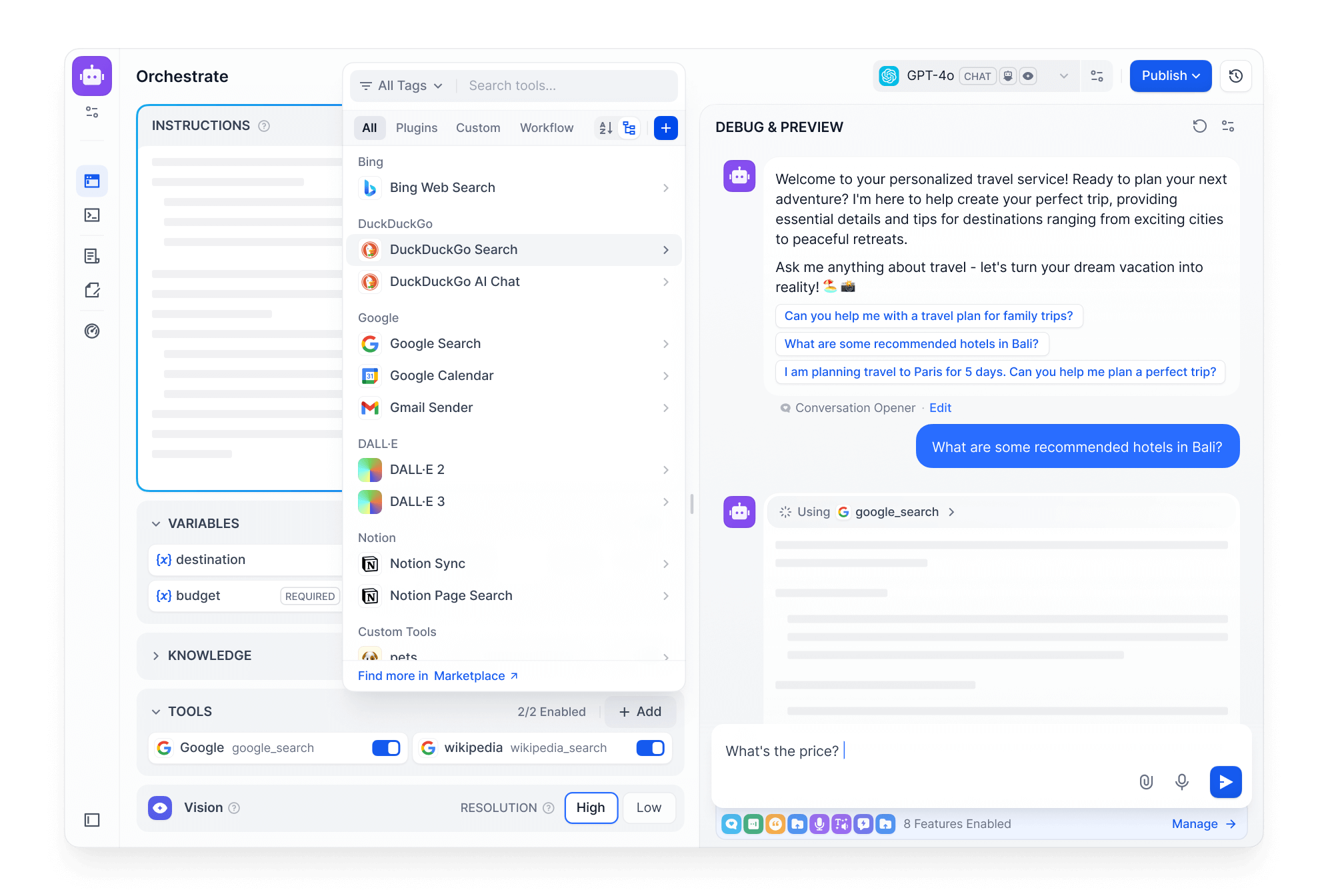
Agent tools and conversation preview
The author-provided UI illustration shows agent instructions, tool selection and a travel-assistant conversation preview.
Licencia
Lossless PNG-to-WebP conversion; original dimensions and decoded pixels preserved. No crop, generated input, execution claim or site test. Existing interface marks remain visible. Source UI illustrations contain placeholder content. Full modified license and branding are retained; no Dify frontend code is deployed or operated.
# Open Source License

Dify is licensed under a modified version of the Apache License 2.0, with the following additional conditions:

1. Dify may be utilized commercially, including as a backend service for other applications or as an application development platform for enterprises. Should the conditions below be met, a commercial license must be obtained from the producer:

a. Multi-tenant service: Unless explicitly authorized by Dify in writing, you may not use the Dify source code to operate a multi-tenant environment.
    - Tenant Definition: Within the context of Dify, one tenant corresponds to one workspace. The workspace provides a separated area for each tenant's data and configurations.

b. LOGO and copyright information: In the process of using Dify's frontend, you may not remove or modify the LOGO or copyright information in the Dify console or applications. This restriction is inapplicable to uses of Dify that do not involve its frontend.
    - Frontend Definition: For the purposes of this license, the "frontend" of Dify includes all components located in the `web/` directory when running Dify from the raw source code, or the "web" image when running Dify with Docker.

2. As a contributor, you should agree that:

a. The producer can adjust the open-source agreement to be more strict or relaxed as deemed necessary.
b. Your contributed code may be used for commercial purposes, including but not limited to its cloud business operations.

Apart from the specific conditions mentioned above, all other rights and restrictions follow the Apache License 2.0. Detailed information about the Apache License 2.0 can be found at http://www.apache.org/licenses/LICENSE-2.0.

The interactive design of this product is protected by appearance patent.

© 2025 LangGenius, Inc.
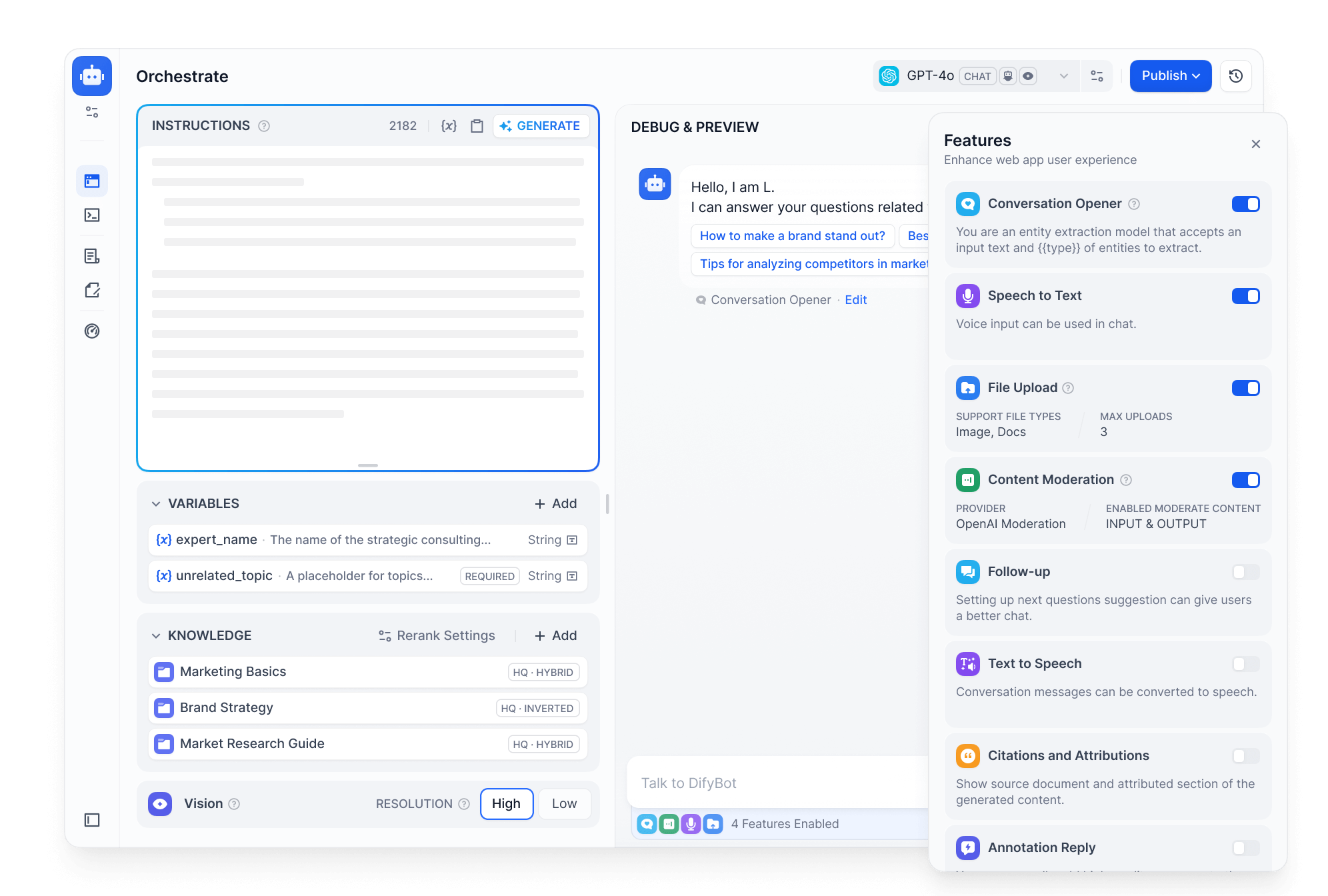
Chatbot features and knowledge sources
The author-provided UI illustration combines instructions, variables and knowledge sources with conversation feature controls.
Licencia
Lossless PNG-to-WebP conversion; original dimensions and decoded pixels preserved. No crop, generated input, execution claim or site test. Existing interface marks remain visible. Source UI illustrations contain placeholder content. Full modified license and branding are retained; no Dify frontend code is deployed or operated.
# Open Source License

Dify is licensed under a modified version of the Apache License 2.0, with the following additional conditions:

1. Dify may be utilized commercially, including as a backend service for other applications or as an application development platform for enterprises. Should the conditions below be met, a commercial license must be obtained from the producer:

a. Multi-tenant service: Unless explicitly authorized by Dify in writing, you may not use the Dify source code to operate a multi-tenant environment.
    - Tenant Definition: Within the context of Dify, one tenant corresponds to one workspace. The workspace provides a separated area for each tenant's data and configurations.

b. LOGO and copyright information: In the process of using Dify's frontend, you may not remove or modify the LOGO or copyright information in the Dify console or applications. This restriction is inapplicable to uses of Dify that do not involve its frontend.
    - Frontend Definition: For the purposes of this license, the "frontend" of Dify includes all components located in the `web/` directory when running Dify from the raw source code, or the "web" image when running Dify with Docker.

2. As a contributor, you should agree that:

a. The producer can adjust the open-source agreement to be more strict or relaxed as deemed necessary.
b. Your contributed code may be used for commercial purposes, including but not limited to its cloud business operations.

Apart from the specific conditions mentioned above, all other rights and restrictions follow the Apache License 2.0. Detailed information about the Apache License 2.0 can be found at http://www.apache.org/licenses/LICENSE-2.0.

The interactive design of this product is protected by appearance patent.

© 2025 LangGenius, Inc.
Descripción del producto
Dify reúne configuración de modelos, recuperación documental y diseño de flujos en un entorno de desarrollo. Un equipo puede crear un asistente con sus documentos o conectar varios pasos de procesamiento. La aplicación terminada se publica en la web o se invoca mediante una API REST.
Antes del despliegue, hay que elegir entre Dify Cloud gestionado y Community Edition autoalojada. El autoalojamiento implica mantener aplicación, almacenamiento, actualizaciones y operación. Los modelos, complementos y herramientas son dependencias separadas; sus credenciales y cuotas no se incluyen automáticamente.
Qué ofrece Dify
- 01Diseñar agentes, asistentes y flujos visualmente.
- 02Conectar una base documental y configurar la recuperación.
- 03Publicar aplicaciones web o integrarlas mediante API REST.
Un flujo práctico
- 01Elegir Cloud o autoalojamiento y conectar un proveedor de modelos.
- 02Configurar una tarea con pocos documentos y los pasos necesarios.
- 03Contrastar respuestas con fuentes y probar errores antes de publicar.
Resumen basado en la fuente; las afirmaciones del producto no se han probado de forma independiente.
Qué lo diferencia
Se centra en ensamblar aplicaciones con modelos y datos. Los pasos visibles facilitan la revisión, pero la calidad depende de documentos, recuperación, instrucciones y modelo.
Para quién es adecuado
- Equipos que crean asistentes con documentos propios.
- Desarrolladores que conectan modelos y herramientas en procesos repetibles.
Qué comprobar
- Separar costes de plataforma, modelos, complementos, almacenamiento y servidores.
- Planificar actualizaciones, copias de seguridad y acceso en autoalojamiento.
- Comprobar dónde se procesan documentos internos y solicitudes a modelos.
Preguntas frecuentes
¿El autoalojamiento incluye modelos gratuitos?
No. No aporta créditos de proveedores de modelos de pago. Cada servicio conectado mantiene sus condiciones.
¿Puede integrarse la aplicación en otro producto?
La documentación describe publicación web y API REST. Revisa el contrato de la API y la autenticación de la aplicación publicada.
La información se contrastó el 26 oct 2026 con el sitio oficial o documentación primaria.