
Guarda in azione
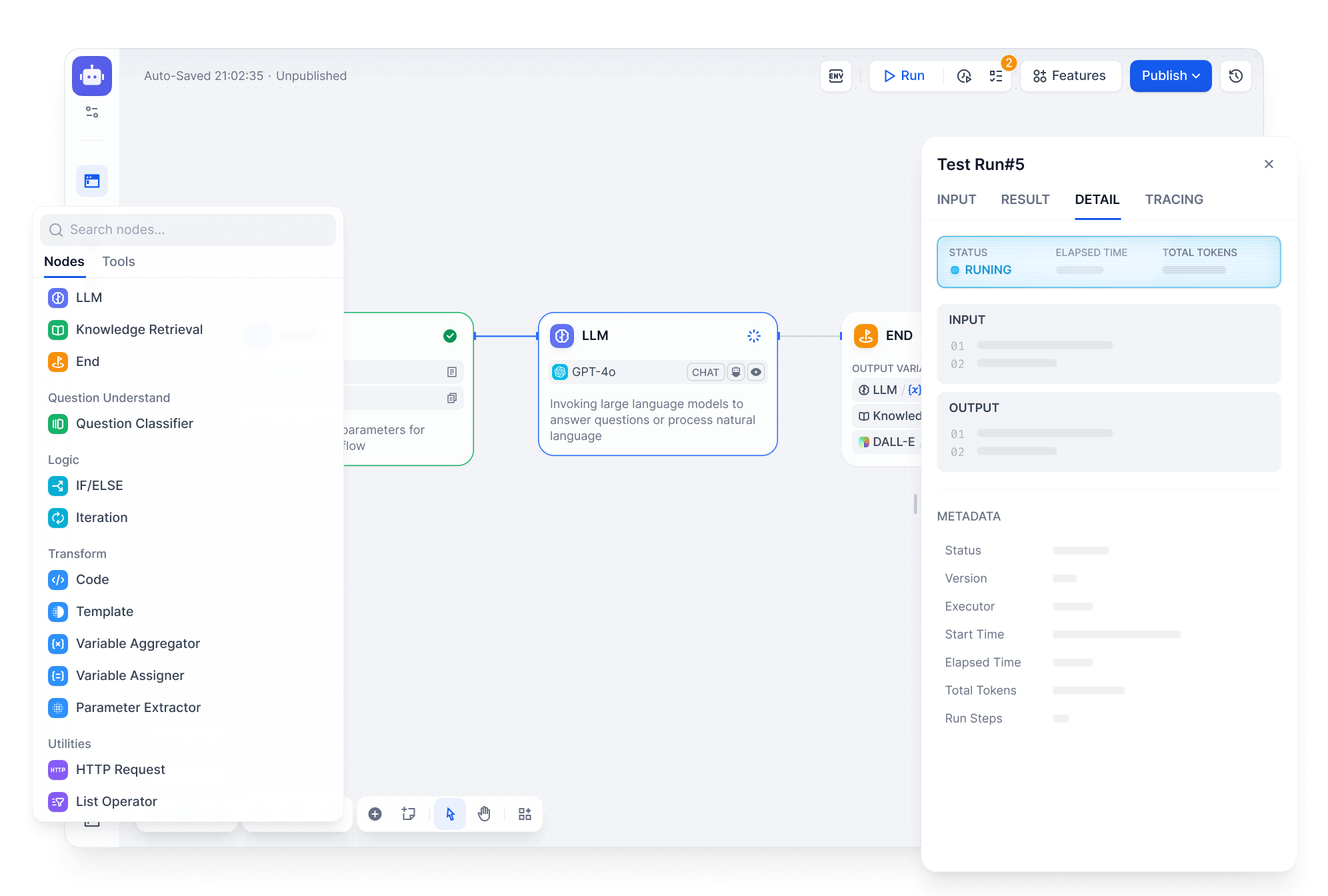
Workflow canvas and test panel
The author-provided UI illustration shows a node picker, connected workflow blocks and the test-run panel.
Licenza
Lossless PNG-to-WebP conversion; original dimensions and decoded pixels preserved. No crop, generated input, execution claim or site test. Existing interface marks remain visible. Source UI illustrations contain placeholder content. Full modified license and branding are retained; no Dify frontend code is deployed or operated.
# Open Source License

Dify is licensed under a modified version of the Apache License 2.0, with the following additional conditions:

1. Dify may be utilized commercially, including as a backend service for other applications or as an application development platform for enterprises. Should the conditions below be met, a commercial license must be obtained from the producer:

a. Multi-tenant service: Unless explicitly authorized by Dify in writing, you may not use the Dify source code to operate a multi-tenant environment.
    - Tenant Definition: Within the context of Dify, one tenant corresponds to one workspace. The workspace provides a separated area for each tenant's data and configurations.

b. LOGO and copyright information: In the process of using Dify's frontend, you may not remove or modify the LOGO or copyright information in the Dify console or applications. This restriction is inapplicable to uses of Dify that do not involve its frontend.
    - Frontend Definition: For the purposes of this license, the "frontend" of Dify includes all components located in the `web/` directory when running Dify from the raw source code, or the "web" image when running Dify with Docker.

2. As a contributor, you should agree that:

a. The producer can adjust the open-source agreement to be more strict or relaxed as deemed necessary.
b. Your contributed code may be used for commercial purposes, including but not limited to its cloud business operations.

Apart from the specific conditions mentioned above, all other rights and restrictions follow the Apache License 2.0. Detailed information about the Apache License 2.0 can be found at http://www.apache.org/licenses/LICENSE-2.0.

The interactive design of this product is protected by appearance patent.

© 2025 LangGenius, Inc.
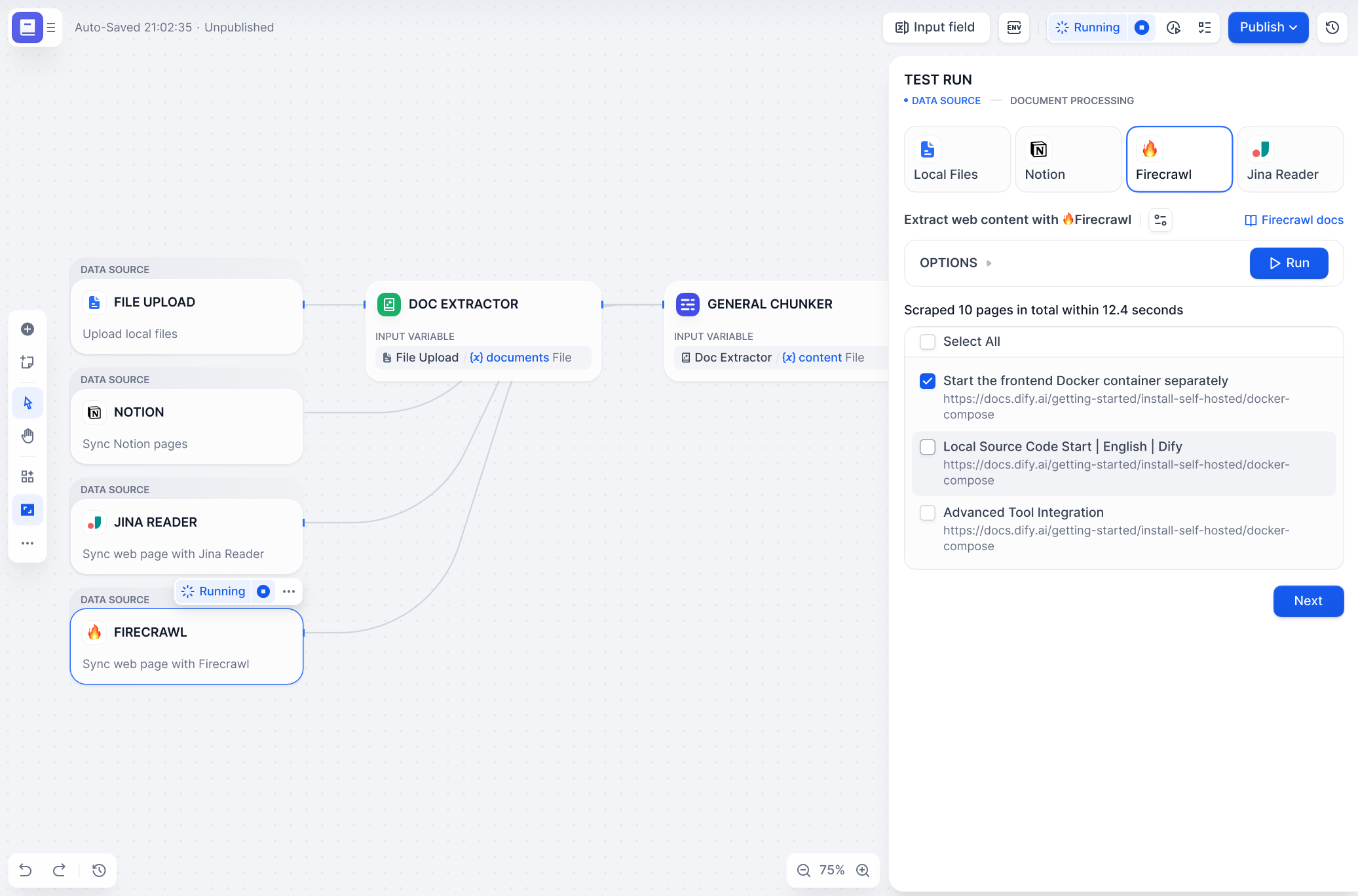
Knowledge-ingestion pipeline
The author-provided pipeline preview connects document sources to extraction and chunking, with a source-selection panel beside the canvas.
Licenza
Lossless PNG-to-WebP conversion; original dimensions and decoded pixels preserved. No crop, generated input, execution claim or site test. Existing interface marks remain visible. Source UI illustrations contain placeholder content. Full modified license and branding are retained; no Dify frontend code is deployed or operated.
# Open Source License

Dify is licensed under a modified version of the Apache License 2.0, with the following additional conditions:

1. Dify may be utilized commercially, including as a backend service for other applications or as an application development platform for enterprises. Should the conditions below be met, a commercial license must be obtained from the producer:

a. Multi-tenant service: Unless explicitly authorized by Dify in writing, you may not use the Dify source code to operate a multi-tenant environment.
    - Tenant Definition: Within the context of Dify, one tenant corresponds to one workspace. The workspace provides a separated area for each tenant's data and configurations.

b. LOGO and copyright information: In the process of using Dify's frontend, you may not remove or modify the LOGO or copyright information in the Dify console or applications. This restriction is inapplicable to uses of Dify that do not involve its frontend.
    - Frontend Definition: For the purposes of this license, the "frontend" of Dify includes all components located in the `web/` directory when running Dify from the raw source code, or the "web" image when running Dify with Docker.

2. As a contributor, you should agree that:

a. The producer can adjust the open-source agreement to be more strict or relaxed as deemed necessary.
b. Your contributed code may be used for commercial purposes, including but not limited to its cloud business operations.

Apart from the specific conditions mentioned above, all other rights and restrictions follow the Apache License 2.0. Detailed information about the Apache License 2.0 can be found at http://www.apache.org/licenses/LICENSE-2.0.

The interactive design of this product is protected by appearance patent.

© 2025 LangGenius, Inc.
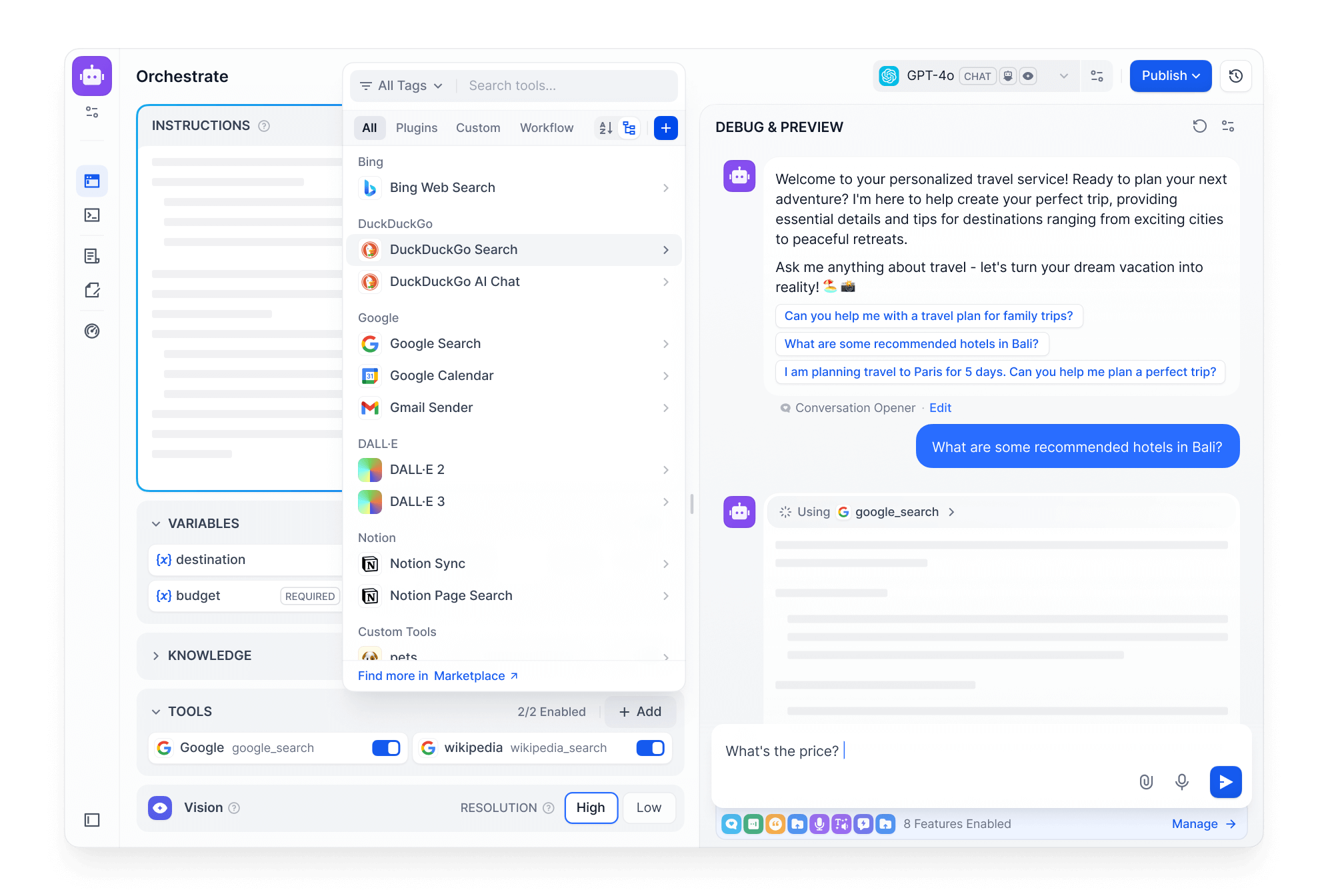
Agent tools and conversation preview
The author-provided UI illustration shows agent instructions, tool selection and a travel-assistant conversation preview.
Licenza
Lossless PNG-to-WebP conversion; original dimensions and decoded pixels preserved. No crop, generated input, execution claim or site test. Existing interface marks remain visible. Source UI illustrations contain placeholder content. Full modified license and branding are retained; no Dify frontend code is deployed or operated.
# Open Source License

Dify is licensed under a modified version of the Apache License 2.0, with the following additional conditions:

1. Dify may be utilized commercially, including as a backend service for other applications or as an application development platform for enterprises. Should the conditions below be met, a commercial license must be obtained from the producer:

a. Multi-tenant service: Unless explicitly authorized by Dify in writing, you may not use the Dify source code to operate a multi-tenant environment.
    - Tenant Definition: Within the context of Dify, one tenant corresponds to one workspace. The workspace provides a separated area for each tenant's data and configurations.

b. LOGO and copyright information: In the process of using Dify's frontend, you may not remove or modify the LOGO or copyright information in the Dify console or applications. This restriction is inapplicable to uses of Dify that do not involve its frontend.
    - Frontend Definition: For the purposes of this license, the "frontend" of Dify includes all components located in the `web/` directory when running Dify from the raw source code, or the "web" image when running Dify with Docker.

2. As a contributor, you should agree that:

a. The producer can adjust the open-source agreement to be more strict or relaxed as deemed necessary.
b. Your contributed code may be used for commercial purposes, including but not limited to its cloud business operations.

Apart from the specific conditions mentioned above, all other rights and restrictions follow the Apache License 2.0. Detailed information about the Apache License 2.0 can be found at http://www.apache.org/licenses/LICENSE-2.0.

The interactive design of this product is protected by appearance patent.

© 2025 LangGenius, Inc.
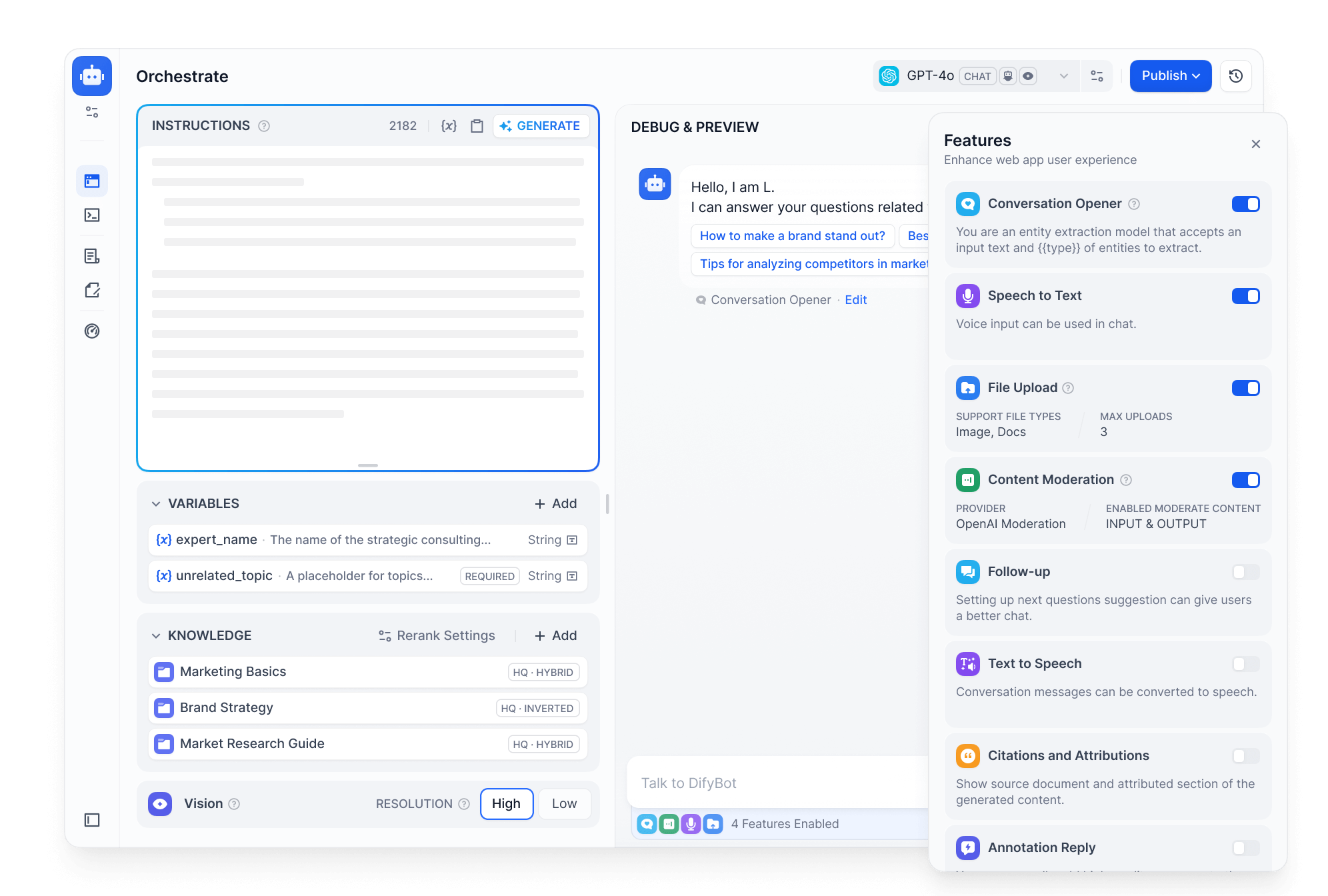
Chatbot features and knowledge sources
The author-provided UI illustration combines instructions, variables and knowledge sources with conversation feature controls.
Licenza
Lossless PNG-to-WebP conversion; original dimensions and decoded pixels preserved. No crop, generated input, execution claim or site test. Existing interface marks remain visible. Source UI illustrations contain placeholder content. Full modified license and branding are retained; no Dify frontend code is deployed or operated.
# Open Source License

Dify is licensed under a modified version of the Apache License 2.0, with the following additional conditions:

1. Dify may be utilized commercially, including as a backend service for other applications or as an application development platform for enterprises. Should the conditions below be met, a commercial license must be obtained from the producer:

a. Multi-tenant service: Unless explicitly authorized by Dify in writing, you may not use the Dify source code to operate a multi-tenant environment.
    - Tenant Definition: Within the context of Dify, one tenant corresponds to one workspace. The workspace provides a separated area for each tenant's data and configurations.

b. LOGO and copyright information: In the process of using Dify's frontend, you may not remove or modify the LOGO or copyright information in the Dify console or applications. This restriction is inapplicable to uses of Dify that do not involve its frontend.
    - Frontend Definition: For the purposes of this license, the "frontend" of Dify includes all components located in the `web/` directory when running Dify from the raw source code, or the "web" image when running Dify with Docker.

2. As a contributor, you should agree that:

a. The producer can adjust the open-source agreement to be more strict or relaxed as deemed necessary.
b. Your contributed code may be used for commercial purposes, including but not limited to its cloud business operations.

Apart from the specific conditions mentioned above, all other rights and restrictions follow the Apache License 2.0. Detailed information about the Apache License 2.0 can be found at http://www.apache.org/licenses/LICENSE-2.0.

The interactive design of this product is protected by appearance patent.

© 2025 LangGenius, Inc.
Panoramica del prodotto
Dify riunisce configurazione dei modelli, recupero documentale e progettazione dei flussi in un ambiente di sviluppo. Un team può creare un assistente con i propri documenti o collegare più elaborazioni. L’applicazione si pubblica sul web oppure si richiama tramite API REST.
Prima del rilascio va scelto Dify Cloud gestito oppure Community Edition con hosting autonomo. Nel secondo caso applicazione, archiviazione, aggiornamenti e gestione sono a proprio carico. Modelli, plugin e strumenti collegati sono dipendenze separate: credenziali e quote non sono incluse automaticamente.
Cosa offre Dify
- 01Creare visivamente agenti, assistenti e flussi.
- 02Collegare una base documentale e configurare il recupero.
- 03Pubblicare sul web o integrare tramite API REST.
Un flusso pratico
- 01Scegliere Cloud o hosting autonomo e collegare un fornitore di modelli.
- 02Configurare un compito con pochi documenti e i passaggi necessari.
- 03Confrontare risposte e fonti e provare gli errori prima della pubblicazione.
Sintesi basata sulla fonte; le dichiarazioni sul prodotto non sono state verificate in modo indipendente.
Cosa lo distingue
Il punto centrale è costruire applicazioni con modelli e dati. I passaggi visibili aiutano il controllo, ma la qualità dipende da documenti, recupero, istruzioni e modello.
A chi è adatto
- Team che creano assistenti con documenti propri.
- Sviluppatori che collegano modelli e strumenti in processi ripetibili.
Cosa verificare
- Separare costi di piattaforma, modelli, plugin, archiviazione e server.
- Pianificare aggiornamenti, backup e accessi nell’hosting autonomo.
- Verificare dove vengono elaborati documenti interni e richieste ai modelli.
Domande frequenti
L’hosting autonomo include modelli gratuiti?
No. Non fornisce crediti per modelli a pagamento. I servizi collegati mantengono le proprie condizioni.
Posso integrare l’applicazione in un altro prodotto?
La documentazione descrive pubblicazione web e API REST. Verifica contratto API e autenticazione dell’applicazione pubblicata.
Le informazioni sono state confrontate il 26 ott 2026 con il sito ufficiale o la documentazione primaria.