
See it in action
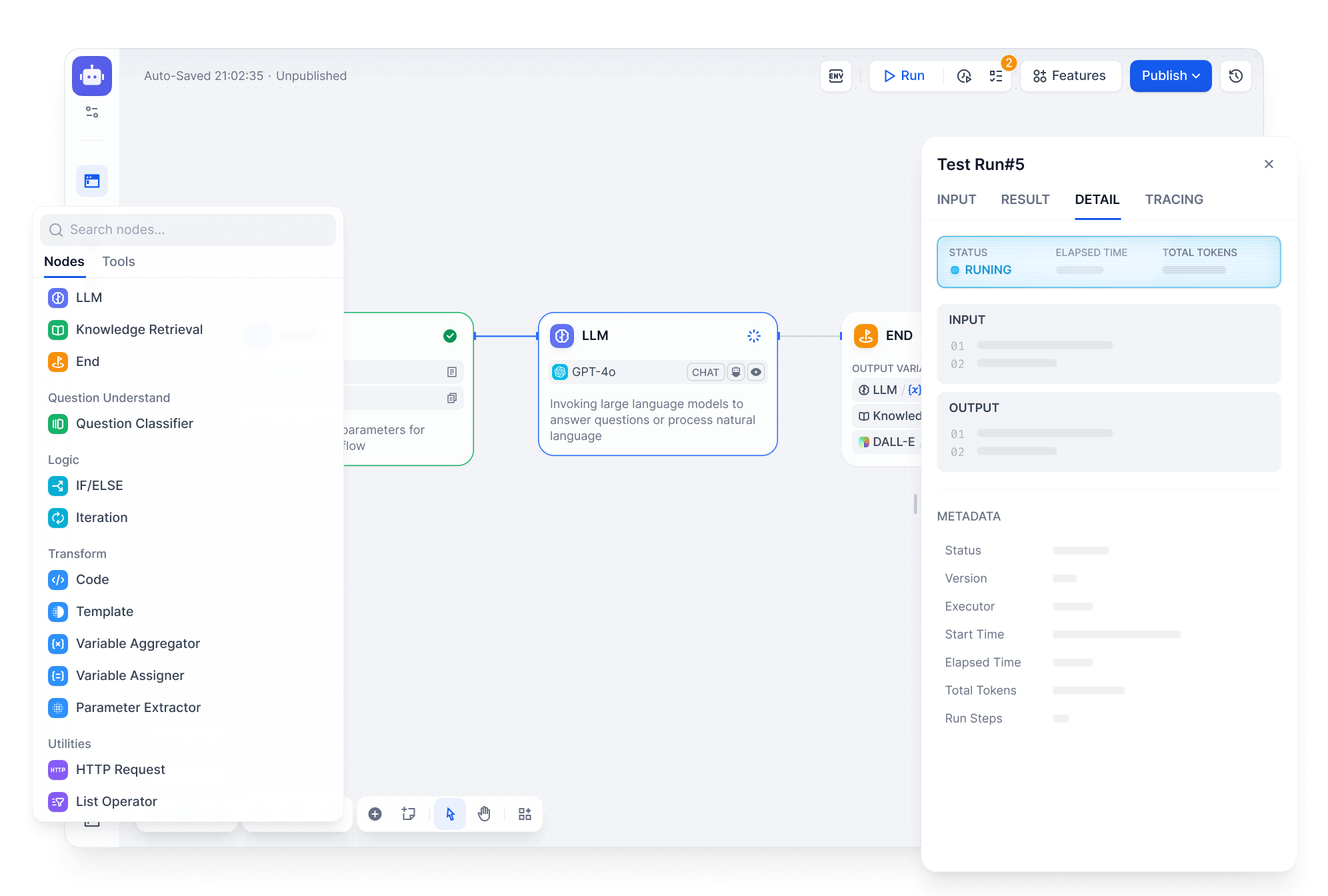
Workflow canvas and test panel
The author-provided UI illustration shows a node picker, connected workflow blocks and the test-run panel.
License
Lossless PNG-to-WebP conversion; original dimensions and decoded pixels preserved. No crop, generated input, execution claim or site test. Existing interface marks remain visible. Source UI illustrations contain placeholder content. Full modified license and branding are retained; no Dify frontend code is deployed or operated.
# Open Source License

Dify is licensed under a modified version of the Apache License 2.0, with the following additional conditions:

1. Dify may be utilized commercially, including as a backend service for other applications or as an application development platform for enterprises. Should the conditions below be met, a commercial license must be obtained from the producer:

a. Multi-tenant service: Unless explicitly authorized by Dify in writing, you may not use the Dify source code to operate a multi-tenant environment.
    - Tenant Definition: Within the context of Dify, one tenant corresponds to one workspace. The workspace provides a separated area for each tenant's data and configurations.

b. LOGO and copyright information: In the process of using Dify's frontend, you may not remove or modify the LOGO or copyright information in the Dify console or applications. This restriction is inapplicable to uses of Dify that do not involve its frontend.
    - Frontend Definition: For the purposes of this license, the "frontend" of Dify includes all components located in the `web/` directory when running Dify from the raw source code, or the "web" image when running Dify with Docker.

2. As a contributor, you should agree that:

a. The producer can adjust the open-source agreement to be more strict or relaxed as deemed necessary.
b. Your contributed code may be used for commercial purposes, including but not limited to its cloud business operations.

Apart from the specific conditions mentioned above, all other rights and restrictions follow the Apache License 2.0. Detailed information about the Apache License 2.0 can be found at http://www.apache.org/licenses/LICENSE-2.0.

The interactive design of this product is protected by appearance patent.

© 2025 LangGenius, Inc.
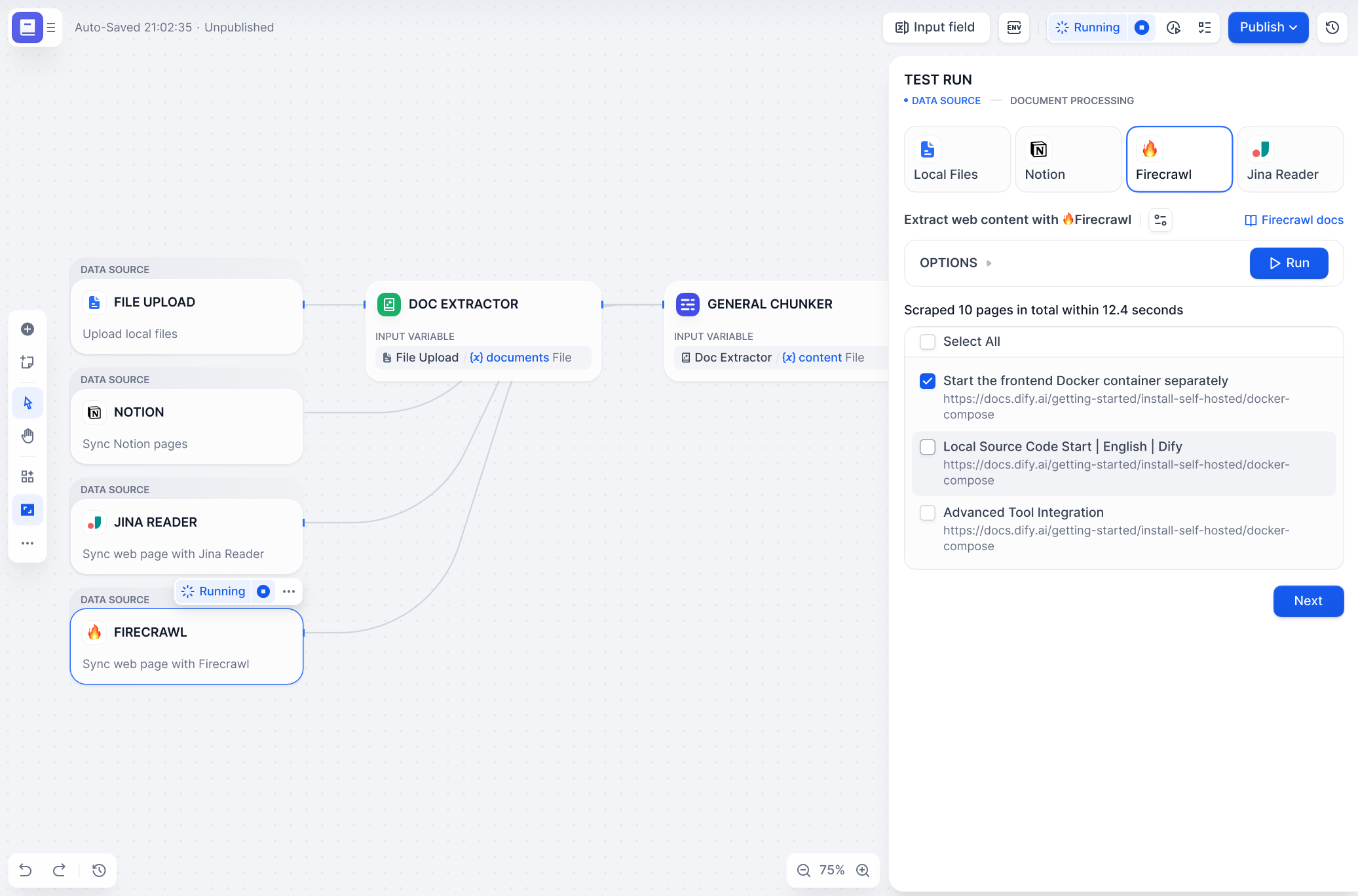
Knowledge-ingestion pipeline
The author-provided pipeline preview connects document sources to extraction and chunking, with a source-selection panel beside the canvas.
License
Lossless PNG-to-WebP conversion; original dimensions and decoded pixels preserved. No crop, generated input, execution claim or site test. Existing interface marks remain visible. Source UI illustrations contain placeholder content. Full modified license and branding are retained; no Dify frontend code is deployed or operated.
# Open Source License

Dify is licensed under a modified version of the Apache License 2.0, with the following additional conditions:

1. Dify may be utilized commercially, including as a backend service for other applications or as an application development platform for enterprises. Should the conditions below be met, a commercial license must be obtained from the producer:

a. Multi-tenant service: Unless explicitly authorized by Dify in writing, you may not use the Dify source code to operate a multi-tenant environment.
    - Tenant Definition: Within the context of Dify, one tenant corresponds to one workspace. The workspace provides a separated area for each tenant's data and configurations.

b. LOGO and copyright information: In the process of using Dify's frontend, you may not remove or modify the LOGO or copyright information in the Dify console or applications. This restriction is inapplicable to uses of Dify that do not involve its frontend.
    - Frontend Definition: For the purposes of this license, the "frontend" of Dify includes all components located in the `web/` directory when running Dify from the raw source code, or the "web" image when running Dify with Docker.

2. As a contributor, you should agree that:

a. The producer can adjust the open-source agreement to be more strict or relaxed as deemed necessary.
b. Your contributed code may be used for commercial purposes, including but not limited to its cloud business operations.

Apart from the specific conditions mentioned above, all other rights and restrictions follow the Apache License 2.0. Detailed information about the Apache License 2.0 can be found at http://www.apache.org/licenses/LICENSE-2.0.

The interactive design of this product is protected by appearance patent.

© 2025 LangGenius, Inc.
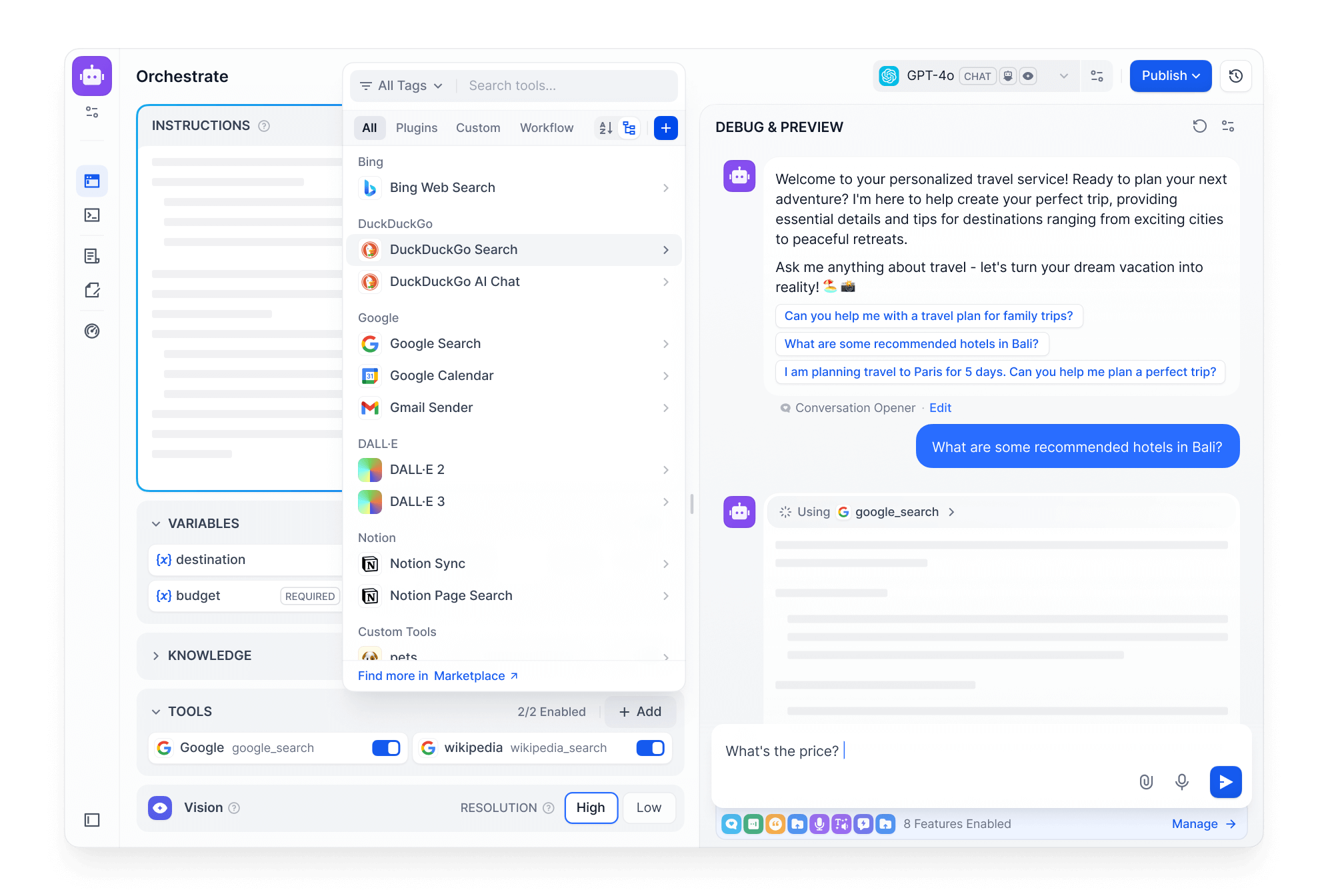
Agent tools and conversation preview
The author-provided UI illustration shows agent instructions, tool selection and a travel-assistant conversation preview.
License
Lossless PNG-to-WebP conversion; original dimensions and decoded pixels preserved. No crop, generated input, execution claim or site test. Existing interface marks remain visible. Source UI illustrations contain placeholder content. Full modified license and branding are retained; no Dify frontend code is deployed or operated.
# Open Source License

Dify is licensed under a modified version of the Apache License 2.0, with the following additional conditions:

1. Dify may be utilized commercially, including as a backend service for other applications or as an application development platform for enterprises. Should the conditions below be met, a commercial license must be obtained from the producer:

a. Multi-tenant service: Unless explicitly authorized by Dify in writing, you may not use the Dify source code to operate a multi-tenant environment.
    - Tenant Definition: Within the context of Dify, one tenant corresponds to one workspace. The workspace provides a separated area for each tenant's data and configurations.

b. LOGO and copyright information: In the process of using Dify's frontend, you may not remove or modify the LOGO or copyright information in the Dify console or applications. This restriction is inapplicable to uses of Dify that do not involve its frontend.
    - Frontend Definition: For the purposes of this license, the "frontend" of Dify includes all components located in the `web/` directory when running Dify from the raw source code, or the "web" image when running Dify with Docker.

2. As a contributor, you should agree that:

a. The producer can adjust the open-source agreement to be more strict or relaxed as deemed necessary.
b. Your contributed code may be used for commercial purposes, including but not limited to its cloud business operations.

Apart from the specific conditions mentioned above, all other rights and restrictions follow the Apache License 2.0. Detailed information about the Apache License 2.0 can be found at http://www.apache.org/licenses/LICENSE-2.0.

The interactive design of this product is protected by appearance patent.

© 2025 LangGenius, Inc.
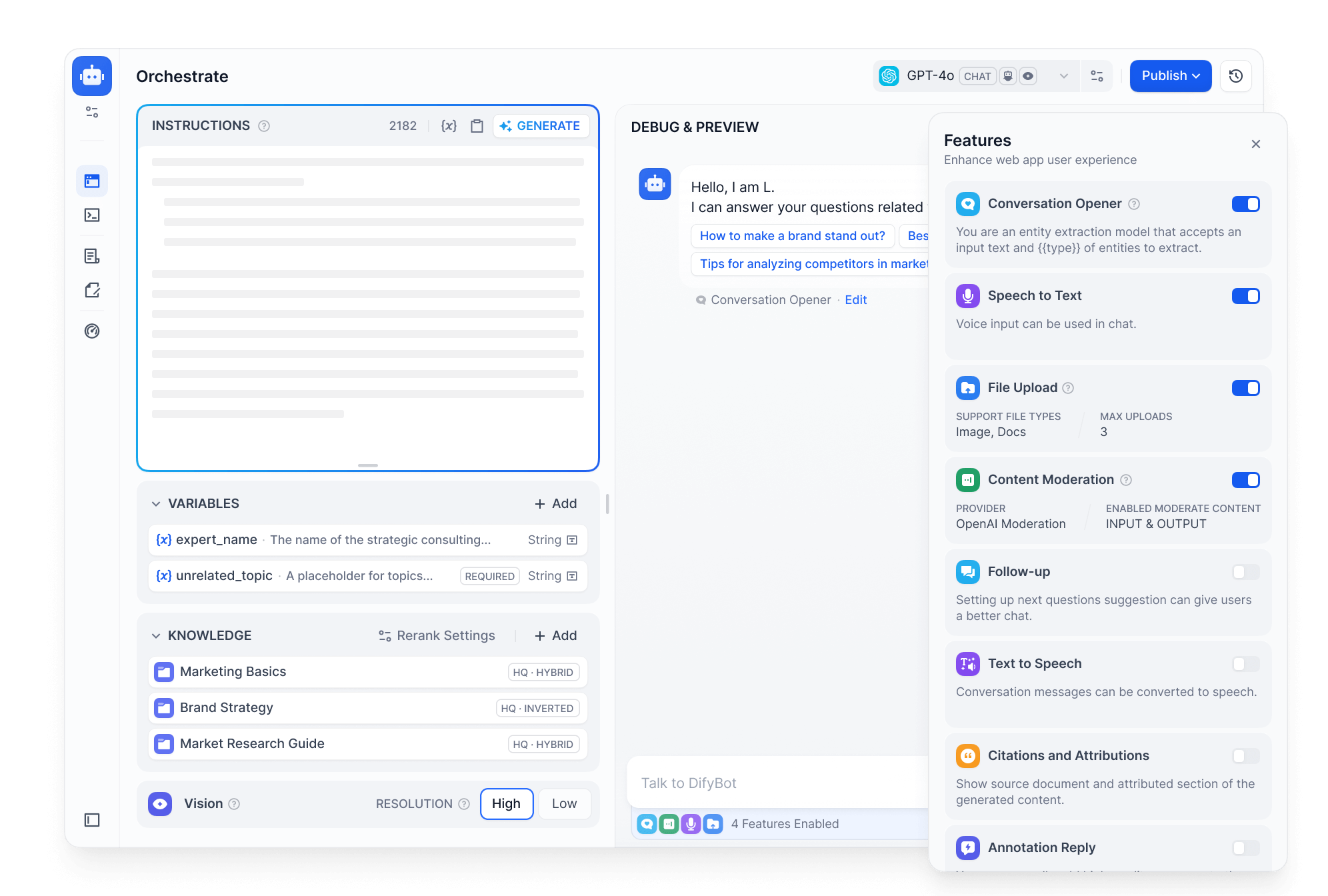
Chatbot features and knowledge sources
The author-provided UI illustration combines instructions, variables and knowledge sources with conversation feature controls.
License
Lossless PNG-to-WebP conversion; original dimensions and decoded pixels preserved. No crop, generated input, execution claim or site test. Existing interface marks remain visible. Source UI illustrations contain placeholder content. Full modified license and branding are retained; no Dify frontend code is deployed or operated.
# Open Source License

Dify is licensed under a modified version of the Apache License 2.0, with the following additional conditions:

1. Dify may be utilized commercially, including as a backend service for other applications or as an application development platform for enterprises. Should the conditions below be met, a commercial license must be obtained from the producer:

a. Multi-tenant service: Unless explicitly authorized by Dify in writing, you may not use the Dify source code to operate a multi-tenant environment.
    - Tenant Definition: Within the context of Dify, one tenant corresponds to one workspace. The workspace provides a separated area for each tenant's data and configurations.

b. LOGO and copyright information: In the process of using Dify's frontend, you may not remove or modify the LOGO or copyright information in the Dify console or applications. This restriction is inapplicable to uses of Dify that do not involve its frontend.
    - Frontend Definition: For the purposes of this license, the "frontend" of Dify includes all components located in the `web/` directory when running Dify from the raw source code, or the "web" image when running Dify with Docker.

2. As a contributor, you should agree that:

a. The producer can adjust the open-source agreement to be more strict or relaxed as deemed necessary.
b. Your contributed code may be used for commercial purposes, including but not limited to its cloud business operations.

Apart from the specific conditions mentioned above, all other rights and restrictions follow the Apache License 2.0. Detailed information about the Apache License 2.0 can be found at http://www.apache.org/licenses/LICENSE-2.0.

The interactive design of this product is protected by appearance patent.

© 2025 LangGenius, Inc.
Product overview
Dify combines model configuration, knowledge retrieval and workflow design in one application-building environment. A team can use its own documents to build a support assistant, or connect several processing steps into a workflow and expose it as an application. The finished application can be published through a web interface or called through a REST API.
Choose between managed Dify Cloud and the self-hosted Community Edition before designing deployment. Cloud provides a managed environment, while self-hosting means taking responsibility for the application, storage, updates and operations. Models, plugins and connected tools are separate dependencies; installing the platform does not automatically provide their credentials or usage allowance.
What Dify offers
- 01Build agents, chat assistants and workflows visually.
- 02Connect a knowledge base and configure retrieval for document-grounded answers.
- 03Publish applications for web use or integration through REST APIs.
A practical workflow
- 01Choose Cloud or self-hosting and connect the required model provider.
- 02Prepare a small document set and configure retrieval or workflow steps for one task.
- 03Check answers against the source documents and test failure cases before publishing the web application or API.
Summary based on source material; product claims have not been independently tested.
What makes it different
Its focus is assembling an application around models and data rather than supplying only a chat window. The visual workflow makes steps inspectable, but answer quality still depends on document preparation, retrieval settings, prompts and the selected model.
Who should consider it
- Teams creating assistants from their own documents.
- Builders connecting model calls and tools into repeatable application workflows.
What to verify
- Separate platform allowances from model, plugin, storage and hosting costs.
- For self-hosting, plan updates, backups and access control.
- Check where uploaded documents and model requests are processed before connecting internal data.
Frequently asked questions
Does self-hosting include free model usage?
No. Operating the application yourself does not supply paid model-provider credits. The selected provider and any connected services have their own conditions.
Can a Dify application be integrated into another product?
The documentation describes web publication and REST API access. Review the API contract and authentication for the application you publish.
Product facts were checked against the official product website or its first-party documentation on Oct 26, 2026.