
Zobacz w działaniu
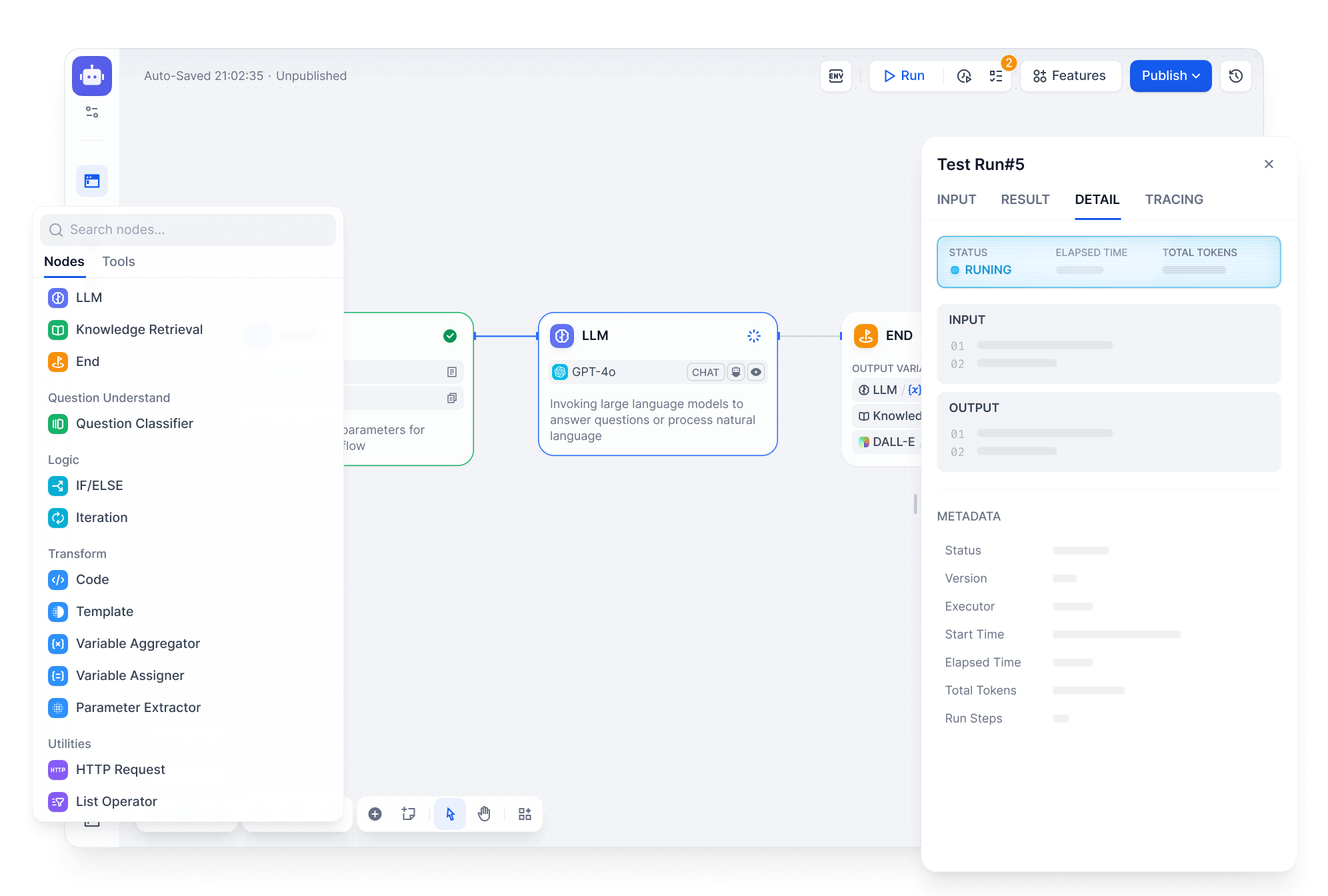
Workflow canvas and test panel
The author-provided UI illustration shows a node picker, connected workflow blocks and the test-run panel.
Licencja
Lossless PNG-to-WebP conversion; original dimensions and decoded pixels preserved. No crop, generated input, execution claim or site test. Existing interface marks remain visible. Source UI illustrations contain placeholder content. Full modified license and branding are retained; no Dify frontend code is deployed or operated.
# Open Source License

Dify is licensed under a modified version of the Apache License 2.0, with the following additional conditions:

1. Dify may be utilized commercially, including as a backend service for other applications or as an application development platform for enterprises. Should the conditions below be met, a commercial license must be obtained from the producer:

a. Multi-tenant service: Unless explicitly authorized by Dify in writing, you may not use the Dify source code to operate a multi-tenant environment.
    - Tenant Definition: Within the context of Dify, one tenant corresponds to one workspace. The workspace provides a separated area for each tenant's data and configurations.

b. LOGO and copyright information: In the process of using Dify's frontend, you may not remove or modify the LOGO or copyright information in the Dify console or applications. This restriction is inapplicable to uses of Dify that do not involve its frontend.
    - Frontend Definition: For the purposes of this license, the "frontend" of Dify includes all components located in the `web/` directory when running Dify from the raw source code, or the "web" image when running Dify with Docker.

2. As a contributor, you should agree that:

a. The producer can adjust the open-source agreement to be more strict or relaxed as deemed necessary.
b. Your contributed code may be used for commercial purposes, including but not limited to its cloud business operations.

Apart from the specific conditions mentioned above, all other rights and restrictions follow the Apache License 2.0. Detailed information about the Apache License 2.0 can be found at http://www.apache.org/licenses/LICENSE-2.0.

The interactive design of this product is protected by appearance patent.

© 2025 LangGenius, Inc.
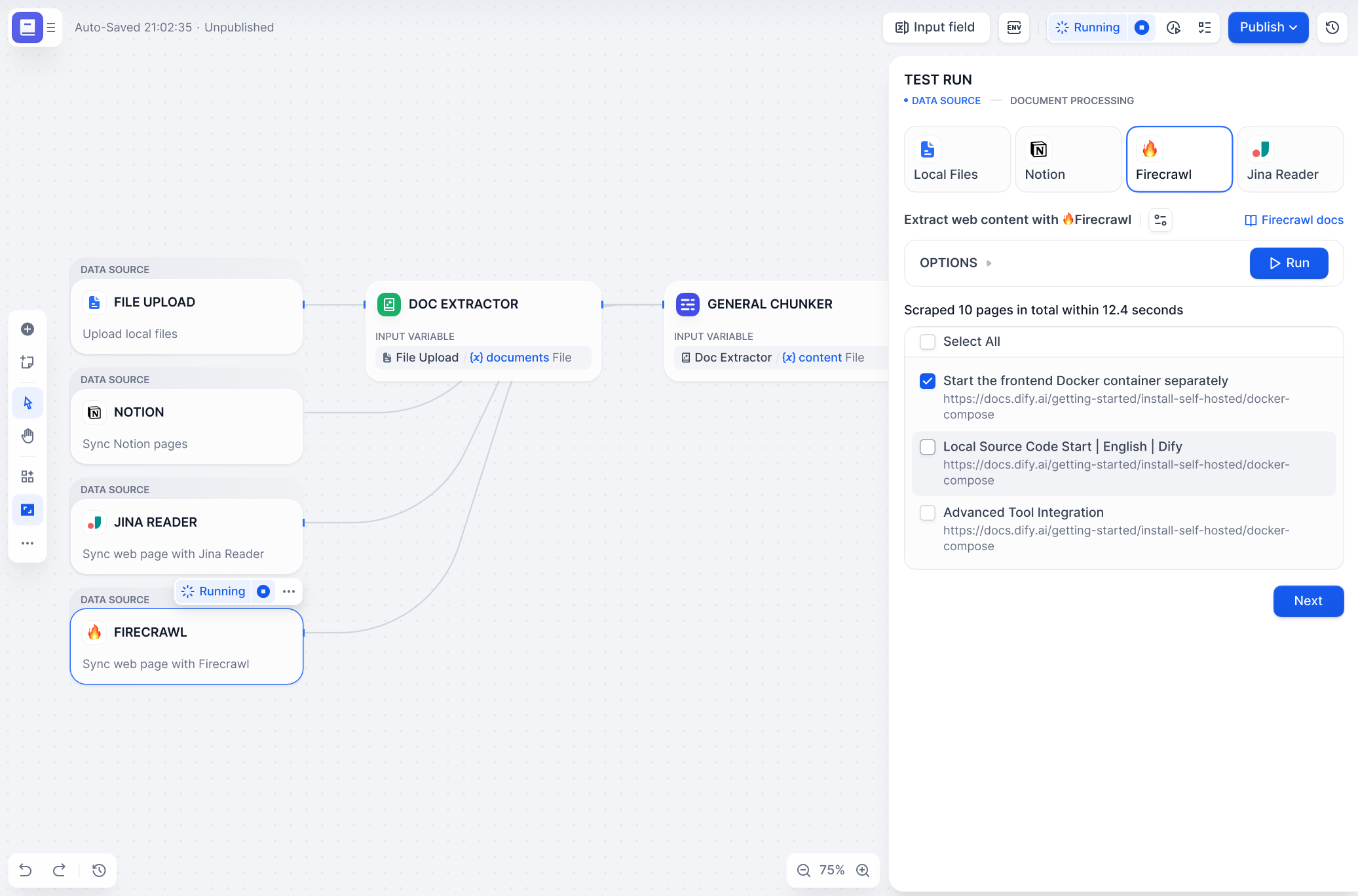
Knowledge-ingestion pipeline
The author-provided pipeline preview connects document sources to extraction and chunking, with a source-selection panel beside the canvas.
Licencja
Lossless PNG-to-WebP conversion; original dimensions and decoded pixels preserved. No crop, generated input, execution claim or site test. Existing interface marks remain visible. Source UI illustrations contain placeholder content. Full modified license and branding are retained; no Dify frontend code is deployed or operated.
# Open Source License

Dify is licensed under a modified version of the Apache License 2.0, with the following additional conditions:

1. Dify may be utilized commercially, including as a backend service for other applications or as an application development platform for enterprises. Should the conditions below be met, a commercial license must be obtained from the producer:

a. Multi-tenant service: Unless explicitly authorized by Dify in writing, you may not use the Dify source code to operate a multi-tenant environment.
    - Tenant Definition: Within the context of Dify, one tenant corresponds to one workspace. The workspace provides a separated area for each tenant's data and configurations.

b. LOGO and copyright information: In the process of using Dify's frontend, you may not remove or modify the LOGO or copyright information in the Dify console or applications. This restriction is inapplicable to uses of Dify that do not involve its frontend.
    - Frontend Definition: For the purposes of this license, the "frontend" of Dify includes all components located in the `web/` directory when running Dify from the raw source code, or the "web" image when running Dify with Docker.

2. As a contributor, you should agree that:

a. The producer can adjust the open-source agreement to be more strict or relaxed as deemed necessary.
b. Your contributed code may be used for commercial purposes, including but not limited to its cloud business operations.

Apart from the specific conditions mentioned above, all other rights and restrictions follow the Apache License 2.0. Detailed information about the Apache License 2.0 can be found at http://www.apache.org/licenses/LICENSE-2.0.

The interactive design of this product is protected by appearance patent.

© 2025 LangGenius, Inc.
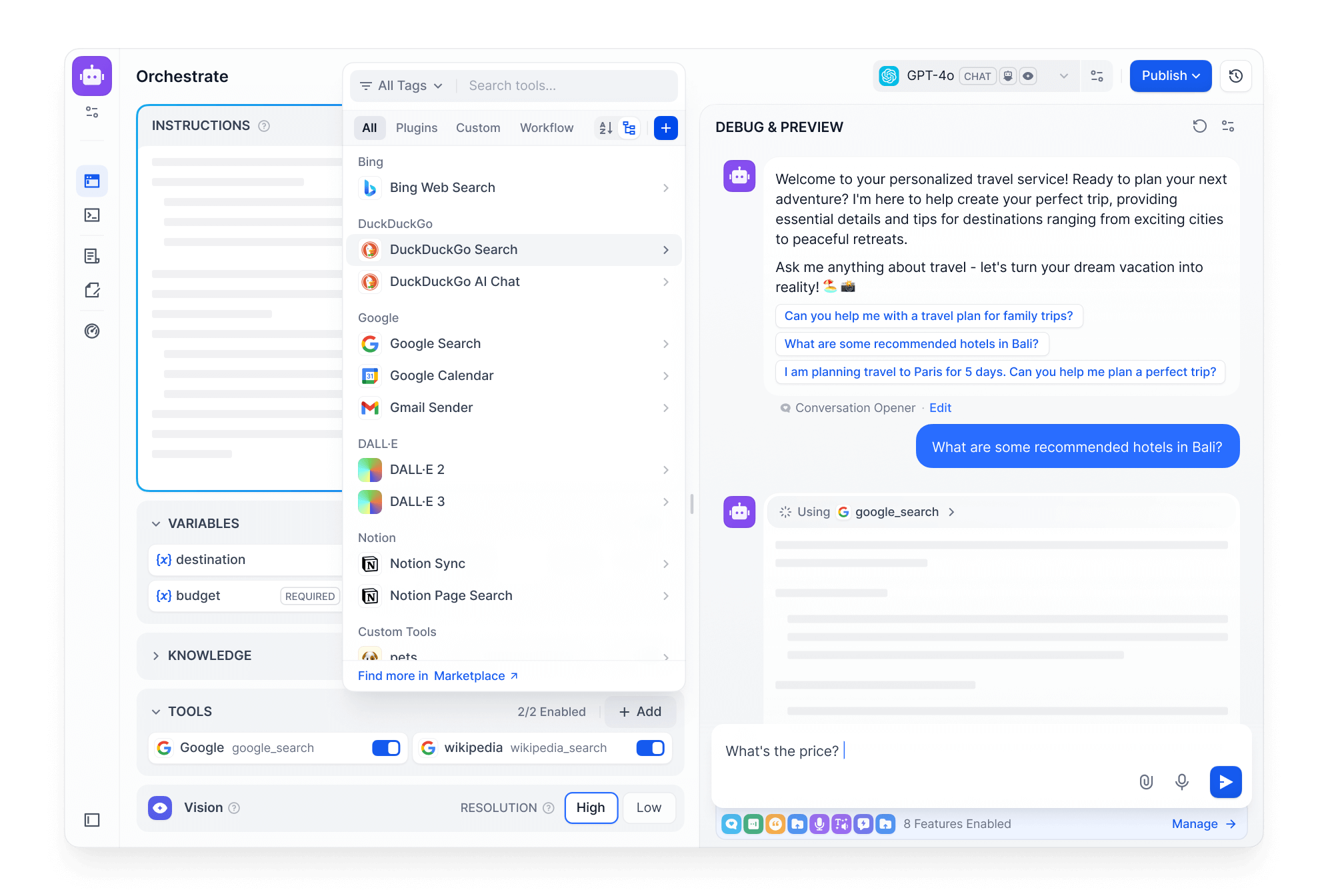
Agent tools and conversation preview
The author-provided UI illustration shows agent instructions, tool selection and a travel-assistant conversation preview.
Licencja
Lossless PNG-to-WebP conversion; original dimensions and decoded pixels preserved. No crop, generated input, execution claim or site test. Existing interface marks remain visible. Source UI illustrations contain placeholder content. Full modified license and branding are retained; no Dify frontend code is deployed or operated.
# Open Source License

Dify is licensed under a modified version of the Apache License 2.0, with the following additional conditions:

1. Dify may be utilized commercially, including as a backend service for other applications or as an application development platform for enterprises. Should the conditions below be met, a commercial license must be obtained from the producer:

a. Multi-tenant service: Unless explicitly authorized by Dify in writing, you may not use the Dify source code to operate a multi-tenant environment.
    - Tenant Definition: Within the context of Dify, one tenant corresponds to one workspace. The workspace provides a separated area for each tenant's data and configurations.

b. LOGO and copyright information: In the process of using Dify's frontend, you may not remove or modify the LOGO or copyright information in the Dify console or applications. This restriction is inapplicable to uses of Dify that do not involve its frontend.
    - Frontend Definition: For the purposes of this license, the "frontend" of Dify includes all components located in the `web/` directory when running Dify from the raw source code, or the "web" image when running Dify with Docker.

2. As a contributor, you should agree that:

a. The producer can adjust the open-source agreement to be more strict or relaxed as deemed necessary.
b. Your contributed code may be used for commercial purposes, including but not limited to its cloud business operations.

Apart from the specific conditions mentioned above, all other rights and restrictions follow the Apache License 2.0. Detailed information about the Apache License 2.0 can be found at http://www.apache.org/licenses/LICENSE-2.0.

The interactive design of this product is protected by appearance patent.

© 2025 LangGenius, Inc.
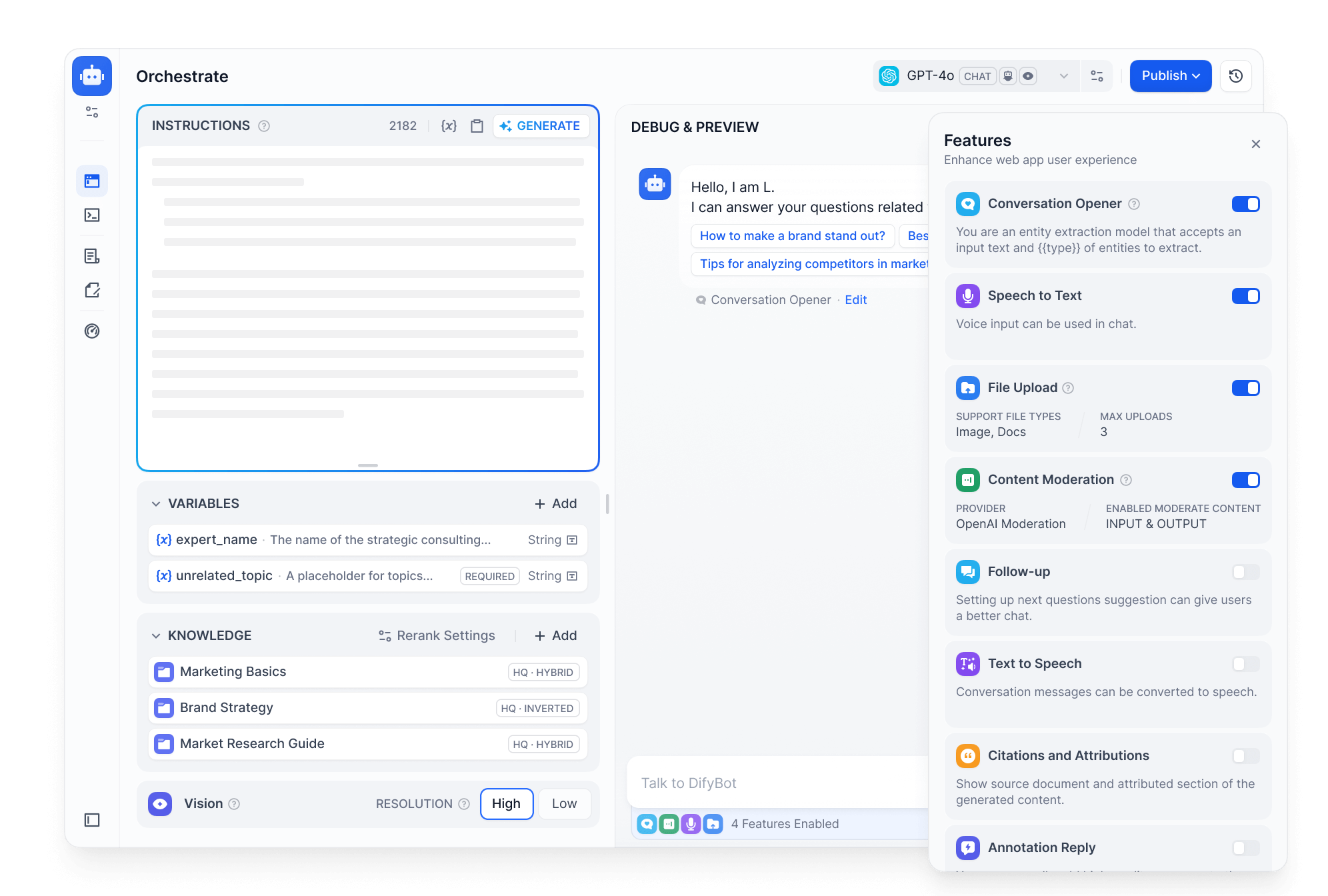
Chatbot features and knowledge sources
The author-provided UI illustration combines instructions, variables and knowledge sources with conversation feature controls.
Licencja
Lossless PNG-to-WebP conversion; original dimensions and decoded pixels preserved. No crop, generated input, execution claim or site test. Existing interface marks remain visible. Source UI illustrations contain placeholder content. Full modified license and branding are retained; no Dify frontend code is deployed or operated.
# Open Source License

Dify is licensed under a modified version of the Apache License 2.0, with the following additional conditions:

1. Dify may be utilized commercially, including as a backend service for other applications or as an application development platform for enterprises. Should the conditions below be met, a commercial license must be obtained from the producer:

a. Multi-tenant service: Unless explicitly authorized by Dify in writing, you may not use the Dify source code to operate a multi-tenant environment.
    - Tenant Definition: Within the context of Dify, one tenant corresponds to one workspace. The workspace provides a separated area for each tenant's data and configurations.

b. LOGO and copyright information: In the process of using Dify's frontend, you may not remove or modify the LOGO or copyright information in the Dify console or applications. This restriction is inapplicable to uses of Dify that do not involve its frontend.
    - Frontend Definition: For the purposes of this license, the "frontend" of Dify includes all components located in the `web/` directory when running Dify from the raw source code, or the "web" image when running Dify with Docker.

2. As a contributor, you should agree that:

a. The producer can adjust the open-source agreement to be more strict or relaxed as deemed necessary.
b. Your contributed code may be used for commercial purposes, including but not limited to its cloud business operations.

Apart from the specific conditions mentioned above, all other rights and restrictions follow the Apache License 2.0. Detailed information about the Apache License 2.0 can be found at http://www.apache.org/licenses/LICENSE-2.0.

The interactive design of this product is protected by appearance patent.

© 2025 LangGenius, Inc.
Opis produktu
Dify łączy konfigurację modeli, wyszukiwanie wiedzy i projektowanie przepływów w jednym środowisku. Zespół może zbudować asystenta na własnych dokumentach lub połączyć kilka etapów przetwarzania. Aplikację można opublikować w sieci albo wywoływać przez REST API.
Przed wdrożeniem należy wybrać zarządzany Dify Cloud lub samodzielnie hostowaną Community Edition. W drugim wariancie odpowiadasz za aplikację, dane, aktualizacje i utrzymanie. Modele, wtyczki i narzędzia są osobnymi zależnościami; ich dane dostępu i limity nie pojawiają się automatycznie.
Co oferuje Dify
- 01Wizualne tworzenie agentów, asystentów i przepływów.
- 02Podłączanie bazy dokumentów i konfiguracja wyszukiwania.
- 03Publikacja aplikacji webowych i integracja przez REST API.
Praktyczny przebieg pracy
- 01Wybrać Cloud lub własny hosting i podłączyć dostawcę modelu.
- 02Skonfigurować jedno zadanie na niewielkiej grupie dokumentów.
- 03Porównać odpowiedzi ze źródłami i sprawdzić błędy przed publikacją.
Podsumowanie na podstawie źródła; deklaracje produktu nie zostały niezależnie przetestowane.
Co je wyróżnia
Służy do budowania aplikacji wokół modeli i danych. Widoczne etapy ułatwiają kontrolę, ale jakość zależy od dokumentów, wyszukiwania, instrukcji i modelu.
Dla kogo
- Zespoły budujące asystentów na własnych dokumentach.
- Programiści łączący modele i narzędzia w powtarzalne procesy.
Co sprawdzić
- Rozdzielić koszty platformy, modeli, wtyczek, danych i serwerów.
- Przy własnym hostingu zaplanować aktualizacje, kopie i kontrolę dostępu.
- Sprawdzić, gdzie przetwarzane są wewnętrzne dokumenty i żądania do modeli.
Najczęstsze pytania
Czy własny hosting obejmuje darmowe modele?
Nie. Samodzielna instalacja nie zapewnia kredytów płatnych dostawców modeli. Usługi mają osobne warunki.
Czy aplikację można połączyć z innym produktem?
Dokumentacja opisuje publikację webową i REST API. Sprawdź kontrakt API i uwierzytelnianie opublikowanej aplikacji.
Informacje o produkcie porównano 26 paź 2026 z oficjalną stroną lub dokumentacją.