
Voir en action
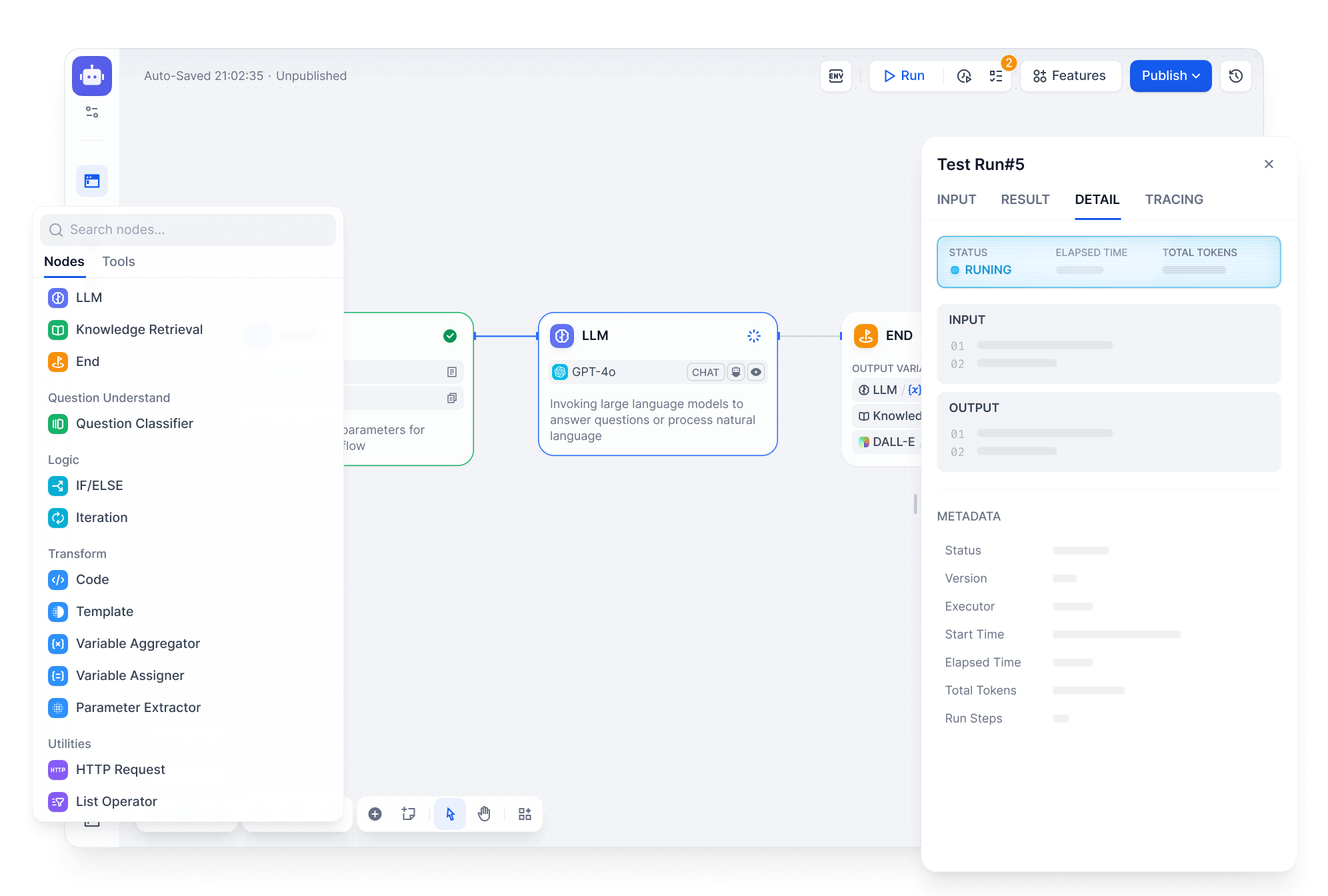
Workflow canvas and test panel
The author-provided UI illustration shows a node picker, connected workflow blocks and the test-run panel.
Licence
Lossless PNG-to-WebP conversion; original dimensions and decoded pixels preserved. No crop, generated input, execution claim or site test. Existing interface marks remain visible. Source UI illustrations contain placeholder content. Full modified license and branding are retained; no Dify frontend code is deployed or operated.
# Open Source License

Dify is licensed under a modified version of the Apache License 2.0, with the following additional conditions:

1. Dify may be utilized commercially, including as a backend service for other applications or as an application development platform for enterprises. Should the conditions below be met, a commercial license must be obtained from the producer:

a. Multi-tenant service: Unless explicitly authorized by Dify in writing, you may not use the Dify source code to operate a multi-tenant environment.
    - Tenant Definition: Within the context of Dify, one tenant corresponds to one workspace. The workspace provides a separated area for each tenant's data and configurations.

b. LOGO and copyright information: In the process of using Dify's frontend, you may not remove or modify the LOGO or copyright information in the Dify console or applications. This restriction is inapplicable to uses of Dify that do not involve its frontend.
    - Frontend Definition: For the purposes of this license, the "frontend" of Dify includes all components located in the `web/` directory when running Dify from the raw source code, or the "web" image when running Dify with Docker.

2. As a contributor, you should agree that:

a. The producer can adjust the open-source agreement to be more strict or relaxed as deemed necessary.
b. Your contributed code may be used for commercial purposes, including but not limited to its cloud business operations.

Apart from the specific conditions mentioned above, all other rights and restrictions follow the Apache License 2.0. Detailed information about the Apache License 2.0 can be found at http://www.apache.org/licenses/LICENSE-2.0.

The interactive design of this product is protected by appearance patent.

© 2025 LangGenius, Inc.
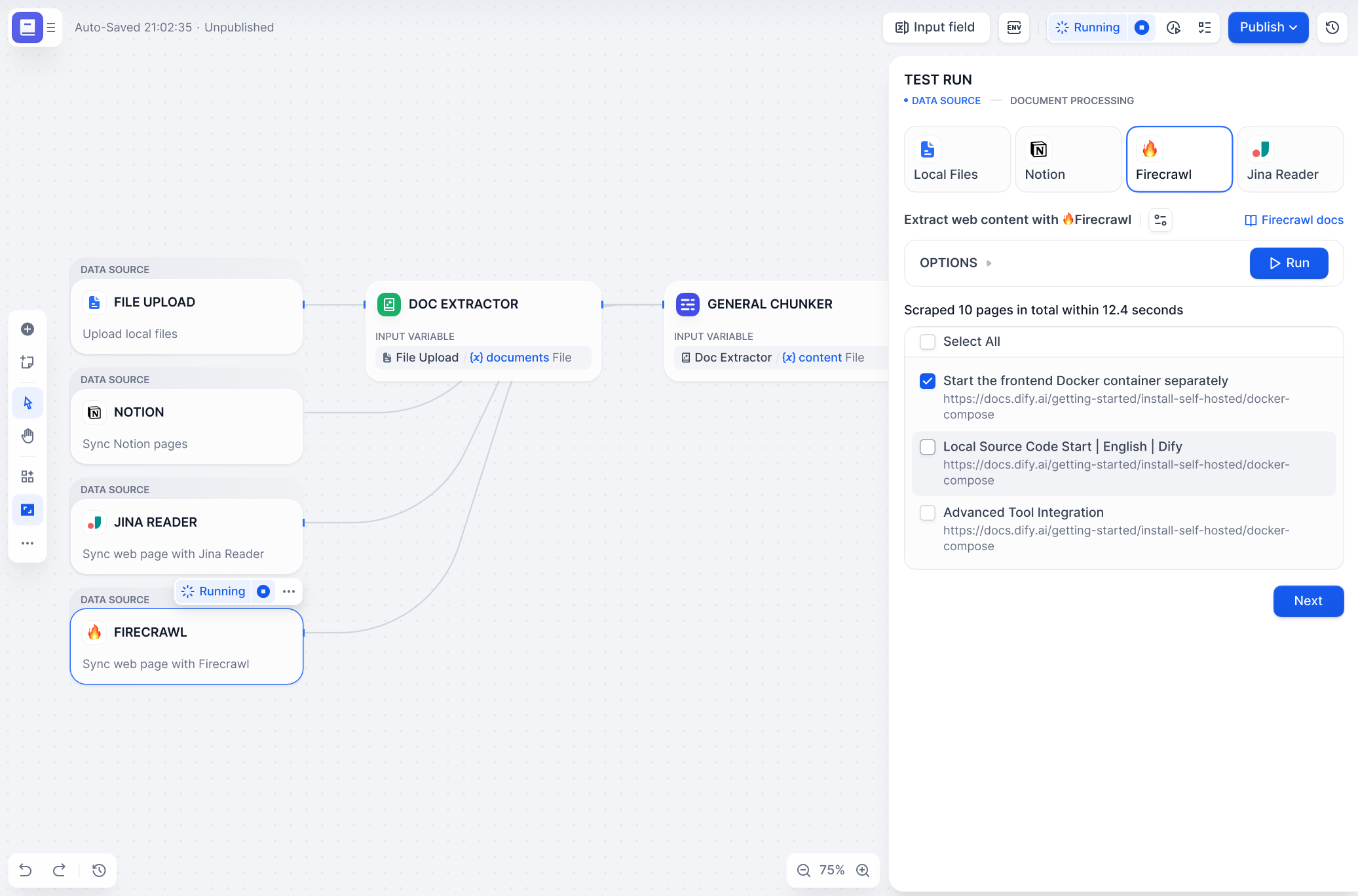
Knowledge-ingestion pipeline
The author-provided pipeline preview connects document sources to extraction and chunking, with a source-selection panel beside the canvas.
Licence
Lossless PNG-to-WebP conversion; original dimensions and decoded pixels preserved. No crop, generated input, execution claim or site test. Existing interface marks remain visible. Source UI illustrations contain placeholder content. Full modified license and branding are retained; no Dify frontend code is deployed or operated.
# Open Source License

Dify is licensed under a modified version of the Apache License 2.0, with the following additional conditions:

1. Dify may be utilized commercially, including as a backend service for other applications or as an application development platform for enterprises. Should the conditions below be met, a commercial license must be obtained from the producer:

a. Multi-tenant service: Unless explicitly authorized by Dify in writing, you may not use the Dify source code to operate a multi-tenant environment.
    - Tenant Definition: Within the context of Dify, one tenant corresponds to one workspace. The workspace provides a separated area for each tenant's data and configurations.

b. LOGO and copyright information: In the process of using Dify's frontend, you may not remove or modify the LOGO or copyright information in the Dify console or applications. This restriction is inapplicable to uses of Dify that do not involve its frontend.
    - Frontend Definition: For the purposes of this license, the "frontend" of Dify includes all components located in the `web/` directory when running Dify from the raw source code, or the "web" image when running Dify with Docker.

2. As a contributor, you should agree that:

a. The producer can adjust the open-source agreement to be more strict or relaxed as deemed necessary.
b. Your contributed code may be used for commercial purposes, including but not limited to its cloud business operations.

Apart from the specific conditions mentioned above, all other rights and restrictions follow the Apache License 2.0. Detailed information about the Apache License 2.0 can be found at http://www.apache.org/licenses/LICENSE-2.0.

The interactive design of this product is protected by appearance patent.

© 2025 LangGenius, Inc.
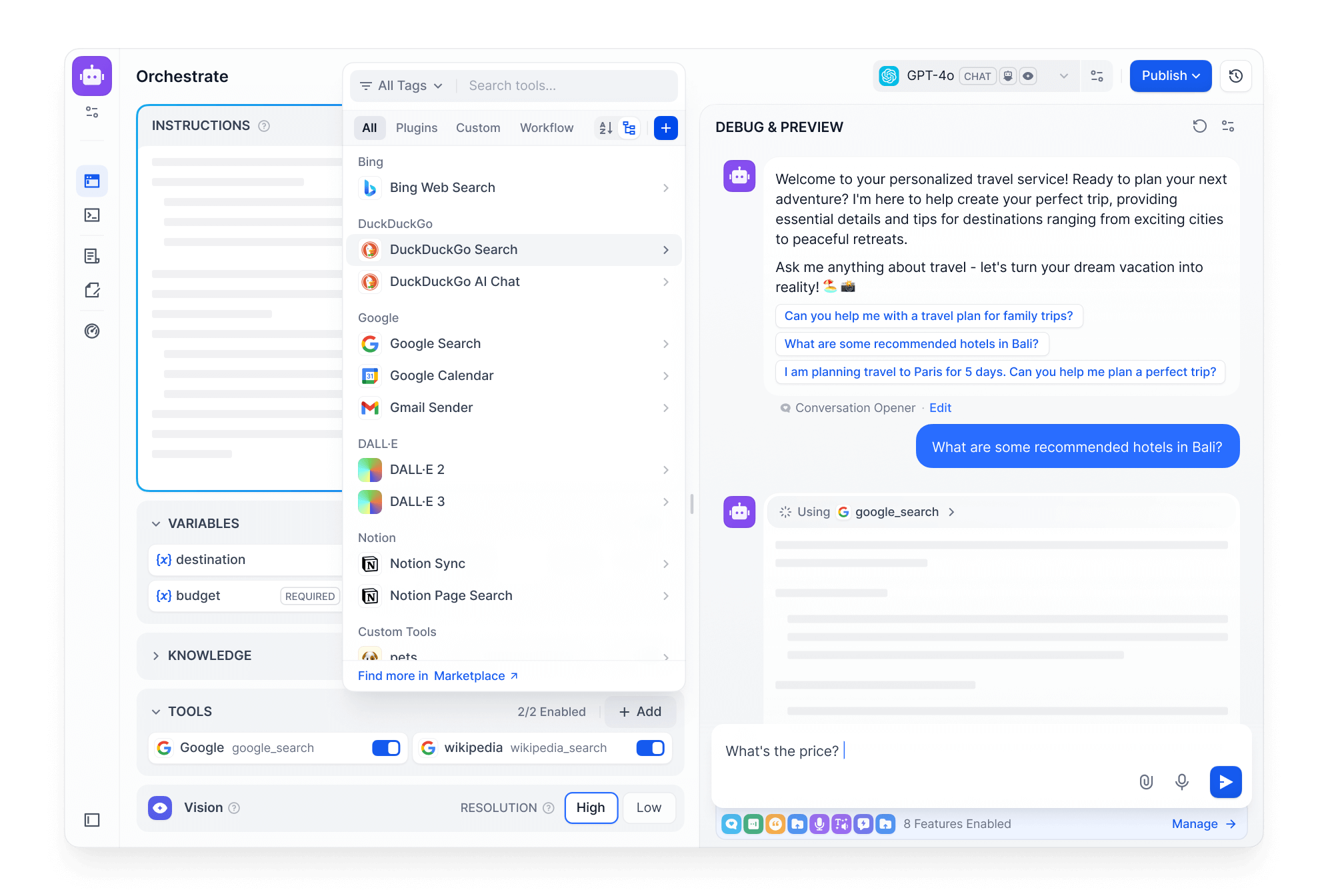
Agent tools and conversation preview
The author-provided UI illustration shows agent instructions, tool selection and a travel-assistant conversation preview.
Licence
Lossless PNG-to-WebP conversion; original dimensions and decoded pixels preserved. No crop, generated input, execution claim or site test. Existing interface marks remain visible. Source UI illustrations contain placeholder content. Full modified license and branding are retained; no Dify frontend code is deployed or operated.
# Open Source License

Dify is licensed under a modified version of the Apache License 2.0, with the following additional conditions:

1. Dify may be utilized commercially, including as a backend service for other applications or as an application development platform for enterprises. Should the conditions below be met, a commercial license must be obtained from the producer:

a. Multi-tenant service: Unless explicitly authorized by Dify in writing, you may not use the Dify source code to operate a multi-tenant environment.
    - Tenant Definition: Within the context of Dify, one tenant corresponds to one workspace. The workspace provides a separated area for each tenant's data and configurations.

b. LOGO and copyright information: In the process of using Dify's frontend, you may not remove or modify the LOGO or copyright information in the Dify console or applications. This restriction is inapplicable to uses of Dify that do not involve its frontend.
    - Frontend Definition: For the purposes of this license, the "frontend" of Dify includes all components located in the `web/` directory when running Dify from the raw source code, or the "web" image when running Dify with Docker.

2. As a contributor, you should agree that:

a. The producer can adjust the open-source agreement to be more strict or relaxed as deemed necessary.
b. Your contributed code may be used for commercial purposes, including but not limited to its cloud business operations.

Apart from the specific conditions mentioned above, all other rights and restrictions follow the Apache License 2.0. Detailed information about the Apache License 2.0 can be found at http://www.apache.org/licenses/LICENSE-2.0.

The interactive design of this product is protected by appearance patent.

© 2025 LangGenius, Inc.
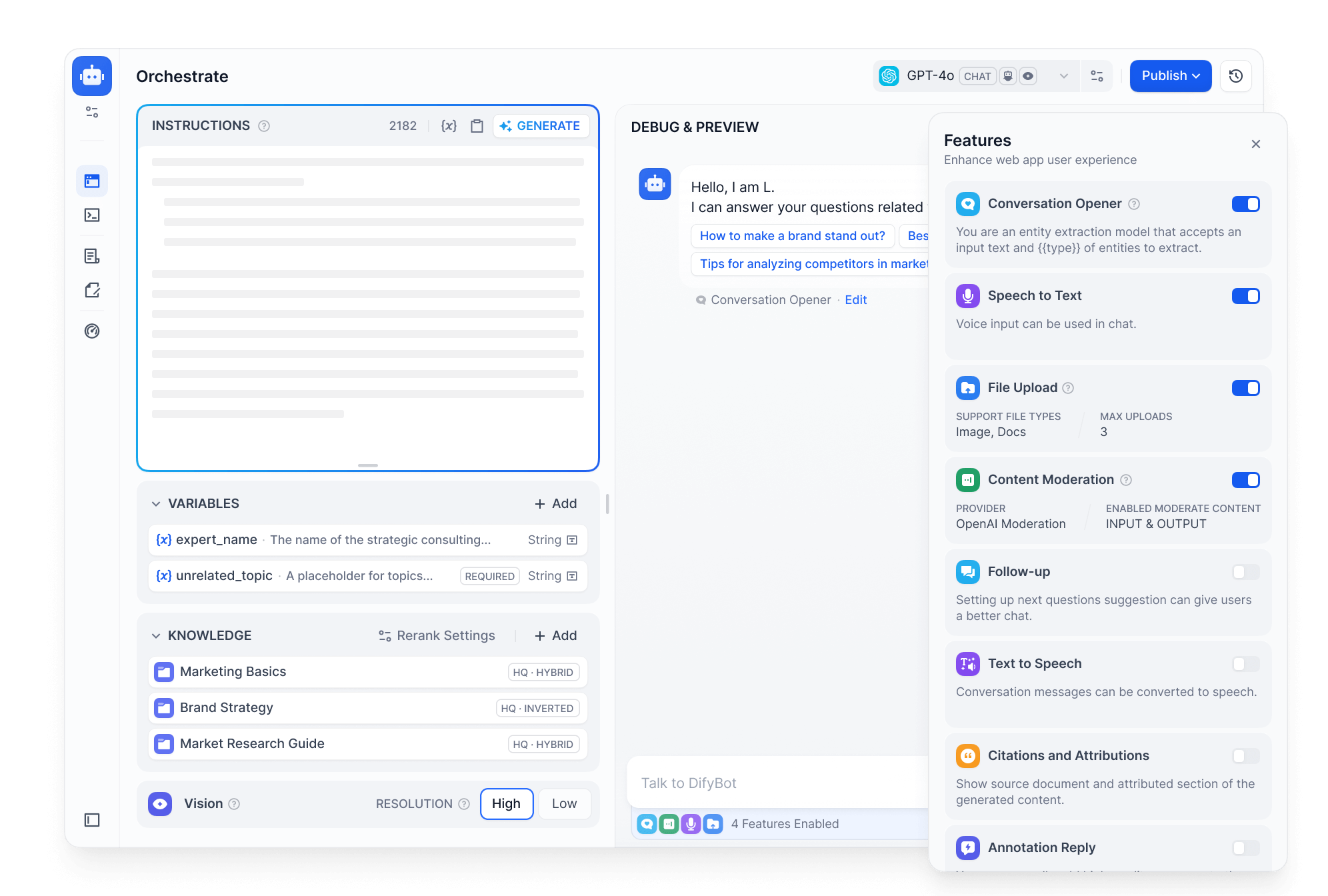
Chatbot features and knowledge sources
The author-provided UI illustration combines instructions, variables and knowledge sources with conversation feature controls.
Licence
Lossless PNG-to-WebP conversion; original dimensions and decoded pixels preserved. No crop, generated input, execution claim or site test. Existing interface marks remain visible. Source UI illustrations contain placeholder content. Full modified license and branding are retained; no Dify frontend code is deployed or operated.
# Open Source License

Dify is licensed under a modified version of the Apache License 2.0, with the following additional conditions:

1. Dify may be utilized commercially, including as a backend service for other applications or as an application development platform for enterprises. Should the conditions below be met, a commercial license must be obtained from the producer:

a. Multi-tenant service: Unless explicitly authorized by Dify in writing, you may not use the Dify source code to operate a multi-tenant environment.
    - Tenant Definition: Within the context of Dify, one tenant corresponds to one workspace. The workspace provides a separated area for each tenant's data and configurations.

b. LOGO and copyright information: In the process of using Dify's frontend, you may not remove or modify the LOGO or copyright information in the Dify console or applications. This restriction is inapplicable to uses of Dify that do not involve its frontend.
    - Frontend Definition: For the purposes of this license, the "frontend" of Dify includes all components located in the `web/` directory when running Dify from the raw source code, or the "web" image when running Dify with Docker.

2. As a contributor, you should agree that:

a. The producer can adjust the open-source agreement to be more strict or relaxed as deemed necessary.
b. Your contributed code may be used for commercial purposes, including but not limited to its cloud business operations.

Apart from the specific conditions mentioned above, all other rights and restrictions follow the Apache License 2.0. Detailed information about the Apache License 2.0 can be found at http://www.apache.org/licenses/LICENSE-2.0.

The interactive design of this product is protected by appearance patent.

© 2025 LangGenius, Inc.
Présentation du produit
Dify réunit configuration des modèles, recherche documentaire et conception de workflows dans un environnement de création d’applications. Une équipe peut transformer ses documents en assistant de support ou relier plusieurs traitements. L’application peut être publiée sur le web ou appelée via une API REST.
Choisissez entre Dify Cloud géré et Community Edition auto-hébergée avant le déploiement. L’auto-hébergement vous confie l’application, le stockage, les mises à jour et l’exploitation. Modèles, extensions et outils connectés sont des dépendances distinctes : leurs identifiants et quotas ne sont pas fournis automatiquement.
Ce que propose Dify
- 01Concevoir visuellement agents, assistants et workflows.
- 02Connecter une base documentaire et configurer la recherche.
- 03Publier une application web ou l’intégrer via une API REST.
Un parcours concret
- 01Choisir Cloud ou auto-hébergement et connecter un fournisseur de modèle.
- 02Configurer une tâche avec un petit jeu documentaire et quelques étapes.
- 03Comparer les réponses aux sources et tester les échecs avant publication.
Résumé fondé sur la source ; les affirmations sur le produit n’ont pas été testées indépendamment.
Ce qui le distingue
L’objectif est d’assembler une application autour des modèles et des données. Les étapes visibles facilitent l’examen, mais la qualité dépend toujours des documents, de la recherche, des instructions et du modèle.
À qui il convient
- Équipes créant un assistant à partir de leurs documents.
- Développeurs reliant modèles et outils dans des processus répétables.
Points à vérifier
- Séparer les coûts de plateforme, modèle, extensions, stockage et hébergement.
- Prévoir mises à jour, sauvegardes et accès en auto-hébergement.
- Vérifier où les documents internes et les requêtes aux modèles sont traités.
Questions fréquentes
L’auto-hébergement rend-il les modèles gratuits ?
Non. Il ne fournit pas de crédits aux fournisseurs de modèles payants. Chaque service connecté conserve ses conditions.
Peut-on intégrer une application Dify à un produit ?
La documentation décrit la publication web et les API REST. Vérifiez le contrat d’API et l’authentification de l’application publiée.
Les informations ont été vérifiées le 26 oct. 2026 sur le site officiel ou la documentation primaire.