
A power-constrained AI facility cannot expand simply by ordering more GPUs. Software decides which model runs, how much work it does, how accelerators wait and when jobs use electricity. Researchers argue that changing those choices can release usable capacity on hardware already installed, faster than replacing chips or connecting new power.
That does not make hardware, cooling or grid investment obsolete. It changes the question from a processor’s advertised performance per watt to useful completed work within the facility’s actual limit—and whether the operator uses savings to reduce demand or produce more output.
PUE measures the building boundary, not the value of its computing
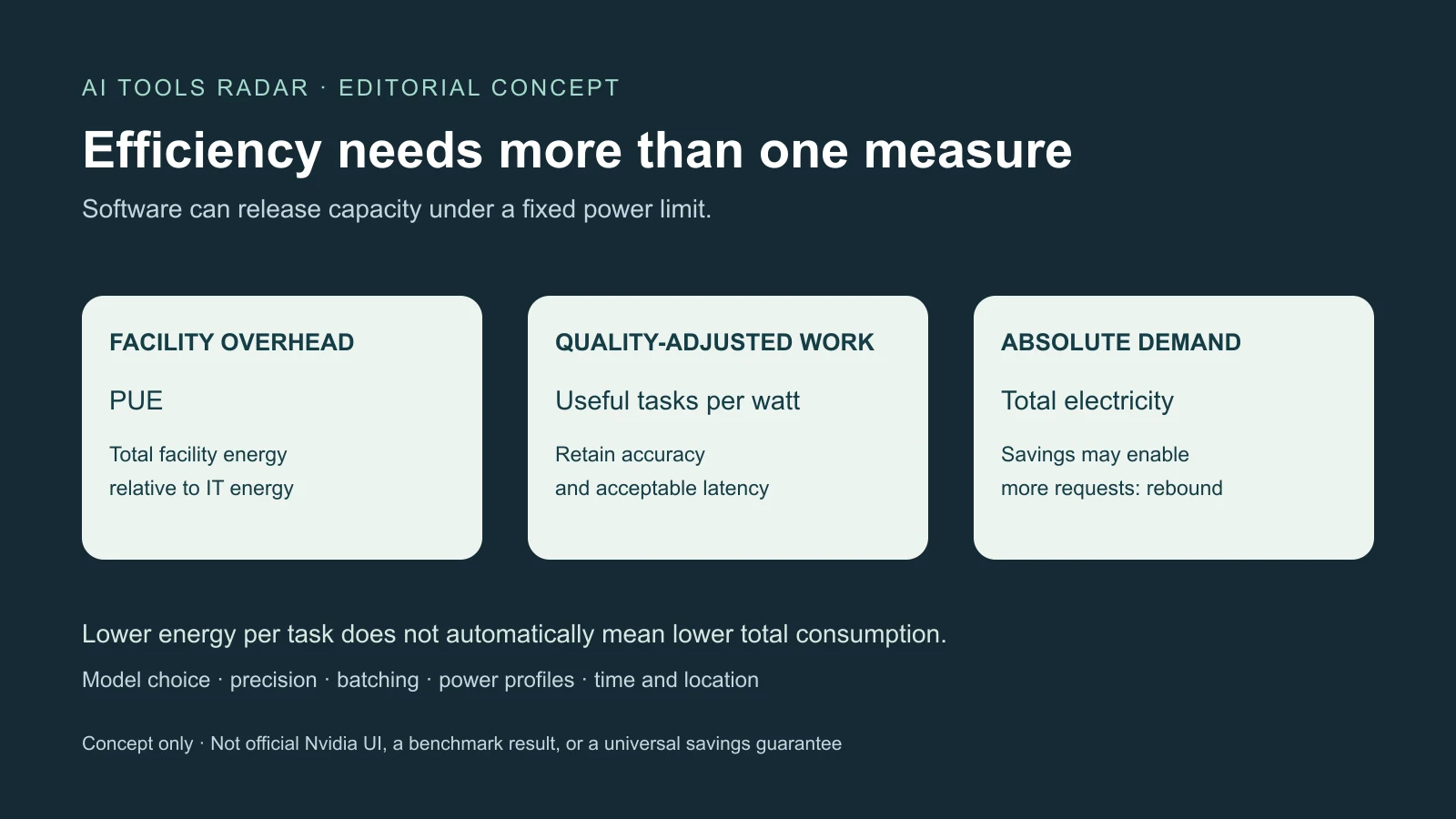
Power usage effectiveness divides total facility energy by energy delivered to IT equipment. Near 1.0 means little overhead for cooling, lighting and conversion, not that every computation is necessary. Excellent PUE can coexist with oversized models, excess tokens and partly idle servers.
Uptime Institute’s 2025 survey reported a weighted average PUE of 1.54 and little improvement for a sixth year, partly because of legacy facilities and regional cooling constraints. The IEA estimates servers account for about 60% of modern-center electricity; storage and networks smaller shares, and cooling roughly 7% at efficient hyperscale sites to over 30% at less-efficient enterprise sites.
Those are different denominators and settings, not shares to add into one universal facility. They explain why overhead improvements alone cannot address application waste. Model selection, precision, batching, output length, processor settings and scheduling determine how productively electricity reaching the racks is used.
University of Michigan researcher Jae-Won Chung, associated with ML.Energy, frames hardware, systems, algorithms and applications as connected layers. Code and scheduling can change faster than fabrication, procurement, installation and testing. Under a fixed power ceiling, more useful work can resemble a capacity addition through extra requests or less delay rather than higher peak load.
Forecast demand is global, while grid constraints are local
The IEA estimates data centers used about 415 TWh in 2024, around 1.5% of global electricity, after roughly 12% annual growth over five years. Its base case reaches approximately 945 TWh in 2030, just under 3% globally and slightly above Japan’s present electricity use.
The US and China account for much of projected growth, adding about 240 TWh and 175 TWh respectively from 2024. Accelerated-server electricity is projected to grow 30% annually, contributing almost half the net increase; conventional servers and infrastructure including cooling each contribute around a fifth.
These are scenario projections, not measured 2030 outcomes. Global percentage also hides concentrated regional loads. A data center may open in two or three years while generation, transmission and substations take longer. The IEA’s high-efficiency scenario delivers the same digital services with over 15% less electricity by 2035 through software, hardware and infrastructure together.
Amazon, Google, Meta, Microsoft and AI providers pursue power contracts, renewables, nuclear agreements, onsite supply, denser racks and custom silicon. Each takes time or investment. Software routing and scheduling offer another lever; buyers experience the power constraint indirectly through quotas, latency and model access even without a per-request electricity bill.
Reported savings use different mechanisms and conditions
Nvidia’s Blackwell power profiles can alter compute and memory frequencies, limits, cache and NVLink states. The vendor claims up to 15% lower energy while retaining at least 97% overall performance, and as much as 13% more throughput in power-limited facilities. These are workload-dependent claims, not guaranteed savings for every installation.
Running at maximum clock can cost disproportionate power for a small performance gain. Reducing speed selectively can preserve most output and free electricity for other accelerators, improving rack-level throughput. Energy reduction and throughput gain describe different constrained comparisons.
ML.Energy researchers tested Qwen3-235B-A22B-Thinking using FP8 rather than bfloat16 and found about one-third lower inference energy on the tested problem-solving tasks. Lower precision can change accuracy; model, hardware and implementation matter. It is not evidence every quantized workload saves the same amount without quality loss.
Training has synchronization slack: some components finish early and wait for slower ones. Chung’s Perseus slows components with less work to finish alongside the bottleneck rather than slowing the whole job. Its published result is up to 30% energy reduction without lower throughput, under the research configuration.
Higher layers can eliminate repeated computation through caching, route routine requests to smaller models, compress prompts, constrain outputs and batch work. Compilers fuse operations and reduce data movement, which consumes energy alongside arithmetic. Right-sizing instances and retiring legacy racks reduce idle baseline consumption; SHI specialist Chetan Visrolia identifies such old equipment as a practical target.
These are not one product or additive percentages. They attack different kinds of work that do not improve the result. A saved computation is useful only if required quality and service remain intact.
Timing and location can matter without lowering all consumption
Interactive assistants need quick responses; evaluations, data processing and some training tolerate delay. Temporal shifting defers flexible work from peak demand; geographic shifting moves suitable jobs to available regions. ETH Zurich researcher Sophie Hall’s work on Google’s fleet combines day-ahead planning with real-time scheduling and performance guarantees.
Electricity during renewable oversupply has different grid effects from an evening constraint. A 2026 trial involving National Grid, Nvidia, Emerald AI and EPRI demonstrated rapid response: one operator reduced demand to about 66% in under a minute; another test ran at 10% capacity for ten hours.
Those are distinct reported demonstrations, not proof every commercial workload can tolerate such reductions. Interruptible connections might allow earlier access to power in exchange for temporary compute constraints, but need agreements among utilities, regulators and operators.
A Nature Reviews Clean Technology review estimates grid-aligned operations can cut lifecycle emissions about 10% in high-renewables grids. It also notes energy, carbon and water can conflict: lower water use can raise emissions in some conditions. Electricity amount, timing, carbon intensity, water stress, latency and data-location rules are separate optimization variables.
Global fleets have more options, but smaller operators can defer batches, reduce idle resources and select models. Developers help by labeling real service requirements: calling a flexible job urgent unnecessarily reserves immediate capacity. Scoped workflows and reusable context reduce repeated application work before infrastructure scheduling begins.
Quality, privacy and rebound limit the conclusion
Energy per token is insufficient if the system emits more unnecessary tokens. Energy per completed acceptable task better reflects differences in model behavior and required retries. Higher utilization can merely process low-value requests; lower precision or wrong routing can create errors, retries and later escalation.
Caching must respect confidential context and freshness. Geographic movement faces data-sovereignty obligations; large transfers consume time, network and energy and can create operational risk. Interactive work cannot wait hours for cleaner power, while interrupted training needs reliable checkpoints and recovery.
Jevons-style rebound can absorb absolute savings. Saving 15% per inference may free capacity for more requests while the facility stays at full allocation. That is economically useful output expansion, not necessarily reduced electricity or emissions. Efficiency standards alone may therefore fail to relieve local grids.
Neither removing waste nor reporting better tokens per joule establishes that every task merits its energy. Optimization cannot replace generation, transmission or cooling; the IEA scenarios already assume broader improvements. Operators need both quality-adjusted useful work per watt and absolute facility consumption.
Comparable data remain scarce. Selective fleet averages or favorable internal workloads can hide mix changes. Independent matched-task tests should report quality, latency, hardware utilization and energy together; ignoring accuracy rewards degraded results, while ignoring latency rewards impractical configurations.
The evidence to watch is operating behavior
Three developments would substantiate the software route: reproducible workload-level reporting across models, precision and power settings; commercial flexible-grid connections beyond controlled trials; and clear evidence of how operators use the resulting capacity.
Lower task energy that delays construction or reduces peak load helps relieve the grid. Reusing every saving for more generation chiefly addresses compute scarcity instead. Both can be engineering successes, but they answer different questions and should not share an unqualified sustainability claim.
Software is attractive because it moves faster than substations and plants and can improve several layers at once. Its test is not one laboratory percentage: it is more acceptable completed work per watt, fewer power-blocked deployments, useful grid flexibility and transparent absolute-demand reporting.
Sources and related reading
Uptime Institute 2025 survey · IEA energy outlook · Perseus research · AI sustainability review · Related reading: scoped AI workflows · Software-efficiency reporting