
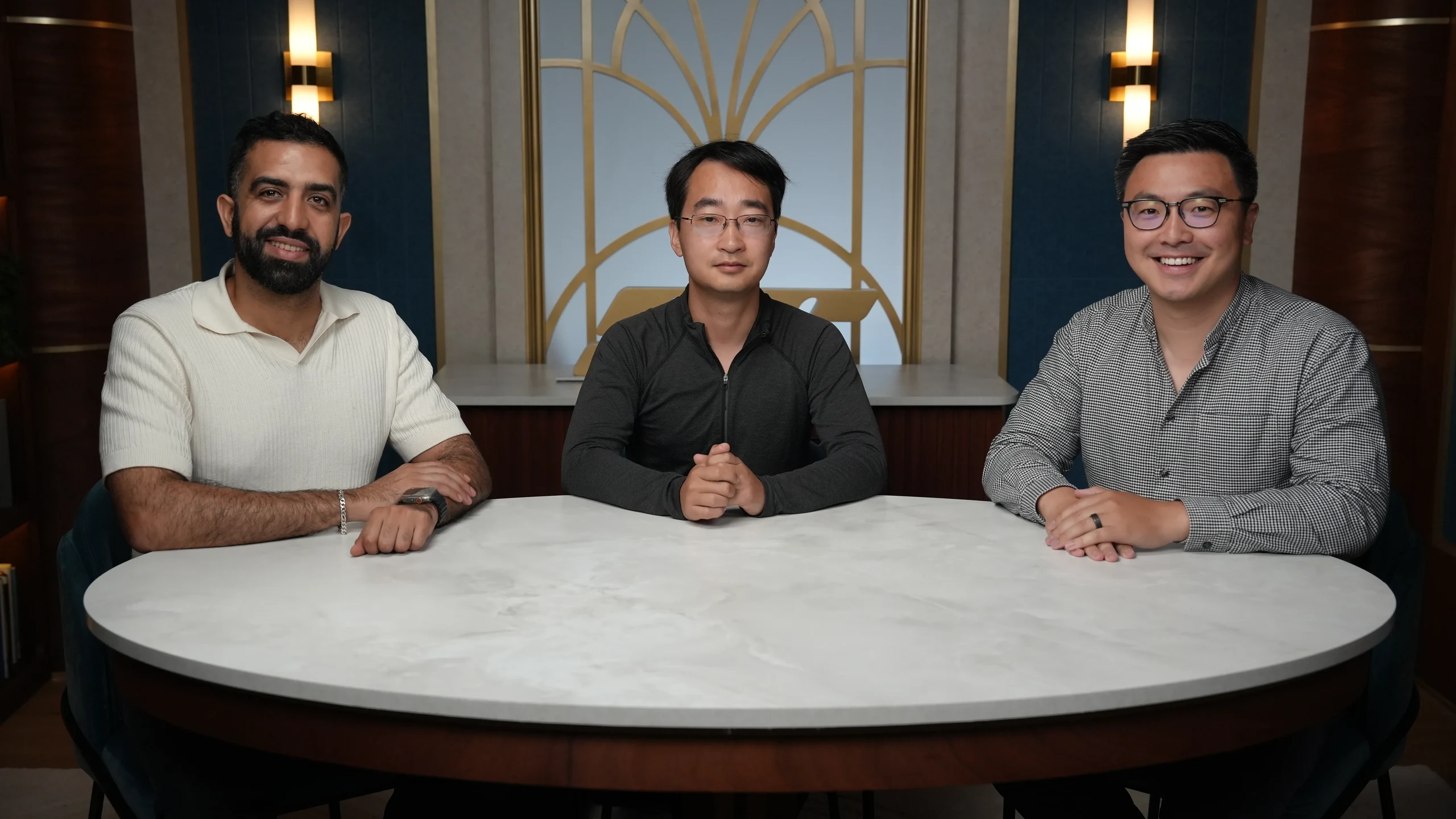
Safeworld has emerged from stealth with more than $12 million in seed funding to test a problem that a convincing robot demonstration cannot resolve: how a machine controlled by probabilistic AI behaves around people it was not specifically prepared to meet. Shine Capital and a16z Speedrun led the round, with Box Group, Carnegie Mellon University Endowment, Innovation Endeavors and SV Angel participating. The company proposes an assurance layer between robot developers and the employers or other buyers deciding whether to bring machines near workers, customers and residents.
Its founders are Ding Zhao, director of Carnegie Mellon's Safe AI Lab, startup executive Kyle Wong and machine-learning engineer Simo Rachidi. Their combined safety-research, enterprise-software, cybersecurity and company-building experience gives the venture relevant expertise, not a safety certification. Safeworld is neither introducing another robot body nor announcing a general-purpose control model. Its bet is that independent, repeatable evidence will become valuable as robot capabilities outgrow narrowly scripted demonstrations.
Why a software update can change a physical risk
A conventional industrial arm can operate along programmed paths inside a guarded cell. A vision-language-action model instead connects visual and language inputs to physical movement, widening the tasks a robot might perform without separate programming for every action. That flexibility also widens the behavior needing evaluation. An unfamiliar person, ambiguous instruction or unusual scene can produce a response that a successful demonstration did not cover.
The metal need not change for a previous assessment to become stale. A different model checkpoint, prompt, perception component or planning policy can change the response. Nor does a warehouse result automatically transfer to a solar construction site, hospital corridor or home. The defensible claim concerns a specified configuration, documented conditions and defined hazards, not a universally safe robot.
Existing machinery, functional-safety and industrial-integration standards remain essential. The Association for Advancing Automation's guide says no single standard covers every general-purpose robot: applicable requirements depend on the task, setting, mobility, human access, AI behavior and intended market. Mapping scenario evidence onto requirements may help, but does not replace physical controls on force, speed, reach and movement.
Safety-rated lower-level mechanisms must remain distinct from AI reasoning and impose limits a model cannot override. DeepMind similarly describes layered safeguards and adversarial evaluations for robotics, while warning that human-detection behavior is not a guaranteed safety-rated system. A model behaving safely during an evaluation is therefore not equivalent to a certified protective function.
Reconstruct an encounter, then vary what matters
Safeworld's proposed workflow starts with an observed environment or incident. A team reconstructs it digitally in a simulator such as Genesis or MuJoCo, inserts a simulated robot running its real control software, and changes the encounter. Human position, motion, appearance and visibility, object placement and timing become variables. The platform aims to generate possible paths, predict interaction risks, retain test evidence and connect findings to relevant safety practices.
Consider a mobile robot approaching a blind factory corner. Detection range, approach speed, stopping distance and the moment an obscured pedestrian appears all matter. Carrying boxes, crouching, running, falling or choosing another path changes the encounter. Repeatedly asking a person to fall near moving machinery would be impractical and potentially dangerous; simulation can explore such variations without recreating the physical exposure.
The idea resembles accelerated autonomous-driving evaluation: concentrate on consequential rare interactions rather than wait for them to occur naturally. Zhao's official Carnegie Mellon profile describes work in reinforcement learning, human-centered robotics, AI reasoning and safe physical human–robot interaction, alongside transport, computing and industrial collaborators. That research background explains the approach, but does not establish the commercial platform's performance.
Gritt Robotics provides an early operational context. It develops AI for robots helping workers install photovoltaic panels at industrial solar farms and is collaborating with Safeworld on safety simulations. Workers may stand, kneel, crouch, run, carry loads or fall, with different clothing and body characteristics. This is an early customer partnership, not published evidence of fewer injuries or a validated deployment result.
The evidence must survive the simulator
A simulation is only as useful as its representation of robot dynamics, sensors, control software, people and surroundings. If a simulated camera sees more clearly than the real sensor, the test can understate risk. If a human model omits an important movement, thousands of runs can repeatedly miss it. Scenario counts are not a substitute for coverage of meaningful failure modes.
A useful record would identify the robot configuration, scenario parameters, model version, hazard, response and chosen safety metric. Rerunning the same scenario family after an update can reveal changed behavior. An incident or near miss could become a persistent regression test rather than a one-off demonstration, giving teams release-to-release traceability and a basis for deciding whether a change increased risk.
Five limits remain material: simulation fidelity; scenarios outside the generator's assumptions; metrics that overlook dropped objects, unstable motion, blocked exits or confusing signals even when collisions are avoided; integration with brakes, actuators, sensors, networks, batteries, attachments and workplace procedures; and people adapting their behavior or taking shortcuts after repeated safe operation. Risk can rise even when the software stays unchanged.
Noise, friction, payload changes, wear, lighting and network delays further complicate the physical system. Simulation can expose failures and compare configurations, but cannot prove that a probabilistic robot will never harm anyone. Formal proof requires sufficiently specified systems and boundaries; statistical models encounter inputs designers cannot exhaustively enumerate. Testing must support a broader safety case incorporating physical safeguards, operating limits, training, incident reporting and field monitoring.
Independence is a business claim that must be earned
Robot manufacturers already use simulation, hardware testing, internal red teams and controlled pilots. Safeworld's potential distinction is an evaluator with different incentives, specialist expertise and shared hazard knowledge. Buyers may understand their own workflow without seeing the robot model's training data, architecture or full failure history. A separate assessment could help them approve, restrict or delay deployment rather than rely solely on a supplier's capability claims.
However, a customer-funded evaluator is not automatically neutral. Repeat business from fast-growing robot companies creates pressure, particularly when a negative finding would delay a launch or require extra safeguards. Methodology, report boundaries and treatment of unfavorable results therefore matter as much as the independent label. A report should separate observed evidence from assumptions, tested from untested conditions, known modeling gaps and residual risks accepted by the operator.
If customers supply the robot model, human model and selected scenarios, testing could merely formalize their blind spots. Safeworld could counter that risk with its own hazard libraries, documented uncertainty and comparisons between simulation and actual incidents. Transparent methods, reproducible conclusions and external technical scrutiny would strengthen confidence; a polished dashboard or large scenario total alone would not.
The company has not presented a universal certification scheme, public benchmark or independently validated performance results. Nor has simulation-to-field correlation established it as an industry authority. Showing that simulated risks predict pilot near misses or interventions would be valuable evidence, but it remains a task to demonstrate, not an achieved result.
A software platform, specialist service, or both?
Safeworld is still deciding how much customers should operate its software themselves and how much its experts should deliver. Software could support continuous regression testing and scale more readily, while requiring customers to configure and interpret it properly. Specialist services offer deeper hazard analysis but are slower, more expensive to expand and dependent on scarce expertise.
A hybrid of routine customer-operated tests and expert-led difficult cases is plausible, not an announced commitment. Tesla, Wayve and major robotics laboratories already treat simulation as core development capability; model developers build adversarial evaluations, while safety specialists, standards consultants and certifiers address overlapping needs. Using simulation alone is no defensible advantage. Finding material risks and producing evidence that deployment decision-makers recognize would be.
Zhao's expectation that companies will have to pay for safety is a market forecast, not an established procurement rule. Some manufacturers will build internally, some buyers will use existing consultants, and others may postpone advanced robots until standards and liability expectations become clearer. The original report anticipated that the next one to three months could clarify the company's software–expert-service balance; that was an expectation, not a guaranteed timetable.
What would turn a test into a deployment decision
The Gritt relationship offers a concrete next test: document how findings changed robot behavior, site controls or operating limits, and which residual risks remained. A traceable before-and-after case would say more than an endorsement. If partnerships remain exploratory, they establish operational interest, not product–market fit or proven protection.
A second test is whether safety professionals can challenge scenario selection, human models and uncertainty, distinguish generated possibilities from validated hazards, and identify where simulator fidelity is insufficient. External review, published benchmarks and documented physical-test correlation could help without requiring disclosure of every proprietary technique. These are possible routes to credibility, not milestones already established.
Finally, reports would gain weight if operators used them for release approvals, insurers considered them in risk assessment, or standards processes recognized compatible methods. Those remain possibilities, not current certifications or requirements. What matters after a simulation is whether someone changes the system, restricts deployment and retains findings across releases. Evidence that changes decisions is a more demanding achievement than generating more scenarios.
Sources
Launch reporting · Safeworld platform · A3 standards guide · DeepMind robotics safeguards · Ding Zhao's official research profile · Reporting link (alternate address)