
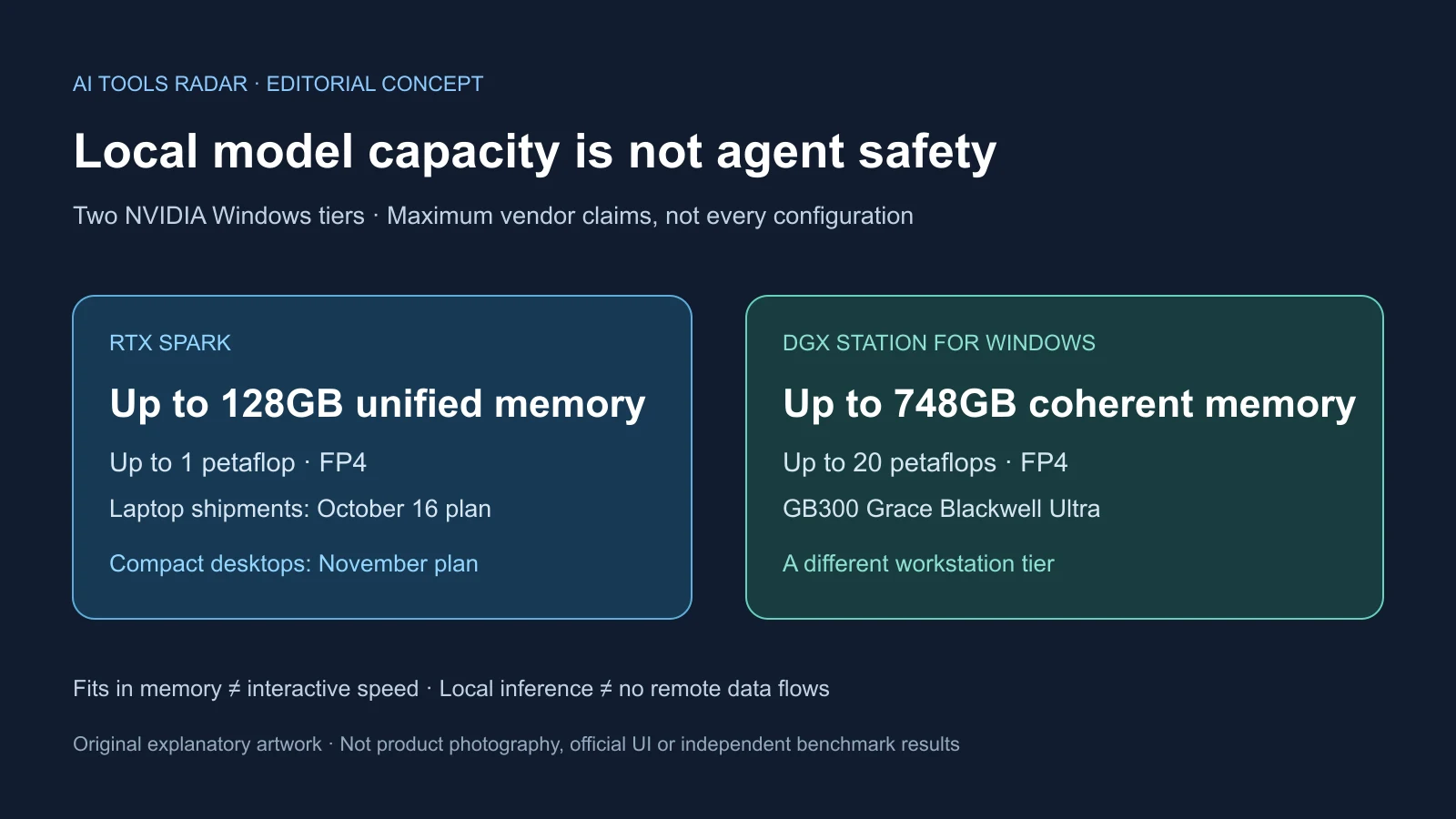
Nvidia’s RTX Spark moved from a June platform promise to a dated Windows product launch on October 7, 2026. Jensen Huang and Satya Nadella presented it in San Francisco as hardware for models and agents running beside a user’s files and applications. Laptops opened for preorder with shipments scheduled from October 16; compact desktops were due in November. Those were launch plans, not evidence that customers already had every device or integration.
The hardware proposition is substantial local memory backed by CUDA, rather than another ordinary PC feature served remotely. The question is whether shipping systems can make that capacity interactive, sustained and manageable. Model size, launch benchmark speed, agent safety and actual reduction in cloud use require different evidence.
What the new commercial category contains
Asus, Dell, HP, Lenovo, MSI and Microsoft offered laptop preorders; Acer and Gigabyte systems were also planned. Microsoft introduced Surface Laptop Ultra for mobile developers, creators and AI builders, plus the compact Surface RTX Spark Dev Box for experiments and continuous local work. Vendor participation suggests a category, not one identical machine.
RTX Spark combines a Blackwell RTX GPU with up to 6,144 cores and a Grace CPU with up to 20 cores. Nvidia specifies a 600GB/s memory interface, up to 128GB of unified memory and up to one petaflop of FP4 AI compute. FP4 is a compact four-bit numerical format; that peak is not a universal application-speed measurement.
Unified memory gives CPU and GPU a shared pool, reducing model-data copies between separate memories. Microsoft says Surface Laptop Ultra can run models exceeding 120 billion parameters locally. Capacity addresses models that cannot fit ordinary consumer GPUs, but fitting is not the same as fast responses. Architecture, quantization, context length, runtime, storage and memory bandwidth still matter.
CUDA provides continuity with larger Nvidia systems, while Windows Subsystem for Linux preserves Linux-dependent tools. Nvidia also advertises AV1 acceleration, 4:2:2 video encoding and decoding, ray tracing, DLSS and high-frame-rate gaming. Creative and gaming uses give manufacturers a broader audience while demand for persistent agents remains uncertain.
A compact desktop can remain available when a traveling laptop sleeps. Approved indexing, scheduled development or media work could benefit. Continuous operation is a use case, not proof that every agent ships ready to do it. Cooling, memory configurations, power limits and software support will differ among manufacturers and form factors.
Keep the workstation tier separate
DGX Station for Windows sits above RTX Spark. Nvidia describes a GB300 Grace Blackwell Ultra Desktop Superchip with up to 748GB of coherent memory, up to 20 petaflops of FP4 compute and support for models of up to one trillion parameters.
Those are a different system’s claims, not specifications for the laptops. The Windows version links large local-model research with familiar enterprise applications and management while retaining Linux toolchains through WSL. The scale does not establish speed for every trillion-parameter architecture or replace the cloud’s role in training, deployment, collaboration and the largest inference jobs.
Microsoft distinguishes efficient everyday Copilot+ PCs from this builder category and larger workstations. Foundry Local can choose execution providers according to available hardware, including CUDA, DirectML, an NPU or CPU. Not every Windows AI application must therefore use RTX Spark or one processor architecture.
The MacBook numbers come with workload boundaries
Microsoft compared selected RTX Spark systems with a 16-inch MacBook Pro using an M5 Pro and 64GB of memory. Its reported ratios were 2.1 times as fast for time to first token, 4.3 times as fast for image generation and 6.2 times as fast for video generation.
The language-model comparison used preproduction Spark hardware, Qwen3.5 27B and a fixed 8,192-token prompt, in testing commissioned by Microsoft. Nvidia performed the image and video comparisons with workloads configured for its NVFP4 format. These conditions belong with the ratios; they are not independent proof of superiority across models, apps, battery modes or retail designs.
After October 16, useful testing would cover sustained inference, fan noise, thermals, battery drain and memory pressure alongside ordinary creative or development applications. A short peak benchmark does not show several hours of indexing, inference and normal use. Thin laptops have less cooling headroom than compact desktops and workstations.
Apple’s unified-memory architecture is the obvious comparison, but Intel, AMD and Qualcomm also compete in Windows AI systems. NPU-focused devices emphasize efficient background inference and mobility. Spark emphasizes larger local models, CUDA, creation and gaming. Nvidia’s advantage is a familiar path from a developer’s laptop to its larger systems, not a demonstration that one AI-PC formula fits every workload.
Local execution is a placement choice, not an automatic privacy guarantee
Local models can process selected files without uploading them, work offline for supported tasks, avoid per-use remote-inference charges and remove a network round trip. Cloud models offer larger centrally maintained capabilities without specialized client hardware. The practical architecture is often hybrid.
A local model might classify documents, retrieve approved context or remove sensitive information, sending a narrowed request to a stronger cloud model. Microsoft’s hybrid-intelligence plan routes according to capability, privacy, available hardware and organizational policy. A personal knowledge base can organize authorized material without authorizing unrestricted access to every source.
Creators might keep early footage on-device; developers can test quantized models against private repositories; knowledge workers can prepare materials from selected folders. But remote search, analytics, synchronization, account services and specialized reasoning may still move data elsewhere. “Local inference” must not be read as “no remote data flow.”
Costs also move rather than disappear. Hardware, power, updates and enterprise management remain even when remote inference falls. Workload-level comparison should include permission review, corrections and maintenance, not only avoided API charges.
Windows containment supports the proposition but cannot prove correctness
At the same event, Microsoft said Execution Containers, MXC, became generally available for Windows 11. It describes policy-controlled file, network and resource access with isolation options including processes, sessions, virtual machines and WSL containers. This is the execution boundary, distinct from the compute capacity advertised by Nvidia.
Dedicated agent identities, restricted initial privileges, explicit resource grants, revocable access and blocking untrusted signed agents are intended to limit consequences. A coding agent may need one project and a development service, not personal documents or every authenticated app. Agent 365 adds organizational discovery, identity and governance rather than replacing the local boundary.
Nvidia OpenShell connects its runtime with Windows security and can enforce policies and conceal personally identifiable information before selected cloud requests, according to Nvidia. It enables hybrid operation, not a promise that everything stays local. Hidden instructions in pages, documents or interfaces can still manipulate an agent; containment reduces reachable resources, not the model’s ability to make mistakes.
Microsoft listed current support including Codex, GitHub Copilot, OpenClaw, Replit, LM Studio, Nvidia OpenShell and Unsloth AI. Claude Code, Hermes Agent, Manus, Perplexity, Raycast and Simular were planned integrations. A roadmap entry is not general availability, and even announced support may range from an experimental connector to a stable managed product.
What would turn a launch into an agent-PC platform
First, independent shipping-device reviews need to show sustained useful capacity across designs, compared with Apple silicon, discrete Nvidia laptops, NPU PCs and cloud inference. If heat or battery limits undermine long sessions, desktops may be the better persistent-agent form factor.
Second, applications need reliable installation, model catalogs, updates, logging, clear permissions and recovery. Security testing should probe injection, privilege escalation, malicious tools, leakage and container-to-app interactions. Success does not require zero defects; it requires constrained attacks, prompt fixes, detectable incidents and understandable controls.
Too many approval requests can make agents unusable; overbroad permissions can defeat isolation. Enterprise logs must explain attempted actions, tools, data and human authorization without creating uncontrolled copies of private content. June’s developer tools and October’s integration announcements supply foundations, not evidence that this balance is solved.
Third, concrete deployments around November’s Microsoft Ignite and later updates should show which bounded workflows genuinely benefit: private code, regulated documents, confidential media or approved legacy applications. They should quantify cloud savings against device and management costs, not simply repeat partner names.
RTX Spark can succeed as a specialist builder and creator workstation even if persistent agents do not become a mainstream purchasing requirement. The larger vision depends on software that earns enough access to help while remaining correctable and stoppable. Memory capacity makes that experiment possible; it does not settle it.
Sources
RTX Spark launch announcement · Windows agent security guidance · Windows hybrid-intelligence plan · Personal and team knowledge-base reference · Independent launch coverage · June developer tools