Overview
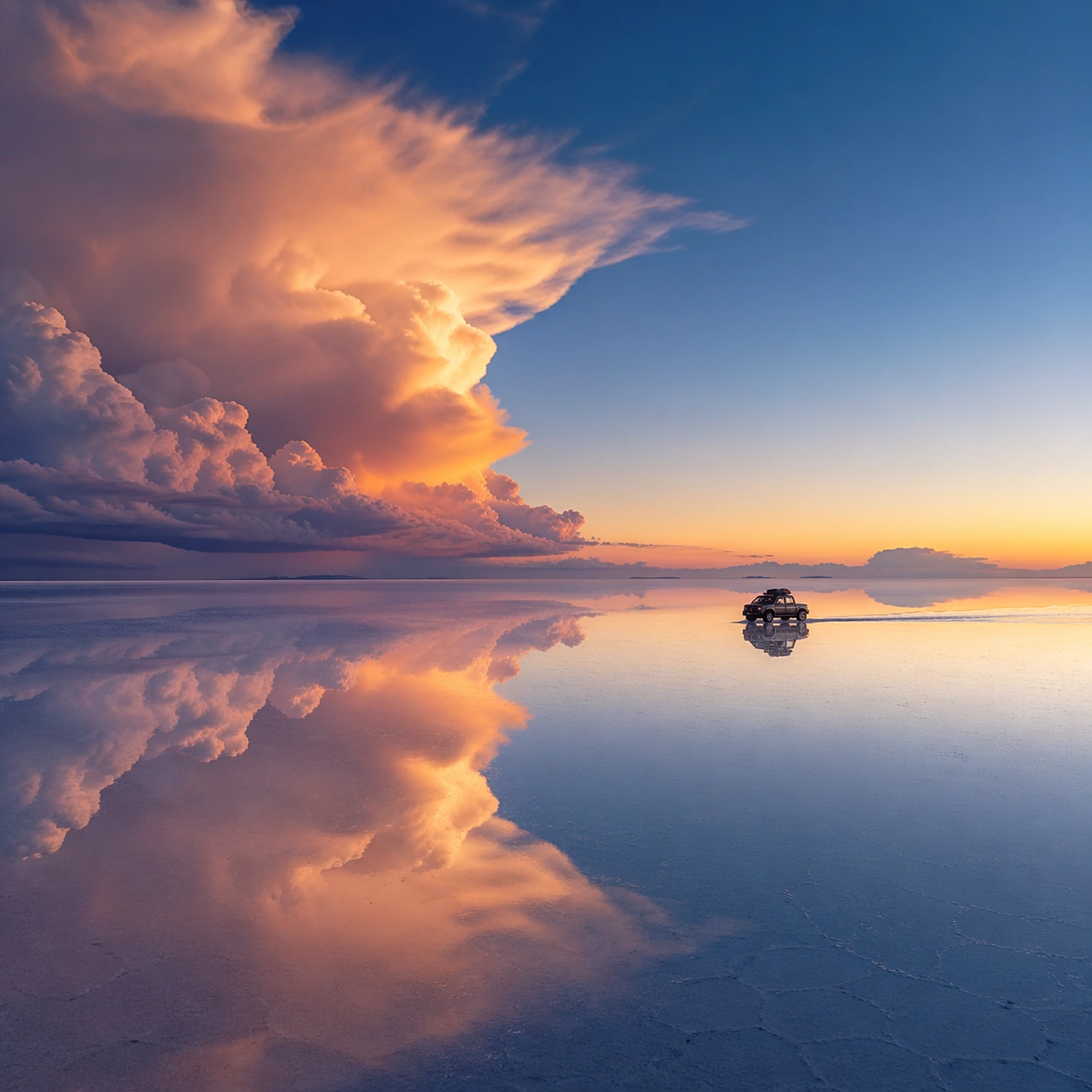
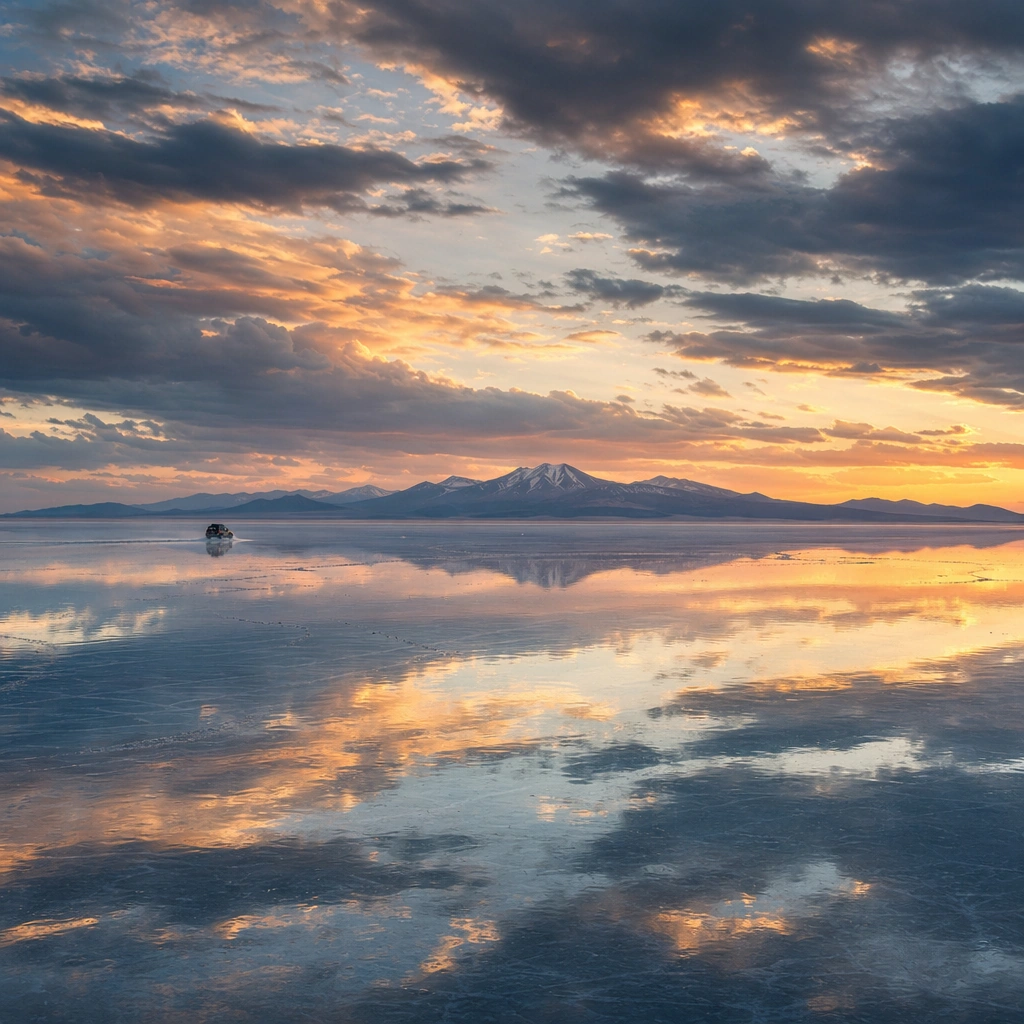
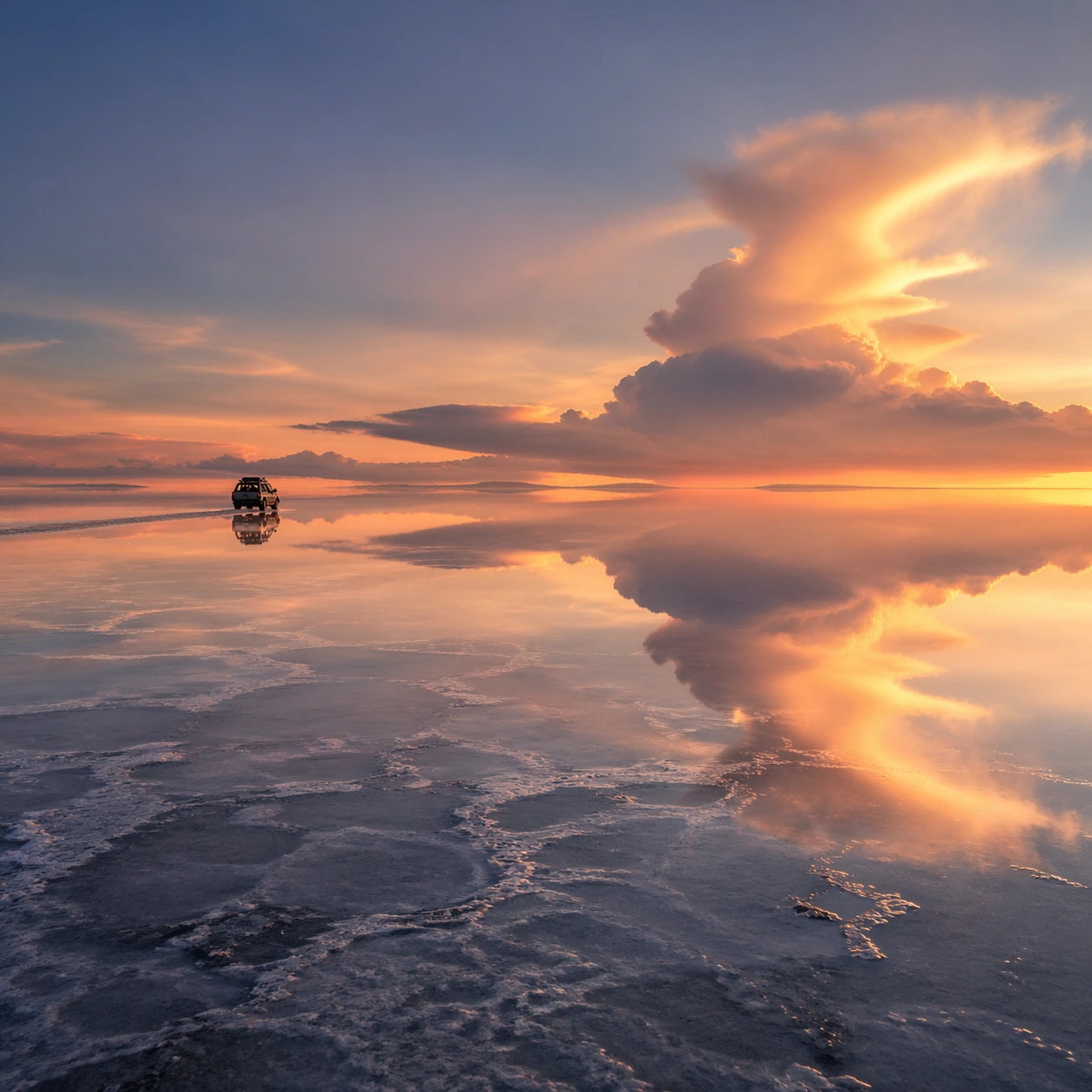
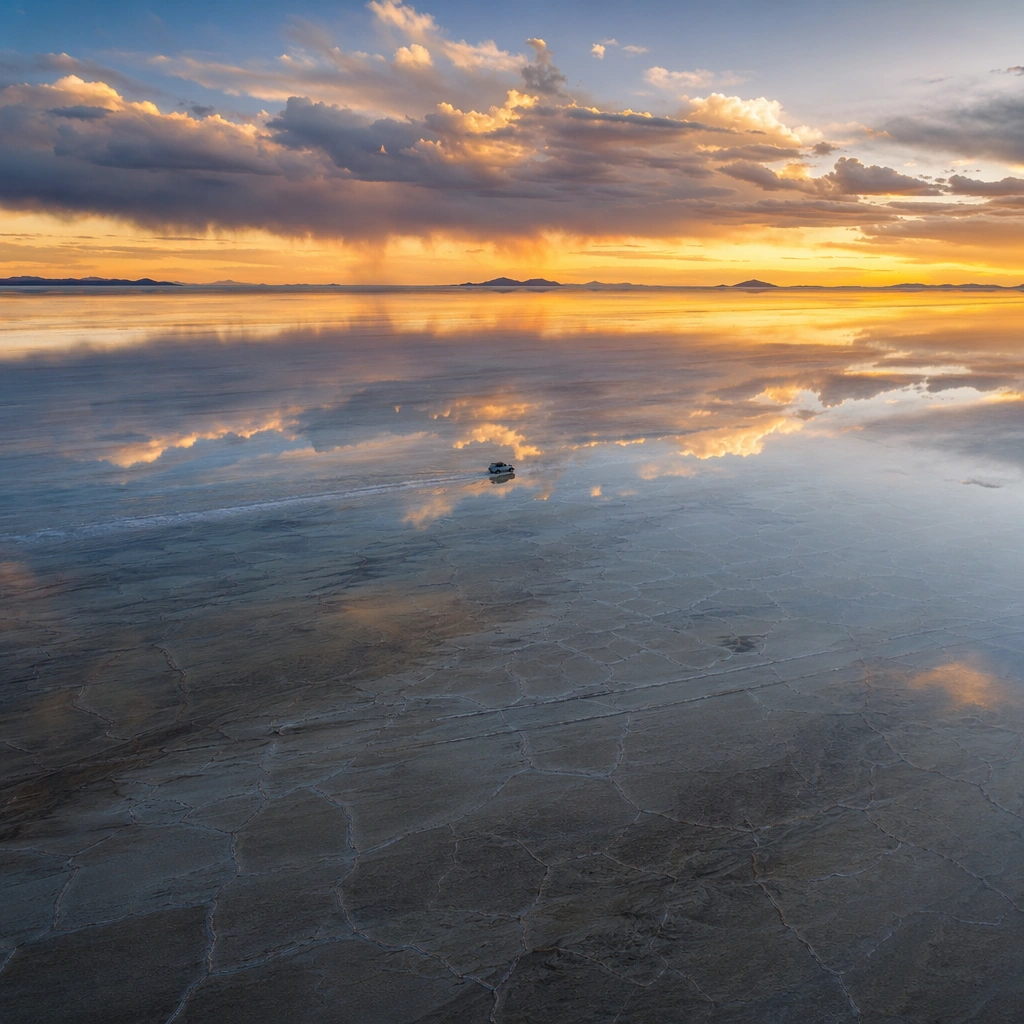
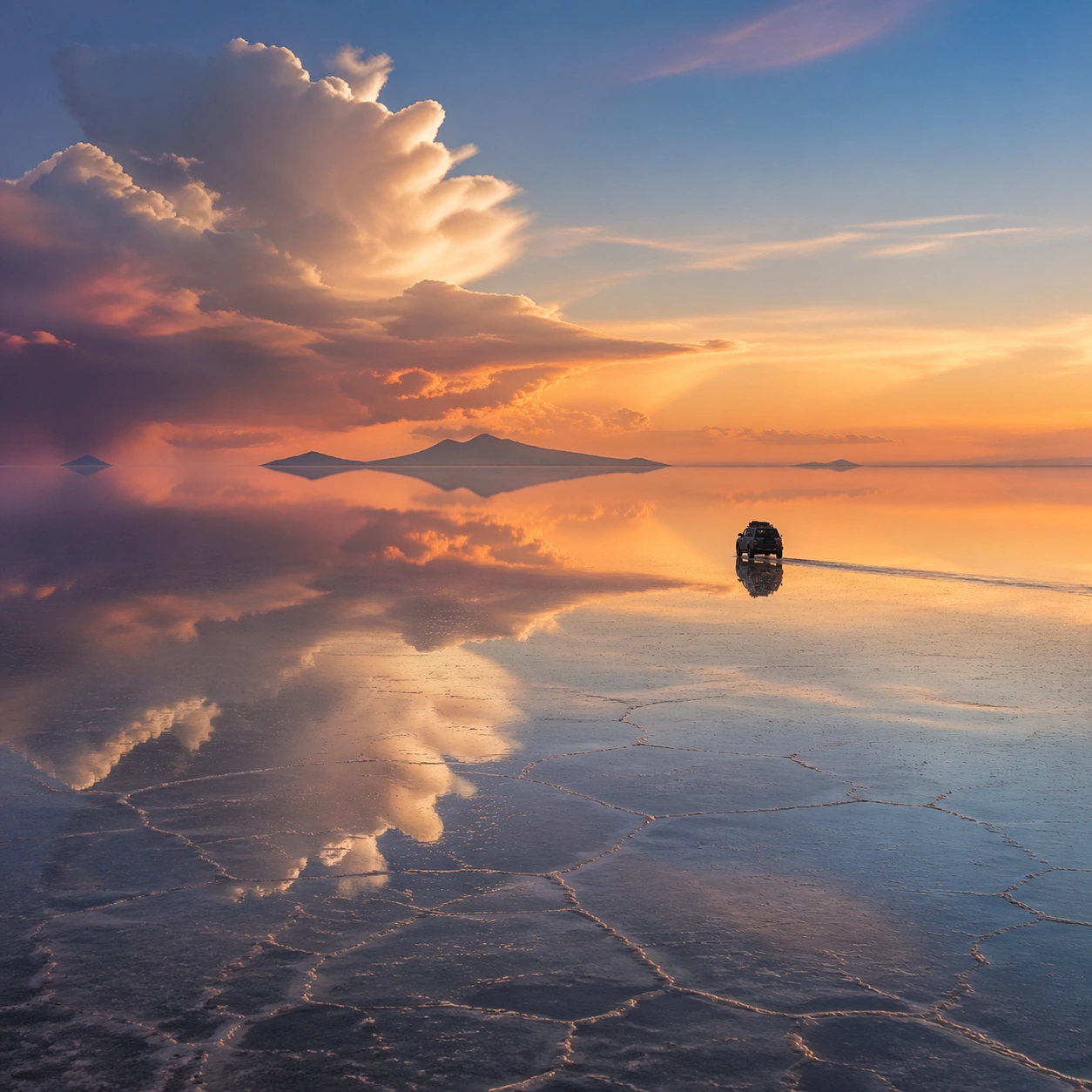
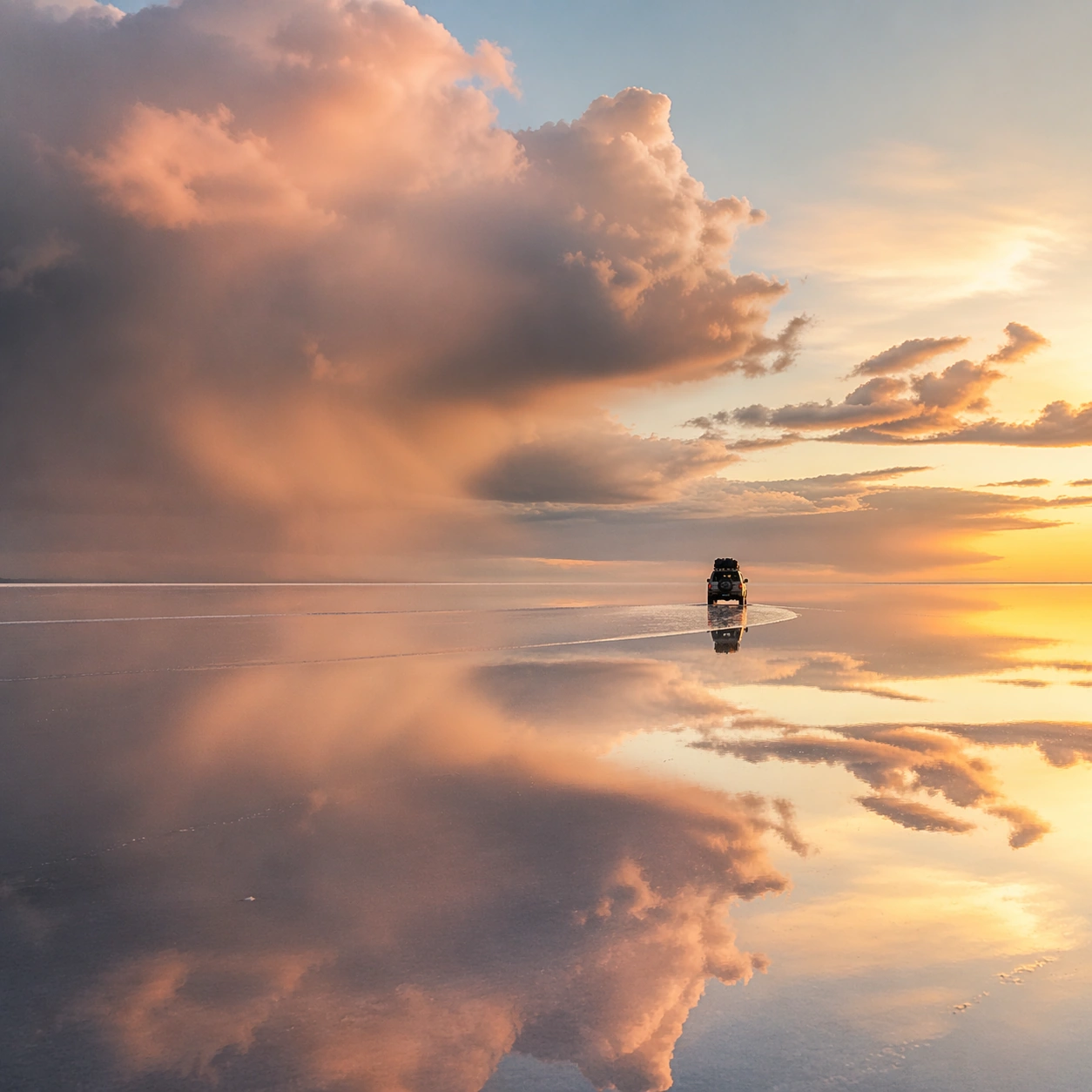
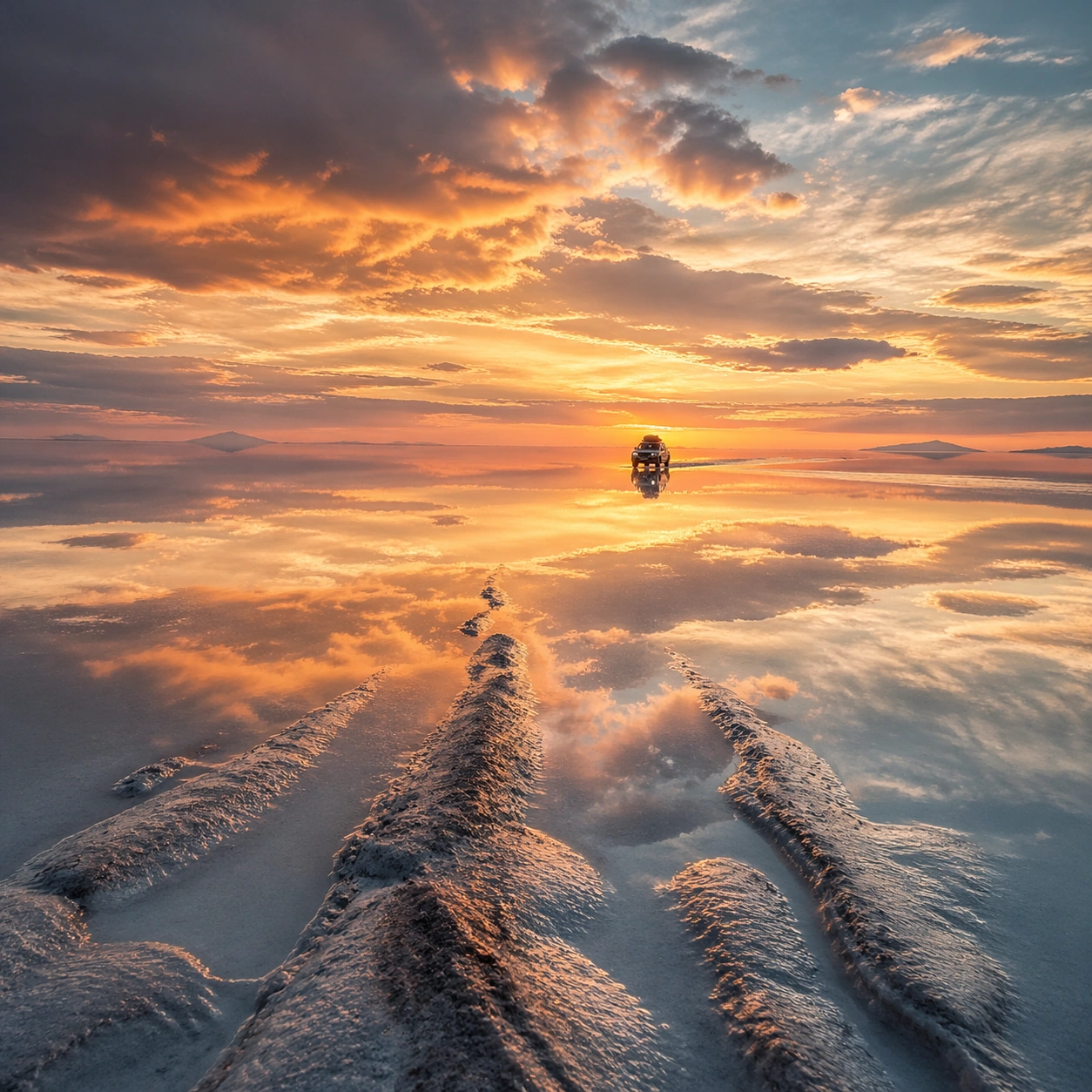
This prompt designs a photorealistic landscape concept of a flooded Bolivian salt flat at sunset. Its composition starts near the ground: textured tracks or a similar foreground line guide the eye towards open water, reflected clouds and a distant landmass. A single small jeep provides a scale reference. The foreground is the main tool for depth, while the sky and its reflection need enough quiet space to keep the scene coherent. This makes the example useful for studying how a detailed near surface can lead into an almost disappearing horizon.
In the published preview, two raised foreground tracks converge towards the vehicle and warm sunset light is repeated across the shallow reflective surface. Those visible relationships are more useful to preserve than adding more dramatic objects. When adapting the scene, coordinate the viewpoint, surface material, sky and scale reference rather than changing a location name alone. The original requests a 1:1 image without text or logos. The preview is generated artwork and supports a composition study; it is not evidence of an actual photograph, local weather or field conditions.
What to prepare
- The complete original prompt, with its scene, subject, detail and constraint sections.
- A chosen location concept, light condition and foreground element to adapt consistently.
- An image model or environment supporting the requested visual composition; this record declares no required reference-image inputs.
What you get
- A square generated landscape concept with foreground-led depth and reflective light.
- An image to inspect for geometry, scale, object count and consistency between sky and reflected surface.
Suggested workflow
- Start with the original prompt and identify the foreground path, reflective plane, horizon and small scale reference.
- If adapting the landscape, update scene and subject together, including the ground material, water behaviour and atmospheric cues.
- Keep the 1:1 frame and a single subordinate vehicle when reproducing this variation. Remove contradictory additions that would compete with the landscape.
- Inspect the result at full size: follow the tracks towards the distance, compare reflections with the sky, and check the vehicle, horizon and unwanted text.
Limits and checks
- Check that the tracks or other leading element form believable depth instead of a blocked or empty foreground.
- Compare cloud placement, light direction and reflected shapes; the water and sky should describe one coherent scene.
- Keep the vehicle small, singular and consistent with its reflection. Count unwanted extra vehicles, people or props.
- The square source preview is a published rendition, not a guarantee of the dimensions or quality of a new output. Series numbering does not establish an input-image requirement.
Common questions
Do I need the other images in the series?
The source describes this as study 2/9, but this record declares no required reference-image inputs. Its complete text can be reviewed as the foreground-led variation while preserving that source context.
What is the main compositional decision?
Use a low viewpoint and a tactile foreground route to lead towards the mirrored distance. The small vehicle helps explain scale; it should remain subordinate to the landscape.
Can I adapt it to a wide image?
The original specifically requires 1:1. A wider adaptation is a new composition decision: review the placement of the foreground route, horizon and scale reference rather than assuming a crop preserves the square design.
Original document
GPT Image 2 · en
Scene:
Create a square, photoreal landscape study of bolivian salt flat mirror. Compose it as a ground-level entry path that pulls the viewer into the terrain, using a lower vantage with a strong foreground element such as a ridge line, shoreline, stream, boot track, or wet surface leading inward. Let the foreground remain tactile and detailed while the distance opens gradually Keep the frame cinematic but disciplined, with a clear foreground, middle distance, and far mass so the viewer can measure real depth. The image should feel like a field photograph made with patience, precision, and sublime restraint rather than a fantasy matte painting.

Subject:
Show a flooded Bolivian salt flat at sunset with a near-perfect mirror surface reflecting cloud towers, a vanishing horizon, and a single jeep sending one subtle ripple across the water film. This variation should emphasize foreground-led composition. The main landform must dominate the composition, but secondary elements should quietly explain how the place works: water paths, sediment lines, snow bands, surf, ash, wind streaks, stars, or human traces where appropriate. Everything in the image should support the same idea of scale and climate, so the scene reads as one coherent environment rather than a stack of spectacular details.

Important details:
Preserve horizon loss, razor-thin water over salt, exact mirror behavior, soft sunset color mirrored above and below, and a clean sense of infinite horizontal space. The image should reward close looking through layered depth cues rather than pure spectacle alone. Keep geology, weather, and atmosphere physically believable. Use subtle micro-texture, tonal separation, and air perspective to reinforce distance. If a human, vehicle, tent, caravan, bird, or boat appears, it must remain tiny and subordinate to the landscape, functioning only as a scale witness. The composition should feel original, severe, and elegant, with no decorative filler and no imitation of any copyrighted visual property.

Use case:
Bolivian Salt Flat Mirror single study 2/9, exploring the foreground-led composition variation.

Constraints:
No readable text, no watermark, no logos, preserve exact 1:1 aspect ratio, no extra vehicles, no crowd of tourists, no giant props, no surreal floating islands, no blocked foreground, no random props, no awkward dead zone in the lower third, no kitsch color grading, no artificial border, no split-panel treatment.