
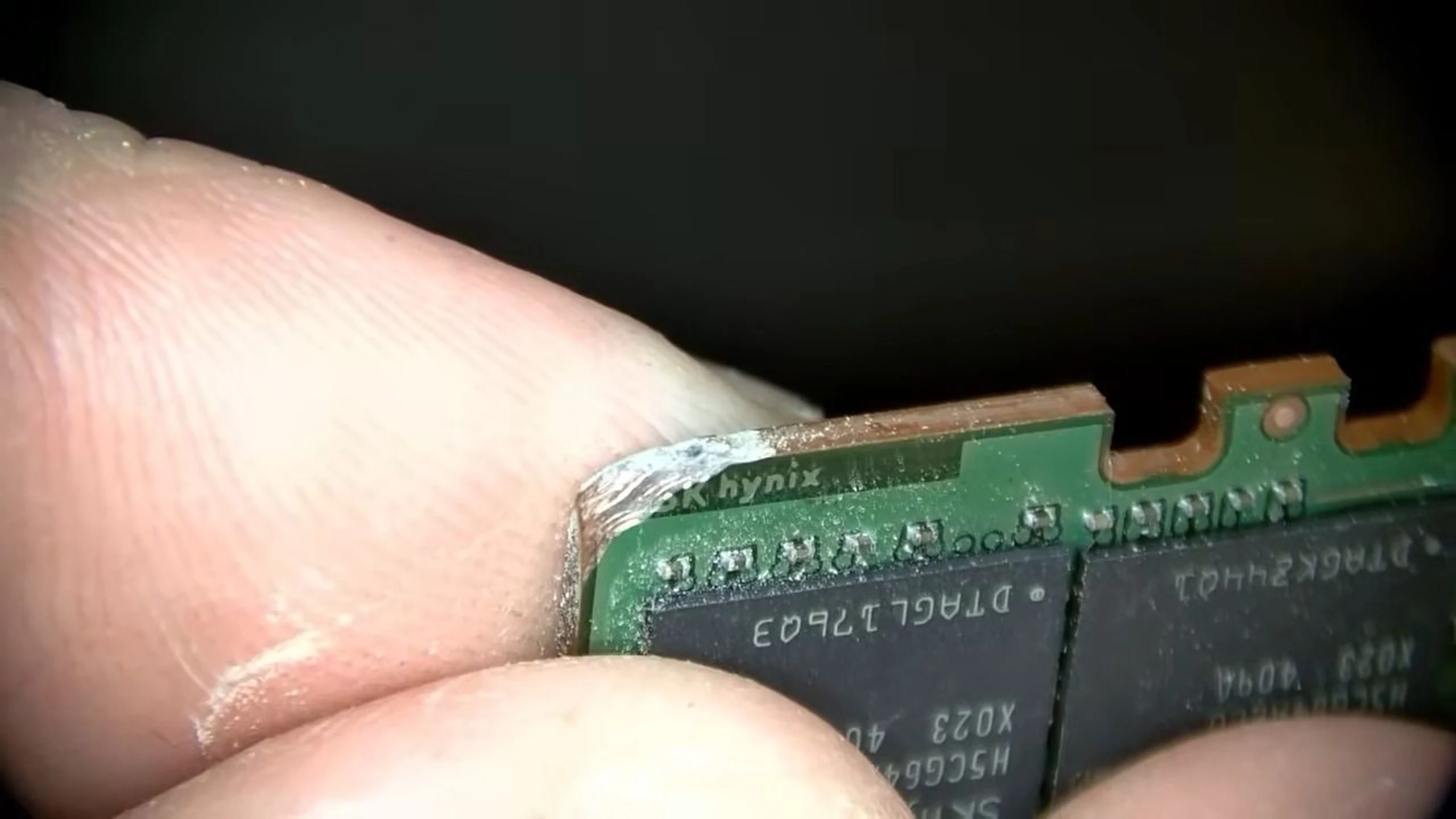
A server memory module can contain hundreds of gigabytes of usable DRAM and still become worthless to its host because a small power component or connection fails. NorthWestRepair’s first recorded DDR5 repair tested that distinction on two damaged modules: a 128GB SK hynix DDR5 RDIMM and a 256GB Samsung module, totaling 384GB.
Technician Tony, better known for graphics-card repairs, restored both through different diagnostic paths. The pair’s purported five-figure replacement value helps explain the labor, but public reporting supplies neither an invoice nor exact part-number pricing. The case demonstrates repairability, not that every expensive DIMM should be repaired or that either module has been qualified for critical production.
One recovery followed the solder; the other followed the power
Both modules reportedly arrived with suspected physical damage, yet visual inspection did not immediately isolate a decisive fault. Similar symptoms can originate in traces, solder, support circuitry, DRAM packages or configuration data. Looking intact is not equivalent to being electrically intact.
A data-line tester did not identify a clear problem on the 128GB module. Tony applied flux and controlled hot air to reflow solder connections, after which it worked. Reflow reheats existing solder; reballing instead removes a chip, cleans its contacts, installs new solder balls and remounts it. The latter is more invasive and demands precise alignment and temperature control. The first recovery suggests a connection problem, but the reporting does not establish one specific joint or package as the sole cause.
The 256GB module showed no life when installed, and thermal imaging revealed no meaningful heat pattern. That cold-board symptom directed attention toward the power path rather than just a data channel. Tony examined the serial presence detect EEPROM, which stores configuration read during initialization, and the PMIC, which regulates and distributes DDR5 component voltages.
Reflowing several packages and reballing suspicious components did not settle the problem. Voltage injection and thermal observation helped reveal a short. Damage near the board edge and a failed capacitor were addressed, but repairing that area and replacing the capacitor did not finish the recovery. A replacement PMIC finally allowed the module to power on and complete memory training.
Training calibrates timings and signal behavior so the platform can initialize installed memory. It is a meaningful recovery milestone, especially for a previously dead board, not a measurement of sustained stability. The second repair was therefore not merely one spectacular chip swap: inspection, measurement, thermal diagnosis, board work, component replacement and retesting all contributed.
DDR5 concentrates replacement value and new failure domains
RDIMM means registered dual inline memory module. Additional logic buffers command signals between the controller and DRAM, reducing electrical loading and supporting greater server capacity and slot population. These modules are not interchangeable with the inexpensive unbuffered UDIMMs used in ordinary desktops. ECC provides another server safeguard by detecting and correcting certain errors; it does not guarantee that every hardware fault is corrected.
Databases, virtualization, scientific computing and AI jobs rely on sustained integrity. A silent error can compromise a long-running workload, while a support-component fault can disable an entire dense module even if most memory packages remain intact. Discarding the assembly then sacrifices much more potential value than the failed part represents.
DDR5 makes local power management particularly important. Micron’s technical material describes PMICs on each module, moving voltage regulation onto the DIMM. This improves local voltage control while adding a diagnostic domain. Failure to initialize can involve the PMIC, capacitors, traces, configuration EEPROM, register or solder—not necessarily failed DRAM cells. NorthWestRepair’s second recovery illustrates that distinction without establishing how common such faults are.
Tools and reasoning transfer from GPU repair: resistance measurement, voltage injection, thermal cameras, oscilloscopes, board views and donor parts can narrow a fault. Tony used a Unified DDR Flasher Main Board with an RDIMM extension, showing why server-specific adapters and configuration access matter. A shop also needs known-good test platforms, readers, thermal equipment and compatible components; soldering skill alone is insufficient.
Compatibility extends beyond physical fit. A replacement PMIC can require the correct vendor programming, firmware state, electrical limits and platform configuration. Donor boards can supply scarce parts but introduce uncertain histories; counterfeit or incorrectly programmed components make validation harder. Meanwhile, excessive heat can warp multilayer boards, damage adjacent packages or weaken healthy joints on tightly constrained high-speed traces. Reflow may also provide temporary improvement without explaining the original joint failure.
AI demand changes the calculation, not the evidence for a price tag
AI infrastructure uses both HBM near accelerators and conventional DRAM around host processors. Those are distinct products, but demand and supplier allocation connect their economics. Fabrication choices depend on process compatibility, customer commitments, expected margins and demand; prioritizing server memory and HBM can constrain supply elsewhere rather than making every kind of memory directly substitutable.
In January, TrendForce attributed suppliers’ server prioritization to AI-server demand, limited inventories and cloud providers securing more available bit growth. It forecast conventional DRAM contract-price increases of 55–60% quarter over quarter in Q1 2026, and more than 60% for server DRAM. These were market forecasts, not documented prices paid for Tony’s two modules.
The firm’s July discussion of Q3 contracts described continued pressure as suppliers favored AI and server uses. Its September outlook likewise said AI-server demand supported Q4 increases despite affordability limits among consumers. The reports provide market context; they do not independently confirm the pair’s purported valuation or establish future scarcity.
Enterprise contracts, distributor listings and spot offers can differ sharply. Capacity alone does not determine price: speed, rank configuration, density, stacking, vendor qualification and availability matter. A 256GB module is not necessarily a 128GB product priced at twice the amount. Without exact parts and purchase terms, a dramatic headline value remains a reported claim.
Replacement lead time can matter as much as price. A server waiting for a qualified part may run below capacity, sit underused or require workloads to migrate, consuming staff and scarce infrastructure. Repair’s expected value therefore includes diagnosis cost, probability of success, turnaround, replacement availability and operational disruption—not just a comparison between a capacitor and a whole DIMM.
This resembles the economics already supporting specialized GPU and industrial-controller repair. It does not prove a mature memory-repair market. The pair reveals neither the number of repairable failures nor how many owners lack warranty or vendor support. If replacement prices fall or qualified inventory becomes readily available, a new module with predictable support may win again. A segmented market—diagnosis for valuable modules, replacement for cheap sticks—is more plausible than universal repair.
The difficult product is a trustworthy repaired module
Initializing once is the start of qualification. Server memory runs for long periods under sustained traffic and temperature changes. A marginal joint can survive boot and fail after thermal cycling; reworked board material can behave differently under load. Internal DRAM defects, multilayer damage and unavailable proprietary components may also be beyond practical repair even when a capacitor or PMIC would be accessible.
Extended tests would need to cover addresses, data patterns, temperatures and operating conditions, monitoring corrected and uncorrected errors. A module that trains in one server can fail in another because controllers, firmware, channel populations and supported speeds differ. Testing should resemble the customer’s intended configuration. Micron’s RDIMM guidance emphasizes enterprise reliability and consistent performance, a higher burden than a few desktop test passes.
Traceability connects the intervention to that evidence. A credible service would record module identity, initial symptoms, measurements, replaced components, thermal profile, test platform, firmware and results. Unauthorized rework may void manufacturer coverage, complicate support or violate procurement policy. Some operators will rationally choose an approved replacement despite an attractive repair estimate.
A repair business could start by separating localized board or power faults from widespread package or internal DRAM failure, then quote before labor expands. Diagnosis fees, success-dependent charges and explicit qualification limits would be more credible than unconditional recovery promises. Recurring documented cases, success rates and testing durations—not a single dramatic video—would justify investment in adapters, server platforms, programmable tools and spare parts.
Shared validation practices, error logs, stress and thermal-cycle records, and conditional warranties could let buyers compare services. Server and memory vendors may be slow to endorse independent work because their qualification depends on controlled manufacturing and traceability. Transparent refurbishers might still establish grades: validated server use, lab or development use, temporary spare, or parts donor. None should be assumed equivalent before evidence supports it.
The lasting question is not whether Tony made two boards start. He did, according to the report. It is whether specialists can repeatedly convert localized repairs into reliable service at a cost and risk preferable to replacement. AI-driven infrastructure pressure can turn a formerly disposable component into a recoverable asset, but the trust required to put it back beside customer databases or AI checkpoints must be earned separately.
Sources and related reading
Tom’s Hardware’s repair report; TrendForce’s January server-memory outlook; Micron’s DDR5 power-management explanation; Micron’s RDIMM guidance; TrendForce’s Q3 contract discussion; TrendForce’s September Q4 outlook.