
The most useful artifact from a reported AI decipherment of a Napoleonic dispatch is not its polished translation. It is a key, a transcription and a script that let another investigator regenerate the proposed French. That changes the claim from an impressive answer into something that can be challenged.
AI engineer Carter Church says OpenAI’s GPT-6 Astra performed the principal transcription and decipherment in about six hours of model execution, with several evenings of his own work. The document is a 217-year-old operational message from Eugène de Beauharnais’s headquarters to General Auguste de Marmont. Eugène was Napoleon’s stepson and viceroy of Italy—not his nephew—and the letter relayed Napoleon’s orders rather than being written by Napoleon himself.
A known order gives the reconstruction an unusually strong control
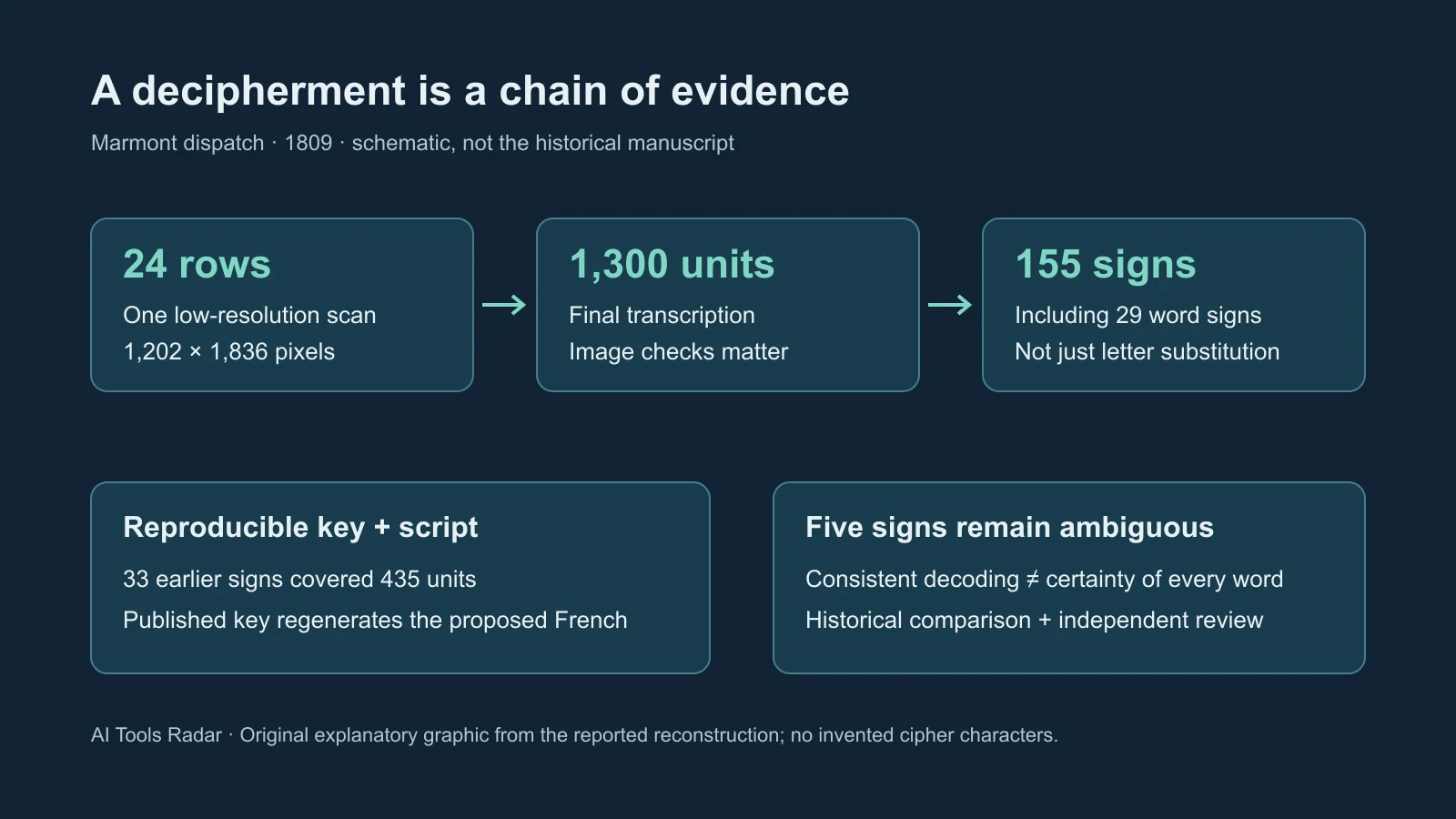
The surviving reproduction appeared in a 1969 French military-history journal. At 1,202 by 1,836 pixels, it appears to be the only publicly accessible image of the complete ciphertext. A readable French opening addresses Marmont; beneath it are 24 rows of numbers, ordinary letters and unfamiliar handwritten marks. The poor image makes identifying the marks part of the problem, not a finished input to a solver.
Church dates the dispatch to late March 1809, correcting an 1807 date in an online catalog. The opening, correspondence and military situation support the change. On March 16, Napoleon had told Eugène to send Marmont an encrypted account of seven French and allied forces, with commanders, positions and reported strengths, carried by an intelligent officer. The reconstructed dispatch lists those forces in the same sequence.
Marmont commanded French troops in Dalmatia, separated from the main formations and exposed if Austria began hostilities. The message sought to reassure him that Austria faced pressure from several directions and that he should not be intimidated when ordered to move. Matching that situation is useful corroboration; matching a specific documented force list is a more concrete test than merely producing plausible military French.
Church published the proposed reading, technical explanation and verification materials. Satoshi Tomokiyo, who maintains the Cryptiana historical-cipher catalog, reviewed the work; the catalog then marked the letter solved and corrected the date to 1809. That is meaningful specialist scrutiny, not broad academic peer review. One imperfect reproduction remains the source, and some rare signs still permit alternative interpretations.
From uncertain handwriting to a mechanically testable reading
The system is homophonic substitution: several symbols can encode the same frequent letter, weakening simple frequency analysis. Some signs also encode whole words or other functions. The final reconstruction contains 1,300 cipher units and 155 distinct signs; these are different quantities, not rival estimates of the alphabet.
A partial key already supplied an important foothold. French cryptology historian Daniel Tant had published values for 33 signs, covering 435 of the 1,300 units. Its description referred to Eugène and “General Grammont,” possibly a mistaken rendering of Marmont, so the table had not been firmly connected to this page. Church says Astra found it during research and tested its values against the image. The advance depended on finding and joining existing materials, not inventing a key without clues.
Initially the model divided the page into rows and assigned provisional labels, producing 1,320 units in 175 symbol classes. Differences in size, shape, ink and orientation could represent either different signs or handwriting variants. Rechecking and consolidating them led to the final 1,300 units and 155 signs. A transcription mistake could corrupt multiple later deductions, which is why returning to the image mattered.
The workflow fixed Tant’s known values and retained a short readable passage, together covering about a third of the units. For the remainder it used simulated annealing: repeatedly changing candidate keys to seek higher-scoring plaintext. Scores drew on three-, four- and five-letter patterns in French texts. This was established computational cryptanalysis, including methods previously described in HistoCrypt research, coordinated inside a wider model-directed investigation.
Twenty-nine signs were ultimately classified as word signs. Words including “de,” “que,” “vous” and “général” could occupy one unit; others represented nulls, punctuation or doubled letters. Once the output became coherent, symbol values were checked against their occurrences in the image. The published transcription, symbol ledger, key and regeneration script make the proposed reading mechanically reproducible without editorial corrections across all 1,300 units.
That consistency does not make every word certain. Five signs remain meaningfully ambiguous: alternatives include “His Majesty” versus “the Emperor,” and “the army of Friuli” versus “in Friuli.” The main military message survives those alternatives, but a stable transformation from published transcription to published French does not independently certify every handwritten identification.
The recovered message is evidence of persuasion as well as deployment
The dispatch places 40,000 Bavarians under the Duke of Danzig between Munich and Passau, 30,000 Poles under Prince Józef Poniatowski on the Vistula near Kraków, and the Saxon army before Dresden. It reports 80,000 French troops at Bayreuth, 60,000 around Ulm and Donauwörth, and 40,000 under Nicolas Oudinot near Augsburg and the Lech. These reproduce the March 16 instructions, not modern verified troop counts.
University of Portsmouth research fellow Zack White told Live Science that Napoleon had roughly 60,000 fewer available troops than the message suggested. The dispatch also said Russian forces were marching against Austria, while other correspondence shows Napoleon was unsure Russia would act as expected. An accurate decipherment can recover an inaccurate or deliberately persuasive military narrative.
The text dismisses Austria’s militia as not having demonstrated effective reinforcement, and adds reported Austrian positions absent from the March 16 instructions. Those locations reportedly fit the military situation, suggesting meaningful intelligence at Eugène’s headquarters. The message therefore records what the headquarters wanted an isolated commander to believe, not simply a neutral inventory.
A recovered reference to a small force or a gathering of rabble helps explain a gap in the published March 16 order after its equivalent of “a handful of.” Because the relay paraphrased the order, it clarifies the missing passage’s meaning without restoring Napoleon’s exact lost words. King’s College London historian Michael Rowe compared the known order to a Rosetta Stone and noted that the result does not uncover an entirely unknown plan. Its historical contribution is comparing the original instructions with what the headquarters transmitted, alongside a reusable 155-sign key.
Lowering the cost of investigation does not automate accountability
Church says he had never broken a cipher before. This was not necessarily a mathematical defense that generations of concentrated specialists had failed to defeat. The scan, partial table, published correspondence and Marmont’s memoirs already existed. Someone still had to locate them, transcribe the marks, understand period French, program a solver and establish context. The neglected task was expensive in expert attention relative to its uncertain historical reward.
A general model coordinating vision, search, programming, statistics and interpretation can make that first investigation accessible. Earlier neural-language-model work on eighteenth-century dictionary codes, including letters involving American general James Wilkinson, already demonstrated computational assistance; this case is broader in its reported coordination from image to evidence package. It also rests on Tant’s cryptology, Tomokiyo’s catalog, digitization and generations of editors, not an autonomous discovery detached from human scholarship.
The strongest control creates its own risk. Knowing Napoleon’s troop list can guide a solver toward expected language. Church’s published materials reportedly include reruns excluding the Napoleonic comparison texts from the solver corpus, an attempt to distinguish cryptanalytic recovery from echoing a known document. Rare, single-occurrence signs still depend more on context and grammar, and independent reviewers must separate image evidence from contextual inference.
Reusing the key on another related dispatch could test those rare signs and reveal variation by correspondent or date. A separate team reproducing the French from the scan and partial table would test the workflow, with symbol-level disagreements more informative than identical English translations. A cipher lacking a parallel known order would pose a harder generalization test and a greater risk of plausible invention.
Church’s point to Live Science was that verification proved harder than generation, and accountability cannot simply be automated. Traceable images, documented transcription, explicit uncertainty, reproducible code, independent records and preserved failed hypotheses make that judgment possible. If proposals arrive faster than historians and catalog maintainers can assess them, cheaper decipherment creates a verification backlog. The opportunity is to investigate more neglected archives while retaining human responsibility for what becomes accepted knowledge.
Sources and related reading
Schneier’s original discussion; Church’s solution and verification package; HistoCrypt study of homophonic-cipher methods; Live Science’s historical analysis; Euronews’ account of the dispatch.