
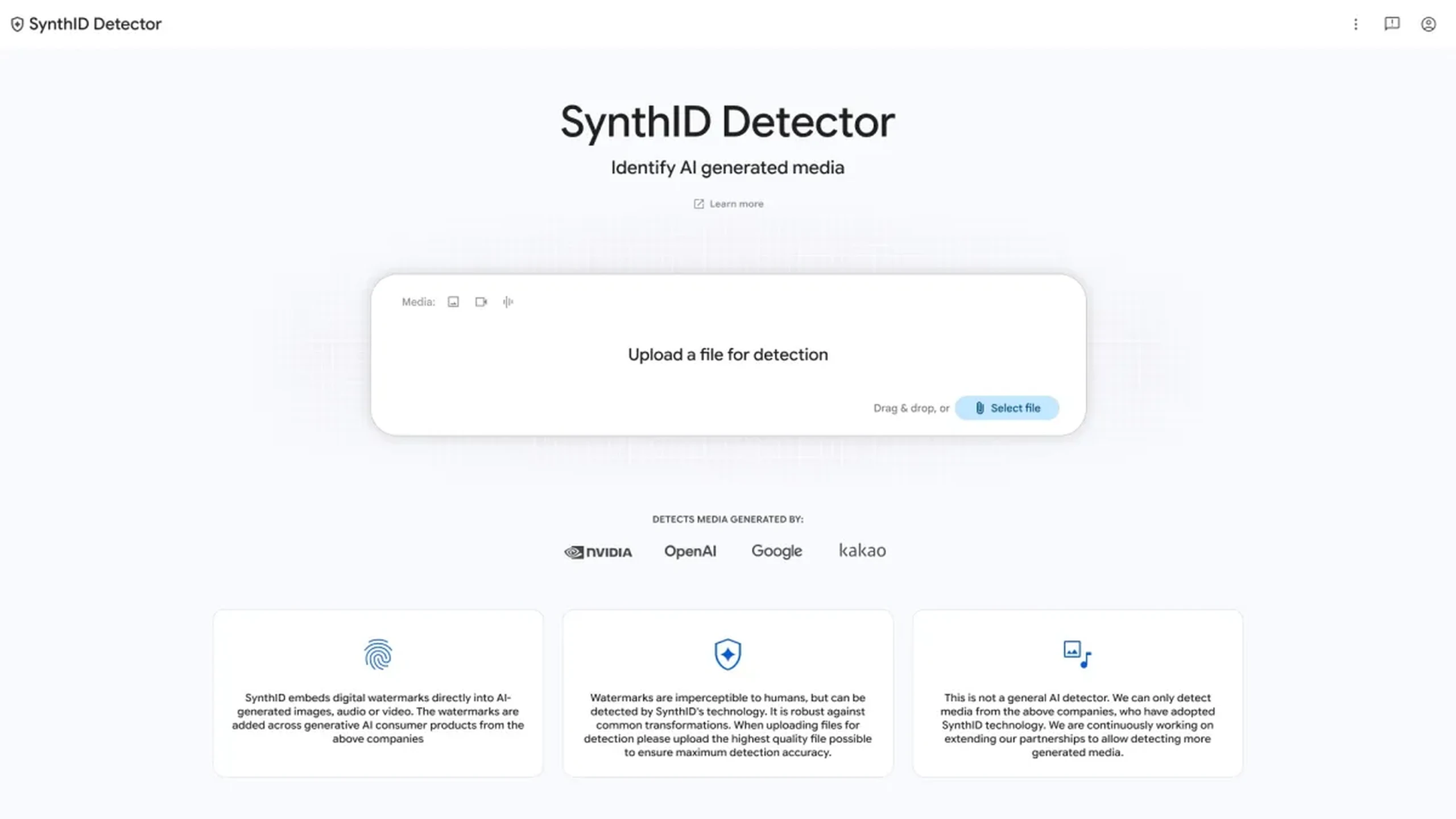
Google's public SynthID Detector gives anyone a direct way to ask whether an image, video or audio file contains a participating generator's invisible watermark. The significant change is access: a tool previously limited to selected journalists, researchers and media professionals now has a globally available English-language website.
Its most important result is also a boundary. A recovered mark is evidence of a compatible generation or editing process, not a verdict that the depicted claim is false. An absent mark is not proof of human authorship. The public launch widens a useful verification network without turning that network into a universal detector.
From a restricted preview to a file-upload service
Google introduced the detector portal at I/O in May 2025. Removing the waitlist now provides a dedicated workflow outside Gemini, Search and Chrome, where verification is already integrated. Google says those integrated tools process more than one million verification requests a day; its earlier rollout account reported fifty million uses before Search and Chrome access expanded.
The website accepts JPG/JPEG, PNG, BMP, WEBP, AVIF, HEIC/HEIF, TIFF/TIF and GIF images; MP4, MOV and WEBM video; and WAV, MP3, OGG, FLAC, AAC and M4A audio. It scans the submitted file and can locate marked areas or time segments, rather than merely returning an undifferentiated label.
That distinction matters for mixed media. A conventional video can carry generated speech, while an edited image can combine marked and unmarked regions. Finding SynthID in an audio segment does not establish that the associated visual track was generated. Nor does any result establish a speaker's consent, a caption's accuracy or whether an event happened.
The website is a media checker, not a universal AI-writing detector. Google also has a text-watermarking technique, but its existence does not mean this image, video and audio upload workflow can evaluate arbitrary writing.
Scale and partnerships explain the timing
Google says it has marked more than 180 billion images and videos and audio equivalent to 240,000 years. These are company deployment figures, not independent measurements of accuracy, false positives or resistance to attacks.
Supported Google products include Gemini, Flow, Vids and ProducerAI, with model families including Nano Banana, Veo and Lyria. The original image system arrived through Imagen on Vertex AI in August 2023, then expanded to other modalities.
According to Google, OpenAI, Nvidia and Kakao support SynthID for relevant output. Apple participation is expected later, not an already-delivered capability. A partner's name alone does not establish that every one of its products, model versions or export paths is covered.
The expansion also follows Google's August announcement that users could remove visible marks from some generated images, videos and songs while retaining invisible SynthID and C2PA metadata. Cleaner output shifts the explanatory burden toward machine-readable evidence. A public reader for that evidence becomes more valuable when there is no obvious label to see.
Cross-company participation improves reach, but adoption remains a condition. Unsupported generators, modified open-model pipelines and export tools that do not preserve signals leave substantial gaps. The size of the marked library cannot be converted into a percentage of all synthetic media.
An embedded signal differs from an appearance-based guess
SynthID actively inserts a planned pattern during generation or editing and later searches for it. The original image implementation used two jointly trained neural networks: one embedded the imperceptible signal and the other learned to recover and classify it. The competing goals were persistence and preserving image quality.
Video extends watermarking across frames rather than attaching a removable corner label. Audio uses inaudible patterns, including in output from Lyria and NotebookLM audio features. Google says ordinary compression, added noise and playback-speed changes can leave audio marks detectable.
For images, the company describes resilience to common cropping, color or brightness adjustments, filters and lossy compression. That does not establish survival under every transformation. Screen recordings or camera recapture can replace the original pixel, sound and metadata structures with a new file.
Text uses a different mechanism: subtly changing token-selection probabilities to create a statistical pattern. Google's research says detection works better with longer, varied passages than short or heavily rewritten text. This background helps explain the shared name, but it should not blur the public portal's media scope.
A forensic classifier, by contrast, estimates synthetic origin from statistical or visual features without requiring an inserted mark. It can attempt unknown sources, but its conclusions are probabilistic and vulnerable to false positives from conventional edits and false negatives as generators change. SynthID makes a narrower claim: whether its compatible signal can be recovered.
Ordinary resilience is not an adversarial guarantee
A negative response leaves unsupported generation, heavy processing, deliberate removal and ordinary human creation among the possibilities. It answers a signal-recovery question, not the broader question of whether any AI system touched the file.
Research provides reasons to test that distinction. A peer-reviewed NeurIPS study found that generative reconstruction could reduce detection across several pixel-level watermarking systems while retaining useful image quality. It did not establish that every such attack defeats Google's current implementation. Neither dismissing all watermarking nor calling the present system attack-proof follows from that evidence.
False positives deserve separate scrutiny when a result might influence a newsroom decision, a disciplinary case or a fraud investigation. Google has not published one public accuracy figure covering every partner, supported format, transformation and real-world upload path. Deployment counts and daily requests cannot fill that evidentiary gap.
Independent tests should distinguish routine resizing, recompression, transcoding and platform processing from deliberate removal attempts. Mixing those threat models into one accuracy headline would obscure what the detector can reliably do. Partner-specific implementations and product coverage also need documentation rather than assumptions.
Provenance can complement a watermark, not certify truth
C2PA Content Credentials offer a different layer: signed claims about capture, generation, edits and the entities that signed them, subject to identity and trust controls. A watermark travels inside media data; a credential can describe a history. Neither is guaranteed to survive screenshots, unsupported exports or platform transformations.
Meta's labeling approach uses machine-readable C2PA and IPTC information alongside its own signals. Microsoft and Adobe also support provenance systems. These approaches can complement embedded marks rather than compete to provide one complete authenticity verdict.
Preserving original files, source URLs, publication times, credentials and the context of a check makes a result more interpretable later. Source investigation, reverse image search and eyewitness confirmation can address questions that watermark recovery cannot. A real camera photograph can still carry a false date or location; an AI-generated educational simulation can be accurately labeled and entirely benign.
The launch therefore improves access to origin evidence, not access to a machine that decides what is true. Its practical value will depend on clear compatibility records, outside evaluation and platforms preserving signals through distribution. A positive SynthID result narrows the origin question; a negative result keeps it open.