
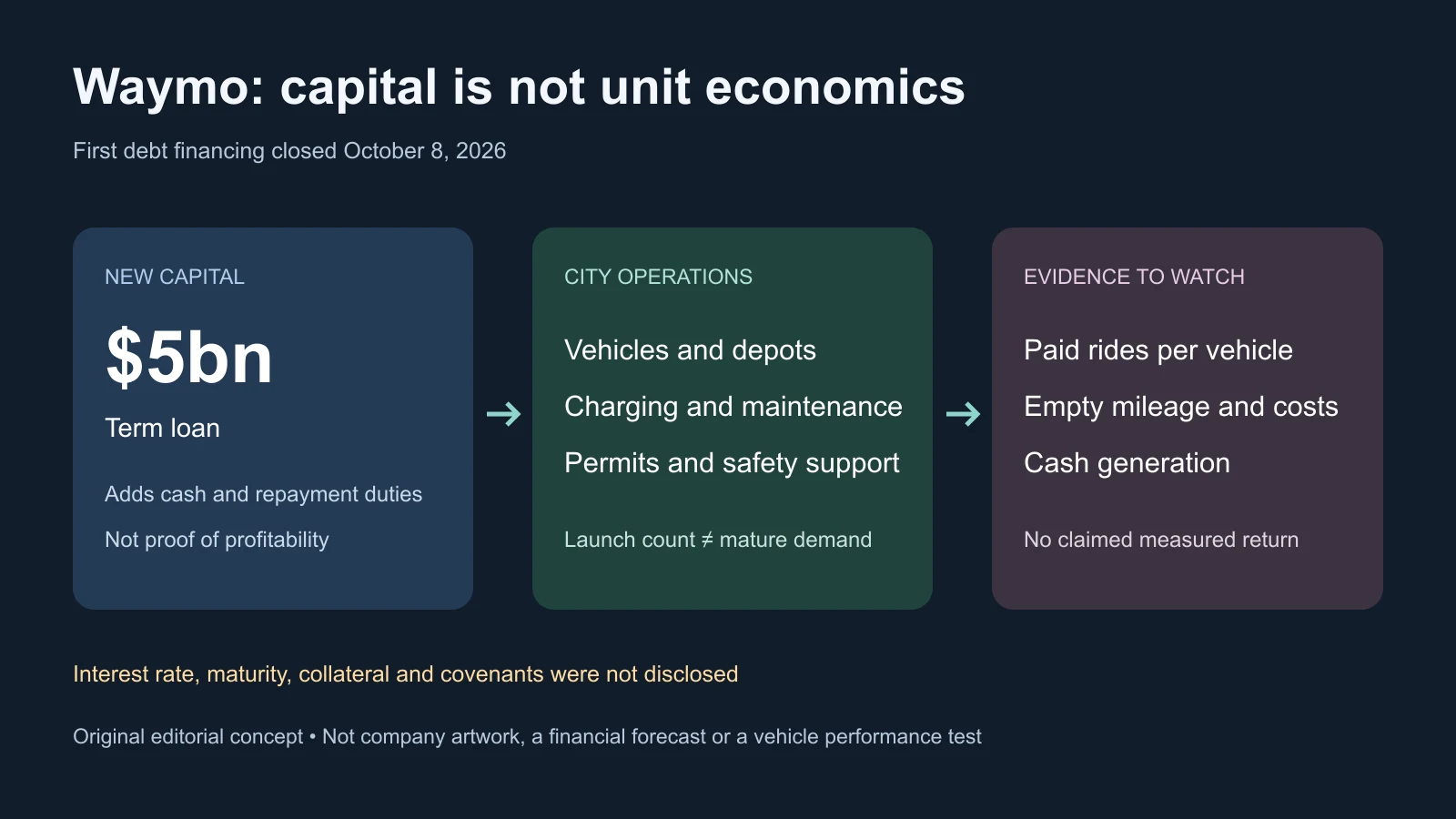
Waymo closed its first $5 billion term loan on October 8, 2026, adding debt to a robotaxi expansion previously financed through equity. The Alphabet subsidiary gains cash without another immediate sale of ownership, but also takes on repayment obligations. The announcement does not disclose the interest rate, maturity, collateral or financial covenants.
That omission defines the limits of the story. The loan demonstrates that lenders accepted the business under undisclosed terms; it does not demonstrate profitability, a particular cost of capital or a formal Alphabet guarantee. The question is whether a growing driverless network can turn vehicles and local infrastructure into dependable cash generation.
A broad lending group backs a different financing model
PIMCO, Blackstone and Sixth Street led the syndicated lending group. Capital Group, Loomis Sayles and T. Rowe Price were significant lenders, while Goldman Sachs acted as sole lead bookrunner.
Other participants included Apollo, Blue Owl, Diameter Capital Partners, Franklin Templeton, Fidelity Management & Research Company, HPS Investment Partners and Oaktree. That breadth signals credit-investor willingness to finance the company, not an independently established operating profit.
A term loan requires repayment on agreed terms rather than directly granting ownership like equity. Interest and contractual protections can constrain decisions even if expansion takes longer or costs more than expected. Waymo has not published its pricing, repayment schedule, security package or limits on further borrowing, preventing a direct cost comparison with parental or equity funding.
Waymo says the money supports fully autonomous ride-hailing expansion in the United States and abroad and increases financial flexibility. More cash does provide flexibility today, but borrowing also adds a liability and future conditions. The financing changes the capital structure, not the technology inside the vehicle.
The earlier equity round does not eliminate the cash timing gap
In February, Waymo completed a $16 billion equity round led mainly by Alphabet. It said that capital would expand the Waymo Driver and prepare operations in more than 20 additional cities during 2026. Preparing a market is not the same milestone as opening broad commercial access.
At that announcement, Waymo reported more than 400,000 weekly rides across six major U.S. metropolitan areas, 15 million rides in 2025 and over 20 million lifetime rides. These were company figures, not independently audited in the announcement, and should remain attached to that earlier period.
September launches in Denver, San Diego and Tampa brought first riders into three more markets; the company said operations had reached 15 major U.S. cities. Initial riders and a city count do not establish that every market has the same coverage, hours, airport access, freeway service or maturity.
Vehicles, depots, charging, cleaning, maintenance, mapping, remote assistance, insurance and local staff can require spending before sustained fares arrive. Debt can bridge this gap while reducing additional equity dilution. The tradeoff is less freedom to wait indefinitely for favorable economics.
Alphabet’s public results cannot isolate Waymo’s revenue, loss or cash burn. Other Bets, which includes Waymo and other businesses, reported $382 million revenue and a $1.8 billion operating loss in Q2 2026, with the segment loss higher year over year. Assigning all of it to Waymo—or attributing any future improvement entirely to Waymo—would be incorrect.
A million rides is a target, not a unit-economics answer
The reported objective was to exceed one million weekly paid rides by the end of 2026. More rides could reflect better utilization, additional vehicles, bigger discounts, wider areas or a mixture. The same headline total can therefore describe very different capital efficiency.
Empty repositioning consumes energy and vehicle capacity, maintenance removes cars from service, and driverless operation still needs remote support, facilities, insurance and regulatory work. Fares becoming more predictable does not by itself make them profitable.
A stronger pattern would combine rising rides with shorter waits and more occupied mileage per deployed vehicle. A weaker one would rely mainly on continuous fleet additions. The latter can maintain leadership while preserving high capital requirements rather than demonstrating operating leverage.
Operating leverage means revenue grows faster than underlying costs. For Waymo, centralized software and systems would need to support additional rides without proportional growth in vehicles, facilities and support. Repeating a city playbook also requires faster, cheaper mapping, permitting, staging, depots and public-safety coordination.
The financing announcement provides no revenue per vehicle, daily paid trips, empty mileage, maintenance cost, insurance expense or time to city maturity. Withholding private data does not prove a flawed strategy, but it prevents outsiders from establishing profitable scale. Service availability, waits, ride frequency, fleet additions and launch pacing are observable clues, not substitutes for a complete financial statement.
Different rivals face different capital and distribution choices
Tesla approaches the market through manufacturing scale, a vertically integrated consumer-vehicle base and a camera-led driving system. At the reporting point, its robotaxi service was more limited than Waymo’s broader driverless operations. Its larger vehicle business could spread engineering and manufacturing spending differently.
Amazon’s Zoox instead designed a purpose-built robotaxi without conventional driver controls. It was expanding Las Vegas and San Francisco operations and developing production capacity, including a factory intended to increase output. The design could improve rider experience or long-run economics, but it also requires manufacturing a new vehicle and creating the network around it.
Waymo combines its autonomous software with vehicles from established automotive partners, avoiding the need to build a full car factory while retaining sensor and integration costs. Another $5 billion can support simultaneous launches without erasing rivals’ advantages: Amazon can fund long development at Zoox without the same independent borrowing structure.
Competition could reduce fares, improve availability or increase service spending, affecting future repayment economics. But the market is not only a contest among three driving systems. Uber and Lyft already aggregate demand and manage riders without owning most vehicles.
Waymo’s Uber relationships in Austin and Atlanta illustrate the distribution tradeoff. Partnerships can help fill cars while dividing revenue and customer control; direct fleet operations and an owned app offer control but require more local investment. Technology providers, carmakers, fleet operators and ride-hailing platforms may share value rather than leaving one winner with every margin.
Safety evidence remains bounded as deployment expands
Waymo points to public safety data spanning hundreds of millions of fully autonomous miles and comparisons with human-driver crash benchmarks. Environments, reporting methods, geography and crash severity affect those comparisons. A growing evidence base does not mean every problem is solved in every new road setting.
A 2026 federal recall identified 3,871 fifth-generation automated driving systems that could enter freeway construction zones in certain circumstances. The filing described incidents in Phoenix and the San Francisco Bay Area, with operating restrictions during investigation and planned software improvements and additional protocols.
The displayed recall chronology identified no deaths or injuries. That statement applies to that chronology, not Waymo’s entire operating history. The filing nevertheless warned that travel at speed through active construction raises collision risk.
Owning the affected fleet lets Waymo distribute software remedies centrally and can shorten the detection-to-remedy path. It also concentrates responsibility when one behavior affects many vehicles. New construction layouts, weather, emergency scenes and local conventions add variety as the network grows.
Safety or regulatory setbacks can restrict areas, delay permissions, raise insurance or require more testing after vehicles and facilities have already been funded. A strong safety record and rising demand help the business, but neither alone resolves the cost of each additional unit of service.
Repayment depends on evidence the announcement leaves open
Secured and unsecured loans create different risks, as do fixed and floating rates. Lenders may impose liquidity requirements or borrowing restrictions, but Waymo has not disclosed whether those examples apply. They should not be invented as actual covenants.
Alphabet led the recent equity financing, yet the debt announcement describes no parent guarantee or other credit support. Waymo is neither demonstrably formally guaranteed nor a startup with no strategic parent connection. Its exact contractual burden remains unknown.
London and Tokyo will test international adaptation through different roads, rules, operating partners and rider expectations. Testing is not commercial launch: permits, named partners, clear service areas and firm access dates would provide stronger evidence than geographic ambition alone.
The other useful updates would connect rides to utilization and costs, explain how quickly cities reach broad access and show how newer vehicle platforms affect operations. Other Bets losses need context either way: early spending can be rational, and segment movement cannot isolate Waymo.
The loan puts repayment beside a deployment race. If ride density rises, international operations mature and financial visibility improves, it could finance a durable network. If cities multiply without evidence of productivity, it will show access to capital more clearly than the ability of autonomous ride-hailing to repay it.
Sources
Waymo financing announcement · Original announcement URL · February equity round · Alphabet quarterly filing · Expansion reporting · Zoox manufacturing reporting · Waymo safety data · Recall filing