
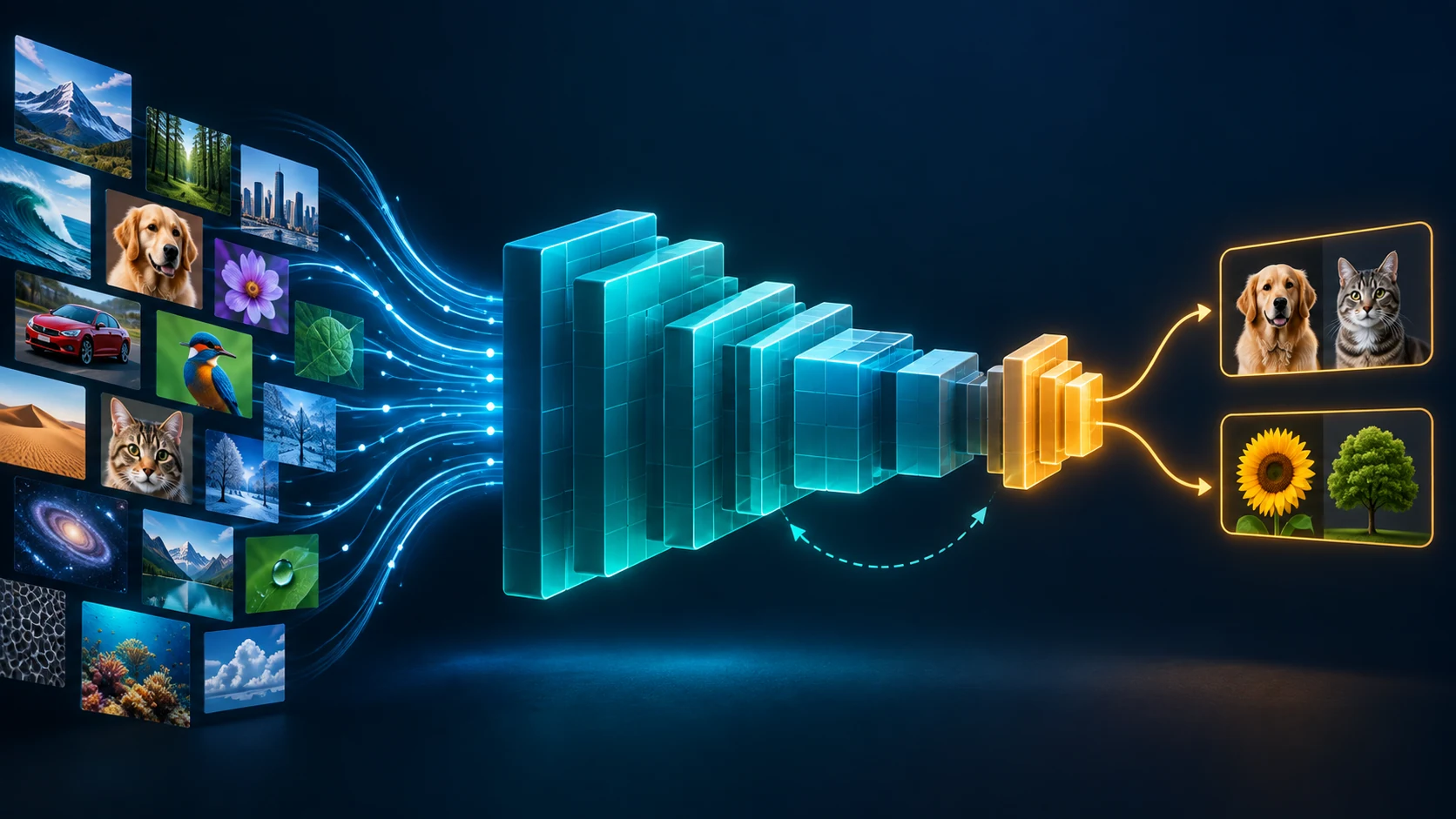
Transfer learning starts with a model trained on one task or dataset and adapts it for another. Rather than learning every feature from random weights, a team can reuse a pretrained representation and train a task-specific component. This often helps when labeled data are limited, but the benefit depends on how closely the source and target tasks match. No fixed reduction in data requirements applies to every project.
Two common approaches. In feature extraction, freeze the pretrained backbone and train a new head on the target data. In fine-tuning, first establish a working head and then update some pretrained layers as well. TensorFlow's image tutorial demonstrates this sequence and warns that unfreezing everything immediately with a new random head can damage useful pretrained features. PyTorch's tutorial also compares these two approaches on a small image dataset. Language-model fine-tuning follows the same broad idea of starting from pretrained weights, though its model and training details differ.
A practical evaluation. Define the target task and a held-out test set before selecting a pretrained model. Compare at least a simple task-specific baseline, frozen feature extraction and a carefully tuned fine-tuning run using the same train and test split. Track task quality, training cost, inference cost and error types. If the target data differ substantially from the pretraining data, inspect whether transferred features help or hurt. A result on a tutorial dataset is an example, not a promised improvement for a medical image, factory camera or legal document workflow.
When transfer can fail. Negative transfer means that source knowledge lowers target performance. Domain shift, a mismatched label space or unsuitable preprocessing can cause it. A model may also overfit a small target set or forget useful behavior during aggressive fine-tuning. Compare against a baseline and keep a separate validation set; do not infer success from training accuracy alone.
How much labeled data can it save? There is no universal 10× or 100× figure. Data needs depend on the source model, similarity of tasks, target quality threshold and evaluation method. Estimate the benefit with a learning curve on your own target dataset instead of quoting a generic multiplier.
Sources: TensorFlow transfer-learning tutorial, PyTorch transfer-learning tutorial, Hugging Face fine-tuning guide, negative-transfer research survey.