
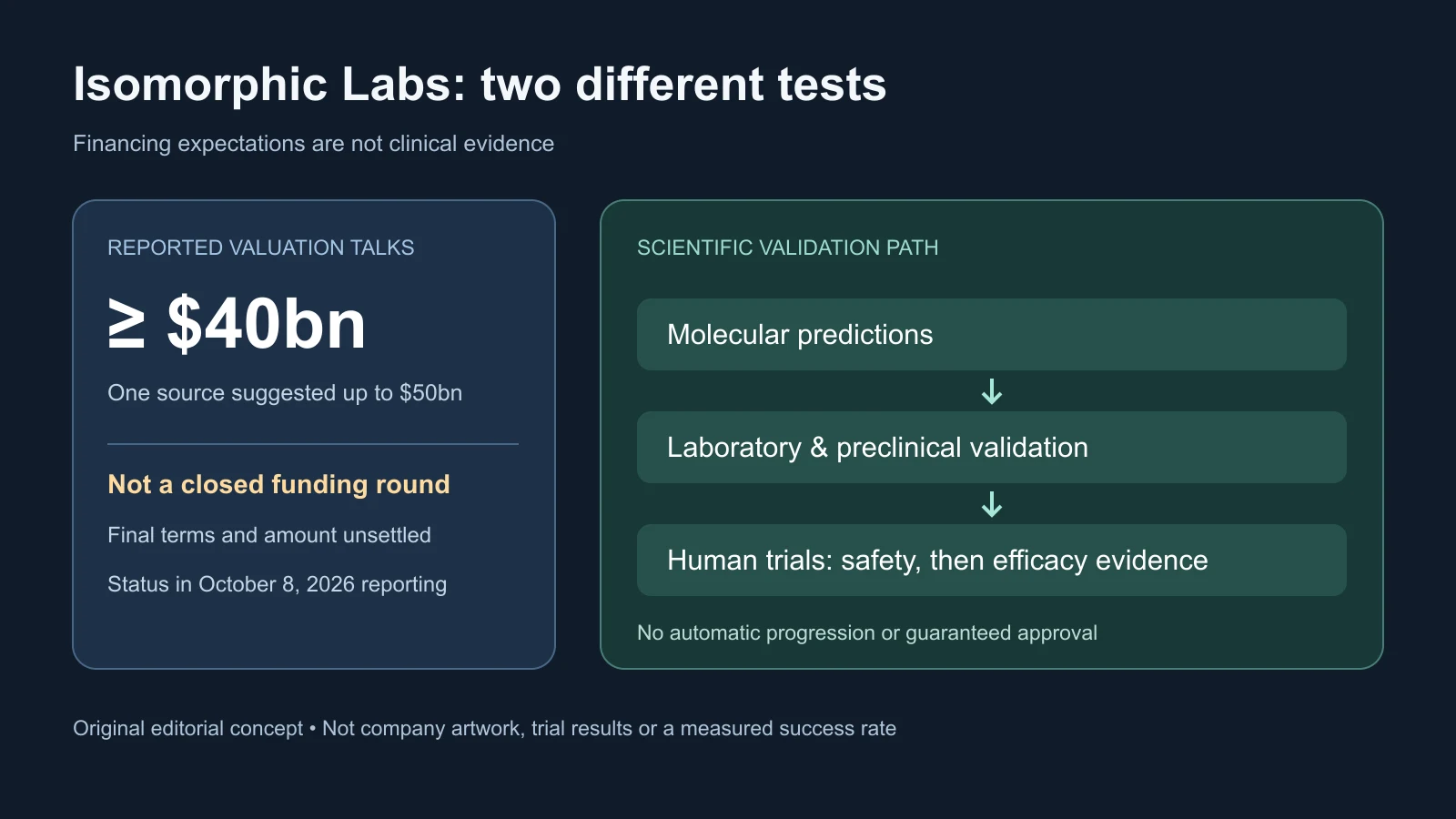
Isomorphic Labs is reportedly discussing financing at a valuation of at least $40 billion, with one person familiar with the effort suggesting as much as $50 billion. As of the October 8, 2026 report, no completed agreement had been publicly confirmed. The amount to be raised, participants, structure and final valuation remained unsettled, and the company had not answered the publication’s request for comment.
The distinction is foundational: $40 billion is a reported company valuation, not the sum being raised or evidence that a medicine works. Only five months after announcing a $2.1 billion Series B, Alphabet’s drug-discovery company is asking the market to consider the value of a repeatable design platform before a broad public clinical record exists.
A second capital discussion arrives before years of results
The May Series B was led by Thrive Capital, with Alphabet, GV, MGX, Temasek, CapitalG and the UK Sovereign AI Fund participating. Isomorphic said the money would support its AI design engine, therapeutic pipeline, international expansion and hiring. It followed a $600 million external investment announced in March 2025.
A further round so soon could give the company a large capital base for research whose costs and timelines differ from ordinary software. It would not show that the earlier money had failed or been exhausted. Investors may see confidential experiments or strategic opportunities unavailable to the public; neither explanation is established by the reported talks alone.
A negotiating valuation is not an independently determined measure of scientific output. Private rounds can include liquidation preferences, governance rights, protection against later declines or separate arrangements for earlier shareholders. Without terms, the headline does not establish equal economic value for every share or reveal the risk accepted by new investors.
The comparison with a mature pharmaceutical company is consequently imperfect. Approved products, clinical assets, revenue, patent life and manufacturing capacity can anchor an established drugmaker’s value. Isomorphic’s public case rests more heavily on models, researchers, preclinical work, partnerships and expected future medicines. The proposed price attaches to that expectation, not a completed clinical history.
From AlphaFold structures to drug-design tradeoffs
Alphabet established Isomorphic in 2021 following DeepMind’s protein-structure work. Demis Hassabis leads both Google DeepMind and Isomorphic; Max Jaderberg is Isomorphic’s president. The connection supplies a recognizable scientific foundation alongside access to technical expertise and computing.
AlphaFold 3 predicts structures involving proteins, nucleic acids, small molecules, ions and modified residues. Its peer-reviewed paper reported higher accuracy than several specialized tools on important interaction-prediction tasks. That is evidence about particular predictive tasks, not a demonstration that a proposed therapeutic is safe or effective.
Drug development still requires choosing a suitable target, designing and synthesizing a candidate, testing its behavior, assessing toxicity and eventually studying it in people. An accurate interaction prediction cannot by itself establish that the chosen target is right for a disease.
Isomorphic says its newer Isomorphic Labs Drug Design Engine, IsoDDE, goes beyond structure prediction, combining models for capabilities including structure, affinity, pocket identification and drug design across therapeutic areas and medicine types. Those broader capabilities are company claims rather than independent clinical confirmation.
The integrated proposition is to manage tradeoffs among binding, selectivity, stability, exposure, safety and manufacturability. Improving one property can damage another. If the engine helps discard weak options earlier and choose better experiments, it could reduce laboratory cycles rather than merely generate more molecular proposals.
That conditional matters. A useful platform needs to improve real project decisions repeatedly. Faster candidate generation has limited value if downstream toxicity, weak efficacy or incorrect disease biology removes the advantage.
Pharma partners provide scrutiny, not a guarantee of approval
Initial agreements with Eli Lilly and Novartis carried potential combined payments approaching $3 billion, excluding possible royalties. Guaranteed upfront payments were far smaller: $45 million from Lilly and $37.5 million from Novartis. Milestone-dependent totals should not be presented as cash already received.
Novartis later expanded the original collaboration from three targets to as many as six research programs. Isomorphic also lists Johnson & Johnson among its partners, with work spanning small molecules and biologics. These relationships connect model development with practical pharmaceutical requirements.
Drugmakers can inspect data, teams, workflows and possible targets before committing, making a research agreement a form of commercial and technical scrutiny beyond a benchmark. But a partnership does not prove that a resulting medicine will succeed. Broad external portfolios are normal precisely because many early programs never reach approval.
Partners also bring disease expertise, development infrastructure and clinical-program experience. Wholly owned projects test something different: whether Isomorphic can choose targets and advance candidates without relying on a partner’s established pipeline.
The resulting strategy is a portfolio. Partnered work can supply payments and external validation; internal assets preserve more economic upside if successful. Ownership also brings the burden of experiments, preclinical development, manufacturing preparation, regulatory work and trials that can absorb years without an approved product.
Human biology does not inherit a software success rate
The platform thesis requires two linked achievements: improving computational discovery decisions, and carrying those improvements through laboratories into patients. Benchmarks and experimental cycles can address the first more quickly than the second.
Each candidate has a distinct target, chemistry, disease setting, dose, safety profile and regulatory path. A compound can work in a laboratory but fail to reach the right tissue, or reach it and produce unacceptable side effects. Patients vary genetically, clinically and environmentally; animal models and laboratory systems capture only some of that variation.
A 2026 clinical-translation review cited in the reporting stresses tying AI to specific project decisions and validation. Discovery data can be conditional, confounded or poorly understood. Historical records reflect previous research choices, while negative results may be incomplete or inaccessible and laboratory methods vary by institution and time.
Learning patterns from such data is not the same as capturing every cause of a clinical outcome. Molecules are dynamic, and a predicted arrangement is a limited view; cellular environments add interactions a structural model does not fully represent. Strong task benchmarks therefore leave substantial uncertainty.
Public evidence cannot yet establish the overall patient-level success rate of Isomorphic-designed medicines. The aim is not simply more speed but better probabilities across multiple programs, targets, modalities and diseases. One successful candidate would matter greatly without alone proving the full platform claim.
Capital changes the competitive field, if the round closes
Insilico Medicine has advanced AI-associated candidates into clinical development; Recursion combines machine learning with large biological datasets and automated experiments. Chai Discovery, EvolutionaryScale and Boltz pursue models involving proteins, antibodies or molecular interactions. Some emphasize open research, others proprietary data or laboratory systems, while traditional drugmakers also develop internal AI.
Isomorphic does not need every rival to lose in a broad research market. It needs durable differentiation from its combination of proprietary data, wet-lab learning, models, candidates and execution. Alphabet’s scientific association is valuable but does not substitute for that record.
A completed round at the reported valuation could fund recruitment, laboratory expansion, licensing and multiple internal programs, increasing the ability to absorb failures. Competitors might respond with more capital, narrower scientific focus, earlier partnerships or stronger clinical validation. Those are possible consequences, not responses already confirmed by the talks.
Pharmaceutical companies would still choose among external partnerships, acquisitions and internal development. Partnerships provide access without owning the entire platform risk; internal work retains control of data, priorities and intellectual property. Drugmakers also retain leverage through experimental datasets, regulation, manufacturing and commercial networks that remain essential after a model proposes a candidate.
Alphabet would gain a test of AI value beyond advertising, cloud, assistants and general models, but on a slower biological timetable. Researchers spanning machine learning, chemistry, structural biology and clinical development could become more contested. Greater capital would raise both endurance and expectations for observable progress.
What would connect the price to scientific evidence
First comes an actual financing announcement: amount raised, final valuation and terms, lead investor, participants and use of proceeds. A close near the reported range would confirm investor agreement, while a lower valuation, delay or unusually protective terms would change its meaning. Existing investors and new strategic or pharmaceutical participants can carry different implications.
Second comes identifiable clinical progress: a candidate, disease target, stage and regulatory milestone. Trial authorization or the first participant dosed would show passage through selection, experiments, preclinical work and manufacturing preparation. It would mark the start of human testing, not proof of benefit; early studies emphasize safety, tolerability and dose before later efficacy evidence.
Delays can result from toxicology, manufacturing, regulatory questions or scientific choices without automatically invalidating the technology. Repeated delays would nevertheless make a software-style valuation harder to defend.
Third comes independent, repeatable evidence across programs: peer-reviewed work, prospective tests, partner advancement, expanded collaborations or milestone payments. Prospective evaluation sets criteria before the tested decisions, reducing some opportunities for hidden overlap or selective presentation found in retrospective benchmarks.
The related knowledge-base article below concerns keeping predictions, assumptions, experiments and outcomes connected; documentation cannot replace experimental validation. Ultimately, the reported valuation becomes more meaningful only when financing terms, pipeline progress and partner actions converge. Until then, it is a price proposed for expected scientific performance, not clinical proof.
Sources and related context
Original Bloomberg report · Bloomberg Tax coverage · Series B announcement · AlphaFold 3 paper · Pharma partnerships · Clinical-translation review · Knowledge-base context