
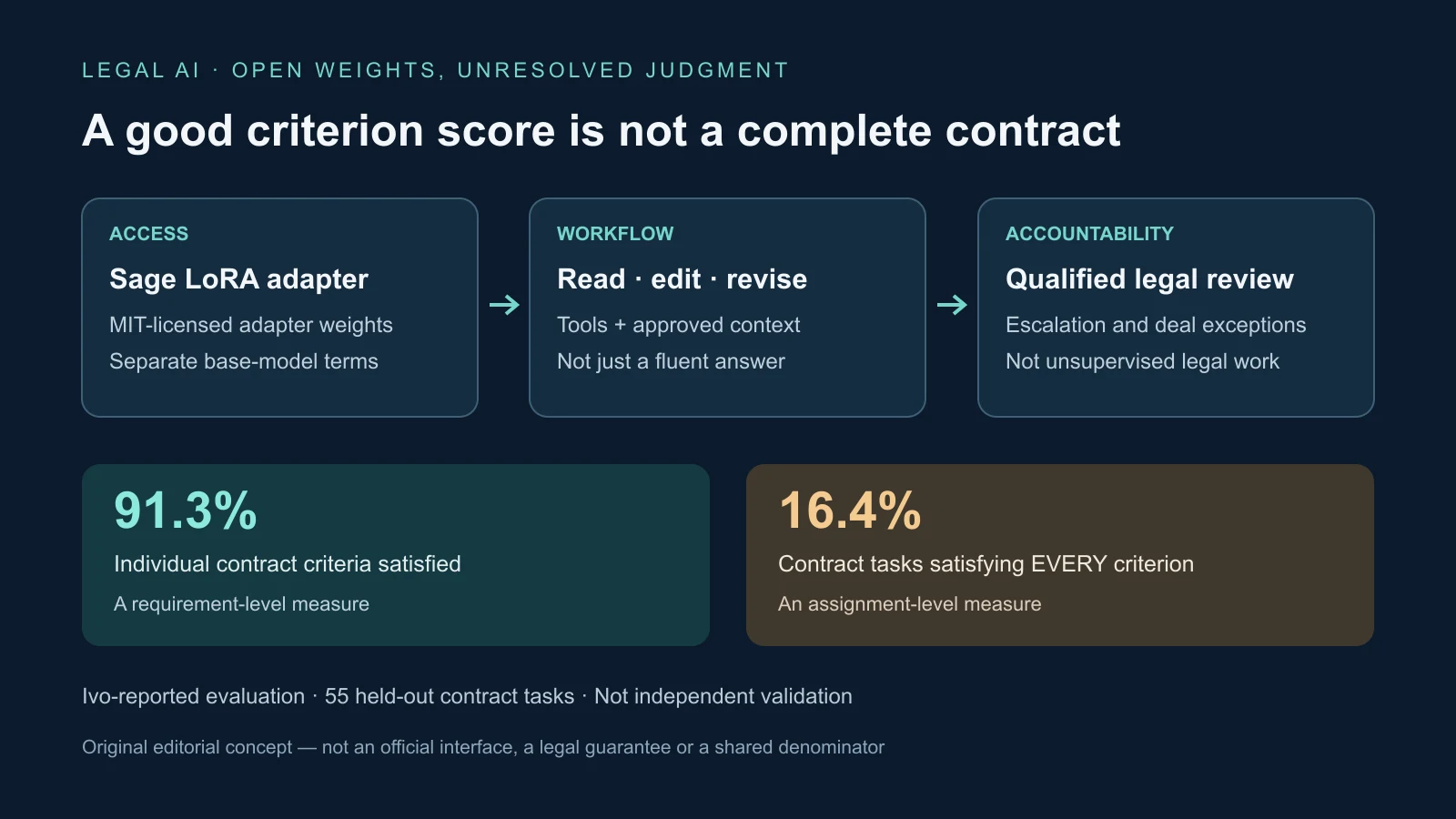
Ivo's open contract model makes an unusually visible argument for specialized legal AI—and exposes how much work remains. Introduced on October 1, 2026 at the company's first Ivo Inscribe customer conference in San Francisco, Sage offers downloadable adapter weights and detailed evaluation records. Its reported contract criterion pass rate reached 91.3%, yet only 16.4% of contract assignments satisfied every requirement. These are very different measures of success.
The release challenges secrecy at the model layer rather than proving that open software replaces a commercial legal platform. Ivo says Sage generates work for a qualified lawyer to review. It does not claim to beat every frontier model. Its strategic wager is that organization-specific documents, negotiation policies and workflow execution will matter more than exclusive access to large models.
An adapter for multi-step work, not a desktop legal adviser
Sage is designed to read documents, use tools, draft and revise deliverables over many steps, producing contract redlines, agreements and memoranda rather than isolated answers. A task may require dozens of tool calls before the final document is saved. That changes what training must reward: a usable result that follows instructions across related files, not merely convincing language.
Ivo did not build a foundation model from scratch. Sage consists of LoRA adapter weights for DeepSeek V4 Flash, a mixture-of-experts model with 284 billion total and 13 billion active parameters. Only selected parts activate for a token, reducing computation relative to activating the whole network. LoRA trains a smaller set of additional weights to alter behavior. The adapter is 12.2 GiB; Ivo trained feed-forward and output projections while freezing attention weights. The reported training and evaluation used a 262,144-token context window.
The company says it applied reinforcement learning to 1,040 Legal Agent Benchmark assignments. Six tools supported reading, writing, editing, searching and navigating files. Episodes ended when tool use stopped or prescribed turn and generation limits were reached. Contracts require locating provisions, comparing sources, applying instructions and saving revisions; reward was tied to deliverables rather than conversational fluency.
Published materials include task lists, transcripts, deliverables, judge decisions and training records. The adapter's MIT license generally allows commercial use, modification and redistribution subject to its conditions, but the DeepSeek base model and related components retain separate terms. Open adapter weights are not a self-contained, completely open application. Ivo recommends SGLang serving on multiple GPUs; its example uses eight-way tensor parallelism across eight accelerators. A small download therefore does not imply a small deployment.
Better averages do not mean complete contracts
Ivo split related contracts and source documents together to reduce near-duplicate leakage between training and validation. The held-out set comprised 180 assignments: 125 general legal tasks and 55 contract tasks. It ran one episode per assignment and three judging passes per episode. Repeated judging assesses a delivered output; it is not three independent attempts at completing each task.
Overall, individual-criterion success rose from the base model's 82.4% to Sage's 91.5%. Strict completion of every criterion increased from 7.2% to 15.6%. For contracts, criterion success rose from 70.1% to 91.3%, while all-criteria completion reached 16.4%. Thus more than four out of five contract assignments still missed something under this protocol. A missed formatting instruction and a missed escalation can have very different consequences, even though either can prevent a strict pass.
Efficiency also improved in the tested environment: mean episode length fell from 31.2 to 25 turns and sampled token use declined 21%. On RedlineBench, excluded from training, the score increased from 30.8 to 45.7. Across 161 LegalBench tasks, the average stayed nearly unchanged at 83.0 versus 83.1 for the base model. Together, these company results suggest specialization improved extended contract behavior without a material loss on that short-form legal benchmark; they do not establish universal preservation of legal ability.
Ivo selected configurations, ran competing models and published the results. LLM judges scored deliverables against rubrics, adding another model to the measurement process. Three judging passes and public traces improve inspectability, but cannot replace independent replication or qualified lawyers assessing real matters. Rankings can also age as base models, inference systems and agent frameworks change.
The harder question is knowing when to resist or escalate
At the conference, Ivo previewed the Ivo-micro1 Contract Bench, assessing prioritization, restraint, deal adaptation, escalation and playbook compliance. Its preliminary figures described tested frontier models, not a second set of proven Sage results. The company said public results would follow; these were company-and-partner findings that outsiders could not yet fully audit.
According to Ivo, models handled acceptance or no-change decisions correctly 82% of the time, falling to 46% when a counterproposal or rejection was needed. They added required new negotiating points only 23% of the time and met an average 23% of expert-defined escalation criteria. These numbers concern distinct decisions and criteria, not interchangeable overall accuracy scores.
Editing style also differed. Lawyers made 64% of changes inline, averaging 92 characters. Models made 14–37% inline, with edits averaging 207–369 characters. Longer rewrites can disrupt negotiated language, increase review time and obscure the precise change even when the new wording sounds reasonable. For standard playbook positions, models met 51% of criteria; when deal facts changed the correct response, that fell to 38%.
The pattern explains why contract judgment extends beyond identifying clauses. A system must decide when to leave language alone, push back, introduce an omitted point or ask a person to intervene. Long context makes documents available, but does not ensure the model links the right provision to the right policy or recognizes a justified exception. More tool calls create further opportunities for error and drift. Failure categories therefore matter alongside averages.
What is open, and where the commercial moat remains
Ivo's “first” claim needs its full qualification: an open model released by a legal AI company and post-trained for long-horizon contract work. Open legal modeling did not begin with Sage. Equall released the MIT-licensed SaulLM-7B for legal text in 2024, and researchers have produced legal encoders, reasoning models, retrieval systems and jurisdiction-specific models. Sage's claimed novelty combines multi-step contract training, accessible weights, permissive adapter licensing and published traces.
Co-founder and CEO Min-Kyu Jung argues that the next gains will come from work context—documents, negotiation playbooks and established legal-team methods—rather than larger models alone. This aligns with Ivo's focus on contracts for in-house teams, versus rivals addressing broader law-firm and enterprise work. Its earlier 2026 financing announcement described a Microsoft Word product for reviewing clauses, finding risks and suggesting redlines.
Harvey created the Legal Agent Benchmark used in Sage's training, but competes through a proprietary legal platform. That contrast is not simply free versus paid. Managed vendors supply deployment, integrations, security controls, support and interfaces. Weights cannot automatically retrieve the right playbook, enforce document permissions or preserve an audit trail. Open access weakens secrecy as a model-layer advantage without supplying the rest of the product stack.
Publishing the adapter may attract developers, universities, vendors and enterprise researchers, enabling alternative agent loops, approved-data fine-tuning and inspection of failures. It also lets rivals copy useful training lessons. Ivo appears willing to accept that risk because it expects models to become more interchangeable and customer context to provide durable differentiation. That is a testable business thesis, not a settled outcome; managed platforms retain an advantage if deployment burdens outweigh the benefits or closed foundations sustain a lead that specialization cannot close.
Local control is not zero cost or automatic governance
Self-hosting can keep contract content inside operator-controlled infrastructure, but does not automatically solve permissions, logging, model governance or license review. DeepSeek lineage can still raise procurement, jurisdiction and supply-chain questions. Although the adapter is relatively compact, the large base model requires substantial GPU capacity for practical serving. Free access to weights leaves computing, engineering, evaluation, security and legal oversight costs.
Organizational knowledge also needs maintenance. Agents can apply internal policy only when it is current, discoverable and linked to the correct matter. Curated documents, task instructions, escalation rules and accountable reviewers are part of the system, not optional substitutes for a stronger model. The related knowledge-base article below illustrates that retrieval challenge; it is not evidence validating Sage's legal accuracy.
Independent replication should examine strict completion, judging consistency, error severity, prompt sensitivity and tool-use stability under comparable conditions. Blinded legal-expert review would test whether numerical gains yield clearer and more usable work. Useful external adoption means published evaluations or adaptations—for procurement, employment, privacy addenda or particular jurisdictions—not download counts alone.
Real deployment reports would need latency, infrastructure demands, failure handling and governance, explaining the whole workflow rather than assigning every improvement to the weights. Competitors could respond without opening their models by publishing task-level traces, permitting customer-controlled tests, supporting customer-managed deployments and disclosing strict completion rates. Silence would not prove inferior performance, but transparent evidence could change buyers' expectations.
Sage's immediate contribution is an inspectable starting point. The same release that reports stronger and shorter contract workflows shows dependable end-to-end legal judgment remains unresolved. Whether independent teams reproduce the gains, find useful adaptations and audit the promised Ivo-micro1 results will determine how much this experiment changes the market. None of those future tests warrants using today's 91.3% criterion score as permission to remove qualified legal review.
Sources
Ivo Sage weights and evaluation materials · Legal Agent Benchmark · Earlier SaulLM-7B research · Ivo funding and product announcement · Related reading: searchable technical-document knowledge bases · Google News aggregation entry, not an official model release