
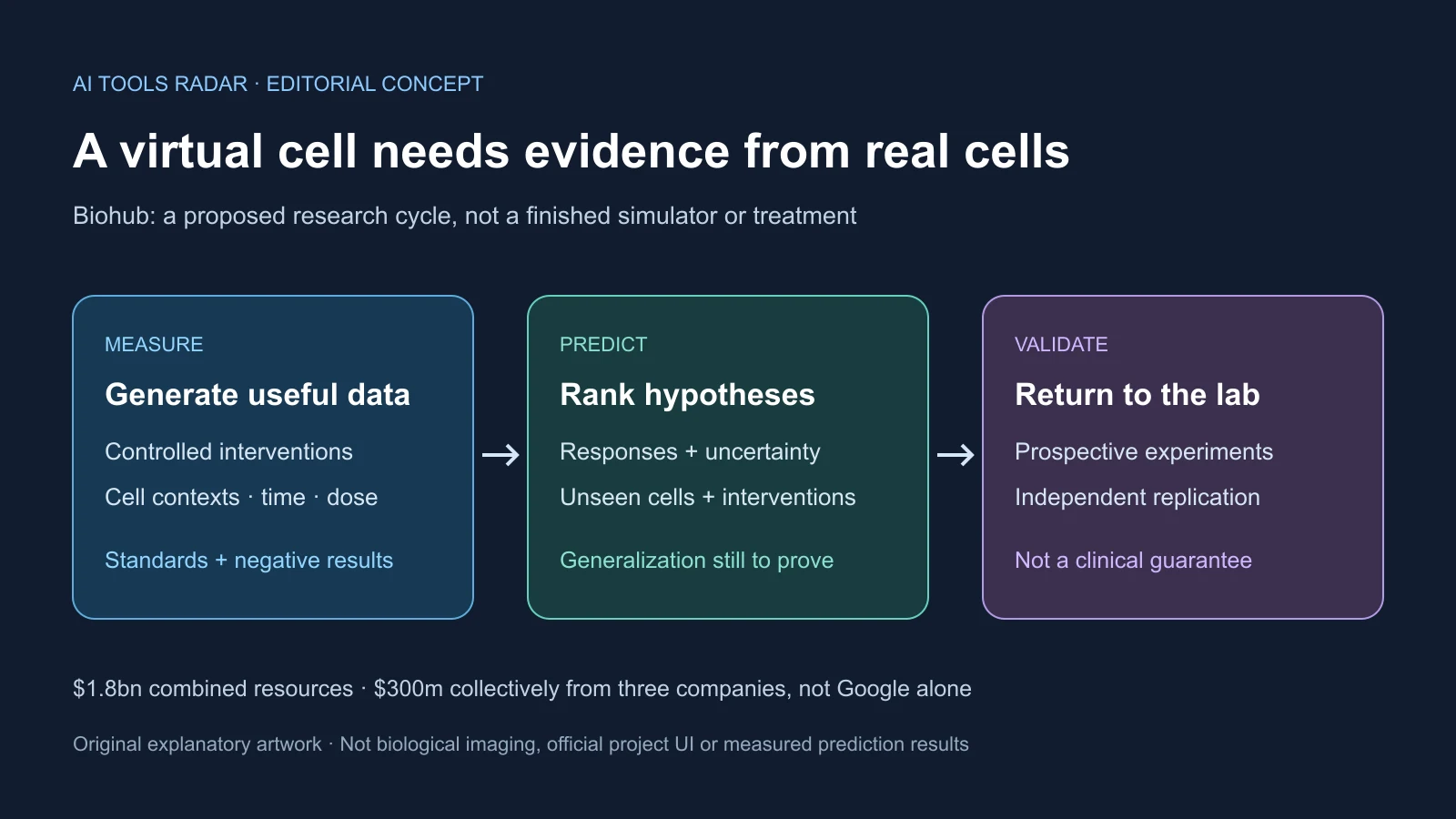
Biohub’s expanded Virtual Biology Initiative is a bet that the next advance in biological AI requires more laboratory evidence, not simply a larger model. Announced on October 7, 2026, the program combines Google DeepMind, Meta, Isomorphic Labs, federal agencies and scientific institutes around the expensive task of generating data on how living cells respond to interventions.
The stated $1.8 billion package includes funding, existing data, computation and measurement technology. It is not a single cash financing round, and the $300 million corporate investment belongs collectively to three companies, not Google alone. Nor is the announcement a finished virtual cell: its first large dataset and reliable predictive models remain future targets.
Four resource streams, not one interchangeable pot of money
Google DeepMind, Meta and Alphabet-owned Isomorphic Labs are collectively investing $300 million, without a disclosed split. The Department of Energy plans more than $500 million over five years through national laboratories for measurement, imaging, modeling, computation and data collection.
NIH will coordinate repositories and datasets produced through more than $500 million of earlier federal investment. Biohub intends to standardize these resources for AI training. That is not another new NIH cash contribution of the same amount.
Biohub itself committed $500 million when launching the initiative in April 2026, including $400 million for new measurement technologies such as advanced microscopy, cryo-electron tomography and tools to modify biological systems at different scales. Together, the streams form a combined resource commitment rather than identical categories of fresh funding.
The nonprofit founded by Mark Zuckerberg and Priscilla Chan named the Allen Institute, Broad Institute, Gladstone Institutes, Human Cell Atlas, Human Protein Atlas and Wellcome Sanger Institute among collaborators. Nvidia will supply computing technology and expertise. Common standards, identifiers and a central access point are part of the work, not administrative decoration.
Different designs, labels, instruments and quality controls can cause a model to learn which laboratory made a measurement instead of meaningful biology. Coordinated experiments, metadata and compatible processing must accompany scale. Biohub science head Alex Rives said the first large dataset is expected in about a year, around October 2027, and partners target accurate predictive models within five years. Those are aims, with no universal accuracy criterion yet establishing success.
What must be measured before a cell can be predicted
A virtual cell can mean a focused predictive program, not necessarily a realistic animation or a universal simulator. Useful questions include how silencing a gene, adding a compound, changing nutrients or introducing a disease-related condition affects molecular activity and behavior.
The desired outputs extend from gene expression to proteins, structure, signaling and observable responses. Training requires paired observations before and after controlled changes, repeated across cell types, conditions, doses and time. Existing public collections cover hundreds of millions of cellular observations; Rives argued that reliable prediction needs billions and eventually trillions.
Quantity is not enough. A trillion poorly documented measurements could magnify bias. Spatial transcriptomics retains the tissue location of molecular activity, cryo-electron tomography provides detailed three-dimensional structural views, and perturbation screens measure responses to genetic or environmental changes. These modalities describe different layers rather than substitute for one another.
The proposed coordination spans molecules, cells, tissues and organisms. DeepMind’s Pushmeet Kohli emphasized an open, standardized commons of experimental responses as the foundation. Protein-structure and interaction work such as AlphaFold is relevant experience, but a dynamic whole cell is not simply a larger protein-structure problem.
An Alzheimer’s-pathway team, for example, might rank interventions by predicted effect and uncertainty before choosing physical experiments. The laboratory still makes the decisive measurement; the model can learn from the result and help choose the next informative test. This active-learning pattern seeks better experiment selection, not an end to experiments.
Generalization remains the obstacle. A cultured line may not represent primary human tissue, and one dose may not represent another. Donor, development, disease, neighboring cells, nutrients and prior treatment all change behavior. Narrowly useful models could emerge from shared data before a universal simulator does.
Shared infrastructure includes a private head start
Biohub says the resource will ultimately be open to scientists. According to Rives, government-funded data will not have private embargoes. Corporate-funded datasets will give commercial funders temporary early access before public release; the duration was not disclosed in the announcement.
That incentive can help pay for costly experiments, but it also allows well-funded partners to train models and develop methods before universities or smaller biotech companies receive the same data. Eventual openness does not erase unequal timing.
Isomorphic Labs has an explicit drug-discovery business, where perturbation data could support targets and compounds. DeepMind contributes biological-AI experience. Meta’s direct commercial path is less explicit, though it has biological-modeling research and Zuckerberg’s connection to Biohub. The collaboration is a shared resource strategy, not an end to commercial competition.
Its credibility depends on embargo length, license terms, metadata, download restrictions and inclusion of negative results. A model must learn that an intervention had no meaningful effect, not only interesting outcomes selected for publication. Dataset cards should describe methods, donors and contexts, limitations and quality checks; outside researchers need usable correction channels.
Stable identifiers, archived versions and durable access matter for reproducibility. Public files alone do not guarantee affordable computation for academic teams; Nvidia’s participation does not settle allocation. Access policies, compute availability, model releases and privacy safeguards will determine whether this remains shared infrastructure or a corporate resource released later.
This sits between two imperfect choices: proprietary data concentrate capability and restrict scrutiny, while fully public funding may struggle to attract equivalent investment or speed. Other AI organizations, including OpenAI’s foundation funding medical and biological datasets and Anthropic’s laboratory-biology activity, illustrate why experimental data are strategic. The central test is governance, not Google beating Meta.
Existing benchmarks show why money is not accuracy
Arc Institute’s first virtual-cell challenge asked models to predict gene-expression changes after suppression of genes in human embryonic stem cells. It included roughly 300,000 single-cell profiles across 300 perturbations. More than 5,000 people registered from 114 countries; over 1,200 teams submitted, with more than 300 final entries.
Arc reported that models did not consistently beat simple baselines across every metric. Leading systems improved perturbation discrimination and identification of changed genes, but combined deep learning with classical statistical features. Pure end-to-end learning had not solved the problem. This does not establish impossibility; it challenges replacing unfamiliar-biology performance with success on familiar data.
The 2026 challenge raises the bar to responses in six cell lines whose perturbations were absent from training, a zero-shot setting closer to research use. Arc’s STATE model learned from observational data covering 167 million cells and perturbation data covering more than 100 million across 70 human contexts. Even that scale leaves sparse coverage of biological possibilities.
Gene-expression accuracy is also not the only relevant endpoint. Protein localization, shape, metabolism, toxicity and cell communication can change without an obvious transcriptomic signature. Ranking a gene target may be useful while clinical prediction remains inappropriate. Different questions require different models, modalities and uncertainty estimates.
A five-year accuracy target must therefore specify unseen cell types, interventions, laboratories and conditions, as well as acceptable error. Independent laboratories using different equipment and samples should replicate results. A prospective study in which a model selects experiments and improves actual decisions is stronger than a polished visualization or retrospective leaderboard.
The next milestones are public evidence, not a promised treatment
The first dataset should be judged by cell types, interventions, doses, time points, donors, negative results, raw measurements and metadata, not only volume. A narrow or delayed release would weaken the model timetable, while common identifiers and interoperable standards could still be valuable even if a universal cell takes longer.
Benchmark progress must extend beyond memorization and laboratory artifacts to unfamiliar tissue, chemicals, timescales and measurements beyond gene expression. Prospective, independent experimental benefit is the meaningful outcome. Claims of faster drug development remain hypotheses until tested, and clinical development still requires toxicity assessment, manufacturing, trials and regulatory review.
Finally, publish the access rules: which partners receive embargoes, how long they last, when each dataset becomes public and how errors are fixed. These conditions shape whether institutions can compare models fairly rather than market selective results as broad biological intelligence.
For researchers and biotechnology companies, the near-term output is data, standards, instruments and experimental models—not a treatment next year. Biohub’s significance is funding the physical work AI cannot obtain by scraping the internet. Whether that becomes reliable shared science will be shown by the first release, independent prospective tests and enforceable governance.
Sources
Biohub expansion announcement · Reported funding and access terms · Biology’s data bottleneck · Arc challenge results · Arc virtual-cell program · Virtual-cell definitions · Original coverage