
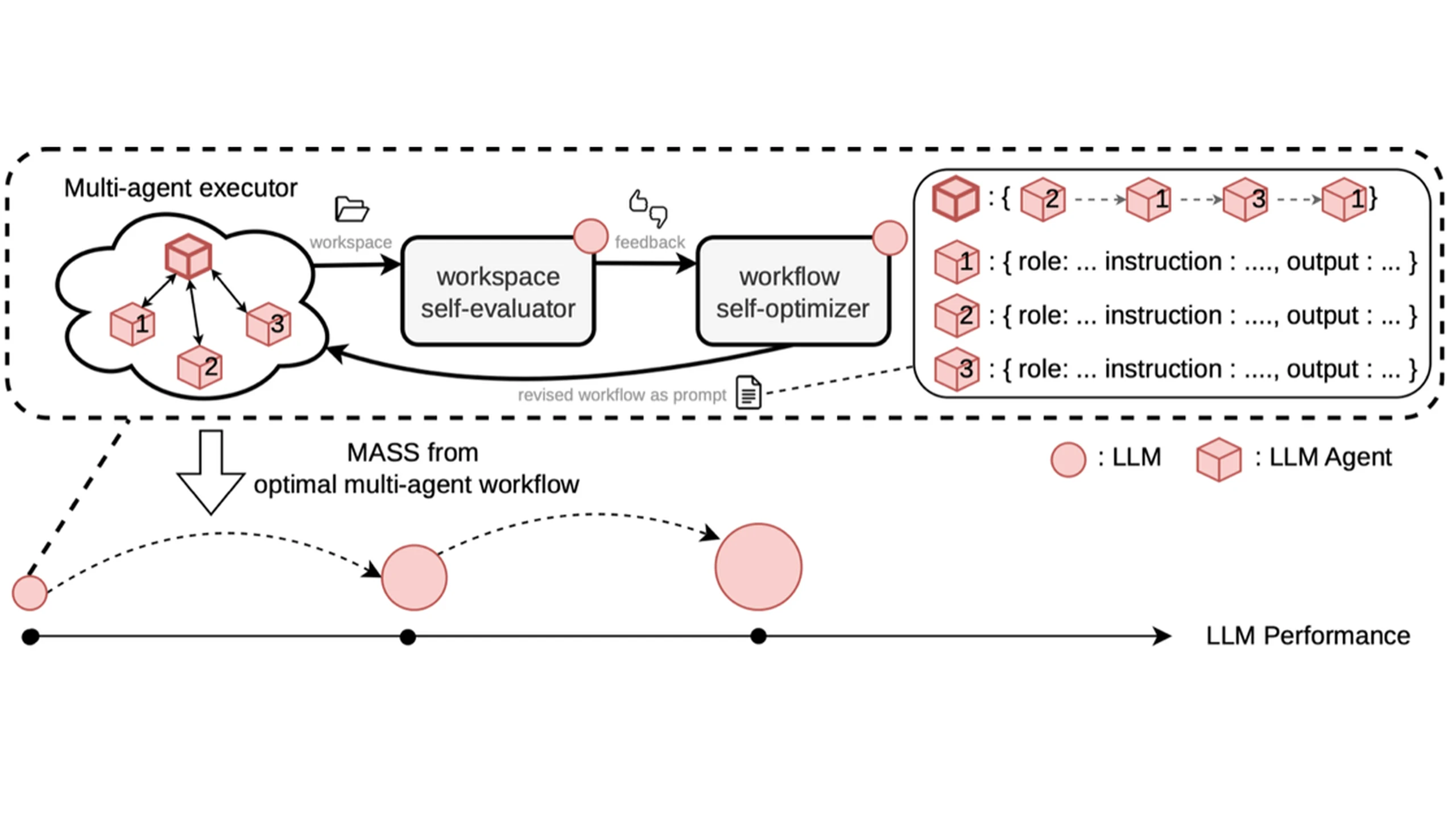
Sakana AI has completed two cycles of Multi-Agent Self-Supervision, or MASS, in which copies of one model generate research work, judge it and turn selected trajectories into training data for their shared successor. The reported improvements are real experimental results, but uneven: research benchmarks improved while two software-engineering benchmarks declined. This is bounded post-training, not evidence of an autonomous intelligence explosion.
The paper submitted on October 8, 2026 and open implementation make the experiment inspectable through task prompts, training configurations, evaluation tools and pipeline documentation. They also expose what the recursive label leaves unresolved: only two complete cycles, a small task suite and a model that can reproduce the same mistake as executor, optimizer and evaluator.
From a team’s work to a model update
Ordinary multi-agent inference divides a task among model instances and assembles their outputs without changing the underlying weights. MASS instead preserves messages, tool calls, intermediate artifacts and results as training trajectories. Separate instances perform different jobs, but all share the same model; they are not independently trained experts.
Its inner loop holds weights fixed and searches for a better prompt-defined workflow. That workflow specifies roles, instructions, output contracts and communication hops. Each training task has a champion workflow. A candidate team executes the task, the model compares its workspace with the champion’s, and the optimizer uses that judgment to propose a revision.
After selecting a workflow, MASS executes it 18 times per task. Pairwise model judgments rank the workspaces, and a Bradley–Terry model converts those preferences into scores. Up to 16 trajectories are retained: 15 can provide training examples and one is reserved for validation. The workflow text is removed from the orchestrator’s initial training prompt so the model must infer organization from the task rather than simply copy the supplied plan.
The outer loop uses low-rank adaptation, or LoRA, to fine-tune a limited set of parameters. Both orchestrator and subagent conversations become training targets. The updated model then returns in all three roles for the next cycle. Calling this recursive is defensible because one generation helps create and select its successor’s data. Humans still define the architecture, tasks, optimization procedure, benchmarks, compute infrastructure and cycle boundaries.
Research gains, with a clear transfer boundary
The base model is Qwen3.6-27B in a coding-agent environment. A synthetic suite contains 12 research tasks in finance, robotics and pharmacy, each requiring code, quantitative analysis and a written report. Nine were designated for training, but eight ultimately contributed data. Three, one per domain, were excluded from fine-tuning, validation and checkpoint selection.
GPT-5.5 and Claude Opus 4.8 served as external judges of completed workspaces, not as training-loop supervisors. On the three held-out tasks, the first-round model won 53.9% of comparisons against the base and the second-round model won 69.9%. Round two beat round one in 60.8% of comparisons. On training tasks, the corresponding wins against the base were 65.6% and 82.5%. The stronger training results make the separation from held-out evidence important.
On public research benchmarks, Sakana reports second-round scores per output token at 1.2–1.6 times the base. MLR-Bench rose from 1.71 to 2.25, with paper delivery increasing from 57% to 76%. ScienceAgentBench improved from 28.8% to 31.7%. AstaBench E2E-Hard rose from 0.053 to 0.067, while report delivery increased from 50% to 76%. DSBench changed only slightly, from 0.473 to 0.482; a stronger efficiency ratio does not turn that small absolute change into a large score gain.
Software engineering moved in the opposite direction. Terminal-Bench 2.0 declined from 0.375 to 0.352, and SWE-bench Verified from 0.626 to 0.611. Their score-per-token ratios were 0.96 and 0.94 times the base. These results rule out describing the model as uniformly stronger.
Task alignment is a plausible explanation: research reports, quantitative evidence and code dominated training, not repository debugging or terminal operations. Adding software-engineering tasks might help, as Sakana suggests, but that remains untested. It might also introduce interference with existing abilities. Genuine transfer tests must check both new domains and retention of the original ones.
What the efficiency numbers leave out
In a training comparison, a multi-agent student reached a 68.3% win rate after 28.8 million supervised tokens. The largest single-agent student reached 64% after 42 million tokens. That is a higher result with 31% fewer supervised tokens, not a demonstrated 31% reduction in the cost of developing the model.
The teams generated roughly 2.4 times as many tokens on average before selection. External judges preferred their work in 85.1% of comparisons with single-agent outputs. In ten pairs with similar trace lengths, teams still won 80%. These results suggest that coordination and selection yield useful examples, but the comparison does not isolate delegation: workflows and verification instructions also differed.
Score per output token measures productive output, not the entire pipeline. Workflow search, repeated executions, comparisons, data generation and evaluation consume additional computation. Supervised-token totals exclude input tokens and several upstream costs. MASS therefore supports a claim about denser selected training data; total development efficiency needs a more complete accounting.
Information contracts matter more than personas
The workflow search changes roles, instructions, contracts and hops. A contract specifies the evidence or artifact an agent must return; a hop determines when that information moves to another agent or returns for review. This is more specific than asking several copies to play a researcher, critic or editor.
In a finance example, agents cover data preparation, feature construction, modeling, backtesting, auditing, reconciliation and reporting. The data agent must disclose whether future information leaked into historical decisions. That requirement targets an actual failure: an impressive backtest may simply have used information unavailable at the time.
Sakana’s textual analysis found task information increasingly concentrated in contracts and communication order rather than roles and general instructions. The sample covers only eight or nine tasks, depending on the comparison, and mutual-information estimates describe workflow text rather than every exchanged message. It is a clue about the mechanism, not a broad causal proof.
Earlier multi-agent debate research studied improvements from exchanged answers and critiques. MASS carries selected collective behavior into weights: orchestrator traces teach decomposition and coordination, while subagent traces teach bounded assignments. A searchable engineering knowledge base offers a related organizational lesson about preserving inspectable evidence and decisions, not independent validation of MASS.
The optimizer and the judge share limitations
One model in three roles reduces reliance on a permanently stronger teacher, but creates correlated failure. An executor can misunderstand a task, the evaluator can reward that misunderstanding, and the next model can learn it with greater confidence. Random sampling and specialized assignments create variation, not independent training histories or guaranteed independent judgment.
Sakana’s project overview identifies shared blind spots as a safety issue. Agreement between internal and external judges increased from 73% to 93% across three model generations. That is encouraging agreement on these tasks, not proof of correctness: judges can share assumptions or favor polished reports while missing errors that need real-world experiments.
Optimizer strength was another constraint. In tests retaining base Qwen as executor, using GPT-5.5 only as evaluator brought limited improvement. Using it as both evaluator and optimizer found winning workflows for all 12 tasks within five search iterations. The homogeneous loop eventually found winners for 11 of 12 tasks but needed up to 13 iterations. Good criticism is insufficient if the optimizer cannot translate it into a better process.
Search was also unstable: strong iterations could be followed by sharp regressions. Community criticism cited in the original reporting questioned both the recursive label and the decision to stop after two rounds. The narrower interpretation is iterative, human-bounded workflow search and supervised fine-tuning, not unrestricted self-rewriting or evidence of indefinite progress.
Oversight must improve with capabilities
Research without an automatic success rule is especially vulnerable to self-confirmation. A coherent report may contain a conceptual error, omit contradictory evidence or implement the wrong objective in code that runs successfully. Model consensus alone cannot settle scientific novelty, strategic judgment, values or safety.
OpenAI’s monitorability research finds that reasoning traces can reveal more than actions and final answers, but monitoring remains incomplete and depends on both agent and monitor. MASS’s rich trajectories create inspection opportunities and hiding places. Optimizing visible reasoning can reward convincing explanations without correcting the underlying behavior.
Anthropic’s discussion of recursive self-improvement likewise emphasizes oversight, validation and verification. Relevant independent checks include outside models, domain experts, executable tests, trusted data pipelines, adversarial evaluations and delayed real-world validation. None covers every failure; several agreeing models may still share a bias.
The decisive next tests are additional cycles, transfer without loss of existing abilities, and recovery from a deliberately introduced shared blind spot. A loop should not merely let external judges catch a defective result: it should revise the workflow and avoid training on the error. For now, MASS supplies evidence for concentrated learning from bounded, evidence-heavy research teams. It does not establish unlimited recursive improvement or justify removing human review from consequential decisions.