
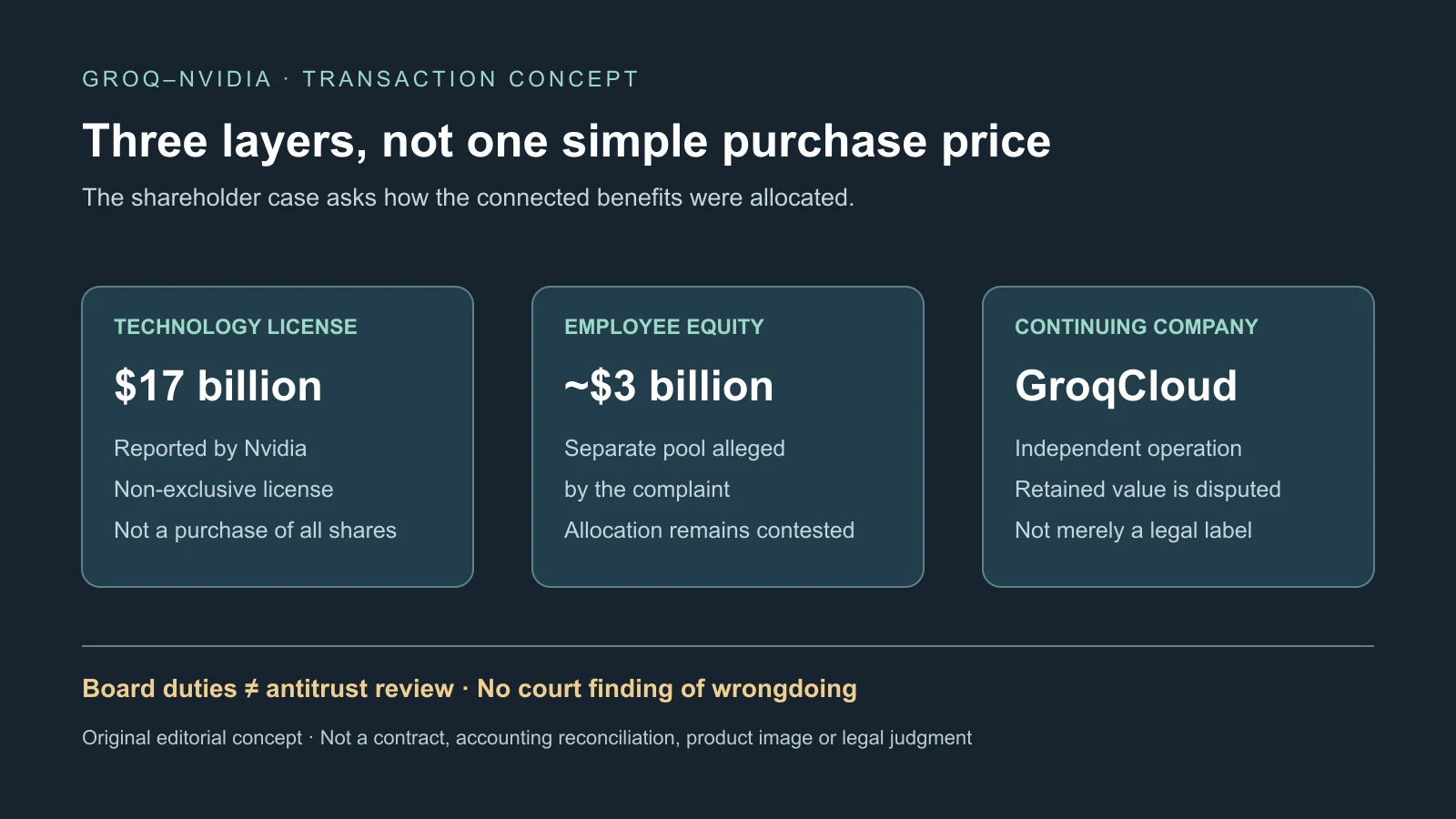
Former Groq engineers Benjamin Serebrin and Joshua Rubin are challenging how the startup's directors divided the value of its December 2025 Nvidia arrangement. Their proposed shareholder class action alleges that core technology and most engineers moved toward Nvidia while some common shareholders received an unfair cash exit. Groq denies wrongdoing and says the deal delivered exceptional value. No court has established the alleged misconduct.
The familiar $20 billion headline combines different economic components, not a conventional price paid for all Groq shares. Nvidia reported $17 billion of license consideration; the complaint describes a separate roughly $3 billion Nvidia stock pool for selected employees. Groq remained independent with a cloud business. Whether those parts together warrant company-sale protections is the dispute, not an already settled legal characterization.
The same case appears in reports with different procedural dates
The initial account dates filing to October 2, 2026. Later reporting describes a September 29 sealed filing in Delaware's Court of Chancery, unsealed October 5. These accounts differ on procedural chronology and should not be turned into two lawsuits or silently collapsed into a verified single filing date. The later account names former CEO Jonathan Ross and former Groq directors as defendants; Nvidia is not a defendant.
Groq announced the non-exclusive inference-technology license December 24, 2025. Ross, president Sunny Madra and other staff would join Nvidia, while Simon Edwards would lead the independent Groq and GroqCloud would continue without interruption. Financial terms and the number moving were not disclosed in that announcement. The complaint estimates nearly all engineers, possibly 200, which remains an allegation.
Plaintiffs say directors favored senior employees, affiliated investors and transferees. They allege an undervalued common-stock cash-out, denial of some voting rights and failure to test price or alternatives. Selected senior holders allegedly accepted discounts on Groq shares while receiving separate Nvidia awards. The Financial Times named BlackRock, Social Capital, Infinitum and Disruptive among funds identified in the complaint, not named defendants.
Earlier Financial Times reporting said Nvidia declined comment and Groq had not immediately responded. The subsequent account adds Groq's rejection of the action as meritless and promise to defend it vigorously. That later response must not be erased by repeating only the initial silence. A complaint presents one side, not a neutral finding.
Nvidia's accounting explains the value, not the legal result
Nvidia's fiscal 2026 annual filing records $17 billion consideration: $13 billion at closing and $4 billion within one year, including imputed interest. It identifies a non-exclusive license to LPU technology and certain hires, but no purchase of Groq equity, existing products or customer contracts. These retained boundaries support the parties' non-merger description.
The filing recognizes $14.4 billion goodwill and a $2.5 billion developed-technology intangible, valued by cost to recreate with a five-year useful life. Goodwill primarily reflects the assembled workforce and future development. The reported recognized amounts are rounded and need not sum exactly to $17 billion; they should not be presented as a separate complete cash-flow reconciliation.
The large goodwill share explains why plaintiffs link employees and technology. It does not itself prove a disguised merger or unfair allocation. Non-exclusive licensing leaves ownership and reuse with the licensor, with other licensing rights dependent on contract. A continuing company with customers, financing and operations is different from an entity existing only on paper.
Plaintiffs reportedly invoke Delaware General Corporation Law Section 271 on sales of all or substantially all assets, alongside fiduciary duties. The complaint acknowledges no Delaware decision directly resolving this exact license-and-hire question. Courts may evaluate retained value, approvals and conflicts without necessarily adopting the broadest sale theory. The unresolved legal standard matters as much as the transaction label.
Employee compensation and shareholder consideration are not automatically the same
Startup employees may own common stock or options while investors hold preferred rights. Vesting, liquidation preferences, taxes, approvals and side agreements affect distributions. A transferee's future Nvidia compensation differs from a remaining worker's exposure to GroqCloud, even when both previously held Groq shares.
The alleged stock pool could reward future service, retention obligations and joining risk rather than divert shareholder value. Plaintiffs argue the reverse: insiders shaped connected agreements to capture upside other holders lost. Individual awards, eligibility, vesting, negotiations and independent approvals would be necessary to test either interpretation. Different payouts or investor affiliations alone do not establish illegality.
Tax is another contested comparison. Plaintiffs say corporate license income created costs a share purchase might avoid. A realistic alternative would also carry its own regulation, liabilities, integration and tax consequences. Neither tax cost nor a hypothetical higher valuation establishes a breach without comparing attainable alternatives.
Nvidia also warned that incorporation of Groq technology requires substantial engineering and might miss schedules, performance, adoption or cost recovery. A large payment was not for a guaranteed completed advantage. Future synergies with Nvidia compute, networking, software and distribution may be valuable, but execution risk and the timing of value creation matter to valuation and any damages theory.
Groq's cloud continuation complicates the hollow-company claim
The initial account reports an August $350 million financing at a $3.5 billion valuation, led by Disruptive with planned Nvidia participation, and says $650 million was raised in June for a recent $1 billion total. It also cites company claims of 13 data centers and more than six million developers. These operational figures are not independently verified here.
The follow-up describes a May effort to seek up to $650 million and later disclosure of the $350 million round. Seeking money and completing a financing are different stages; these accounts should not be silently treated as independent confirmation of one exact fundraising chronology. Both report a surviving cloud-focused business, but later valuation alone cannot prove earlier holders were underpaid after strategy, capitalization and ownership changed.
The later technology reporting adds a striking reversal. Groq would deploy Nvidia Groq 3 LPX racks, reportedly with Dell support, using the architecture it had licensed out. LPU designs emphasize predictable execution and on-chip SRAM, fast memory close to logic. Nvidia positions LPX as a decoding companion to Vera Rubin: token-by-token output generation can use specialized processors while GPUs handle broader work.
That transition can reduce the risks of designing and manufacturing independent chips while making Groq more dependent on Nvidia's roadmap and hardware supply. Groq's deployment experience remains valuable, but a cloud operator buying systems is a different competitive actor from an independent chip designer. Later production progress does not eliminate software integration, utilization, customer adoption and repeat-order risk.
A real cloud business and an unfair earlier value allocation could coexist. Equally, later struggles would not automatically prove directors breached duties at approval. The case needs evidence about what value remained, who retained participation and which upside existed before versus after the agreement.
Antitrust and the shareholder case ask different questions
Delaware focuses on board duties and shareholder treatment. Competition authorities ask whether Nvidia absorbed an independent technical path that could constrain it. A deal might be fair to shareholders yet harm competition, or raise fiduciary issues without an antitrust violation. Neither process determines the other.
Senators Elizabeth Warren and Richard Blumenthal questioned the arrangement in March 2026, pointing to Nvidia's position and its 2025 Enfabrica license-and-hire structure. September reporting described a Justice Department inquiry into potential review avoidance. An inquiry or political allegation is not a public finding of illegality; no lack of enforcement would prove Groq's board acted fairly either.
Microsoft, Google, Amazon and Meta have used related structures with different contracts and surviving operations. Flexible licenses can disseminate technology, preserve customers and give engineers resources, yet also move key intellectual property and development capacity without equity ownership. Groq's non-exclusivity and retained operations must be weighed against workforce transfer and future independent chip capability.
The inference market remains contested by Google TPUs, Amazon and Microsoft custom accelerators, AMD, Cerebras, SambaNova and others. Nvidia could argue integration adds useful capability or lowers inference costs. Those potential benefits require evidence, not universal LPU performance claims across every model and workload. Competitive losses and customer alternatives need their own analysis.
What would make the next stage informative
Early Delaware rulings will show which theories can proceed; dismissal reasoning matters more than a headline win or loss. Discovery could reveal board minutes, valuations, conflicts, employee awards, negotiations, shareholder communications and alternatives. Independent bargaining evidence may weaken the allegations; undisclosed linked benefits may strengthen them.
Federal action or closure would change regulatory uncertainty without resolving shareholder fairness. Commercially, LPX shipments, software support, repeated adoption and GroqCloud customer retention, financing and utilization will test whether the retained business has durable value. Buyers also need continuity of support, hardware supply, models and roadmaps, not just an intact corporate name.
For workers and directors, the practical issue is the complete economic arrangement: share class, vesting, exercise windows, information rights, retention benefits and taxes interact with employment decisions. These are questions for individual independent advice, not a promise that every holder shares a transaction headline equally. The lawsuit leaves the outcome open. It tests whether separate licenses, hiring and financing agreements were negotiated and allocated fairly—not whether calling something a license automatically proves either legitimacy or evasion.
Sources
Financial Times complaint reporting · Groq transaction announcement · Nvidia annual filing · Groq cloud funding · Senators' inquiry · Reported DOJ inquiry · Bloomberg Law case account · Technical deal follow-up · May financing account · Inference market analysis · Original news index