
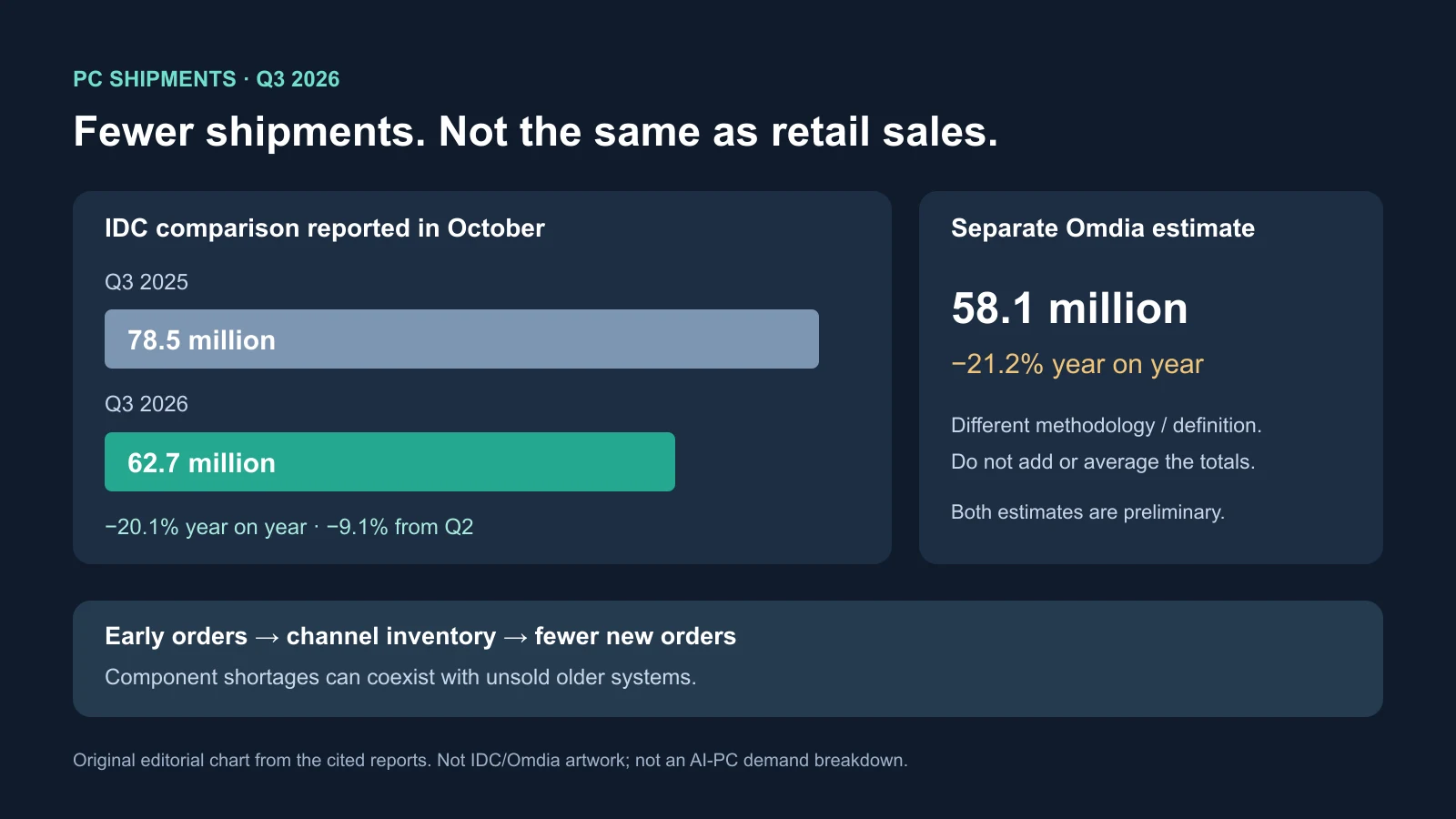
Worldwide traditional PC shipments fell to 62.7 million units in the third quarter of 2026, according to preliminary IDC figures reported in October. That was 20.1% below the 78.5 million comparison figure and 9.1% below the second quarter. A normally stronger back-to-school and pre-holiday period instead produced a substantial sequential contraction.
The central complication is that expensive components and excess channel inventory can exist simultaneously. Buying early helped vendors and distributors secure supply before anticipated price increases; it also moved orders out of later quarters. The shipment decline therefore measures a severe adjustment, not proof that consumer purchases, revenue or interest in AI PCs fell by the same percentage.
How a supply defense became an order gap
IDC consumer devices research director Jitesh Ubrani attributed part of the unusual seasonal pattern to earlier inventory decisions. Systems bought before expected component inflation supported the first half but reduced the need for new channel orders in the third quarter. That timing shifts activity; it does not create an equivalent amount of lasting demand.
The 15.8 million-unit difference is between two third-quarter shipment totals a year apart, not a loss of 15.8 million from full-year sales. IDC’s traditional PC category includes desktops, notebooks and workstations, while excluding tablets and certain detachable devices. Its estimates are preliminary and track shipments into distribution, not every completed retail or enterprise purchase.
Distributors can keep selling stocked computers while ordering fewer replacements, making shipments look weaker than end-user sales. The opposite risk remains: if older stock does not sell, channels may cut orders again. Neither interpretation can be settled from a shipment total alone.
Manufacturers still suffer lower assembly, logistics and retail throughput even if inventory explains the timing. They must manage existing systems while obtaining costly parts for future products. Discounts can clear old stock but weaken margins and compete with new models; cutting production too far could leave shortages if demand returns.
AI demand acts through the supply chain, not a one-for-one swap
DRAM working memory and NAND flash for solid-state storage are central constraints in the source analysis, alongside tighter processors, graphics chips and other integrated circuits. Data centers buy advanced memory, storage, accelerators and supporting parts, giving suppliers reasons to favor stronger returns or reliable long-term contracts.
That does not mean a server directly takes an identical memory module from a laptop. Manufacturing capacity, materials, packaging, supplier bargaining and investment priorities overlap across related markets. Capital allocated to data-center growth can slow the expansion of capacity for consumer devices without a one-for-one transfer of finished components.
PC makers can absorb higher costs, reduce specifications or raise prices. The first reduces margins, the second weakens product appeal, and the third discourages households, students and small businesses able to keep existing machines. Limited entry-level margins make even relatively small memory or storage increases consequential.
Scarce components may consequently go to business and premium models with higher margins or more urgent replacement needs. This can protect revenue while reducing affordable choices, even for buyers who do not want premium processors, AI features or elaborate displays. Popular configurations may be unavailable while older, less appealing systems remain on shelves.
The largest vendors lost volume faster than the market
The reported IDC estimates put Lenovo first at 14.9 million units and 23.8% share, down 22.6% from a rounded 19.3 million a year earlier. HP shipped 10.3 million, down 30.9%, for 16.5% share—the steepest decline among the leading five. Dell remained third at 7.6 million and 12.1% share, down 25% from about 10.1 million.
Together the three shipped about 11.6 million fewer computers and lost a reported combined 4.2 percentage points of share. Those are shipment and share changes, not disclosed revenue or profit declines. Their procurement scale, supplier relationships and financial resources can secure components but cannot remove the timing of large enterprise, government and education orders.
The previous Windows 11 transition and commercial replacement cycle created demanding comparisons. After a large Windows 10 migration, a business can restrict purchases to new employees, failures or specialist workloads rather than repeat an entire fleet refresh. Dell’s support and standardized configurations remain valuable, but do not prevent buyers negotiating or extending lifecycles.
There is also a source-data boundary: the reporting cites an earlier preliminary Q3 2025 total of 75.9 million, with Lenovo near 20 million, while using 78.5 million for the current annual comparison. These are not interchangeable baselines. The available material does not reconcile the earlier estimate with the comparison series, so the reported 20.1% decline should not be recalculated using 75.9 million.
HP’s particularly large fall suggests exposure to the correction, not a complete diagnosis. Product timing, geography, channel inventory and contracts can all affect a quarter. Lenovo’s slightly worse-than-market contraction did not remove its leading position, and all three retained extensive commercial operations and larger volumes than Apple or ASUS.
Gaining share did not mean growing shipments
Apple shipped an estimated 5.9 million Macs, down 11.3%, while its share rose from 8.5% to 9.5%. ASUS shipped about 5.5 million computers, down 8.6%, and reached 8.7% share. ASUS had the smallest decline among the leading five. Both gained relative position because other vendors fell faster, not because either increased volume.
Apple’s control of its operating system, main processor design and tightly managed range can simplify planning relative to many processor, memory and enterprise configurations. Its position outside the cheapest PC tiers also provides more room to pass on costs. Macs nevertheless depend on memory, storage, displays, packaging and a global supplier network; integration is not immunity.
ASUS spans consumer notebooks, gaming systems, commercial devices and components. Its product or geographical mix appears more resilient in this quarter, but gaming launches and retail promotions can shift timing just as Apple launches can. One preliminary quarter cannot establish permanent loyalty changes or a lasting retreat by Lenovo, HP and Dell.
Volume is also not a complete financial result. The source cites IDC saying vendors passed through price increases faster than demand declined earlier in the year. A company can lose units, gain share and defend revenue together. That does not remove the buyer’s problem of fewer budget configurations or higher replacement costs.
Two trackers agree on direction, not an identical market total
Omdia separately estimated 58.1 million shipments, down 21.2% annually. Its total is 4.6 million below IDC’s 62.7 million. Different market definitions and tracking methods—including device scope, vendors, geography and channel estimates—mean the totals should not be added, averaged or treated as measurements of an identical category.
Both analyses nevertheless report declines above 20% and connect them to fading pull-forward purchases and supply constraints. That supports the broad direction more than a precise common market size. Preliminary figures can change as further channel information arrives.
Nor do these totals isolate neural processing unit-equipped systems from other PCs. NPUs are dedicated processors for local AI workloads, but the estimates cannot tell whether buyers reject AI features, want them but cannot justify the price, lack supply or simply still have a useful computer. Treating the slump as an AI-PC referendum would exceed the data.
The post-pandemic correction provides perspective: shipments had a larger annual contraction in Q1 2023 and later stabilized as inventory cleared and comparisons eased. This cycle also has component scarcity and higher input costs. Clearing stock alone cannot restore affordable new supply if memory and storage remain constrained.
The next quarter will separate inventory timing from a longer reset
IDC’s earlier outlook projected an 11.3% full-year 2026 decline, deteriorating conditions toward year-end and a Q4 annual fall near 20%. Those are forecasts cited in the analysis, not already achieved outcomes or a guarantee that every future quarter contracts by that amount.
A substantially smaller Q4 decline would suggest Q3 absorbed more of the earlier-order correction. Continuing weakness could indicate persistent destocking or buyer resistance. Memory and storage supply must improve without another cost shock, yet better components alone cannot eliminate inventory already sitting in channels.
The vendor gap and new configurations offer additional evidence. Persistent resilience at Apple and ASUS could reflect durable customer and product mix; convergence could reveal a timing effect as large deployments return. Smaller base memory, less storage and fewer budget models would show manufacturers coping through product design rather than fully restored supply.
Replacement demand has not vanished: failures, new employees, software requirements and supported fleets remain. But it need not produce a quick rebound. A failing machine, security support and workload requirements create a different decision from a discretionary upgrade of a reliable computer; reduced baseline specifications can also create later productivity and support costs.
The unresolved industry question is whether affordable models survive a supply chain increasingly influenced by data centers. Selling fewer, more expensive computers may stabilize revenue without restoring units. The next phase depends on channel orders, component availability and actual buying behavior, not the shipment headline alone.
Sources
Shipment and vendor reporting · Earlier IDC market forecast · Separate Omdia estimate