
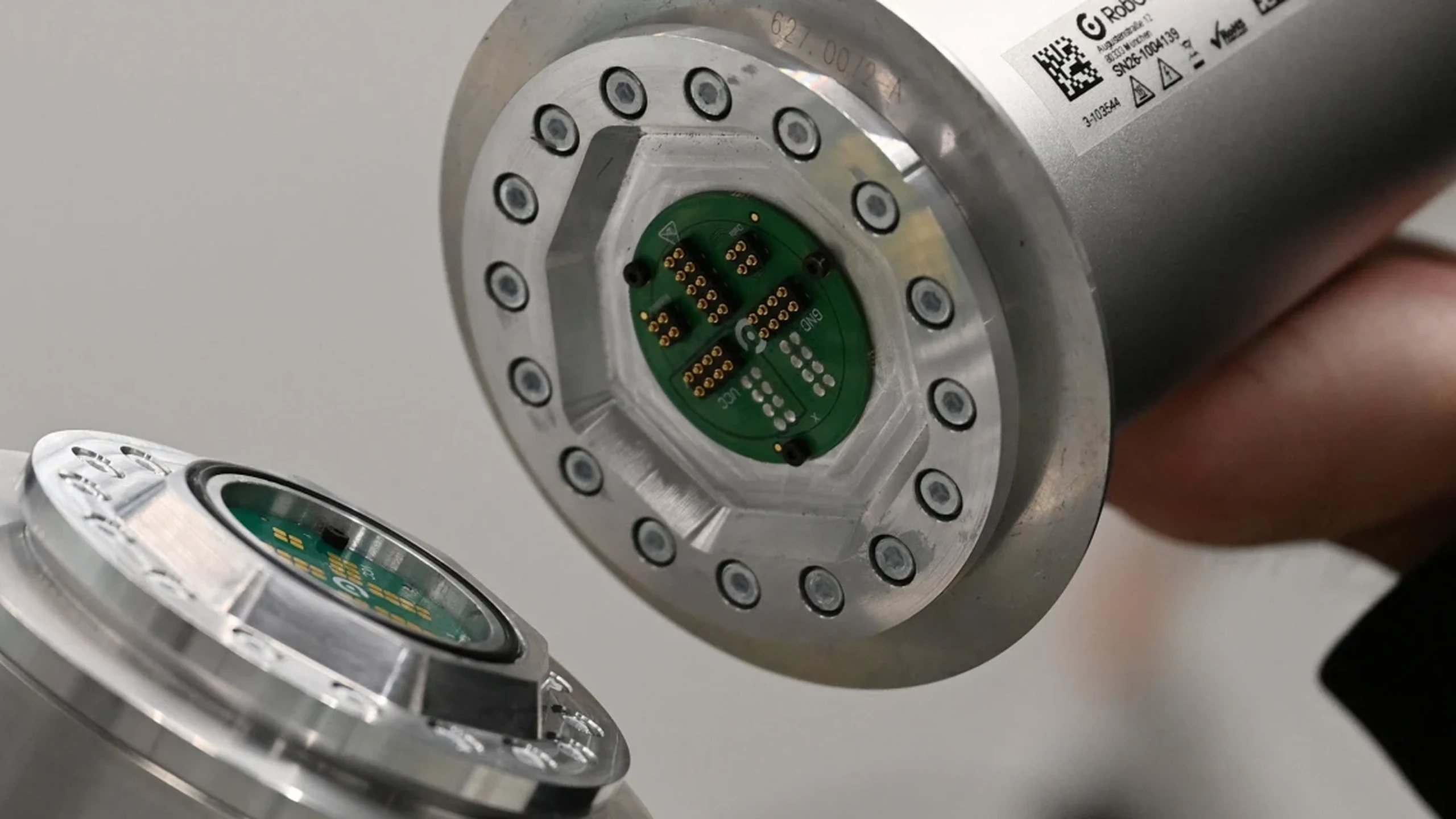
RobCo’s valuation changed faster than the factory deployments it hopes to transform. On October 5, 2026, the Munich robotics company announced a private share transaction valuing it above $1 billion, roughly double the approximately $500 million benchmark nine months earlier. The deal combined new investment with liquidity for long-serving employees, rather than being presented as a conventional funding round.
The Wall Street Journal reportedly put the transaction at $40 million, as relayed by Techmeme. RobCo did not confirm that total or disclose the primary-secondary split. Calling this a $40 million injection into the business would therefore overstate what is known. The event establishes investor willingness to buy shares at a new private valuation; it does not establish the company’s current revenue, profitability or success in scaling autonomous industrial robots.
The money reaching shareholders is not necessarily money reaching RobCo
A secondary sale transfers existing shares between holders and buyers. That portion creates liquidity for the seller, not fresh operating capital for the company. RobCo says there was new investment as well, but the amount entering its balance sheet cannot be calculated from the announcement. It also did not disclose share classes, buyer protections or the detailed transaction structure.
Those terms matter when interpreting valuation. Preferred shares can carry liquidation preferences or downside protections that ordinary employee holdings do not. Without knowing the actual terms, the headline is not equivalent to a public-company market capitalization. Nor does a reported transaction size reveal what proportion belonged to employees.
According to RobCo, existing investors Sequoia Capital, Lightspeed Venture Partners, Greenfield Partners, Kindred Capital, Lingotto and Promus Ventures participated alongside newcomers Cherry Ventures and European Tech Collective. Existing backers have access to operating information, so their return signals continued confidence. Their participation is not independent evidence of margins, revenue or technical performance.
Chief executive Roman Hölzl framed the event around recognizing people who built the business. Controlled employee liquidity can reward early service before an acquisition or listing and support retention without indefinite waiting. It does not remove the need to retain those employees afterward; a higher valuation also raises expectations among recruits, customers and investors.
The contrast is January 29, when RobCo announced a $100 million Series C co-led by Lightspeed Venture Partners and Lingotto Innovation, with earlier investors participating. The company said that funding would support its physical-AI roadmap, enterprise deployments and U.S. expansion. Physical AI refers here to machines that perceive and act in the physical world, not evidence that every factory task is already autonomous.
The product thesis is an engineering reuse loop
The investment case depends on moving from custom robot projects toward a transferable platform. Traditional automation can be reliable once installed and tuned, but a robot arm is only part of the work. Tooling, sensors, vision, programming, safety systems and connection to a production line all have to fit the process. Large manufacturers can spread those costs across long, high-volume production runs; smaller firms with changing product mixes and limited automation teams often cannot.
RobCo initially targeted that underserved group. Its modular hardware lets customers configure reach and payload without beginning from an unrelated platform. A common software environment is intended to define tasks, connect vision and monitor operation. The company says demonstrations and autonomous learning can teach task-specific skills, reducing the need to hand-program every movement or new configuration.
Target applications include machine tending, palletizing, dispensing and material handling. Their repetitive nature makes them candidates for automation, but differences in parts, equipment and layouts still matter. A platform that handles those variations through reusable capabilities could make each successful installation contribute to faster later deployments.
That is the route to software-like economics within a hardware business: deployments would grow faster than bespoke engineering labor. It is a thesis, not a disclosed financial result. RobCo has not published current revenue, gross margins, renewal rates, deployment times or the share of installations needing extensive customization. A polished interface can still sit above a service-intensive integration operation.
The customer buys a working manufacturing process, not merely a configurable arm and application. Learning and vision may broaden the variations a cell can handle, but they also require predictable behavior, validation and recovery from unusual conditions. Near workers, materials and equipment, adaptation must remain within validated safety limits. Success in a controlled demonstration is not proof of reliable behavior over thousands of production cycles.
Plant teams must be able to see status, diagnose failures and understand recovery paths when conditions change. Shorter setup, faster task changes, stable cycle performance, uptime and human-intervention rates would show whether autonomy produces operational value. Public materials do not supply enough independent cross-factory data to settle those comparisons.
Customer names and old module counts need their own boundaries
Reported customers include BMW, DynaEnergetics, Fabricated Extrusion Company, T-Systems and Rosenberger. The list spans large enterprises and specialist industrial operators, but names do not reveal deployment depth, contract size or customer concentration. One pilot robot and a standardized program across facilities carry different commercial weight.
A February 2024 Forbes profile described roughly 1,000 modules deployed across more than 100 customers by early 2024. Modules are not automatically complete robots, and that dated snapshot is not RobCo’s present installed base. It provides an early commercial reference, not a current growth calculation.
The next economic step is expansion within those customers: transferring configurations to more workflows, lines and plants without restarting engineering each time. Transfer can expose regional differences in safety rules, suppliers, equipment and processes. Repeat installations would support the platform thesis more strongly than a succession of isolated, heavily supported projects.
Hardware quality must survive that expansion. Software updates can move quickly; mechanical components need manufacturing, tests, inventory, spare parts and field maintenance. Shared components and recurring software could improve economics, but do not eliminate physical capital needs. International growth adds regulation, supply chains, languages and service requirements. Margins and support intensity determine the quality of growth, not revenue alone.
The competition is between deployment models, not simply robot arms
ABB, FANUC and KUKA have long experience, proven precision and reliability, installed bases and global service networks. Their established route combines robot hardware with specialist integrators who optimize each cell, connect unusual equipment and handle local constraints. That custom work is valuable, particularly for a precise, stable production process.
Frequent changes can make the same model expensive or slow: a highly tailored cell may need fresh engineering for a new part or workflow. RobCo aims to make reconfiguration a product feature through coordinated modular hardware and common software. The question is whether complexity truly declines or merely moves into testing, training and support.
Incumbents are not standing still. They already offer collaborative robots, vision, simulation and simpler programming, and can bundle financing, maintenance, software and equipment. RobCo can design around newer software assumptions without preserving every legacy interface. Its disadvantage is having to build the support scale those suppliers already possess.
The company entered the United States in 2025, establishing San Francisco and Austin operations. It cites labor constraints, reshoring and operational complexity as reasons to prioritize American manufacturing. San Francisco offers software and AI talent; Austin sits near manufacturing and logistics. Neither automatically creates national spare-parts coverage, trained technicians or rapid responses across long distances when production stops.
Competition also comes from humanoids, mobile manipulators and AI factory systems. Humanoids seek compatibility with human-designed environments; conventional arms offer established industrial precision and efficiency. RobCo occupies a middle position: industrial modular machinery with more adaptive software, avoiding some uncertainty of general-purpose humanoids. Yet humanoid startups are narrowing to repeatable factory work while incumbents add AI, pressing that position from both directions.
Trade uncertainty, tariffs, demand changes and supply disruptions can postpone factory investment even when manufacturers support automation in principle. January’s funding provides resources, and the repricing may help recruiting or future capital access. Neither eliminates delayed orders or service obligations. If operations lag the higher price, the next financing can become harder rather than easier.
The billion-dollar benchmark therefore measures a private-market expectation about a deployment model. Repeat customer expansion would test transferability, independent production outcomes would test autonomy, and U.S. service capacity would test the ability to keep machines working. RobCo’s challenge is to combine software’s learning speed with equipment manufacturing’s operational discipline—without assuming that the price of its shares has already proved either.
Sources and related reading
Techmeme’s relay of the transaction reporting; RobCo’s employee-liquidity announcement; RobCo’s January Series C announcement; IFR related industry reading on service robots; Forbes’ February 2024 company profile.