
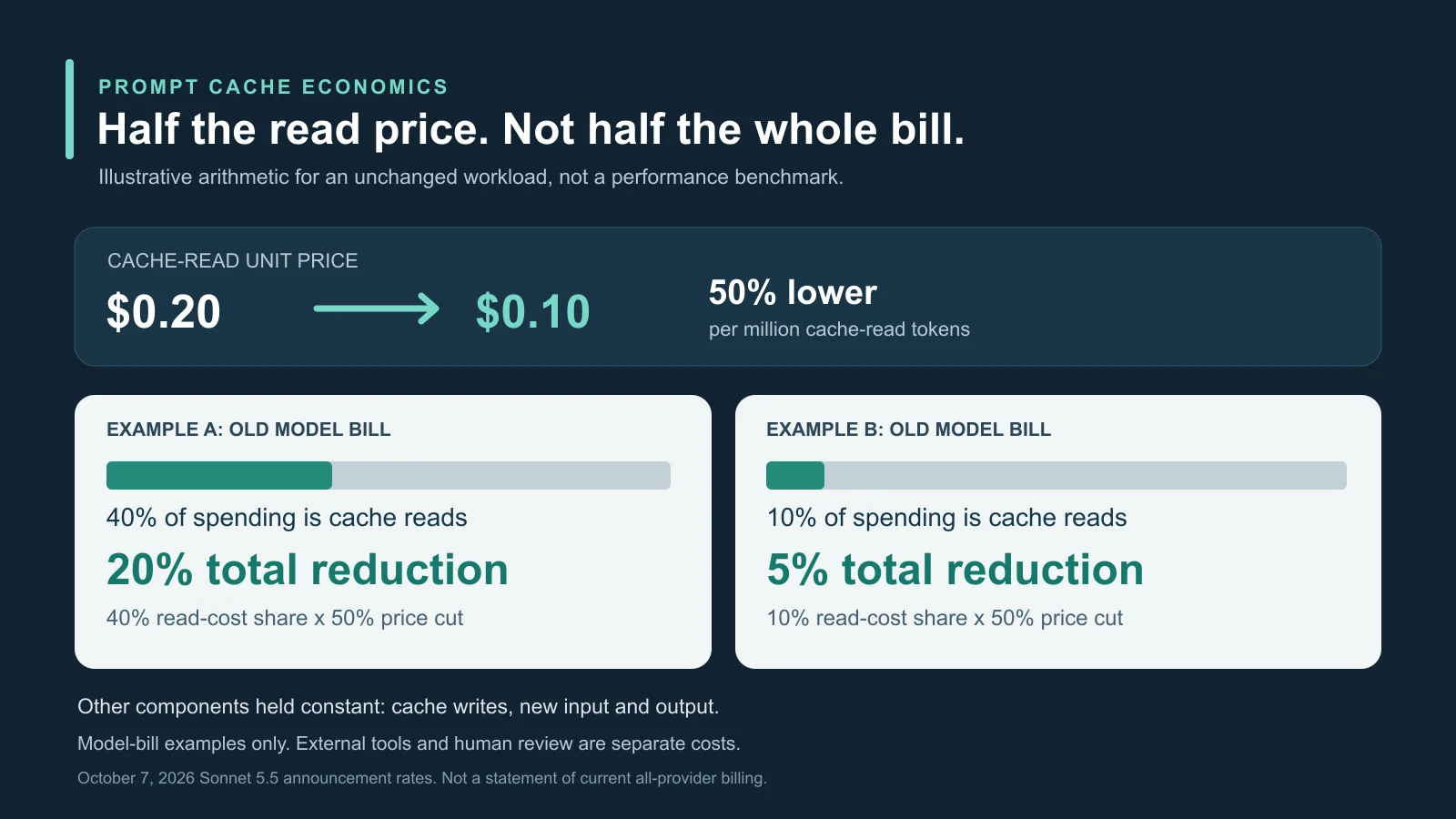
The relevant number in Anthropic’s price announcement is not simply the 50% reduction. It is the fraction of an agent’s existing bill that came from cache reads. Halving one component can meaningfully improve long-running workflows, while barely changing a short conversation or an output-heavy task.
On October 7, 2026, alongside Claude Haiku 5.5’s release, Anthropic lowered Sonnet 5.5 cache reads from $0.20 to $0.10 per million tokens. It described Sonnet as about 20% cheaper for most agentic work. Standard input and output rates did not change. The distinction separates a concrete unit-price change from a workload-dependent estimate.
What changed in the rate card
The pricing described at the announcement lists Sonnet 5.5 standard input at $2 per million tokens and output at $10. A successful cache read therefore costs 5% of ordinary input, down from 10%. Generated output remains 100 times the new cache-read price per token.
Creating the cache is a different charge. Anthropic lists five-minute cache writes at $2.50 per million tokens and one-hour writes at $4. Both exceed ordinary input because reusable material must first be stored. Lower reads pay off only when enough subsequent requests reuse that material.
A coding agent can repeatedly carry repository instructions, tool schemas, coding standards and selected files. A research workflow can reuse a policy manual or document packet, while support agents can retain product catalogs and escalation rules. Changing messages and working state need not replace the whole stable prefix.
Consider the source’s simplified example: 100,000 stable tokens sent across 100 requests represent 10 million ordinary input tokens without caching. With effective reuse, the first request writes the prefix and later requests read most of it from cache. The new price halves those reads, not the write, fresh input, output or other parts of the workflow.
The change followed Sonnet 5.5’s September 28 launch by less than two weeks. At launch, cache reads were $0.20. Anthropic already emphasized fewer tokens than Sonnet 5, up to 30% lower cost per task and more than 30% faster output generation. Those are company claims about particular work and configurations, not discounts guaranteed for every request.
The price move consequently reinforces a task-level argument: persistent agents repeatedly pay to supply operating context, rather than making one isolated chatbot response. Whether that repetition is efficient remains a separate question.
The arithmetic behind roughly 20% savings
Suppose cache reads represented 40% of a workload’s old model bill. Halving that component reduces the total by 20%. If reads represented only 10%, the same cut reduces total model spending by 5%. These are illustrative relationships, not measurements of a particular customer.
Anthropic has not published a detailed customer-workload distribution behind “most agentic work.” Coding, research, browsing and support have different token profiles. The approximately 20% figure should therefore be read as the company’s modeled or observed mix, not an automatic reduction in total operating costs.
A cache hit requires matching eligible content within a defined lifetime. It is not permanent model memory. Similar prose is not necessarily the same reusable prefix; changing an early instruction, timestamp, tool definition or retrieved-document order can break reuse.
Prompt organization thus matters. Anthropic recommends placing static instructions and tools near the beginning and frequently changing content later. A stable prefix reused hundreds of times can absorb its write premium; one used once cannot generate later read savings.
Expiry creates another trade-off. A five-minute cache may suit dense loops but expire during a long approval pause. The more expensive one-hour write can reduce total spending if it prevents enough repeated writes. Its higher unit price alone does not decide the cheaper route.
Separating creation and read counters helps explain poor results. Low read-to-write ratios can reflect short lifetimes, changing prefixes, model routing or requests that never return to their stored material. Optimizing theoretical prompt size without these counters can mistake potential reuse for billed reuse.
Context selection still matters independently of caching. A searchable engineering knowledge base and an agent both need relevant, organized material. Caching irrelevant context makes repeated transmission cheaper, not the information more useful; ambiguity can still provoke extra output and corrections.
Equal headline rates do not create equal tasks
The source comparison places Sonnet 5.5 and OpenAI’s GPT-6.1 Sol at the same $2 standard input, $0.10 cached input and $10 output rates per million tokens at the time of the announcement. The previously visible twofold difference in cached input disappears.
The original comparison also presents a $2.50 basic-duration cache-write figure for both. That is the source’s rate-card presentation, not evidence that the providers share identical cache-creation billing or implementation. Endpoint-specific write treatment and eligibility must not be inferred solely from a table that places the numbers together.
The source describes GPT-6.1 Sol documentation as listing a 1.05-million-token context window and multiple reasoning-effort settings. It also discusses explicit or implicit caching breakpoints, minimum prompt lengths and usage reporting. Anthropic has its own controls, durations, breakpoints and counters. Equal read prices do not guarantee equal hit rates after migration.
A task may require eight calls on one model and 15 on another. The second can generate more reasoning output, invoke extra tools or repeat an unsuccessful patch. These are examples of how identical token prices can produce different bills, not reported head-to-head measurements.
Anthropic reports 70.6% on Terminal-Bench 4.0, a command-line benchmark of multistep professional tasks, and says Sonnet 5.5 can use fewer tokens and run more than 30% faster than Sonnet 5. The company’s effort settings, harness, prompts and tools matter; a production distribution may behave differently.
OpenAI’s launch account makes its own efficiency claim, describing GPT-6.1 Sol as approaching GPT-6 Astra capabilities at lower standard token rates. Its research evaluation environment is not a promise of identical API behavior. Neither vendor’s suite establishes a universal winner.
Fewer sequential steps can also shorten waiting and free compute capacity. For an interactive product that can outweigh a small token-price difference. But a low-priced first attempt is not economical if a person must find mistakes, restore damaged work and rerun it. The meaningful unit is an accepted result.
The unchanged costs can dominate the discount
New input, output and cache writes remain outside this read-price reduction. Long reasoning traces, verbose explanations and repeated corrections can dominate model spending because output is much more expensive than cached context.
The orchestration bill is broader still: search, browsers, databases, code execution and third-party APIs retain their own charges. Human review is another cost, particularly for software changes, regulated work and customer-data actions. A lower model component does not lower those fees or remove error consequences.
Routing introduces a further source of waste. Anthropic says Opus 5.5 remains stronger on complex, open-ended tasks requiring sustained judgment. Sending routine, bounded work to Sonnet and harder work to a larger model may help, but repeated failed Sonnet attempts before escalation can exceed the cache savings.
The full path therefore includes failed attempts and escalation calls, not only the final successful model response. A router that looks cheap per request can be expensive per accepted task.
Distribution also prevents a universal billing conclusion. Sonnet is available through Anthropic and partner platforms, whose pricing, regions and feature timing can differ. The announced $0.10 needs to be reflected by the actual production endpoint; a cloud marketplace’s regional services should not be assumed to have changed simultaneously.
Nor does a cheaper cache make every migration worthwhile. Provider-specific prompt structure, lifetime, eligibility and reporting may require application changes before hit rates can be compared. Benchmark quality and portability remain part of the purchasing decision.
From a cheaper component to cheaper completed work
Useful evidence links several weeks of usage to outcomes: read tokens, creation frequency, uncached input, output, tool calls, latency, retries and escalation, alongside completion and human acceptance. Model spending and external or labor costs should remain distinguishable.
A representative comparison needs the same internal task set, context package, tools, reasoning settings, retry policy and acceptance criteria. Giving one model extra capabilities or a looser budget prevents a reliable economic comparison. Independent evaluations should disclose these conditions rather than presenting token price as task cost.
The next competitive signals are actual endpoint bills, partner adoption and independent task-level results. Further cuts from other vendors could make inexpensive reuse a baseline; no response could indicate differentiation through quality, infrastructure or caching design. Those are possibilities, not established outcomes of this announcement.
Anthropic has reduced a specific recurring charge that matters to agents with long stable prefixes. Its broader savings claim remains conditional. If cache spending falls but cost per accepted result does not, the expensive part may be output, repeated failure, external tools or human correction—not the context that just became cheaper.
Sources and related reading
Original Claude announcement; Haiku release and cache-price announcement; Sonnet 5.5 launch; related reading on searchable engineering knowledge bases; Anthropic prompt caching; GPT-6.1 Sol model documentation; OpenAI launch account; OpenAI caching guide.