
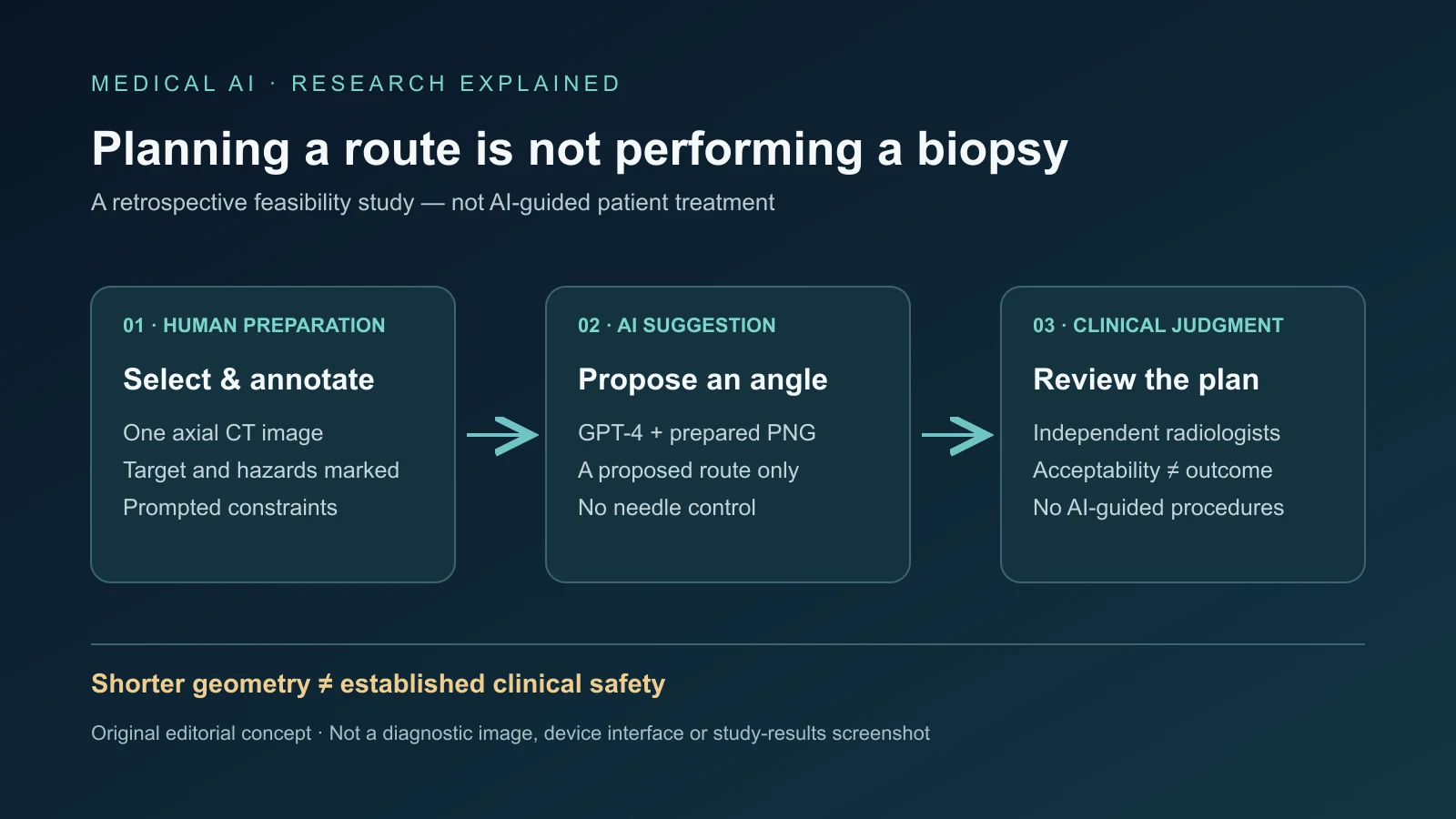
A retrospective lung-biopsy experiment at Memorial Sloan Kettering Cancer Center found that GPT-4 could propose plausible entry angles from carefully prepared CT images. Independent radiologists considered 28 of 30 routes adequate, or 93.3 percent. The proposed paths crossed a median of 5 millimeters of lung tissue, against 23 millimeters for routes already used by experienced clinicians.
Those are feasibility results, not evidence of safer biopsies. No patient underwent a procedure guided by the AI proposals. Two plans failed review, including one that crossed four times as much lung tissue as the manual route and another that raised needle-stability concerns. The useful advance is a testable planning hypothesis, not an autonomous navigator or demonstrated reduction in complications.
Expert preparation preceded every recommendation
The open-access CVIR Oncology study used 30 consecutive historical procedures performed by three interventional radiologists, each with at least ten years of experience. The de-identified cohort included 17 men and 13 women, median age 65. Nodules measured 5–45 millimeters, median 21. Locations included five apical, seven subpleural, three para-mediastinal and four near the lung base, introducing different anatomical problems.
A researcher selected an axial CT slice, cropped and enlarged it, and added a radial grid in GIMP before converting the medical image to PNG. An author marked the lesion with a blue circle and sensitive structures in red. The model therefore received an image whose target and hazards had already been identified by people, not an unmodified examination requiring independent anatomical detection.
A standardized prompt supplied five criteria: reach the target, minimize lung-tissue traversal and avoid bones, fissures and the mediastinum. Each case began in a fresh chat. Researchers could add follow-up prompts if a condition was missed, recording the first response incorporating all requested parameters. The median was two iterations, with an interquartile range of one to three.
Two experienced interventional radiologists who had not performed the original procedures independently reviewed the routes, blinded to their origin. This tested whether a general multimodal model could suggest a plausible angle after substantial human preparation. It did not test autonomous segmentation, full three-dimensional planning, live navigation or robotic needle control. Specialists remained necessary throughout the workflow.
Shorter lines were not equivalent to better clinical outcomes
GPT-4's median lung traversal was 5 millimeters, with an interquartile range of 0–25, compared with 23 and 5–57 millimeters for manual routes. The reported difference was statistically significant, p=0.0063. Zero traversal occurred for subpleural lesions beside the pleural surface, where a direct route can avoid normal lung parenchyma. Length is nevertheless only one component of procedural risk.
The mean proposed entry angle was 179 degrees versus 174 for the manual route, a difference that was not statistically significant. Similar group averages concealed substantial case-level differences. The main results reported good agreement in only eight cases, using angles within ten degrees and a similar route through tissue planes. Elsewhere the authors described a stricter interpretation yielding three matches. These counts should not be silently reconciled into one agreement rate.
The comparison was unequal in an important respect: clinicians' routes had been performed successfully on patients, whereas the model's routes remained lines on planning images. A convincing line on one axial slice may not work across neighboring slices. Breathing, body position, anchoring, equipment limits and changing anatomy affect whether a path can actually be used.
The original procedures had no major complications. Four patients had minimal pneumothorax resolving without intervention; two had mild, self-limiting hemoptysis. Those outcomes belong to the clinician-guided procedures, not GPT-4. The study did not simulate whether the alternative paths would change them and cannot establish diagnostic yield for routes never used.
The two failures expose competing constraints
In Case 19, GPT-4 proposed 20 millimeters of lung traversal against 5 for the manual route: four times as much, contrary to the stated minimization goal. It also offered a broad angle range rather than a precise preferred plan. Reviewers considered it theoretically feasible but inconsistent with good clinical practice. Avoiding obvious obstacles was not sufficient.
Case 27 involved a subpleural nodule. The proposed path unnecessarily crossed 5 millimeters of lung and raised concerns about stability. Too little supporting-tissue engagement can leave a coaxial biopsy needle insufficiently anchored and vulnerable to movement or dislodgement during sampling. Minimizing tissue distance and securing the needle are not always the same objective.
The two-dimensional setup could not represent structures above or below the selected plane or the full three-dimensional course. Radiologists normally inspect multiple slices and multiplanar reconstructions. GPT-4 did not independently detect every lesion, segment organs or reliably determine safety margins. The study also omitted a specified minimum five-millimeter margin from subclavian and axillary neurovascular bundles because patient positioning kept them away from the evaluated routes; future systems cannot assume that condition.
Follow-up prompting was not fully scripted, so different users could steer identical images differently. Separate sessions reduced cross-case contamination but did not demonstrate that repeated runs of one case would reproduce the same angle. General AI service updates add another uncertainty: validation must attach to a controlled model version, defined inputs and a documented process rather than transfer automatically to later configurations.
Specialized planners offer context, not a simple league table
A 2024 purpose-built study combined three-dimensional lesion detection and Bayesian trajectory optimization. It trained on 2,147 nodules from 219 scans and validated detection on another 235 scans with 354 lesions. Reported detection AUROC was 97.4 percent, mean sensitivity 93.5 percent and specificity 93.2 percent. These are detection metrics, not percentages of clinically successful biopsies.
Trajectory comparison used 150 patients and defined a match as an angle difference below five degrees. Feasible routes were generated in 85.3 percent of evaluated cases; 82 percent matched actual paths under that definition, with mean deviation 2.30 degrees among matching routes. The software addressed three-dimensional segmentation and detection that GPT-4 had not performed, but remained a retrospective evaluation without demonstrated patient benefit.
A 2023 rule-based proof of concept generated five paths for each of 28 patients. Four experienced physicians rated the 140 paths; computer and physician scores were identical in 57.9 percent of cases, and all 28 algorithm-selected best routes were considered safe. That was reviewer judgment, not proof that those recommendations reduced complications in clinical use.
TRAX, the Trajectory Recommendation Algorithm for CT-guided Biopsy, ranks about 20,000 routes after a physician identifies the target. In a 53-patient comparison, blinded readers rated all AI-selected and physician-selected routes safe. Ratings matched in 58 percent, favored TRAX in 23 percent and physicians in 19 percent, without a statistically significant preference difference. TRAX paths were slightly shorter; half used an angled plane, while 81.1 percent of physician routes were axial.
These studies used different inputs, datasets, definitions and matching thresholds. Their percentages cannot rank systems directly. Specialized planners can encode anatomy, measure distances and consistently rank many alternatives. General multimodal models are flexible but depend heavily on preparation and prompting. A support role comparing options or documenting reasoning still requires an interface that separates suggestions from approved plans and retains the full anatomical route and human review.
What stronger validation would need to establish
Repeated identical cases and fully standardized prompts would test consistency; studies should record how often human corrections occur and how much they change the output. Native full-volume CT analysis would need segmentation of lesions, lungs, vessels, ribs, fissures, mediastinum and other relevant structures, explicit margins and display of the complete path. Combining a language model with segmentation software introduces integration risks requiring separate validation.
External, multicenter datasets must cover scanners, reconstructions, patient positions and lesion locations beyond one cancer center. Prospective testing could begin in shadow mode, generating suggestions without changing care. Later controlled studies could compare AI-assisted and usual planning while qualified radiologists retain final responsibility, measuring diagnostic yield, pneumothorax, bleeding, procedure time, radiation exposure, repositioning and recovery.
Failures should be reported separately, not hidden by averages. Direct robotic execution would demand substantially stronger evidence and device oversight. The 30-case result—28 acceptable plans and 18 millimeters less median lung traversal—justifies further experiments. Alongside manual annotation, unscripted follow-ups, two rejected routes and no AI-guided patient outcomes, it does not justify immediate clinical deployment or a claim that shorter chatbot-drawn paths make biopsies safer.
Sources
GPT-4 feasibility study · Three-dimensional planning study · Rule-based planning study · TRAX comparison · Original report index