
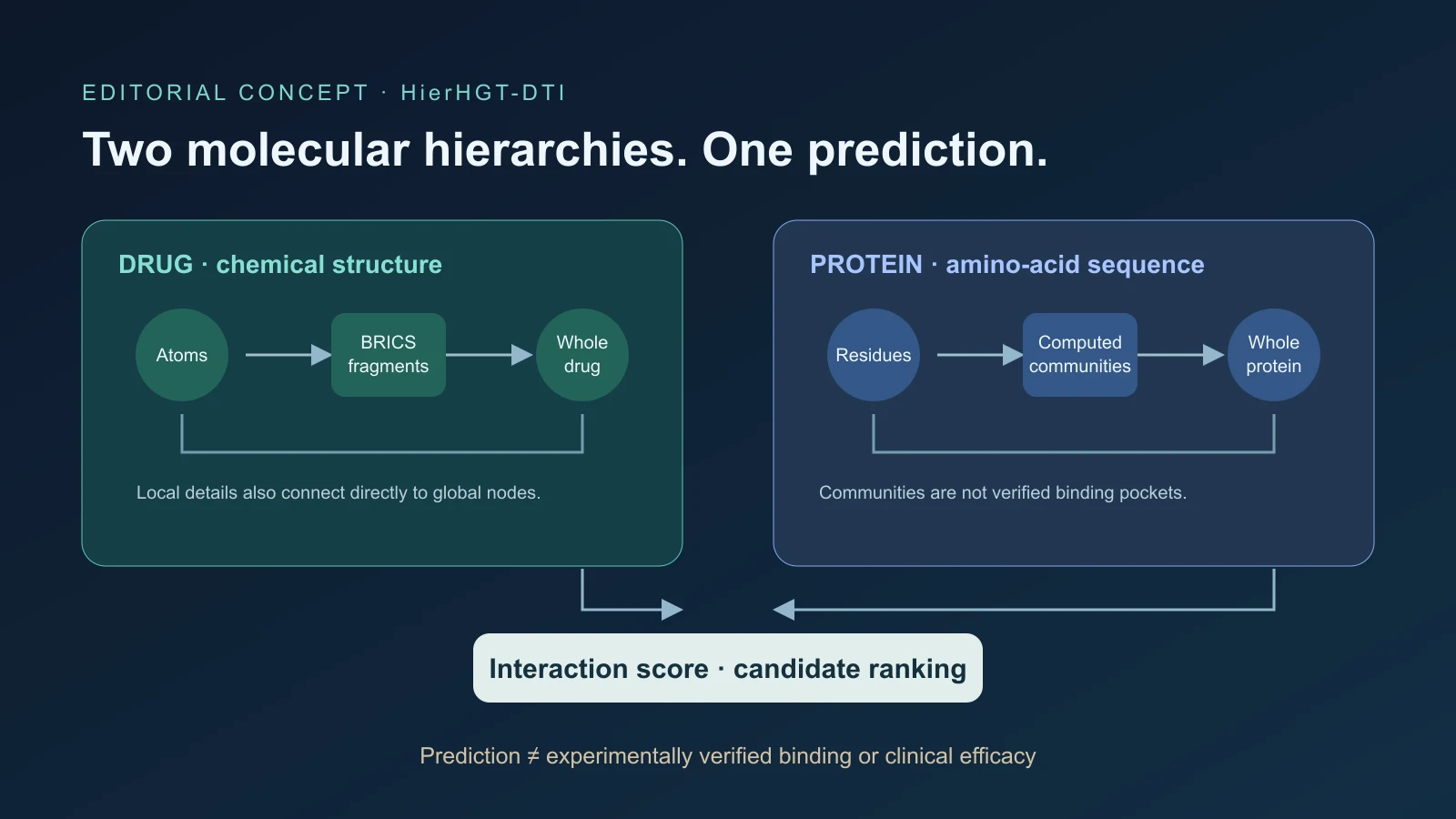
HierHGT-DTI's strongest result is a better ranking of compounds for protein targets withheld from training—not the discovery of a validated medicine. Zhangben Chen and Yaping Wan of the University of South China built the system to combine chemical structure and protein sequence in a typed, multiscale graph. Their results make a credible case for harder evaluation while exposing how much “cold start” still leaves familiar.
The BMC Bioinformatics study, published September 14, 2026, compares six alternatives on DrugBank, BioSNAP and BindingDB. Its practical promise is experimental prioritization: decide which compound–target pairs deserve scarce biochemical or cellular tests first. A prediction score does not confirm physical binding, a biochemical mechanism or clinical efficacy.
Where the benchmark advantage holds—and where it does not
The researchers used random, cold-drug and cold-protein splits. Random splits withhold pairs but can retain the same drugs and proteins across training and testing. Cold-drug splits withhold whole drug identities; cold-protein splits withhold test protein sequences from training and validation. The latter better approximates a newly implicated target without established ligand data.
HierHGT-DTI led all six settings across DrugBank and BioSNAP. The comparison models—MolTrans, TransformerCPI, DrugBAN, DO-GMA, GeNNius and HiGraphDTI—used matched splits and the same five random seeds, rather than scores imported from unrelated papers. Repeated seeds reduce dependence on a favorable initialization.
DrugBank's cold-protein AUROC was 0.864 and AUPR 0.878. The strongest baseline AUROC was 0.776, an 8.8-percentage-point gap; the AUPR advantage was 7.9 points. BioSNAP's corresponding scores were 0.863 and 0.866, versus a strongest baseline AUROC of 0.805, a 5.8-point gap. These principal differences survived the study's multiple-comparison correction for the DrugBank/BioSNAP benchmark family.
BindingDB prevents a universal-superiority claim. HierHGT-DTI led cold-protein AUPR at 0.681, but HiGraphDTI's AUROC was slightly better, 0.835 versus 0.831. HiGraphDTI also led BindingDB's random and cold-drug settings. On the random split its AUROC/AUPR were 0.934/0.837, compared with HierHGT-DTI's 0.932/0.829.
The prepared datasets differ: DrugBank had 34,748 pairs and 17,250 positives; BioSNAP had 27,457 and 13,830; BindingDB had 24,743 and 5,784. BindingDB's positive rate was 23.4%, while the other two were near 50%. AUROC summarizes positive-versus-negative ranking across thresholds. AUPR emphasizes precision and recall among retrieved positives, but changes with prevalence: raw AUPR values should not be compared across these datasets.
An unseen identity is not necessarily unfamiliar biology
New targets can emerge from genetics, disease biology, resistance research or pathway evidence while lacking enough tested ligands for conventional supervision. Earlier work on unexplored therapeutic targets illustrates why interaction-history scarcity matters. Yet benchmark-memorization research warns that similarity to familiar compounds can make tests look easier than deployment.
In conventional DrugBank and BioSNAP cold-drug splits, more than half of test compounds shared a Bemis–Murcko scaffold with training or validation compounds. This scaffold captures core rings and their connecting framework: not molecular identity, but potentially substantial structural familiarity.
Under additional scaffold-disjoint tests, HierHGT-DTI's AUROC fell 2.5 points on BioSNAP, 2.1 on DrugBank and 1.4 on BindingDB. Only this model was tested under that stricter protocol, so the exercise cannot establish a new relative ranking against the six baselines.
Cold-protein evaluation has a parallel limitation. Exact sequences were excluded, but proteins were not separated by sequence-family clustering. Close homologues could remain across splits. The evidence therefore supports transfer beyond identical proteins, not proven transfer to distant protein families.
How molecular details reach a pair-level score
Inputs are drug SMILES strings encoding chemical structure and target amino-acid sequences; experimentally resolved three-dimensional structures are not required. The compact eight-million-parameter ESM-2 protein language model supplies a 320-dimensional embedding per residue and predicted residue-contact maps. This makes sequence-only targets accessible, while leaving open how much improvement comes from pretrained features rather than graph organization.
Each candidate pair becomes one heterogeneous graph with six node types. The drug side contains atoms, chemical substructures and a whole-drug super-node. The protein side contains residues, residue communities and a whole-protein super-node. Atom descriptions have 74 dimensions, including element, valence, charge, aromaticity, hybridization and chirality. RDKit's rule-based BRICS fragmentation creates chemically meaningful substructures.
The protein branch retains full recorded sequences instead of truncating long proteins; overlapping windows provide predicted contacts for sequences too long for one pass. Sequence proximity, predicted contacts and embedding similarity link residues, then Louvain clustering forms communities. Code calls them “pockets,” but these are computational groups—not experimentally measured ligand-binding pockets.
Adjacent scales connect bidirectionally: atom–substructure–drug and residue–community–protein. Direct atom-to-drug and residue-to-protein shortcuts also carry fine information to global nodes. A bidirectional drug–protein super-node edge exists in both positive and unlabeled pairs, so its presence does not reveal the interaction label.
The graph has 18 directed relation types. Two heterogeneous graph-transformer layers use four attention heads and hidden size 128, treating different relations distinctly. Each node gathers messages separately by incoming relation, then a learned allocation combines them using relation preferences and neighbor counts. The final predictor combines drug/protein vectors, element-wise products and absolute differences into an interaction score.
Why the hierarchy is not a proven cause of the gain
Removing the intermediate hierarchy changed AUPR by only −0.0042 to +0.0041 across six DrugBank/BioSNAP settings. None of those hierarchy comparisons was statistically significant; the complete bilateral hierarchy led related variants in only three settings. Removing direct fine-to-global shortcuts lowered average AUPR in all six, by 0.0002–0.0109.
Even that pattern is not definitive causal evidence. No ablation remained significant after correction over the full family of 96 tests. Removing both shortcut families together also prevents attributing an effect to the drug or protein side alone.
Post hoc removal in one BioSNAP checkpoint reduced AUROC by 0.239 for shortcuts, 0.069 for protein-internal relations and 0.038 for hierarchy. Those diagnostics identify dependencies of one trained model, not the cause of its broader benchmark advantage. The defensible interpretation is an effective integrated system with multiple routes; direct routes appear useful, while intermediate hierarchy has inconsistent measured benefit.
Unknown negatives and a small interpretation exercise
Recorded interactions form positive labels, but many supposed negatives are merely unobserved pairs. “Not recorded” can mean untested, not biologically impossible. DrugBank's deduplicated pool included 17,250 positives and 17,498 candidate negatives. Original sampling metadata did not fully document the candidate universe, seed, degree weighting, scaffold controls or protein-similarity controls.
Changing candidate construction mattered. Endpoint-degree-aware sampling reduced AUPR by 0.040–0.067 relative to uniform sampling in selected tests. A three-to-one candidate-negative ratio yielded AUPR of 0.680–0.878. Screening-pool design therefore changes absolute performance.
As research on precision–recall evaluation explains, AUROC may look reassuring with abundant negatives while top-ranked screening precision remains more operationally relevant. BindingDB's conflicting AUROC and AUPR rankings illustrate the distinction. Neither metric estimates laboratory hit rates without prospective testing.
An external interpretation exercise examined five recorded positive interactions with GABAA receptor alpha subunits, including clonazepam, isoflurane and desflurane. Overlap between the five top-ranked residues and expected coarse regions ranged from zero of five to five of five. One unadjusted permutation value reached 0.050, another 0.077; the others were weaker. This uneven exercise did not validate physical binding sites or mechanisms. Attention can identify influential inputs without identifying biochemical causation.
Reproducibility now, prospective evidence next
Fixed preprocessing choices included contact threshold 0.5, Louvain resolution 1.0 and minimum community size three. They were not systematically optimized. Different thresholds, clustering or larger ESM-2 representations could alter results. A simpler predictor using the same embeddings is still needed to isolate the typed graph's contribution.
Runs used one Nvidia RTX 4090 with precomputed molecular and protein inputs. Across nine main dataset/split combinations, training took 26.8–43.6 minutes per seed. Mean test inference took 5.3–11.1 seconds, approximately 592–890 samples per second, with 1.53–2.54 GiB peak allocated GPU memory. Sequence precomputation is additional work outside those training times.
The reproducibility package includes code, configurations, processed splits, manifests, result summaries and reproduction instructions. Organized experimental records also matter; the related engineering knowledge-base article concerns preserving searchable technical assumptions, not evidence for this model's accuracy.
The next decisive tests are protein-family holdouts with the same baselines and matched candidate sets, seeds, metrics and tuning budgets; a frozen model ranking a new target's compound library for blinded assays; and representation-controlled ablations, including separate drug/protein shortcuts. Positive-unlabeled learning would avoid treating every unrecorded pair as negative. Temporal splits would train before a cutoff and test later discoveries without future knowledge leaking into preprocessing.
A prospective study should report confirmed binding, functional activity, false positives and enrichment over practical alternatives; negative results could expose sequence similarity or database bias. For now, HierHGT-DTI is a candidate-prioritization method, not a replacement for docking, biochemical assays, cellular work, toxicology or clinical evaluation. Its strongest benchmark evidence deserves reproduction, not conversion into a claim of discovered medicines.