
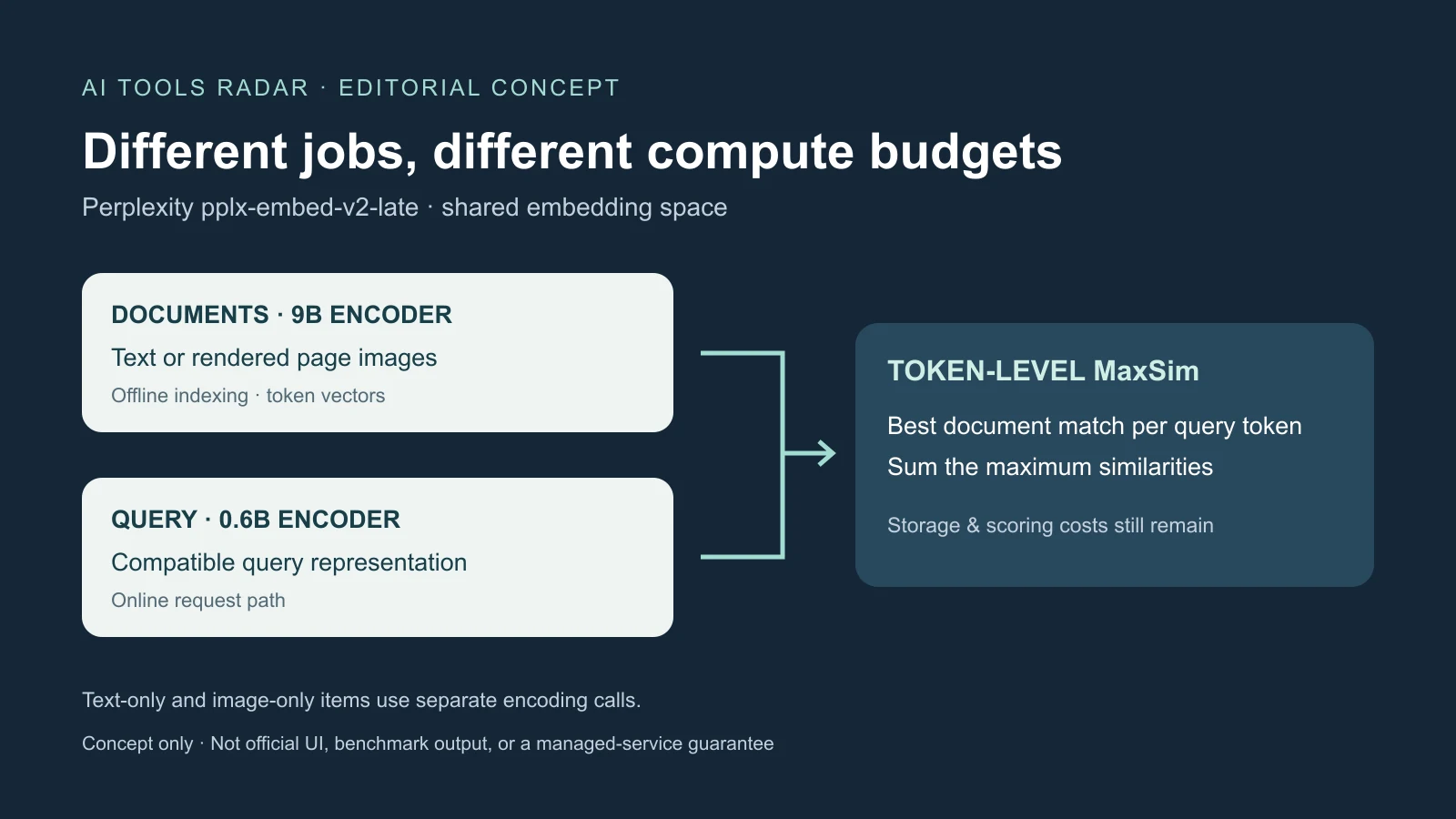
Perplexity’s two MIT-licensed pplx-embed-v2-late checkpoints propose a different division of labor for multimodal retrieval. A 9B encoder can build a richer document index while a compatible 0.6B encoder handles live queries. Shared space, not merely smaller parameter counts, makes that asymmetric configuration possible.
Both encode text, images and rendered document pages. Document processing can be batched offline and amortized across many searches; query processing recurs on the latency-sensitive request path. Spending differently on those jobs is the practical hypothesis, not a promise that total search becomes inexpensive.
Token vectors preserve detail that one vector compresses
Dense retrieval normally assigns one vector to a query and document or chunk, enabling efficient nearest-neighbor search. Chunking helps with length but can separate a table from its label or a clause from its qualification. Cross-encoders compare query and candidate together in detail, but repeat model work for each pair and generally rerank a short list.
Late interaction pre-encodes documents while retaining token representations. Each token gets a 128-dimensional vector. MaxSim finds each query token’s strongest document-token similarity and sums those maxima. A statute, deadline and exception can match separate evidence within a page instead of being blended into one representation.
The Qwen3.5-based family uses bidirectional attention and distillation from an internal 18B ColBERT teacher. Perplexity fully fine-tuned the smaller model; for 9B it fully tuned the last eight transformer layers and used LoRA on remaining layers and the vision encoder.
The small checkpoint has about 594 million total parameters and a reported 340 million active: roughly 240 million for text and 340 million for images. A 24-layer Qwen3.5-0.8B text tower was pruned to 12 layers; its embedding table contributes another 254 million parameters. “0.6B” therefore should not be mistaken for the same active computation on every input.
A shared space lets 0.6B queries search documents encoded with 9B without rebuilding the index just to replace the query encoder. Perplexity also proposes smaller local encoders paired with a cloud 9B index. Those are deployment options, not automatic privacy or managed-service guarantees.
OCR-free retrieval still needs an ingestion pipeline
The application renders PDF pages as images before the vision encoder processes them; it does not simply feed an unprepared PDF file into retrieval. Visual representations can preserve table positions, diagram relationships and layout that OCR loses, and avoid some scan or font recognition errors.
They do not automatically supply extracted passages for quotes, highlighting, lexical search, compliance or downstream language-model context. Native text or OCR can remain alongside visual search: find the promising page visually, then recover precise evidence. Page rendering, normalization, failure handling, metadata, revisions and deletions remain application work.
Perplexity reports training on 186 million query-document pairs from 594 datasets and 46 languages. Raw proportions were 88.3% text-to-text, 8.3% text-to-image and 3.4% text-to-visual-document; final sampling weights changed those to 56.5%, 30.9% and 12.6%. Photograph retrieval and evidence in a dense report page are different tasks, so the balance matters.
There is also an ingestion constraint: text-only and image-only items require separate encoding calls; one mixed text-plus-image item is unsupported. The “multimodal” label does not remove that distinction.
The asymmetric gains are specific comparisons
Across 72 domain-specific retrieval tasks, Perplexity reports a 1.6-percentage-point average gain from 0.6B-query/9B-document encoding over 0.6B on both sides, with the query encoder unchanged. On ViDoRe v3 images that pair scored 63.5% nDCG@10 versus 62.3%, a 1.2-point difference.
Symmetric 9B remained strongest on the reported domain average at 81.3%. The company says asymmetry recovered about half the text-quality gap without larger query-time encoding. That supports testing a large indexer, not claiming the small encoder independently matches every 9B result.
Public ViDoRe v3 image scores were 65.2% for 9B and 62.3% for 0.6B; corresponding markdown scores were 64.7% and 61.2%. The company places 0.6B within 1.2 points of Nemotron ColEmbed V2 8B on image retrieval and compares with Qwen3-VL-Embedding, EVIE and TopK Embed.
Its 128 dimensions per token contrast with 2,048 for EVIE-4.5B and 4,096 for larger EVIE and Nemotron models. That reduces each token’s dimensions, not necessarily the whole index. Retained token counts, precision, compression, metadata, index design and candidate generation also determine storage; representative complete corpus calculations were not published.
Answer benchmarks measure more than embeddings
Perplexity reports 64.0% answer accuracy on BrowseComp+ for 9B, ahead of the next ColBERT by 4.9 points and next dense model by 8.7. The benchmark has 830 difficult queries and around 100,000 curated web documents with human-verified support. Its fixed corpus improves reproducibility, but differs from changing live-web search.
That score pairs retrieval with GPT-OSS-120B at high effort and another model judging answers against references. It is an agent-retriever result, not an isolated embedding metric. The company says 0.6B surpassed every model outside this family, but not all underlying scores were available as searchable text; a complete report was promised later in the year.
On MADQA, with Gemini 3.5 Flash, reported answer accuracies were 92.4% for 9B and 90.1% for 0.6B. The original paper describes 2,250 human-authored questions across 800 documents; Perplexity’s evaluation uses a 500-question subset spanning over 18,000 pages, requiring corpus evidence rather than general knowledge.
The 9B result exceeded standard Mixedbread retrieval with the same agent by 3.5 points. Mixedbread Agentic Search reached 93.4%, reportedly within Perplexity’s confidence interval, but includes a sub-agent planning several searches per outer call. Comparing that whole service with a retriever is not a like-for-like component comparison.
MADQA’s authors note that systems approaching human accuracy can succeed on different questions and compensate for weak strategy through repeated searches. Better retrieval cannot guarantee planning or synthesis. Answer accuracy, evidence-page recall, retrieval quality, latency and tool-call counts need separate measures.
Private PPLX-Q2I uses production image-search logs: 10,000 queries against 100,000 images. Perplexity says both models beat Qwen3-VL-Embedding-8B by over nine points and 9B trails Gemini Embedding 2 by about two. Outsiders cannot yet reproduce that private test; these remain company claims.
Query savings do not erase scoring and storage
Dense retrieval stores one vector per document or chunk. Late interaction stores many token vectors, and MaxSim does more work than one inner product per candidate. Efficient serving needs suitable indexing, pruning or staged retrieval; long documents increase the burden even at 128 dimensions.
Measure query encoding, candidate generation, MaxSim scoring and downstream reranking or generation separately. A small query encoder can still create an expensive match across millions of vectors. Frequently changing corpora also require ongoing GPU indexing capacity, re-encoding and deletion workflows.
Dense search remains useful at huge scale, lexical search protects exact names and identifiers, and cross-encoders can rerank bounded candidates. A hybrid technical knowledge base can reserve visual indexes for layout-sensitive pages while keeping text for exact lookup, citations and evidence extraction. Permissions must filter unauthorized content before an agent receives it; compatible local-cloud vectors do not provide access control.
Edge suitability depends on device memory, acceleration, quantization and battery. The published small checkpoint uses F32 tensors; lower-precision conversions need ranking-quality checks. The model card requires Sentence Transformers 6.0+ and Transformers 5.4+, and warns that PyLate positions query/document markers differently.
Native Sentence Transformers modules avoid custom Python code, not the need to build an index or service. No inference provider was serving the small checkpoint in the cited model card. Planned gradual API support for late-interaction, dense and contextual embeddings is not a live managed endpoint or grounds to infer pricing from older single-vector services.
Open weights make the hypothesis testable, not settled
MIT permits broad use and modification, but adopters still need dependency, training-data and sensitive-document review. Open weights and implementation instructions do not disclose the full training corpus or internal 18B teacher. Perplexity claims exclusion of benchmark-related datasets; the promised report matters for examining contamination controls, settings and uncertainty.
Independent tests should reproduce symmetric and asymmetric setups on representative legal, financial, technical and scanned material, including duplicates, revisions, restrictions, similar layouts, handwriting and hard negatives. Equal end-to-end budgets should prevent stronger OCR, extra search rounds or reranking from masquerading as an embedding gain.
The decisive evidence is independent quality reproduction, full hardware/latency/compression/storage reporting and actual product support for the mixed-size path. Measure ingestion throughput, index size, evidence recall, answer quality and failure cases together. The release’s idea is clear: offline documents and online queries need not receive the same compute budget. Whether that beats simpler retrieval after all operational costs remains an empirical question.
Sources and related reading
0.6B model card · Perplexity technical explanation · Related reading: searchable technical knowledge · BrowseComp+ design · MADQA paper · Release announcement